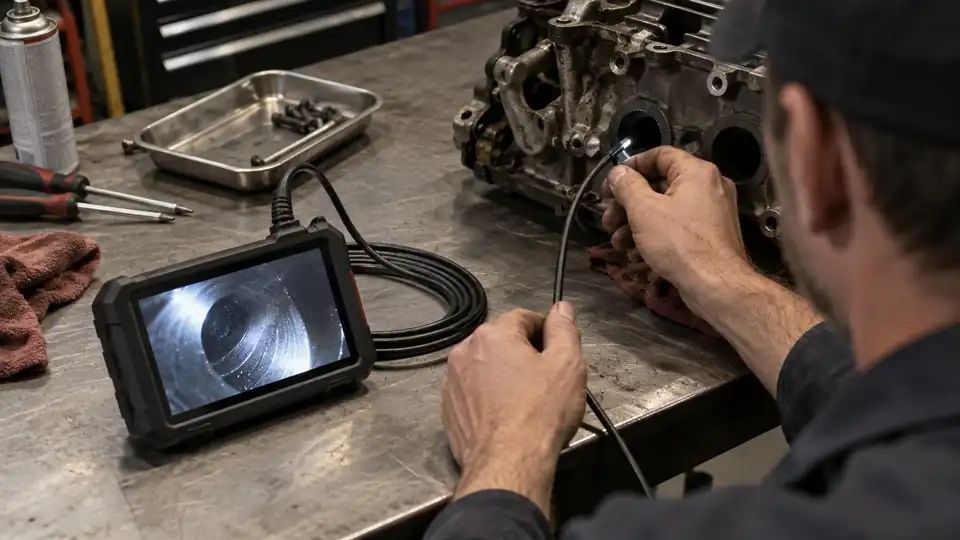
Looking through a spark-plug opening, transmission housing, or cramped engine bay can save hours of unnecessary disassembly, but the camera must reach the inspection area and still point where you need it. The best automotive borescope choices balance probe diameter, tip control, lighting, focus distance, screen usability, and the ability to save evidence. A long cable alone does not solve a difficult inspection if the camera keeps facing the wrong direction.
Automotive buyers often compare headline resolution while overlooking the physical probe. An 8 mm camera may work well in larger openings, while a 5.5 mm or 6.2 mm probe can reach spaces that reject a thicker tip. Active articulation also deserves careful attention. A semi-rigid cable can hold a curve, but it does not steer the camera tip like a joystick or thumb wheel. Dual-lens models add a second viewing direction, yet they are still different from an articulating probe.
This comparison focuses on inspection cameras with integrated screens, practical automotive access, useful lighting, and documented features from the product listings. Some are built for controlled engine diagnostics, while others suit broader work around vehicles, walls, HVAC systems, and pipes. The strongest choices appear first in the quick answer, followed by the specifications and trade-offs that separate them.
Quick Answer
- Best Overall: DXZtoz Dual Lens Articulating Borescope, for its slim 0.25-inch probe, two-way articulation, front and side cameras, 5-inch display, recording, and long battery claim.
- Best for Tight Engine Access: FOXWELL Y400, with a listed 6.2 mm probe, 220-degree steering, zoom, and overheat protection.
- Best Slim Automotive Specialist: Teslong 5.5mm Slim Probe Borescope, for spark-plug holes, injector ports, valve seats, and other narrow access points.
- Best for Long-Reach Viewing: Teslong 5-inch Dual Lens Borescope, with a 16.5-foot semi-rigid cable and front and side cameras.
Best Automotive Borescope Comparison Table
| Product | Best For | Probe / Cable | Viewing System |
|---|---|---|---|
| DXZtoz Dual Lens Articulating Borescope | Overall automotive diagnostics | 0.25 in, 5 ft | 210° articulation, front and side cameras |
| FOXWELL Y400 | Tight engine access | 6.2 mm, length not clearly stated | 220° two-way articulation |
| Teslong 5.5mm Slim Probe Borescope | Spark-plug and injector openings | 5.5 mm, 5 ft | 180° two-way articulation |
| Teslong Articulating Dual Lens Borescope | Forward and side viewing | 5 ft semi-rigid probe | Two-way articulation, dual cameras |
| Teslong Articulating Borescope | Phone-free controlled viewing | 5 ft semi-rigid gooseneck | Two-way articulation |
| DXZtoz 220° Articulating Borescope | Close-up engine inspection | 8.5 mm, 5.5 ft | 220° two-way articulation |
| Teslong 5-inch Dual Lens Borescope | Long-reach engine-bay work | 8 mm, 16.5 ft | Front and side cameras |
| Anykit 210° Articulating Borescope | Short, slim inspections | 0.22 in, 4 ft | 210° two-way articulation |
| 5-inch Dual-Lens Inspection Borescope | Automotive and wet-area work | Length not clearly stated, 16.4 ft cable | Front and side cameras |
The detailed reviews below show how each scope handles access, directional control, lighting, recording, and the compromises that matter inside a vehicle.
1. DXZtoz Dual Lens Articulating Borescope — Best Overall

The DXZtoz combines several features that matter during automotive inspection rather than chasing one headline specification. Its listed 0.25-inch probe is slimmer than the 8 mm designs in this roundup, while the 210-degree two-way articulation lets the operator redirect the tip after insertion. That pairing is useful around spark-plug openings, valve areas, and cramped engine spaces where twisting the cable may be awkward.
A button switches to the 90-degree side camera, giving a second viewing direction without relying entirely on tip repositioning. The 5-inch 1080P display is larger than the 4.3-inch and 4.5-inch screens used by several alternatives, and the listing states that photos and videos with sound can be stored on the included 32GB card. A front-exit cable design and screen bracket may also help when the scope is held above or in front of an engine bay.
Pros
- 0.25-inch probe supports access through relatively narrow openings.
- Two-way articulation is listed at 210 degrees.
- Front and side cameras provide different viewing directions.
- 5-inch display and 10X zoom are listed for close inspection.
- Photo and video recording with sound and included 32GB storage support documentation.
Cons
- The product listing uses several large performance claims that are not independently measured.
- The dual-camera system and articulated mechanism add complexity compared with a basic fixed probe.
This is the most complete fit for buyers who want one tool for directional control, narrow access, side viewing, and reportable images. It is especially compelling for inspection work where a still image or narrated video helps explain a finding. Buyers who need a very long reach should look at the 16.5-foot Teslong instead, while those who value the smallest listed probe may prefer the Anykit or FOXWELL models.
To buy this product, click here.
2. FOXWELL Y400 — Best for Tight Engine Access

The FOXWELL Y400 takes a focused approach to confined inspection. Its 6.2 mm probe is slimmer than the 8 mm camera used by several long-reach options, and the listing specifically describes access through spark-plug holes, valves, pipes, and HVAC openings. That does not guarantee fitment for every vehicle, but the smaller stated diameter is meaningful when the access point is the limiting factor.
Its thumb-wheel control provides 220 degrees of two-way steering, so the camera tip can be redirected rather than merely pushed through a curved cable. The integrated display includes 2X and 4X zoom, six adjustable LEDs, and three brightness levels. The listing also identifies IP67 protection for the probe, overheat shutdown at 158 degrees Fahrenheit, 32GB storage, and a claimed five to seven hours of runtime. Those features make it particularly suited to repeated, close-range diagnostic work.
Pros
- 6.2 mm ultra-slim probe is suited to tighter openings than 8 mm designs.
- 220-degree two-way steering gives direct tip control.
- 2X and 4X zoom can enlarge details without moving the probe.
- Probe is listed with IP67 protection and overheat shutdown.
- 32GB storage and a claimed five to seven hours of battery life support longer jobs.
Cons
- The product information does not clearly state the probe length.
- It provides forward viewing rather than the dual-camera side view found on several alternatives.
The Y400 fits the buyer who expects the probe to enter a narrow automotive opening and then needs controlled movement at the far end. It gives up the longer reach and side camera of some competitors, but its smaller probe and steering control are more relevant for cylinder, valve, and injector-area work than a long cable alone.
To buy this product, click here.
3. Teslong 5.5mm Slim Probe Borescope — Best for Narrow Automotive Openings

At 5.5 mm, this Teslong has the smallest clearly stated probe diameter in the group. That matters around spark-plug holes, injector ports, and valve seats, where a thicker camera may stop before reaching the area of interest. Its joystick-controlled tip articulates through 180 degrees, giving the operator a way to inspect around pistons and behind valves instead of accepting the first view the opening provides.
The 5-inch IPS screen displays the live image, while 1.3X and 1.5X magnification can help examine carbon buildup, wear patterns, and cylinder-wall detail. Six adjustable LEDs provide illumination, and the listing includes a 3000mAh battery, USB-C charging, hard case, and SD card. The product information does not identify the precise storage capacity of that card, so buyers who need extensive video documentation should confirm the current listing before ordering.
Pros
- 5.5 mm probe targets narrow engine access points.
- 180-degree joystick-controlled articulation changes the viewing direction.
- 5-inch screen provides a self-contained inspection workflow.
- Adjustable LEDs and digital magnification support close viewing.
- Includes a hard case, USB-C cable, and SD card according to the listing.
Cons
- Its 180-degree articulation range is lower than the 210- and 220-degree options here.
- The listing does not clearly state the SD card capacity or recording specifications.
This is a strong match for engine work where access diameter comes before cable length. It makes less sense for a deep cavity that needs many feet of reach, and it lacks the side camera of the dual-lens models. For a cylinder or valve inspection that begins at a tight opening, however, the 5.5 mm probe is the defining advantage.
To buy this product, click here.
4. Teslong Articulating Dual Lens Borescope — Best for Forward and Side Viewing

Some inspection problems are caused by the viewing direction rather than a lack of reach. This Teslong addresses that with front and side cameras on a two-way articulating probe. The operator can switch views while inspecting a confined area, which may reduce the need to withdraw and reposition the cable when a surface sits at a right angle.
The 5-foot semi-rigid gooseneck holds its shape during short automotive inspections, while the 4.5-inch IPS screen operates without a phone or app. Adjustable probe lighting helps in dark cavities, and the rear multifunction button handles camera switching or photo and video capture according to the listing. The two-way joystick gives directional control, but the supplied information does not state the probe diameter, so fit through a particular spark-plug opening should be confirmed.
Pros
- Front and side cameras provide two genuine viewing directions.
- Two-way articulation adds control in cramped spaces.
- Semi-rigid 5-foot probe balances reach with manageable handling.
- Integrated 4.5-inch screen requires no phone or app.
- Listing identifies photo and video capture.
Cons
- The probe diameter is not clearly stated in the available product information.
- The 5-foot cable is less suitable for deep or extended-reach inspections.
This model suits inspections where an obstruction blocks a straight-on view, such as an engine compartment with nearby walls or components. It is more capable than a fixed single-camera scope in that situation, but buyers focused on the narrowest possible probe should choose a model with a clearly stated smaller diameter.
To buy this product, click here.
5. Teslong Articulating Borescope — Best for Phone-Free Controlled Viewing

A two-way articulating probe can feel more useful than a longer fixed cable when the inspection target is close but hidden behind a bend. This Teslong pairs that control with a 5-foot semi-rigid gooseneck, allowing the cable to hold a chosen shape while the central joystick steers the camera tip. The result is a compact setup for engine bays, HVAC sections, wall cavities, and other short insertion tasks.
The 4.5-inch IPS display works without an app, and the listing identifies adjustable high-brightness LEDs plus a rear photo button for image or video capture. Its lightweight handheld format may appeal to buyers who move between several inspection points. The available information does not specify the probe diameter, focus range, or articulation angle, so this option is easier to recommend for general controlled viewing than for a particular narrow opening.
Pros
- Two-way articulation provides active camera-tip control.
- 5-foot semi-rigid gooseneck holds a useful working shape.
- Integrated 4.5-inch screen avoids phone dependency.
- Adjustable probe lighting suits dark cavities.
- Photo and video capture are identified in the product information.
Cons
- Probe diameter and articulation range are not clearly listed.
- It lacks the side camera included with the dual-lens alternatives.
This scope is a sensible choice for short, controlled automotive inspections where the operator wants a direct screen and a steerable tip. It should be skipped when a known probe diameter is critical or when the job requires a long cable. In those cases, the FOXWELL or long-reach Teslong supplies clearer evidence about fit or reach.
To buy this product, click here.
6. DXZtoz 220° Articulating Borescope — Best for Close-Up Engine Inspection

The DXZtoz 220-degree model is aimed at close-up inspection of cylinders, valves, pistons, spark plugs, and similar components. Its 8.5 mm camera is larger than the slim probes above, but the 5.5-foot semi-rigid gooseneck offers a little more reach for an engine bay. The central distinction is the control wheel, which actively turns the camera tip through a listed 220 degrees.
The 4.3-inch IPS monitor displays the live image without an app, while eight LEDs offer four brightness settings. The listing also gives an advertised 1 to 15 cm focal distance, 8X zoom, IP67 and oil-resistant probe, a 3000mAh battery, and a four-hour working claim. Hook, magnet, and side mirror attachments are included, but the side mirror should be treated as an accessory rather than a second camera.
Pros
- 220-degree two-way articulation helps redirect the camera tip.
- 5.5-foot semi-rigid probe offers useful short-range reach.
- Eight LEDs with four brightness levels support dark inspections.
- Integrated screen requires no phone or Wi-Fi connection.
- Hook, magnet, side mirror, and protective case are listed as included.
Cons
- 8.5 mm probe may not fit openings suited to slim 5.5 mm or 6.2 mm scopes.
- The listing states that the camera is for close viewing, so it is less suited to very deep cable runs.
This model fits larger access points where strong directional control matters more than minimum probe diameter. It is a practical middle ground for someone inspecting engine components, HVAC passages, and wet work areas with one handheld screen. For modern engines with especially restricted openings, its 8.5 mm camera is the main limitation.
To buy this product, click here.
7. Teslong 5-inch Dual Lens Borescope — Best for Long-Reach Viewing

When the camera must travel through a long cavity, a short articulating probe can run out of reach quickly. This Teslong uses a 16.5-foot semi-rigid gooseneck, making it more suitable for deep ducts, extended engine-bay access, walls, and pipes. The 8 mm diameter is a trade-off, since it needs a larger opening than the slim automotive specialists.
Its front and side cameras each have independent lighting, and the 5-inch IPS display operates without a phone, Wi-Fi, or app. The 5000mAh battery is listed for approximately 4.5 hours of use, while the probe is identified as IP67 waterproof. A hard case, hook, magnet, and mirror are included. The camera has dual-lens viewing but no active articulation, so the cable must be guided and repositioned manually.
Pros
- 16.5-foot semi-rigid cable provides substantial reach.
- Front and side cameras reduce blind spots in long inspection paths.
- 5-inch integrated screen removes phone and app requirements.
- Independent camera lighting and brightness control support dark spaces.
- 5000mAh battery and hard carrying case are listed.
Cons
- 8 mm probe is larger than the narrow automotive-focused options.
- It does not provide active tip articulation.
This is the long-reach choice for situations where distance matters more than fine tip steering. It can make sense around ducts, engine compartments, and extended passages, but the semi-rigid cable takes more room to manage and may be awkward in a short inspection. Choose an articulating scope instead when the target is close but hidden around a corner.
To buy this product, click here.
8. Anykit 210° Articulating Borescope — Best for a Slim Short Probe

The Anykit focuses on a compact probe and short, stable handling. Its listed 0.22-inch probe is slim, while the two-way mechanism provides 210 degrees of directional movement. A 4-foot semi-rigid cable is easier to manage around a single engine bay than a 16-foot cable, although it will not reach as far into a long passage.
The 4.3-inch IPS screen includes three zoom levels and 180-degree image flipping, which can make an upside-down probe view easier to interpret. The listing identifies a 1920 by 1080P camera claim, adjustable LEDs, an 8GB TF card, a 3000mAh battery, and a built-in temperature alarm for hot environments. It also lists IP67 protection, but the probe should still be used within the operating guidance for the vehicle and inspection conditions.
Pros
- 0.22-inch probe supports tight access.
- 210-degree two-way articulation provides controlled viewing.
- Image flip and three zoom levels aid orientation and close inspection.
- 8GB TF card and 3000mAh battery are listed.
- Built-in temperature alarm adds a visible warning during hot-area work.
Cons
- Four-foot probe length limits reach compared with the long Teslong.
- The 4.3-inch display is smaller than the 5-inch screens on several alternatives.
The Anykit is a good fit when the opening is tight and the inspection path is short. It offers more documented orientation controls than a basic fixed camera, but buyers working deep inside ducts or across a large engine bay may find the short probe restrictive. Its temperature warning is useful context, though it should not be treated as permission to inspect hot or moving machinery.
To buy this product, click here.
9. 5-inch Dual-Lens Inspection Borescope — Best for Automotive and Wet-Area Work

This dual-lens inspection camera is built around broad utility. Its front and side views can be switched at the push of a button, while the 16.4-foot semi-rigid cable reaches farther than the articulating automotive specialists. The listing identifies a 5-inch screen, 170-degree viewing angle, 1080P claim, and a 1.2 to 4-inch focus range, giving buyers useful information about close viewing around engines, pipes, and ducts.
Eight adjustable LEDs illuminate the probe area, and the listing describes the probe as IP67 waterproof. A 2000mAh battery is listed for three to four hours of operation. It does not record photos or videos, which is a meaningful limitation for anyone who needs inspection evidence for a repair estimate or before-and-after report. The cable bends and holds shape, but this is dual-lens viewing rather than active articulation.
Pros
- Front and side cameras provide two viewing directions.
- 16.4-foot semi-rigid cable supports long inspection paths.
- 5-inch screen and stated 170-degree viewing angle aid live viewing.
- Eight adjustable LEDs and listed IP67 probe protection suit wet, dark areas.
- 1.2 to 4-inch focus range is clearly identified in the listing.
Cons
- The camera cannot take photos or videos according to the listing.
- It does not provide active articulation for steering the tip.
This model is useful when reach and side viewing matter more than documentation or joystick control. It can cover engine compartments, pipes, and ducts with one long probe, but the lack of recording makes it less suitable for repair reports. Buyers who need to capture a suspected defect should choose one of the articulating models with stated photo or video support.
To buy this product, click here.
Buying Guide: Choosing the Best Automotive Borescope
Probe Diameter Determines Which Openings Are Usable
Probe diameter is often the first practical filter for engine inspection. The 5.5 mm Teslong, 6.2 mm FOXWELL, 0.22-inch Anykit, and 0.25-inch DXZtoz are better suited to restricted access than the 8 mm models. A smaller probe does not automatically produce a better image, though. The camera still needs adequate lighting, useful focus, and enough control to face the target after insertion. Check the vehicle opening and the exact product dimensions before ordering.
Active Articulation Is Different From a Bendable Cable
A semi-rigid cable can curve and hold its shape, which helps guide a camera through a bay or duct. Active articulation moves the distal camera tip through a joystick, wheel, or slider. That distinction matters around pistons, valves, and cylinder walls, where the operator may need to look behind an obstruction without pulling the probe out. The FOXWELL, Anykit, Teslong articulating models, and DXZtoz articulating models provide documented directional control. The long Teslong and 5-inch dual-lens inspection camera rely on cable positioning instead.
Dual-Lens Viewing Reduces Repositioning
A front camera looks ahead, while a side camera looks across the probe axis. That second view can be handy for checking a nearby wall, pipe surface, or engine component at a right angle. It does not steer the probe. If the target is around a bend, active articulation may be more useful. If the target is beside a long straight inspection path, a side camera may save repeated withdrawal and repositioning.
Match Cable Length to the Workspace
A 16.4- or 16.5-foot cable reaches much farther than a 4- or 5-foot probe, but extra cable can bunch up around an engine bay. Long semi-rigid cables are most useful for ducts, walls, deep passages, and broad areas. Shorter probes are easier to control for close engine work. There is no universal best length, so base the choice on the distance from the access opening to the inspection target.
Focus Distance Matters Alongside Resolution
Resolution labels such as 1080P or 1920P describe an advertised image specification, but they do not guarantee better defect visibility. The camera must focus at the distance where the target will appear. The DXZtoz listing gives a 1 to 15 cm focal distance, while the dual-lens inspection camera lists a 1.2 to 4-inch focus range. Lighting, glare, lens position, and screen size also affect what can be seen.
Choose Recording Features for Documentation
A live screen is enough for a quick check, but recorded images help with repair estimates, customer explanations, and before-and-after comparisons. The DXZtoz dual-lens articulating model lists photo and video recording with sound. Several Teslong and articulating models list image or video capture. The Daxiongmao and 5-inch dual-lens inspection camera specifically state that they cannot take or store photos and videos, making them better suited to immediate viewing than documentation.
Read IP Ratings as Probe Information
An IP67 claim attached to the probe does not automatically make the display, handle, connector, or entire system waterproof. The products in this roundup describe protection for the camera probe, but the listing information does not establish unlimited underwater use or protection for every component. Keep the control unit and charging connections away from liquid, and follow the product instructions for wet inspections.
Best Automotive Borescope FAQ
What Probe Diameter Is Best for Engine Inspection?
A smaller probe is generally preferable when access runs through a spark-plug hole, injector port, or narrow valve opening. The 5.5 mm Teslong and 6.2 mm FOXWELL provide clearly stated slim dimensions. An 8 mm camera may still be suitable for larger openings and can be paired with a longer cable or broader inspection system.
Do I Need an Articulating Borescope for Automotive Work?
You need active articulation when the camera must change direction after entering a confined space. It is especially useful for viewing around pistons, valves, and cylinder walls. A fixed or semi-rigid camera can work for straight paths and larger engine bays, particularly if it has a side camera.
Is a Dual-Lens Borescope Better Than a Single-Lens Model?
It depends on the inspection path. A dual-lens model gives forward and side views without changing the probe position, which helps around nearby walls and components. It does not provide the same directional control as an articulating tip, so a single-lens articulating model may be better for looking around a bend.
Can These Borescopes Inspect a Hot Engine?
Do not insert a probe into hot or moving machinery unless the product instructions explicitly support those conditions. The FOXWELL listing includes overheat protection, and Anykit lists a temperature alarm, but those features do not establish that every engine temperature or operating condition is safe. Allow components to cool and follow appropriate service precautions.
Do All Automotive Borescopes Record Video?
No. The 5-inch dual-lens inspection camera and Daxiongmao listing state that photos and videos cannot be captured or stored. Other products identify photo or video recording, sometimes with included storage. If documentation matters, confirm the exact recording function and memory arrangement before purchase.
Is IP67 Safe for Submerging the Whole Borescope?
No. The listings generally associate IP67 with the probe or camera portion. The display, handle, controls, charging port, and connectors may have different protection. Treat the rating as component-specific unless the product information clearly states otherwise, and avoid extending it to full-system immersion.
Is a 16-Foot Cable Better for Automotive Inspection?
A long cable is helpful when the target lies deep inside a duct, wall, pipe, or extended passage. For a nearby engine component, it can be harder to manage than a 4- or 5-foot probe. Short articulating scopes usually provide better control in cramped engine spaces, while long dual-lens models favor reach and broad access.
Final Verdict
The DXZtoz Dual Lens Articulating Borescope is the strongest overall choice for a broad range of automotive inspection tasks. Its 0.25-inch probe, 210-degree articulation, front and side cameras, 5-inch display, and stated recording support cover the main problems that make engine inspection difficult: restricted access, poor viewing direction, and the need to document what appears on screen. It is a particularly complete option for buyers who want one self-contained system rather than a simple live-view camera.
The FOXWELL Y400 is the more focused alternative for tight access and controlled tip movement, while the Teslong 5.5mm model targets the narrowest engine openings. For long passages, the 16.5-foot Teslong dual-lens model trades articulation for reach. Match the scope to the access point first, then weigh articulation, side viewing, focus, lighting, and recording. A smaller probe may open the door, but the right viewing system determines whether the inspection actually answers the question.
