
A useful budget borescope puts a light and camera into a place you cannot otherwise see, without making you pay for features the job does not need. A phone-connected cable can suit occasional checks, while a basic screen model removes app compatibility from the decision. Recording and a second lens are worthwhile upgrades when they solve a real inspection problem.
Start with the opening size, the distance to the target, and whether you need to save what the camera sees. The options below cover simple forward viewing, phone-based dual views, independent screens, and recording kits. None needs to be treated as a substitute for a specialist long-distance sewer camera or a precision articulating instrument.
The best value is the camera that fits the route and includes the functions you will use. A live-view model can answer a quick troubleshooting question; a recording model is the better purchase for repeat inspections or sharing a finding. Check the exact cable, connector, and storage package before choosing.
Quick Answer
- Best for a Simple Phone-Based Starter: 7.9mm Single-Lens Phone Borescope.
- Best for phone-Based Recording and App Controls: DEPSTECH NTC55 2K Phone Borescope.
- Best for a Larger Screen for Saved Footage: DEPSTECH DS620 5-Inch Dual-Lens Borescope.
- Best for a Short Head With Simple Screen Controls: 7.9mm Compact-Screen Inspection Borescope.
Best Budget Borescope Comparison Table
| Product | Best For | Probe or Cable | Viewing and Recording |
|---|---|---|---|
| 7.9mm Single-Lens Phone Borescope | A Simple Phone-Based Starter | 7.9 mm forward-view camera; 16.4 ft semi-rigid cable | Phone display; adjustable probe lighting; Photo/video through SUP-ANESOK |
| 7.9mm Dual-Lens Phone Borescope | Dual Views in a Compact Phone Kit | 7.9 mm dual-lens camera; 16.4 ft semi-rigid cable | Phone screen; front and side cameras; Photo/video through SUP-ANESOK |
| DEPSTECH NTC55 2K Phone Borescope | Phone-Based Recording and App Controls | 7.9 mm front/side camera head; 16.5 ft semi-rigid cable | Phone display; dual cameras; 8+1 LEDs; Photo/video through DEPSTECHCAM |
| Daxiongmao 4.3-Inch Inspection Borescope | Straightforward Phone-Free Live Viewing | 8 mm forward-view camera; 16.5 ft semi-rigid cable | 4.3-inch LCD; eight adjustable LEDs; Live view only; no photo/video recording |
| T TAKMLY Dual-Lens Inspection Camera | Phone-Free Front and Side Views | 8 mm dual-lens head; 16.4 ft semi-rigid cable | 4.3-inch IPS display; front/side cameras; Live view only; no photo/video recording |
| DEPSTECH DS300 Dual-Lens Inspection Camera | A Recording-Capable Standalone Kit | Dual-lens probe; 16.5 ft semi-rigid cable | 4.3-inch IPS screen; front/side views; Photo and video; microSD card purchased separately |
| DEPSTECH DS620 5-Inch Dual-Lens Borescope | A Larger Screen for Saved Footage | Dual-lens inspection head; 16.5 ft semi-rigid cable | 5-inch IPS display; front/side cameras; Photos/video with separately supplied microSD card |
| Vorth 16.5-Foot Phone Inspection Camera | A Compact Phone Kit for Damp Areas | 8 mm camera head; 16.5 ft semi-rigid cable | Phone screen; eight LED lights; Phone-based capture through UseePlus |
| 7.9mm Compact-Screen Inspection Borescope | A Short Head With Simple Screen Controls | 7.9 mm probe; approximately 1.29-inch camera body; Approximately 16.5 ft semi-rigid cable | 4.3-inch IPS screen; eight LEDs; Live view only; no stored photos |
The comparison table shows the main differences in access, viewing, and handling. The individual reviews below explain which configuration fits each inspection task.
1. 7.9mm Single-Lens Phone Borescope — Best for A Simple Phone-Based Starter
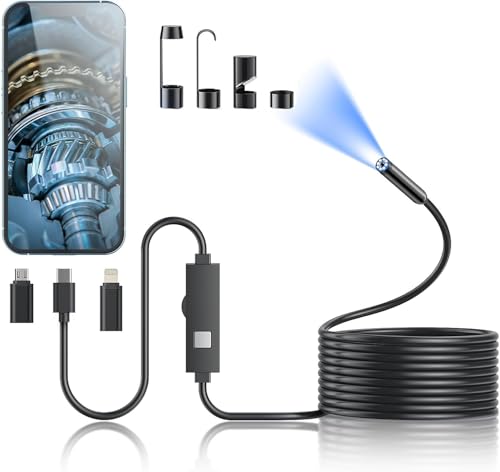
This single-lens borescope keeps the system simple: a 7.9 mm camera, a 16.4-foot semi-rigid cable, and a compatible phone running SUP-ANESOK. It provides a forward view and adjustable illumination for inspecting a prepared path through an accessible opening.
For occasional home or garage checks, a single-lens phone camera avoids paying for a separate display or steering system. Choose it when the route is accessible and a forward view is sufficient for the job.
The single-camera arrangement makes sense when the main task is to identify what lies ahead rather than inspect a surface from several directions. The cable retains a bend, helping position the head without requiring a separate joystick or display unit. Photos and video use the connected phone, which also reduces the amount of dedicated equipment to store. The trade-off is viewing flexibility. A supplied mirror can redirect the image, but it takes more preparation than switching to a built-in side lens. Check the connector and app requirements against the phone you intend to use, and keep that phone protected from the working environment.
Pros
- Compact kit uses the phone already available for viewing.
- 16.4-foot cable balances storage convenience and reach.
- Adjustable lighting helps with close inspection.
Cons
- No built-in side camera or mechanically articulating tip.
- Requires a compatible phone and app.
Choose this configuration for a Simple Phone-Based Starter.
To buy this product, click here.
2. 7.9mm Dual-Lens Phone Borescope — Best for Dual Views in a Compact Phone Kit

This dual-lens phone borescope combines a 7.9 mm head with a 16.4-foot semi-rigid cable. The front and side views let the operator examine the route ahead and the adjacent surface through a compatible phone using the SUP-ANESOK app.
A side lens is a useful upgrade when a basic forward camera repeatedly points past the surface you need to inspect. This configuration adds that viewing option while keeping the kit compact and using the phone as its display.
A phone connection keeps the inspection kit compact while providing a convenient place to view and retain images. The cable can be shaped before feeding it into the opening, and adjustable lighting helps when a nearby surface reflects too much light. The supplied connector options include USB-C, Lightning, and an Android connection, but the phone still needs to support the app and camera connection. Keep the viewing device away from water and dirt even when the camera head is being used in a damp space. The side camera changes the viewpoint without changing the physical shape of the tip; a tight bend may still require a different access point.
Pros
- Front and side viewing in a compact phone-connected kit.
- 16.4-foot semi-rigid cable supports a prepared inspection route.
- Multiple connectors accommodate different supported phones.
Cons
- Viewing depends on the phone and SUP-ANESOK app.
- The camera tip does not mechanically articulate.
Choose this configuration for dual Views in a Compact Phone Kit.
To buy this product, click here.
3. DEPSTECH NTC55 2K Phone Borescope — Best for Phone-Based Recording and App Controls

The DEPSTECH NTC55 uses a 7.9 mm dual-camera head and a 16.5-foot semi-rigid cable, sending the image to a compatible phone. A USB-C connector and Lightning adapter cover different devices, while the DEPSTECHCAM app handles the viewing and capture controls.
The NTC55 suits a buyer who values saved images and a familiar phone interface. It is a feature-focused step up from a basic cable camera without adding a dedicated monitor, provided the phone supports the connection and app.
The front and side cameras are useful for checking both the route ahead and a surface beside the probe. Phone-based capture makes it convenient to retain a reference image or compare the same area later. The app also provides image rotation and zoom, and the cable holds a prepared shape while remaining flexible enough to coil for storage. Compatibility deserves attention before ordering: the supported systems are iOS 11 or later and Android 9 or later, with OTG support required on Android. There is no separate monitor in the kit, so the phone must remain accessible and protected throughout the inspection. The cameras switch direction electronically; the tip itself is not mechanically steered.
Pros
- Forward and side cameras provide two perspectives.
- Photo and video capture use the phone’s viewing workflow.
- USB-C and Lightning connection options suit different devices.
Cons
- Requires DEPSTECHCAM and a supported phone; Android needs OTG.
- No mechanical tip articulation or separate display.
Choose this configuration for phone-Based Recording and App Controls.
To buy this product, click here.
4. Daxiongmao 4.3-Inch Inspection Borescope — Best for Straightforward Phone-Free Live Viewing

The Daxiongmao is a straightforward live-view camera with a 4.3-inch LCD, an 8 mm probe, and a 16.5-foot semi-rigid cable. Powering it on produces an inspection image without connecting a phone, installing software, or setting up Wi-Fi.
A built-in screen removes app compatibility from occasional inspection work. This version is useful for answering an immediate visual question, with recording deliberately left out of the feature set.
Its simplicity is useful when the immediate question is whether an obstruction, loose item, or visible surface problem is present. Eight adjustable LEDs illuminate the target, and the recommended working distance is roughly 1.5–5 inches. The cable can retain a curve to help direct the head, but there is no mechanical articulation. The main purchasing distinction is recording: this version cannot save photos or video. Choose it for direct viewing rather than a job that requires an inspection report. The supplied side mirror is an accessory for redirecting the view, not a second electronic camera, and the screen should remain protected even when the rated probe is used in a damp area.
Pros
- Independent 4.3-inch screen is ready without an app.
- 16.5-foot cable provides useful general reach.
- Adjustable LEDs allow simple brightness control.
Cons
- This version cannot take photos or record video.
- No mechanical steering or separate side camera.
Choose this configuration for straightforward Phone-Free Live Viewing.
To buy this product, click here.
5. T TAKMLY Dual-Lens Inspection Camera — Best for Phone-Free Front and Side Views

The T TAKMLY camera combines a 4.3-inch IPS screen with separate forward and side lenses on an 8 mm probe. Its 16.4-foot semi-rigid cable can be prepared into a curve before insertion, while the display works independently of a phone.
The T TAKMLY is useful when two viewing directions matter more than saved footage. It offers a compact independent display and electronic camera switching without the extra mechanism of an articulating scope.
Switching cameras is useful when the forward view shows where the probe is going but a side view is needed to inspect the surface beside it. The stated 2–10 cm focusing distance suits nearby inspection, and the forward LEDs can be adjusted or switched off. This is a live-view tool: the selected version cannot record photographs or video. That is a worthwhile distinction for a buyer choosing between quick troubleshooting and a camera that must document findings. The cable is shapeable rather than mechanically articulating, so a longer cable does not guarantee that the head can turn through every bend.
Pros
- Front and side cameras switch without attaching a mirror.
- Built-in display avoids app and phone requirements.
- 16.4-foot cable provides useful general inspection reach.
Cons
- No photo or video recording on this version.
- 8 mm head and fixed cable direction limit tight access.
Choose this configuration for phone-Free Front and Side Views.
To buy this product, click here.
6. DEPSTECH DS300 Dual-Lens Inspection Camera — Best for A Recording-Capable Standalone Kit
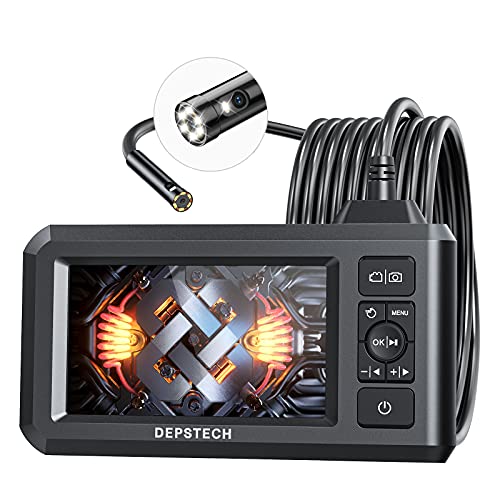
The DEPSTECH DS300 combines a 16.5-foot semi-rigid cable with a 4.3-inch IPS display and separate forward and side cameras. A button changes the viewing mode, including a split-screen option, so the operator can inspect a nearby surface without fitting a mirror to the tip.
The DS300 is a practical choice when saving a finding is part of the job. It adds recording and dual views while remaining simpler than an articulating instrument; remember to include a recording card in the purchase.
Its recording functions make it useful when a finding needs to be reviewed after the probe comes out. The front camera focuses at roughly 3–8 cm and the side camera at 2–6 cm, so positioning matters more than digital magnification when examining a nearby surface. Adjustable LEDs help control glare. The camera assembly is positionable, but the DS300 does not mechanically steer its tip; plan the route with the cable before insertion. Add a compatible microSD card if you intend to save photos or video, because this package does not include one.
Pros
- Forward, side, and split-screen viewing modes.
- Built-in screen and 16.5-foot cable suit independent inspections.
- Photo and video capture support repeat checks and documentation.
Cons
- No mechanical tip articulation.
- A microSD card must be supplied separately for recording.
Choose this configuration for a Recording-Capable Standalone Kit.
To buy this product, click here.
7. DEPSTECH DS620 5-Inch Dual-Lens Borescope — Best for A Larger Screen for Saved Footage

This dual-lens DEPSTECH DS620 uses a 5-inch IPS screen and a 16.5-foot semi-rigid cable. The forward and side cameras provide alternative views, while the built-in monitor removes phone and app compatibility from the inspection workflow.
This DS620 configuration is useful when a five-inch display and recording matter more than camera-tip steering. It gives a broader working image than a compact screen, with a separate memory-card purchase needed for capture.
The larger display is useful when the operator needs to watch the image continuously while feeding or withdrawing the cable. Camera switching helps examine the adjacent surface without fitting and removing a mirror attachment. Photo and video capture are available after adding a microSD card; the card is not included in this package. The cable can hold a prepared bend, but its position must still be managed from the access opening because the camera head is not mechanically articulating. This combination suits buyers who want the convenience of a dedicated screen and saved footage without stepping into a joystick-controlled inspection system.
Pros
- 5-inch IPS screen keeps the working image easy to view.
- Front and side cameras switch electronically.
- Photo and video recording are available with a card.
Cons
- The microSD recording card is purchased separately.
- No mechanical camera-tip articulation.
Choose this configuration for a Larger Screen for Saved Footage.
To buy this product, click here.
8. Vorth 16.5-Foot Phone Inspection Camera — Best for A Compact Phone Kit for Damp Areas
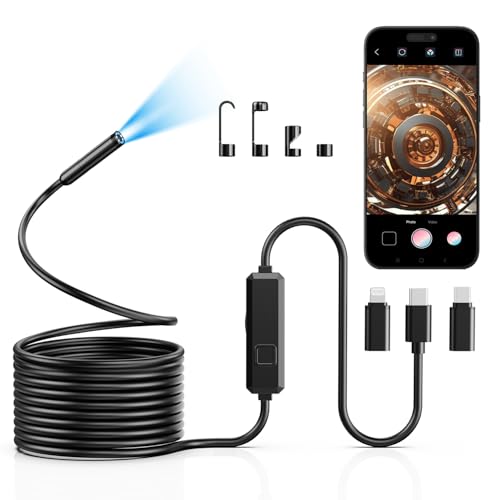
The Vorth phone inspection camera pairs an 8 mm head with a 16.5-foot semi-rigid cable and eight LED lights. The UseePlus app provides the viewing interface, with connector options for supported iOS and Android devices.
The Vorth is useful for an occasional check through a reachable drain, duct, or service opening. Its cable length and phone-based arrangement keep the stored kit small, while the phone and connectors still need protection from the work area.
The long cable is useful when the access point is several feet from the area that needs attention. Shape the cable before feeding it, then adjust the lighting to keep nearby surfaces from washing out the picture. The probe carries an IP67 rating, while the connected phone and adapters still need protection from moisture. This is a positionable cable camera rather than a joystick-steered instrument. It is therefore a practical choice for a known route or a broad opening, where the camera can be guided without forcing it around a sharp turn. Check the current app and device compatibility before ordering.
Pros
- 16.5-foot cable offers useful reach in a small stored package.
- Adjustable lighting helps inside dark cavities.
- Multiple connector options support different phones.
Cons
- Requires UseePlus and a compatible viewing device.
- Cable positioning does not provide active tip articulation.
Choose this configuration for a Compact Phone Kit for Damp Areas.
To buy this product, click here.
9. 7.9mm Compact-Screen Inspection Borescope — Best for A Short Head With Simple Screen Controls

This compact-screen inspection camera uses a 7.9 mm head with an approximately 1.29-inch camera body. A 4.3-inch IPS display and an approximately 16.5-foot semi-rigid cable provide a self-contained live-view arrangement with no phone or Wi-Fi setup.
This live-view model suits a buyer who wants a dedicated screen and straightforward operation. Its short camera body can help with positioning near an opening, while a recording or articulating model is preferable when those features are essential.
A short camera body can be easier to position where a longer rigid head would meet the wall of an opening. The semi-rigid cable holds a prepared curve, and eight adjustable LEDs illuminate the close viewing area. Its focus range is approximately 2–10 cm, so bring the camera near the feature instead of relying on a distant wide view. This version does not store photos, which makes it better for immediate visual troubleshooting than for producing a record. The hook, magnet, and mirror provide useful accessory options, but the mirror is separate from the forward-view lens and the tip does not actively steer.
Pros
- Short camera body helps with positioning near restrictive angles.
- Integrated 4.3-inch display operates without a phone.
- Adjustable LEDs and a long cable support general checks.
Cons
- Cannot store inspection photos.
- Forward-view camera has no mechanical articulation.
Choose this configuration for a Short Head With Simple Screen Controls.
To buy this product, click here.
Buying Guide
Choose the Display Before the Resolution
A phone camera is compact to store, but it depends on a supported app, connector, and operating system. A built-in display costs space in the toolkit but simplifies setup at the work area. Decide which arrangement you will actually use before comparing image-resolution labels.
Pay for Recording When You Need a Record
Some of the screen models here provide live viewing only. That is useful for checking whether something is present, but it cannot produce a saved photograph or video. Recording-capable models may also need a separately purchased microSD card. Include the required storage in the buying decision.
Match Reach and Viewing Direction
A sixteen-foot semi-rigid cable is useful only when the route lets the camera reach the target. A side lens helps inspect a neighboring surface; it does not turn the tip through a tight bend. Measure the access opening and leave room for withdrawal.
Keep the Viewing Equipment Protected
An IP67-rated probe does not make a phone, screen, or connector waterproof. Keep the control equipment dry, guide the cable gently, and allow machinery to cool before inspection. Adjustable light is often more useful than maximum brightness when a nearby surface is reflective.
Frequently Asked Questions
Is a phone borescope enough for occasional use?
Yes, when the phone supports the camera and app and the probe fits the task. A forward-only phone camera is a sensible starting point for an accessible route. Choose a side lens or a dedicated screen when those features solve a problem you expect to encounter.
Can every budget screen camera record video?
No. The Daxiongmao, T TAKMLY, and compact live-view screen versions selected here do not provide recording. The DEPSTECH DS300 and dual-lens DS620 support capture with a suitable memory card, which is purchased separately for these packages.
Does a longer cable inspect every drain?
No. Cable length measures available reach, not the ability to travel through every bend or blockage. A handheld semi-rigid camera is useful for an accessible local section. Long main-line work calls for an appropriate reel and push-rod system.
Which upgrade makes the biggest difference?
Choose according to the task. A side lens helps examine walls beside the probe, recording retains findings, and a standalone screen removes phone dependence. Mechanical articulation is a different upgrade for aiming the camera after insertion.
Final Verdict
For the simplest phone-based start, choose the single-lens 7.9mm kit. The dual-lens phone version adds a useful side view, while the DEPSTECH NTC55 offers a more developed phone-recording workflow. For independent viewing, the Daxiongmao is straightforward and the T TAKMLY adds a second camera. Choose the DS300 or dual-lens DS620 when saved footage matters, remembering to add the required memory card.
Match the complete camera head to the opening, choose the viewing and recording arrangement you will use, and select the exact cable and accessory package for the job.
