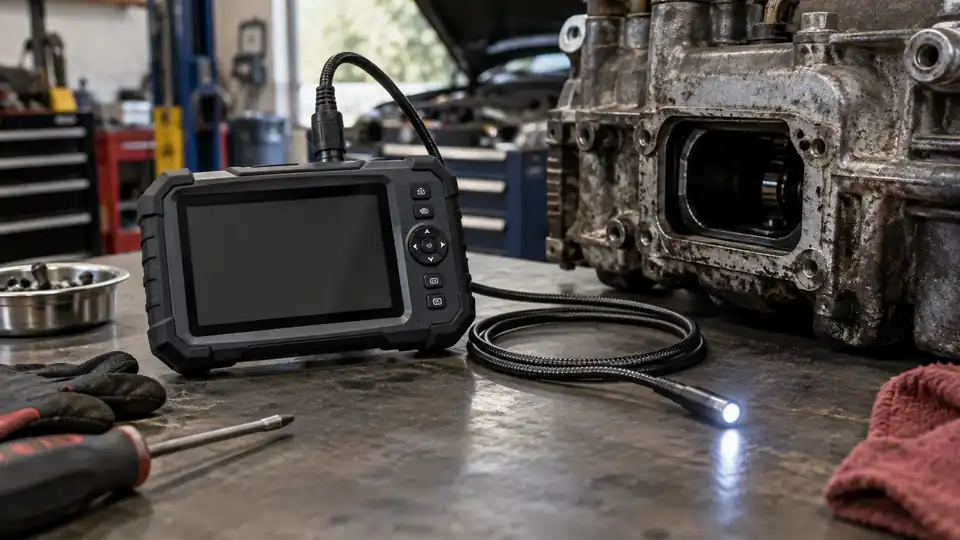
A useful automotive inspection camera should do more than show a blurry image at the end of a long cable. It needs to reach the access point, hold a useful position, illuminate oily or enclosed surfaces, and help you understand what you are seeing on the screen. Engine cylinders, spark-plug openings, valve areas, HVAC passages, and cramped body cavities each place different demands on a borescope, so probe diameter and control often matter more than a headline resolution number.
There is a major difference between a semi-rigid snake camera and an actively articulating borescope. A bendable cable can help you push the camera forward, but it cannot necessarily aim the tip once it is inside an engine compartment. Dual-lens models solve a different problem by switching between forward and side views. Buyers who need documentation may also care about photo and video capture, while someone troubleshooting a vehicle in the driveway may prefer an integrated screen that works without an app or phone.
This comparison focuses on automotive access, tip control, viewing direction, lighting, screen usability, cable behavior, and environmental protection. Some models are better for close engine work, while others make more sense for long cavities, wet areas, or occasional inspections. The strongest choices are separated below so you can match the camera to the job rather than choosing by resolution alone.
Quick Answer
Best Overall: FOXWELL Y400 220° 2-Way Articulating Borescope combines a 6.2 mm probe, two-way steering, a built-in screen, zoom, storage, and overheat protection. It is a strong fit for spark-plug openings, valve areas, cylinder walls, and other spaces where the tip needs deliberate directional control.
Best for Close Automotive Access: Anykit 210° Two-Way Articulating Borescope uses a listed 0.22-inch probe, two-way articulation, image flip, zoom, and a temperature alert. Its four-foot cable is better suited to close work than deep pipe runs.
Best Dual-Lens Screen Model: Teslong 5" Dual Lens Borescope Camera provides forward and side cameras, a large integrated display, a 16.5-foot semi-rigid cable, and roughly 4.5 hours of listed runtime. It is a practical choice when viewing direction matters more than active steering.
Best Automotive Inspection Camera Comparison Table
| Product | Best For | Probe / Cable | Viewing System |
|---|---|---|---|
| FOXWELL Y400 220° 2-Way Articulating Borescope | Overall automotive inspection | 6.2 mm probe, 5 to 7 hour battery claim | Two-way steering, screen, 4X zoom |
| Teslong Articulating Borescope | Compact controlled access | 5-foot semi-rigid probe | Two-way articulation, 4.5-inch IPS screen |
| Anykit 210° Articulating Borescope | Slim automotive openings | 0.22-inch probe, 4-foot cable | Two-way steering, screen, zoom |
| DXZtoz Two-Way Articulating Borescope | Close engine inspection | 8.5 mm probe, 5.5-foot cable | 220° steering, 4.3-inch IPS screen |
| Teslong 5" Dual Lens Borescope Camera | Long-reach forward and side viewing | 8 mm probe, 16.5-foot cable | Dual camera, 5-inch IPS screen |
| 5" 1080P Dual-Lens Inspection Borescope | Automotive and wet-area work | 16.4-foot cable | Front and side cameras, screen |
| Acoath Dual-Lens 1920P Borescope | Phone-based inspection | 7.9 mm probe, 16.4-foot cable | Dual lens, iOS and Android app |
| 1920P Dual-Lens Endoscope Camera | Broad phone compatibility | 7.9 mm probe, 16.4-foot cable | Dual lens, iOS and Android app |
| 1920P Borescope Tools, 16.5FT | Phone-free long reach | 7.9 mm probe, 16.6-foot cable | 4.3-inch IPS screen |
The detailed reviews below separate active steering, dual-lens viewing, phone operation, and integrated-screen convenience so the differences are easier to judge.
1. FOXWELL Y400 220° 2-Way Articulating Borescope — Best Overall

The Y400 earns the leading position because its automotive strengths work together rather than relying on one headline feature. The listed 6.2 mm probe is slimmer than the 8 mm and 8.5 mm probes in several competing models, which can make access through restricted openings easier. Once inserted, the thumb wheel provides two-way articulation through a listed 220 degrees. That distinction matters in a cylinder or valve area where rotating the cable may move the camera away from the target instead of aiming it toward the target.
A built-in HD IPS screen keeps the inspection independent from a phone, while listed 2X and 4X zoom can help examine carbon buildup, gasket wear, or surface marks without immediately repositioning the probe. The product information also lists six adjustable LEDs, 32GB storage, photo and video capacity, a five to seven hour battery claim, and overheat protection that shuts down at 158°F. Those features make the Y400 especially suitable for repeat inspections where capturing evidence and monitoring operating conditions matter.
Pros
- Listed 6.2 mm probe suits tighter automotive access points.
- Two-way 220-degree steering provides active tip control.
- Integrated screen works without Wi-Fi, an app, or phone pairing.
- Listed 4X zoom, 32GB storage, and photo and video capture support documentation.
- Overheat protection and IP67-rated probe add useful safeguards for inspection work.
Cons
- Two-way articulation does not provide full four-direction steering.
- The available product information does not clearly state the exact cable length.
The Y400 is the most complete fit for close automotive diagnosis among these choices. It suits anyone who needs controlled viewing inside an engine rather than a camera that merely bends around an obstacle. A long pipe or wall cavity may still call for a longer cable, and the listed overheat cutoff means the probe should be used only within appropriate temperature conditions. For spark-plug access, valve areas, and compact engine spaces, its combination of reach, control, and recording is unusually well balanced.
To buy this product, click here.
2. Teslong Articulating Borescope for Mechanic Automotive HVAC Wall Inspection — Best for Compact Controlled Access

A five-foot semi-rigid gooseneck gives this Teslong a more compact working profile than the long snake cameras lower in the list. The cable is intended to retain its shape, which can help when the inspection begins near the operator and the camera must be held at a particular angle. Its documented two-way articulation adds active directional control, while a centrally placed joystick supports one-handed operation with either hand.
The 4.5-inch IPS color screen keeps the view visible without a phone, and adjustable high-brightness LEDs address the dark surfaces common inside engine compartments. The product information also identifies a rear photo button for capturing images or videos. That makes it more useful for documenting a suspected issue than screen-only models that cannot save inspection records. The shorter probe length is a strength for close work, although it is less suited to deep cavities.
Pros
- Documented two-way articulation helps aim the camera after insertion.
- Five-foot semi-rigid gooseneck balances shape retention with maneuverability.
- 4.5-inch IPS screen avoids phone and app dependence.
- Adjustable probe lighting supports dark engine compartments.
- Rear control allows listed photo and video capture.
Cons
- Shorter five-foot reach is less suitable for deep or extended passages.
- The available product information does not clearly identify the probe diameter.
This is a sensible fit for close automotive work where the camera does not need to travel far from the handle. It can be easier to manage around an engine bay than a 16-foot cable, especially when excess cable would coil across the floor. Buyers needing a very slim probe or long reach should look elsewhere, but anyone prioritizing a compact articulating setup with documentation tools has a strong reason to choose it.
To buy this product, click here.
3. Anykit 210° Two-Way Articulating Borescope — Best for Slim Automotive Openings

The Anykit focuses on access and control in a compact package. Its listed 0.22-inch probe is one of the slimmest in this comparison, and the two-way articulation reaches 210 degrees. For an automotive inspection, that combination can matter when a larger camera cannot pass through an opening or when the tip needs to look across a nearby surface instead of straight ahead.
The four-foot semi-rigid cable is short enough for close-up work, and the thumb slider is intended for ambidextrous operation. A 4.3-inch IPS screen, three zoom levels, and 180-degree image flip help with orientation when the camera is pointed in an awkward direction. The listing also includes an 8GB TF card, a 3000mAh battery with a listed five-hour runtime, USB-C charging, and a high-temperature alert. Those details give it a clear role in engine and exhaust-area inspection, provided the probe is used within safe temperature limits.
Pros
- Listed 0.22-inch probe supports restricted access.
- Two-way 210-degree articulation gives active directional control.
- Image flip and three zoom levels improve screen usability.
- Temperature alert is useful near hot automotive components.
- Includes listed 8GB storage and a 3000mAh battery.
Cons
- Four-foot cable limits reach compared with long snake cameras.
- Two-way steering cannot aim in every direction without repositioning.
Choose this model for a compact inspection route where probe diameter is the first hurdle. It is more specialized than a long-reach dual-lens camera, and its screen-based workflow does not offer the same phone flexibility as app-connected models. The slim probe, active steering, and temperature alert give it a particularly clear automotive use case.
To buy this product, click here.
4. DXZtoz Two-Way Articulating Borescope — Best for Close Engine Viewing

The DXZtoz is built around a short, actively steerable probe for inspections such as cylinders, valves, pistons, and spark-plug areas. Its product information lists a 220-degree two-way steering lens, an 8.5 mm probe, a 5.5-foot gooseneck, and a 1 to 15 cm focal distance. The combination favors close viewing, where the camera needs to stay near a component and the operator needs to guide the tip around an obstruction.
A 4.3-inch IPS monitor provides a self-contained viewing system, while the listing identifies eight LEDs, four brightness levels, and 8X zoom. The 3000mAh battery is listed for roughly four hours of operation. An IP67 and oil-resistant probe, carrying case, hook, magnet, and side mirror extend its usefulness beyond engine work, although the mirror is an accessory and should not be confused with a second camera or active articulation.
Pros
- Documented two-way 220-degree steering supports close directional inspection.
- Listed 1 to 15 cm focal distance suits nearby engine components.
- 4.3-inch IPS monitor operates without an app.
- Eight LEDs and four brightness settings help manage dark areas.
- Includes a case and listed hook, magnet, and side mirror accessories.
Cons
- 8.5 mm probe is larger than the slim probes in the top three models.
- The listing gives a shorter working range than long-cable inspection cameras.
This model makes sense for close engine work where a four-foot or five-foot reach is enough and a built-in display is preferred. Its larger probe may restrict access in some openings, so the dimensions of the vehicle and inspection point should be checked first. Buyers who need a long route through ducts or pipes will get more practical reach from a dual-lens long-cable model.
To buy this product, click here.
5. Teslong 5" Dual Lens Borescope Camera — Best for Long-Reach Forward and Side Viewing

When the inspection path is long or the target may sit beside the probe, dual-lens viewing can be more useful than a single forward camera. This Teslong provides separate forward and side cameras, each with independent LEDs, so the operator can switch perspectives without relying on a detachable mirror. Its 16.5-foot semi-rigid cable is suited to engine bays, ducts, wall cavities, and other areas where a short articulating probe may run out of reach.
The five-inch IPS display is larger than the screens on several compact models, and the built-in 5000mAh battery is listed for approximately 4.5 hours of continuous use. Six front LEDs and one side LED allow brightness adjustment for dark or reflective surfaces. The 8 mm probe is a practical middle ground for many general inspections, though it may not pass through an opening intended for a slimmer 6.2 mm or 0.22-inch model.
Pros
- Genuine forward and side cameras provide two viewing directions.
- 16.5-foot semi-rigid cable offers substantial inspection reach.
- Five-inch IPS screen is convenient for viewing in the work area.
- Listed 5000mAh battery provides approximately 4.5 hours of use.
- Includes a hard case with hook, magnet, and mirror.
Cons
- 8 mm probe is less suitable for the narrowest access points.
- Dual-lens switching does not provide active mechanical articulation.
This is a strong pick for broad automotive and maintenance use where the camera must travel farther than a short gooseneck allows. The side camera can reduce repeated insertion and withdrawal, but it does not steer the tip around a bend. Choose an articulating model for precise directional control inside a compact engine cavity, or choose this Teslong for reach and alternate viewing angles.
To buy this product, click here.
6. 5" 1080P Dual-Lens Inspection Borescope — Best for Automotive and Wet-Area Work

This dual-lens camera brings a long semi-rigid cable and an integrated display to inspections that may move between vehicles, drains, HVAC passages, and other damp spaces. The listing identifies a 16.4-foot cable, an IP67 waterproof probe, eight adjustable LEDs, and front and side views. A 1.2 to 4 inch focus range is also listed, which gives the camera a defined close-up working range for surfaces near the lens.
The five-inch screen has a listed 170-degree viewing angle, and the 2000mAh battery is described as providing three to four hours of operation. It does not take photos or videos, so it is best suited to live inspection rather than creating a record for a repair file. The semi-rigid cable can hold a route through a duct or pipe, but it does not replace an articulating tip when the target must be aimed around a tight obstruction.
Pros
- Front and side cameras provide two live viewing directions.
- 16.4-foot cable supports extended inspection routes.
- Five-inch screen offers a broad listed viewing angle.
- Eight adjustable LEDs and IP67 probe suit dark or damp areas.
- Listed 1.2 to 4 inch focus range supports nearby surface inspection.
Cons
- The camera cannot take or store photos and videos.
- Dual-lens switching does not provide active tip articulation.
This model fits live troubleshooting where the goal is to see a problem immediately rather than save images. It can be useful around vehicle cavities, ducts, and wet inspection areas, provided the IP67 claim is treated as applying to the probe rather than the complete handle and screen. Buyers who need service documentation should choose one of the recording-capable models.
To buy this product, click here.
7. Acoath Dual-Lens 1920P Borescope — Best for Phone-Based Dual-Lens Inspection

The Acoath takes a different approach from the screen-based models above. It uses a phone app, with listed support for iOS 9.0 or newer and Android 7 or newer, plus Android, Lightning, and Type-C connectors. The 7.9 mm probe carries two camera views, while the 16.4-foot semi-rigid cable provides reach for engine compartments, HVAC paths, pipes, and wall cavities.
The listing identifies 1920 by 1440 image and video capture, eight adjustable LEDs, and IP67 protection with a stated immersion limit of up to 3.28 feet for one hour. Those details are useful for buyers who want to save inspection records directly through a phone. The app requirement also creates the main trade-off. Physical connectors alone do not guarantee compatibility with every phone, so the operating-system and app requirements should be confirmed before ordering.
Pros
- Dual-lens design provides front and alternate viewing directions.
- Listed iOS and Android support with multiple connectors.
- Supports listed 1920 by 1440 photo and video capture.
- 16.4-foot semi-rigid cable offers useful reach.
- Includes hook, magnet, mirror, protective cap, and connectors.
Cons
- Requires a compatible phone and the SUP-ANESOK app.
- The probe is listed as not heat resistant, so the engine must be cooled before inspection.
This is a good fit for someone who already wants a phone-based workflow and values saved images or videos. It can cover a broad range of inspection tasks, but it lacks the phone-free convenience of an integrated screen and does not actively steer the tip. Use the stated immersion and temperature limits as boundaries rather than assuming the entire system is suitable for wet or hot conditions.
To buy this product, click here.
8. 1920P Dual-Lens Endoscope Camera — Best for Broad Phone Connector Support

This phone-connected camera offers a similar inspection format with a 7.9 mm probe, two lens views, and a 16.4-foot semi-rigid cable. The included connectors cover Type-C, Micro-USB, and Lightning, while the listing identifies iOS 9.0 and Android 7 or newer compatibility through the SUP-ANESOK app. That broad connector package can be useful in a household or workshop where more than one type of phone may be used.
The product information lists 1920 by 1440 photo and video output, adjustable lighting, and an IP67 probe rated for underwater use up to 3.28 feet for one hour. It also advises cleaning the dual lenses before use and notes that some Android devices may show more blur than iOS devices. That qualification is helpful because a physical connector does not guarantee identical software behavior across phones.
Pros
- Dual cameras support forward and alternate-angle viewing.
- Includes Type-C, Micro-USB, and Lightning connectors.
- Listed iOS and Android app compatibility broadens device options.
- Supports listed photo and video capture at 1920 by 1440.
- 16.4-foot cable and adjustable lighting support automotive access.
Cons
- Requires app installation and a compatible phone.
- The listing acknowledges that some Android devices may produce a less clear image.
Pick this model when connector flexibility and phone recording matter more than an integrated display. It is useful for documenting a suspected leak, residue, or component condition, but the phone must remain available and compatible during the inspection. Buyers seeking consistent phone-free operation should choose a screen-based camera instead.
To buy this product, click here.
9. 1920P Borescope Tools, 16.5FT — Best for Phone-Free Long Reach

A long cable and a self-contained screen make this model useful for buyers who want to inspect without handling a phone near oil, dust, or moisture. The product information lists a 16.6-foot semi-rigid cable, a 7.9 mm probe, an integrated 4.3-inch IPS screen, and a 2 cm to 10 cm focus range. That combination suits longer routes through engine compartments, HVAC passages, and other confined spaces where the operator needs live viewing from a distance.
Eight adjustable LEDs help illuminate dark areas, and the screen provides image flip and brightness controls. The probe is listed as IP67 waterproof, while the device does not capture or store photos. This is therefore a live-view tool rather than a documentation camera. The included hook, magnet, and side mirror can help with retrieval or alternate viewing, but the cable remains semi-rigid rather than actively articulating.
Pros
- 16.6-foot semi-rigid cable offers substantial reach.
- Integrated 4.3-inch IPS display avoids phone and app requirements.
- Listed 2 cm to 10 cm focus range suits close inspection surfaces.
- Eight adjustable LEDs and image flip support live viewing.
- Includes hook, magnet, and side mirror accessories.
Cons
- Cannot take or store photos and videos.
- No active articulation or dual-camera viewing is listed.
This model is best for straightforward live inspection where reach and phone-free operation are the priorities. It gives up documentation, dual-lens viewing, and tip steering, so it is less suitable for a target hidden behind several turns. For checking a long cavity or following a cable route, its reach can be more useful than a short premium probe.
To buy this product, click here.
Buying Guide: Choosing an Automotive Inspection Camera
Probe Diameter Determines Where the Camera Can Fit
Probe diameter sets a physical access limit before resolution or lighting becomes relevant. The FOXWELL Y400 lists a 6.2 mm probe, while the Anykit lists 0.22 inches, and both are better suited to restricted openings than an 8 mm or 8.5 mm design. A larger probe may offer a sturdier feel or broader hardware package, but it cannot enter an opening that is too narrow. Check the actual access point on the vehicle before choosing.
Active Articulation Is Different From a Bendable Cable
An articulating probe changes the direction of the camera tip through a control wheel, joystick, or similar mechanism. That is different from bending a semi-rigid cable by hand. Active steering helps when a camera has entered a cylinder, valve area, or engine cavity and needs to look sideways without being withdrawn. Two-way steering still has limits, so it may require rotating or repositioning the probe for targets outside its bending plane.
Dual-Lens Viewing Adds Perspective, Not Steering
A dual-lens camera can switch between forward and side views, which is helpful for seeing a nearby wall, pipe junction, or engine surface. It does not physically bend the tip. A side-view mirror is also different from a second camera. If the inspection requires the camera to aim around an obstruction, choose documented articulation rather than assuming another viewing direction will solve the problem.
Match Cable Length to the Workspace
A 16.4-foot or 16.6-foot cable can reach through a long cavity, but excess cable can become awkward around a vehicle. Shorter four-foot to five-foot articulating models are easier to manage during close engine work. Cable stiffness also matters. A semi-rigid probe can hold a route better than a loose flexible cable, yet it still may not navigate a complicated path without active tip control.
Integrated Screens Avoid Phone Compatibility Problems
A built-in display allows immediate use without an app, Wi-Fi connection, or phone adapter. That makes screen-based models convenient around oil and dust. Phone-connected cameras can offer easy image and video storage, but the connector is only one part of compatibility. The operating system, app, port behavior, and device support all matter. Confirm those details before choosing an iOS or Android camera.
Resolution Does Not Tell the Whole Story
Listings may use terms such as 1080P or 1920P, but a number alone does not establish close-focus performance. Lighting, lens position, focus range, display quality, and the surface being inspected all influence what appears on screen. The DXZtoz lists a 1 to 15 cm focal distance, while the 16.5-foot screen model lists 2 cm to 10 cm. Those practical ranges can matter more than comparing marketing labels.
Check What the IP Rating Covers
An IP67 claim generally applies to the probe when the listing describes a waterproof camera head. It should not automatically be extended to the handle, display, connectors, or phone. Some listings provide an immersion depth and duration, while others provide only the rating. Keep the control unit dry, follow the stated limits, and never insert a probe into hot or moving machinery unless the product instructions specifically permit it.
Best Automotive Inspection Camera FAQ
What type of camera is best for inspecting an engine?
An articulating borescope is usually the strongest choice for close engine inspection because active tip control helps aim the camera after insertion. A slim probe is useful for restricted openings, while adjustable lighting and a close focus range help reveal nearby surfaces. A dual-lens model is a good alternative when side viewing matters more than steering.
Is a smaller probe always better?
No. A smaller probe can enter narrower openings, but probe diameter is only one part of the decision. Cable control, image quality, lighting, focus, articulation, and durability also affect the inspection. Choose the smallest probe that fits the access point while still providing the control and viewing features required for the task.
Can an IP67 inspection camera be used inside a hot engine?
Do not assume so. IP67 describes protection against dust and water under specified conditions, not resistance to engine heat. One of the phone-connected listings specifically says its probe is not heat resistant and instructs users to let the engine cool. Follow the exact product guidance and inspect only stationary components at a safe temperature.
Do dual-lens borescopes record photos and video?
Some do and some do not. The Acoath and the 1920P dual-lens phone camera list photo and video capture through an app, while the five-inch dual-lens screen model states that it cannot take or store photos and videos. Check the recording capability of the exact model rather than assuming dual-lens hardware includes storage.
Is a phone-connected camera better than one with a screen?
It depends on the job. A phone-connected model can make saving photos and videos convenient, while an integrated-screen camera starts immediately and avoids app or device compatibility issues. For oily work or quick live checks, a screen can be simpler. For repair documentation, a compatible phone camera may be more useful.
How much cable length is practical for automotive work?
Close engine inspections often benefit from a four-foot to five-foot probe because there is less cable to manage around the vehicle. A 16-foot cable becomes useful for long ducts, wall cavities, pipe routes, and deep access through an engine bay. More reach does not automatically mean better control, so match the length to the inspection path.
Should I choose articulation or a side-view camera?
Choose articulation when the camera tip must be aimed around an obstruction. Choose a side-view camera when switching perspective from forward to sideways will reveal the target without steering the tip. Some products combine both functions, but dual-lens viewing alone should not be treated as mechanical steering.
Final Verdict
The FOXWELL Y400 is the strongest overall choice for automotive inspection because it brings together a slim listed probe, two-way steering, a self-contained screen, zoom, storage, recording, and overheat protection. It is especially well suited to close engine work where the operator needs to aim the camera rather than simply push a cable forward. The Anykit is a strong alternative for tight access, while the Teslong articulating model makes sense for compact work with photo and video capture.
If long reach and alternate viewing matter more than active steering, the Teslong dual-lens camera offers a useful forward-and-side workflow. Phone-connected Acoath and dual-lens models are better suited to buyers who want saved records and already have a compatible device. Before ordering, measure the access opening, decide whether you need documentation, and choose between a short articulating probe and a long semi-rigid cable based on the actual inspection route.
