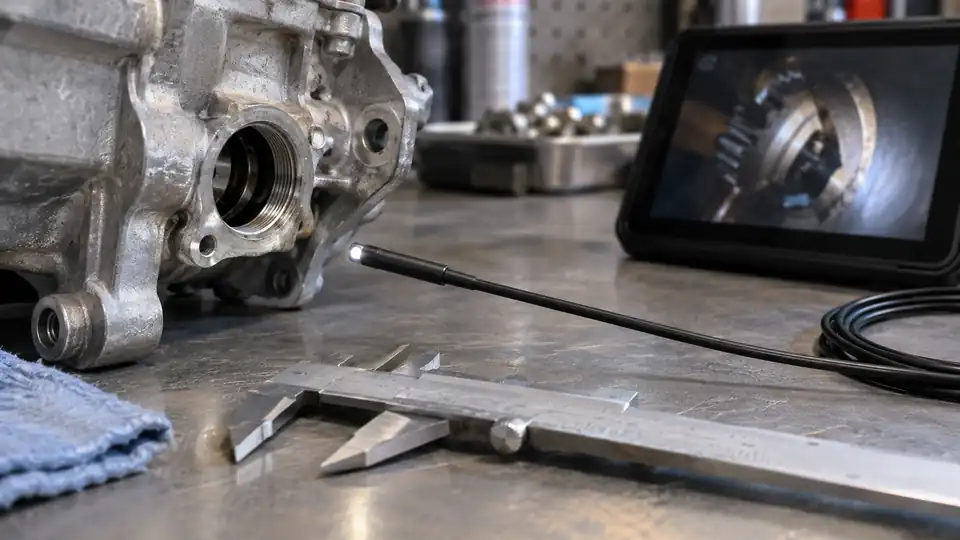
A 6mm borescope sits in a useful middle ground. Its probe is slim enough for many engine openings, HVAC access points, wall cavities, valves, and plumbing paths, while still leaving room for active steering, useful lighting, and a practical camera system. The hard part is separating genuine directional control from a cable that merely bends, and separating a useful viewing system from headline resolution that tells you little about focus or lighting.
Probe diameter matters, but it is only the first filter. A 6mm camera can enter a narrow opening, yet the inspection may still be frustrating if the cable is too short, the tip cannot turn toward the target, or the phone connection creates compatibility problems. Buyers also have different priorities. An integrated screen keeps a work phone out of oily spaces, while a phone-connected model can make sharing photos and reports easier. Some inspections benefit from dual-lens viewing, while others need a dependable articulating tip.
This comparison focuses on products with documented 6mm probes and meaningful differences in articulation, viewing systems, displays, connectivity, reach, and environmental protection. The selections include compact phone-based tools, screen-equipped inspection cameras, and more controlled joystick systems so you can match the instrument to the space rather than choosing by resolution alone.
Quick Answer
Best overall: The Elitech Articulating Borescope offers a well-balanced 6mm probe, 180-degree steering, a 4.3-inch display, adjustable lighting, a stated 15 to 100mm focus range, and temperature protection.
Best for dual-lens viewing: The TORQBEAST Dual Lens Borescope combines a 6mm probe, two-way articulation, a 5-foot semi-rigid cable, and a built-in screen for automotive and HVAC work.
Best for controlled joystick movement: The Vividia ME-610 Industrial Borescope uses a 6mm, 1-meter probe with 360-degree joystick articulation, a detachable probe, and a sapphire protective lens.
Best for phone-free recording: The Articulating 1080P Borescope with 4.3-Inch Screen includes a 32GB card, a 6mm probe, two-way steering, and a hard case.
Best 6mm Borescope Comparison Table
| Product | Best For | Probe And Reach | Viewing System |
|---|---|---|---|
| Elitech Articulating Borescope | Overall inspection work | 6mm, 3ft semi-rigid | 180° steering, 4.3-inch screen |
| TORQBEAST Dual Lens Borescope | Automotive and HVAC access | 6mm, 5ft semi-rigid | 210° articulation, dual lens |
| Two-Way Dual Lens Inspection Camera | Longer general inspections | 6mm, 5ft semi-rigid | Two-way articulation, 4.3-inch screen |
| Vivida ME-610i | Phone-connected joystick control | 6mm, 1m flexible | 360° joystick, iOS and Android |
| Vividia CX-6010i | Lockable probe positioning | 6mm, 1m rigid configuration | 360° joystick, phone app |
| Klaray UW19-MP60 | Lightweight phone-based inspections | 6mm, 3.3ft | 180° articulation, Type-C and Lightning cables |
| Articulating 1080P Borescope | Screen-based recording | 6mm, length not stated | 180° steering, 4.3-inch screen |
| Poseidon Articulating Industrial Endoscope | Basic recording and reach | 6mm, 80cm | Approximately 175° sweep, 2.7-inch screen |
| Vividia ME-610 Industrial Borescope | Heavy-duty automotive inspection | 6mm, 1m detachable probe | 360° joystick, integrated monitor |
The detailed reviews below explain how each 6mm camera handles access, steering, viewing, recording, and the compromises that matter in real inspection work.
1. Elitech Articulating Borescope — Best Overall

The Elitech has the most balanced specification mix in this group. Its 6mm probe and 3-foot semi-rigid cable suit openings where a larger camera would struggle, while the two-way 180-degree steering gives the tip a useful change of direction after insertion. That matters in a valve cavity or pipe bend where simply twisting the handle leaves the camera facing the wrong wall.
A 4.3-inch 1080P IPS display keeps the inspection self-contained, so there is no app pairing or phone screen to protect from grease and moisture. The listing also identifies adjustable LEDs, a 90-degree field of view, and a 15 to 100mm focus range. A built-in temperature sensor displays heat levels and triggers shutdown above 90°C, which adds a clear operating safeguard for recently warm equipment. The 4-hour stated battery life is suitable for extended work sessions, while the probe itself is listed as IP67 rated.
Pros
- 6mm probe fits many tight inspection openings.
- Two-way 180-degree steering helps redirect the camera tip.
- Integrated 4.3-inch 1080P IPS display avoids phone dependency.
- Adjustable lighting and a stated 15 to 100mm focus range support close inspection.
- Temperature monitoring and IP67-rated probe add practical protection.
Cons
- The 3-foot cable offers less reach than the 5-foot alternatives.
- Two-way steering does not provide the same directional freedom as a four-way system.
This is the strongest general choice for buyers who want a self-contained 6mm inspection camera with useful steering and a straightforward display. It fits automotive, HVAC, plumbing, and wall-cavity tasks without forcing a phone into the workflow. A longer probe may suit deep pipe runs better, and a joystick model offers broader control, but the Elitech makes fewer compromises for ordinary inspection work.
To buy this product, click here.
2. TORQBEAST Dual Lens Borescope — Best for Dual-Lens Viewing

Some inspection problems are about direction, while others are about seeing the area beside the probe. The TORQBEAST addresses both with a 6mm dual-lens camera and a stated 210-degree articulating head. That combination is useful around evaporator housings, condensers, engine bays, and duct access points, where removing panels simply to change the viewing angle can turn a short inspection into a larger repair job.
The 5-foot semi-rigid cable gives more reach than the Elitech, and the cable can hold a selected shape while it is guided through an opening. Its built-in display works without Wi-Fi, a phone, or an app. Adjustable LED brightness supports dark spaces, while the listing identifies IP67 and oil-resistant protection for the camera probe. A temperature warning icon is included for hot inspection environments. MicroSD expansion is supported, but the card is sold separately, so storage planning matters if image documentation is part of the job.
Pros
- Dual-lens viewing provides an additional inspection direction.
- 210-degree articulation helps aim the camera in confined spaces.
- 5-foot semi-rigid cable offers useful reach and shape retention.
- Built-in display works without a phone or wireless connection.
- Adjustable LEDs, IP67 probe protection, and an overheat alert support service work.
Cons
- MicroSD expansion is supported, but the required card is sold separately.
- Dual-lens viewing adds flexibility but does not replace the need for careful tip positioning.
The TORQBEAST is a strong fit for automotive and HVAC inspection, especially where a second camera view can reveal the side of a component without repeatedly withdrawing the probe. Buyers who want a compact, self-contained tool with longer reach will find a lot to like here. Choose another model if a specific focus range or included storage is more important than dual-lens coverage.
To buy this product, click here.
3. Two-Way Dual Lens Inspection Camera — Best for Long Reach

This Level Up Auto model combines a 6mm dual-lens system with a 5-foot semi-rigid gooseneck, giving it a useful reach advantage for machinery, vehicle cavities, HVAC paths, and plumbing access points. The listing describes two-way articulation controlled by a roller and a 360-degree viewing capability through the camera system. That wording should be read carefully. The tip has documented two-way steering, while the dual-lens setup provides another view rather than turning the probe into a four-way articulating instrument.
Its 4.3-inch IPS display is specified at 1080P, with a 2cm to 10cm focus range and a 178-degree viewing angle. Six LEDs plus an extra side LED help illuminate the area, and brightness can be adjusted across three levels. The package includes a 32GB SD card, a 2000mAh rechargeable battery with a stated 4-hour life, a carrying case, and hook, magnet, and mirror accessories. IP67 and oil-resistant lens protection are listed, although the rating applies to the camera components described rather than automatically to every part of the system.
Pros
- Dual-lens camera broadens the available viewing perspectives.
- 5-foot semi-rigid probe reaches farther than several compact models.
- Documented 2cm to 10cm focus range supports close inspection.
- Includes 32GB storage, a case, and retrieval accessories.
- Integrated screen and rechargeable battery allow phone-free operation.
Cons
- The listing describes two-way articulation rather than four-way tip control.
- The supplied accessory set may be unnecessary for buyers focused on simple visual inspection.
This is a practical option for jobs where reach and documentation matter more than a compact handle. A 5-foot probe can reach deeper spaces, though extra cable also demands more careful handling in short cavities. The Level Up model suits users who want dual-lens coverage and a ready-to-use kit, while the Elitech remains the cleaner choice for a shorter, more balanced general-purpose setup.
To buy this product, click here.
4. Vivida ME-610i — Best for Phone-Connected Joystick Control

The ME-610i takes a different approach from the screen-based cameras above. Its 6mm flexible probe connects directly to an iOS or Android phone or tablet through a USB cable and the USee app, while a joystick controls 360-degree movement with 180-degree backward bending. That arrangement can feel natural in a tight engine bay because the screen, controls, and captured files stay in the same device ecosystem.
The 1-meter probe gives roughly 3.3 feet of reach, and six bright white LEDs provide illumination at the camera tip. The listing identifies 1280×720 HD resolution and about 4 hours of rechargeable-battery operation. Photos and videos are saved on the connected smartphone, which makes sharing a report or sending a still image from a service call convenient. The trade-off is clear: the phone and the USee app are part of the inspection setup, and direct wired compatibility should be confirmed for the exact device being used.
Pros
- Joystick offers 360-degree control with 180-degree backward bending.
- 6mm probe and 1-meter length suit confined access points.
- Direct wired operation supports iOS and Android devices through the USee app.
- Photos and videos save directly to the connected phone or tablet.
- Rechargeable battery is listed for approximately 4 hours of use.
Cons
- Requires a compatible phone or tablet and the USee app.
- 1280×720 resolution is lower than the 1080P display claims on several screen-based models.
The ME-610i fits a connected inspection workflow where files need to move quickly from the camera to a phone. Its joystick is the key reason to choose it, especially for users who prefer active tip control over a bendable cable. Skip it if a self-contained display is important or if the inspection environment makes using a personal phone awkward.
To buy this product, click here.
5. Vividia CX-6010i — Best for Lockable Probe Positioning

The CX-6010i shares the phone-based USee workflow and 6mm camera format of the ME-610i, but its friction-based articulation locking feature gives it a more deliberate positioning approach. Once the tip is aimed at a valve edge, pipe wall, or hidden connector, the ability to maintain that position can be useful while the operator studies the screen or captures a recording.
The listing describes 360-degree joystick control, 180-degree backward articulation, six white LEDs, and 1280×720 HD output. The selected configuration is described with a 1-meter rigid probe, while related configurations in the listing use different probe designs and lengths. That distinction matters, so buyers should confirm the exact configuration before ordering. Like the other Vividia phone-connected unit, it sends images and video to an iOS or Android device through the USee app rather than using an integrated display.
Pros
- Friction-based articulation locking helps hold a selected viewing position.
- 6mm probe supports access through relatively small openings.
- 360-degree joystick control offers broad directional movement.
- USee app supports image and video storage on a phone or tablet.
- Six bright white LEDs illuminate dark inspection areas.
Cons
- Requires a compatible iOS or Android device and app.
- The listing describes related probe configurations, so the exact selected version should be confirmed carefully.
This model suits repeated inspections where holding the camera steady is more valuable than quick repositioning. It is a specialized choice within the phone-connected group, with the lock feature providing a meaningful reason to select it over a basic joystick camera. Buyers who want a built-in screen or a simpler plug-and-view setup should look toward the Elitech or other integrated-display models.
To buy this product, click here.
6. Klaray UW19-MP60 — Best for Broad Connector Support

The Klaray keeps the hardware compact by drawing power from the connected phone instead of carrying its own internal battery. Its 6mm articulating probe bends up to 180 degrees in both directions, and the stated 3.3-foot length is manageable in engine compartments, appliance cavities, and short pipe paths where a long cable can become a looping nuisance.
Interchangeable Type-C and Lightning cables are listed for Android and iOS use, with the important caveat that a physical connector does not guarantee compatibility with every device. The camera provides 1280×720 visuals, a 30 to 80mm focal range, a 75-degree viewing angle, and eight adjustable LEDs. Photos and videos can be captured for inspection reports and shared through the phone. Since there is no dedicated display or internal battery, the connected device remains central to the entire workflow.
Pros
- 6mm probe provides two-way articulation for curved access paths.
- Interchangeable Type-C and Lightning cables broaden documented device support.
- Phone-powered design avoids charging a separate borescope battery.
- 30 to 80mm focal range is clearly stated for close viewing.
- Eight adjustable LEDs support dark inspection areas.
Cons
- Requires a compatible phone, connector, and viewing software setup.
- No integrated display or independent battery is included in the phone-powered design.
The Klaray is a sensible fit for portable inspections where the operator already wants to use a phone for capture and sharing. Its shorter reach keeps the setup easy to handle, and the supplied connector approach is broader than a single fixed plug. It is less suitable for a dirty or wet workspace where keeping a phone connected and visible is inconvenient.
To buy this product, click here.
7. Articulating 1080P Borescope With 4.3-Inch Screen — Best for Phone-Free Recording

This screen-based camera is aimed at users who want to inspect and record without installing an app. Its 6mm probe uses a 180-degree two-way steering system, and the 4.3-inch display shows the live view directly from the handheld unit. The listing describes a 2600mAh battery with up to 3 hours of continuous runtime, which is shorter than some alternatives but still suited to a focused inspection session.
A 32GB microSD card and hard carrying case are included, giving the setup a ready-made documentation path. Six adjustable LEDs illuminate dark spaces, and the probe is listed as IP67 and oil-resistant. A temperature sensor warns of heat and triggers automatic shutdown at 85°C. The listing also describes a tungsten-braided cable, though the exact probe length is not identified in the supplied information. That missing reach specification is worth checking before buying for a deep pipe or extended cavity.
Pros
- Integrated 4.3-inch display avoids phone and app dependency.
- 6mm probe with 180-degree steering supports confined inspection work.
- Includes a 32GB microSD card for recording.
- Includes a hard carrying case for transport and storage.
- Temperature alarm and automatic shutdown address high-heat conditions.
Cons
- The exact probe length is not clearly stated in the available product information.
- Listed runtime is up to 3 hours, shorter than several 4-hour alternatives.
Choose this model for engine, HVAC, and general maintenance jobs where recording evidence matters and a personal phone should stay safely in a pocket. The included card reduces setup friction, while the screen keeps the controls self-contained. Buyers planning long pipe runs should verify the probe length first, since the available information does not establish its reach.
To buy this product, click here.
8. Poseidon Articulating Industrial Endoscope — Best for Basic Screen-Based Recording

The Poseidon is a simpler 6mm inspection camera with an integrated 2.7-inch color LCD, a flexible cable measuring 80cm, and a documented sweep of approximately 175 degrees. Its fixed-focus camera is listed with a 3cm to 6cm focal distance, so it is best suited to targets that can be brought into that working range rather than broad scenes at varying distances.
The system records still photos and video, and a microSD card is included. Four AA batteries power the unit, but those batteries are not included. Six LEDs provide illumination, and the listing identifies IP67 protection for the probe only. That limitation matters around wet work. The smaller display and 640×480 sensor resolution are modest beside the 1080P units, yet the Poseidon remains useful for straightforward checks where a self-contained recorder matters more than a large screen or advanced image detail.
Pros
- 6mm probe fits many narrow inspection openings.
- Integrated LCD works without a phone or app.
- Captures photos and video with a microSD card included.
- Approximately 175-degree probe sweep helps view angled targets.
- Fixed 3cm to 6cm focal distance is clearly identified.
Cons
- Four AA batteries are required but not included.
- Smaller 2.7-inch display and 640×480 resolution provide less detail than the leading screen models.
The Poseidon makes sense for occasional maintenance, appliance checks, and basic vehicle inspection where a simple recorder is preferable to a phone-connected tool. Its short 80cm reach limits deep access, and the fixed focus requires attention to camera distance. Select it for uncomplicated, phone-free documentation rather than demanding close detail from a long or highly maneuverable probe.
To buy this product, click here.
9. Vividia ME-610 Industrial Borescope — Best for Detachable Probe Construction

The ME-610 is the most industrially specified option in this group. It uses a detachable 6mm by 1-meter probe with 360-degree joystick articulation, giving the operator broad control over the camera tip in automotive and machinery inspections. A detachable probe can be useful in a working environment because the camera assembly is treated as a replaceable or separable part of the system, although the supplied information does not detail replacement availability.
The listing identifies a sapphire protective lens, a titanium-alloy probe with high wear resistance, and IP67 protection for the camera probe and insertion tube. High-illuminance LEDs provide the light source, while an integrated monitor with an 8GB mini SD card records photos and video. This model is less compact and more specialized than the Elitech, and the supplied information does not state a display size or battery runtime. Its appeal rests on probe construction, long reach, and joystick control rather than a broad list of consumer conveniences.
Pros
- 6mm, 1-meter probe provides substantial inspection reach.
- 360-degree joystick articulation offers broad tip control.
- Detachable probe design separates the probe from the main system.
- Sapphire lens and titanium-alloy probe are listed for added wear resistance.
- Integrated monitor and 8GB mini SD card support photo and video recording.
Cons
- The supplied information does not identify display size or battery runtime.
- Its industrial design may be more equipment than needed for short, occasional inspections.
This is the specialist choice for buyers who need a longer 6mm probe and broad joystick movement for automotive or industrial work. The 1-meter reach can open inspection paths that a 3-foot cable cannot, while the detachable construction and protective materials add practical appeal. For routine household checks, a smaller screen-based unit is easier to justify and simpler to carry.
To buy this product, click here.
Buying Guide
Probe Diameter Determines Where the Camera Can Fit
A 6mm probe is narrow enough for many access points, but the stated diameter may refer to the probe rather than every part of the camera assembly. Check the opening, entry angle, and surrounding clearance before assuming a camera will pass. A slim probe helps in an engine cavity or HVAC port, yet it cannot compensate for a camera head or connector that needs more room.
Active Articulation Is Different From Cable Bending
Active articulation means the control changes the direction of the distal camera tip. A semi-rigid cable can hold a curve, but it does not automatically steer the lens after insertion. Two-way systems are useful for turning forward and backward, while joystick-controlled systems with broader movement offer more freedom when the target sits off to one side.
Dual-Lens Viewing Adds Coverage, Not Four-Way Steering
A dual-lens camera can switch between different views, which is useful around ducts, engine components, and pipe walls. It should not be confused with a four-way articulating probe. The TORQBEAST and Level Up models combine dual-lens viewing with two-way steering, giving them more coverage than a single forward camera while retaining the limits of their documented articulation.
Match Cable Length to the Inspection Path
A 3-foot probe is easier to manage around a vehicle or appliance. A 5-foot or 1-meter probe reaches deeper, but extra cable can bunch up on the floor or make precise positioning harder in a short cavity. For a long pipe route, reach deserves priority. For a compact engine bay, control and cable handling may matter more than another foot of length.
Working Distance Can Matter More Than Resolution
Image resolution is only one part of useful visibility. Focus range, lighting, camera stability, field of view, and distance from the target all affect whether a crack, buildup, or loose connection can be seen clearly. The Elitech lists a 15 to 100mm focus range, while the Poseidon lists a 3cm to 6cm fixed-focus distance. Those details can be more useful than comparing “HD” labels alone.
Choose Between an Integrated Screen and Phone Operation
An integrated display keeps the camera independent from a phone, app, and device connector. That is convenient around oil, water, dust, or a busy service call. Phone-based systems can make sharing images easier and may fit existing documentation habits, but USB-C or Lightning hardware does not guarantee compatibility with every phone. Confirm the app and device requirements before ordering.
Check What the IP Rating Covers
Several products list IP67 protection for the probe or camera tube. That does not automatically make the handle, display, charging port, or connected phone waterproof. Treat the rating as applying only to the component identified in the product information, and follow the operating instructions for wet environments rather than treating IP67 as unlimited underwater capability.
Best 6mm Borescope FAQ
Is a 6mm borescope suitable for engine inspection?
It can be suitable for many engine access points, especially where the opening accepts a 6mm probe and the camera has enough steering control to view valves, cylinder walls, or confined components. Check the exact access point and avoid inserting any camera into moving equipment or hot machinery beyond the product’s documented limits. Temperature alerts on some models provide information, but they do not replace safe cooling and inspection procedures.
What is the advantage of a semi-rigid cable?
A semi-rigid cable can hold a bend while it is pushed through a cavity, making it easier to guide than a very loose flexible cable. It still requires manual positioning unless the product specifically documents active tip articulation. The best choice depends on whether the inspection needs reach and shape retention or precise camera-direction control.
Do these 6mm cameras record photos and video?
Several do, including the Elitech, Level Up, phone-connected Vividia models, Klaray, screen-based 1080P model, Poseidon, and Vividia ME-610. Storage methods differ. Some use a microSD card, while phone-connected models save files to the connected device. Confirm whether storage is included, supported separately, or dependent on the app.
Can a 6mm probe inspect a drain?
A 6mm probe can enter many narrow plumbing paths, and several products list IP67 protection for the probe. That does not make every model a dedicated sewer camera. Cable length, bend behavior, lighting, focus range, and retrieval ability still matter, especially in a long or heavily obstructed drain. The Elitech, TORQBEAST, Level Up, and screen-based 1080P models are more relevant to wet plumbing tasks than a short phone-connected setup.
Is a dual-lens borescope better than a single-lens model?
A dual-lens design can provide a second viewing direction and reduce the need to withdraw and reposition the probe. It does not automatically offer better image quality or active four-way steering. Choose dual-lens viewing when seeing forward and to the side is useful. Choose a strong articulating system when changing the physical direction of the camera tip is the main challenge.
Does an integrated screen make a borescope easier to use?
For many inspections, yes, because the system can work without a phone, app, or wireless connection. This is especially convenient around dirty equipment or wet plumbing. Phone-connected cameras can still be the better choice for users who need quick file sharing, phone-based reports, or a familiar screen. The decision is about workflow as much as image display.
Should I choose the longest probe available?
Choose enough reach for the inspection path rather than automatically choosing the longest option. A 1-meter probe or 5-foot cable can help in deep machinery or pipe access, but extra length is harder to manage in a small engine bay. Shorter probes often provide a cleaner, more controlled setup for nearby targets.
Final Verdict
The Elitech Articulating Borescope is the strongest overall choice in this group because it combines the central requirements of a useful 6mm inspection camera: a slim probe, active two-way steering, adjustable lighting, a stated focus range, an integrated screen, and temperature protection. It is broad enough for automotive, HVAC, plumbing, and general maintenance without depending on a phone or app.
Choose the TORQBEAST when dual-lens coverage and a 5-foot semi-rigid cable matter more, or step up to the Vividia ME-610 when a 1-meter probe, detachable construction, and 360-degree joystick control are the priority. The screen-based 1080P model is a useful middle path for phone-free recording with included storage. Before ordering, confirm the access opening, required reach, phone compatibility if applicable, and which component carries the IP rating. Those practical checks will matter more than a large resolution label on the box.
