
A wireless borescope earns its keep the moment a hidden space becomes too narrow, dark, or awkward to inspect by eye. It can help reveal debris in a drain, a loose part inside an engine bay, insulation behind a wall, or an obstruction in a vent without immediately reaching for a larger tool. The catch is that “wireless” says very little about how useful the camera will be. Probe diameter, cable behavior, lighting, phone compatibility, focus distance, and the way images are recorded matter far more than a bold resolution claim on the box.
A 49-foot cable sounds appealing until you try to guide all that extra length through a short inspection path. A tiny 3.9 mm probe can enter tighter openings, but the available product information gives it a close viewing range, which may limit how far away a target can be. Dual-lens viewing can show another direction without physically steering the tip, while a semi-rigid cable can hold a bend but is not the same as active articulation. These distinctions separate a convenient inspection camera from one that becomes frustrating after the first few minutes.
The options below cover compact phone-connected cameras, long-reach probes, rugged gooseneck designs, an integrated-screen system, and a camera that works with extension rods. The comparison gives priority to practical access, viewing control, documentation, and supported compatibility rather than treating every “1080P” listing claim as proof of superior inspection quality.
Quick Answer
Best Overall: The Klein Tools ET30 Wireless Inspection Camera offers a well-rounded setup with 1080P listing resolution, auto focus, always-up viewing, and compatibility with Klein fish rods for longer reach.
Best for Tight Access: The NIDAGE 3.9mm Slim Wireless Endoscope has the narrowest documented probe in this group, making it a natural fit for very small openings and close inspection work.
Best for Forward and Side Viewing: The NIDAGE Dual Lens Endoscope can switch between two camera views, which may reduce the need to repeatedly reposition the cable around a confined target.
Best With an Integrated Screen: The Extech BR250 includes a detachable 3.5-inch color monitor, so the inspection does not depend on a phone or a companion app.
Best Wireless Borescope Comparison Table
| Product | Best For | Probe or Cable | Viewing and Connection |
|---|---|---|---|
| NIDAGE 5.5mm Endoscope | General phone-based inspection | 5.5 mm, 4.92 ft | Wi-Fi, 1080P listing claim, single view |
| NIDAGE 3.9mm Slim Wireless Endoscope | Very tight openings | 3.9 mm, 5 ft | Wi-Fi, 2MP, IP67 probe |
| NIDAGE Dual Lens Endoscope | Forward and side viewing | 5.0 mm | Wi-Fi, dual lens, IP67 camera |
| Klein Tools ET30 | Documented inspections and extended reach | Compact camera, fish-rod compatible | Wi-Fi, 1080P, auto focus |
| Klein Tools ET20 | Rigid cable control | 9 mm, 6 ft armored gooseneck | Wi-Fi, 640 × 480 listing specification |
| BlueFire 49FT Wireless Endoscope | Long-distance reach | 5.5 mm, 49 ft | Wi-Fi, 2MP, IP68 camera and cable |
| BlueFire 33FT Wireless Endoscope | Long flexible runs | Length listed as 33 ft | Wi-Fi, 2MP, semi-rigid cable |
| Ferret Pro Wireless Inspection Camera | Rod-mounted cavity inspection | Reach depends on compatible rod | Wi-Fi hotspot, 720P streaming |
| Extech BR250 | Phone-free viewing and recording | 9 mm, 39 in gooseneck | Detachable 3.5 in monitor, microSD recording |
The detailed reviews explain how each camera handles access, lighting, viewing, recording, and the trade-offs that may matter in a real inspection.
1. NIDAGE 5.5mm Endoscope — Best General-Purpose Wireless Borescope
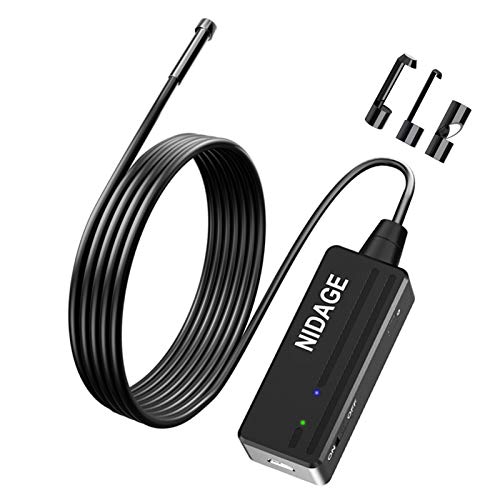
The NIDAGE 5.5mm Endoscope sits in a useful middle ground. Its camera head is slimmer than many larger inspection cameras, while the 4.92-foot semi-rigid cable gives the user enough reach for engine compartments, HVAC openings, appliance cavities, and short pipe checks. The cable can be bent and retain a shape, which helps aim the camera before insertion, although that should not be confused with active tip articulation.
The listing describes 1080P video, MJPEG snapshots, and six adjustable LEDs. That combination gives the phone display more control than a fixed-light camera, particularly when a shiny metal surface creates glare or a dark cavity swallows detail. It connects through NIDAGE Wi-Fi to Android devices, iPhones, and tablets. A person checking behind a wall opening or looking around a vehicle component can save images without carrying a separate monitor, though the phone and app remain part of the workflow.
Pros
- 5.5 mm camera head suits many narrow inspection openings.
- Semi-rigid 4.92-foot cable can hold a useful guiding shape.
- Six adjustable LEDs allow brightness changes in dark spaces.
- Supports Wi-Fi viewing on Android, iPhone, and tablet devices.
- Listing identifies video and still-image capture.
Cons
- Single-camera viewing does not provide a side view.
- Semi-rigid cable control is different from active articulation.
This is a sensible starting point for general maintenance where the access path is short and a phone display is convenient. It suits someone who wants one compact camera for occasional automotive, HVAC, plumbing, or household checks. A different model makes more sense for very small openings, very long runs, or inspections that need a self-contained display.
To buy this product, click here.
2. NIDAGE 3.9mm Slim Wireless Endoscope — Best for Tight Access

A 3.9 mm probe changes the access question. Openings that reject a 5.5 mm camera may accept this slimmer NIDAGE, which is why it stands out for engine-cylinder access, narrow wall cavities, small appliance spaces, and other confined points. The five-foot cable is flexible and can hold its shape, helping the camera snake around a short bend rather than simply drooping at the entrance.
The product information gives a 3 to 10 cm focal length, so this is primarily a close-viewing tool. That detail matters. If the target is immediately beyond an opening, the camera can be well matched to the task. If the goal is to inspect a broad chamber from farther away, the short stated focal range may be less convenient. Wi-Fi support covers Android 5.0 and newer, iOS 9 and newer, and iPad devices, while six adjustable LEDs and an IP67 waterproof cable support dim or damp inspection areas.
Pros
- 3.9 mm probe reaches tighter openings than the larger probes here.
- Five-foot cable provides useful reach for close inspection tasks.
- Three listed image resolutions include 1920 × 1080.
- Six adjustable LEDs help manage dark or reflective surfaces.
- Published compatibility includes Android, iOS, and iPad devices.
Cons
- The listed 3 to 10 cm focal length favors close objects.
- It does not provide dual-lens viewing or active articulation.
Choose this camera when fitting through the opening is the first hurdle. It is especially appealing for close visual checks where a thicker probe simply cannot enter. Buyers who need a long pipe run, a side-facing view, or a screen that works without a phone should look elsewhere.
To buy this product, click here.
3. NIDAGE Dual Lens Endoscope — Best for Forward and Side Viewing

The NIDAGE Dual Lens Endoscope solves a different problem from a thin probe. Instead of relying on one forward-facing camera, it provides two lens views that can be switched from the handheld Wi-Fi box. In a cramped engine compartment or appliance cavity, that can let the viewer inspect ahead and toward the side without constantly pulling the cable back to change its angle.
The 5.0 mm probe remains reasonably slim, and the listing pairs it with 1080P wireless viewing, seven LEDs, and a separate bright flashlight. A three-times zoom function can help frame a small detail on the phone display, although zoom should not be treated as a substitute for moving the camera closer. The camera is listed as IP67 and compatible with Android 5.0 or newer and iOS 9 or newer. Dual-lens viewing improves perspective, but it does not steer the tip mechanically.
Pros
- Dual-lens design provides forward and alternate viewing directions.
- 5.0 mm probe balances access with a broader viewing setup.
- Seven LEDs and a separate flashlight support dark inspections.
- Three-times zoom is available through the handheld control system.
- Works with listed Android and iOS device versions.
Cons
- Switching camera views is not the same as active articulation.
- The product still depends on a phone or tablet for the image display.
This model makes the most sense where the obstruction is around the target rather than at the entry point. A side view can be handy inside a tight machine compartment, behind an appliance, or near a drain bend. Select the slimmer 3.9 mm NIDAGE if entry diameter is the main concern, and choose an articulating system if the camera tip itself must be steered.
To buy this product, click here.
4. Klein Tools ET30 Wireless Inspection Camera — Best for Controlled Documentation

The ET30 is built around a cleaner inspection workflow. Its listing describes a 1080P camera, auto focus, and always-up viewing, so the image stays correctly oriented as the camera rotates. Those features can matter during a drain, cavity, or equipment inspection where the probe twists and the viewer needs to keep track of what is above, below, or directly ahead.
It connects to an app for real-time viewing, photos, and video, and the product information identifies compatibility with iPhone and Android devices. The compact camera can fit through listed opening sizes, with the larger opening supported when the accessory collar and attachments are used. It is also compatible with Klein fish rods and can connect to other brands through a threaded adapter. That makes it more adaptable for reaching behind walls, into ducts, or above ceilings than a short handheld cable alone.
Pros
- Auto focus is listed for maintaining a sharp view as distance changes.
- Always-up viewing helps keep the image orientation consistent.
- Wi-Fi app supports live viewing, photos, and video.
- Fish-rod compatibility can extend reach for cavity inspections.
- Supports the listed iPhone and Android workflow.
Cons
- The product depends on a compatible phone and app for viewing.
- The larger listed opening requires the accessory collar and attachments.
The ET30 is a strong fit for inspections where the result needs to be saved or shared, such as documenting a hidden obstruction or showing a customer what is inside a cavity. It also suits users who already work with fish rods. Those seeking the narrowest possible camera head or a completely phone-free setup may prefer another design.
To buy this product, click here.
5. Klein Tools ET20 Wi-Fi Borescope — Best for Rigid Cable Control
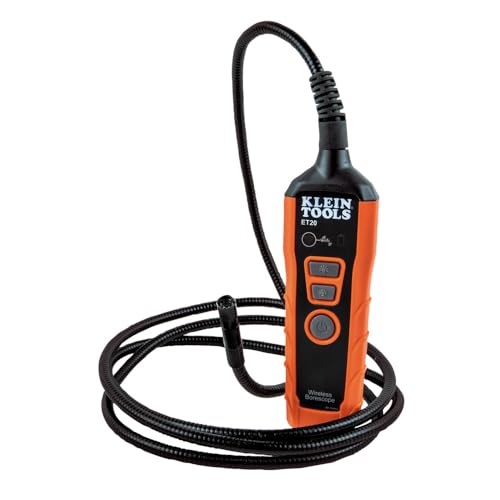
The ET20 takes a sturdier approach to positioning. Its 9 mm camera sits at the end of a six-foot armored gooseneck that is described as flexible while maintaining rigidity. That structure can be useful when the probe must be pushed around an obstacle or held along a particular path, such as inside a wall cavity or near a piece of equipment. It will not enter openings suited to a 3.9 mm or 5.0 mm probe, so access size remains a major limitation.
The listing specifies a waterproof camera with six adjustable LEDs and 640 × 480 images. The lower stated image resolution is a trade-off against the physical control offered by the larger armored cable. Wi-Fi transmits images and video to a smartphone up to the stated range, while the Klein app stores and shares inspection files. A rechargeable built-in battery, charge indicator, and USB-C charging make it easier to keep ready between jobs.
Pros
- Six-foot armored gooseneck maintains rigidity while being maneuverable.
- Six adjustable LEDs allow control over light output.
- Wi-Fi transmission works with the Klein mobile app.
- App supports storing and sharing inspection images and video.
- Rechargeable battery includes a status indicator and USB-C charging.
Cons
- The 9 mm camera requires a larger access opening.
- The listed 640 × 480 image specification is lower than several alternatives.
Pick the ET20 when cable behavior matters more than a small camera head or headline resolution. It can be easier to guide through an open cavity than a loose flexible snake. For engine-cylinder work or tiny openings, the slimmer NIDAGE models are more appropriate, while the ET30 offers a stronger documentation-oriented feature set.
To buy this product, click here.
6. BlueFire 49FT 1080P Wireless Endoscope Camera — Best for Long Reach

Forty-nine feet of listed cable gives this BlueFire a clear role. It is aimed at long runs where a short handheld probe cannot reach the target, such as extended pipe paths, vents, or distant cavities. The 5.5 mm camera head is considerably more manageable than the cable length might suggest, while the semi-rigid design can provide some directional control near the entry point.
The camera supports listed resolutions up to 1920 × 1080, six adjustable LEDs, and three zoom modes. The product information also identifies Android and iOS compatibility and an IP68 rating for the camera and cable. The Wi-Fi box is not waterproof, and the listing recommends limiting underwater use to under 10 minutes. That warning matters because a protected camera tip does not make the complete wireless system suitable for immersion.
Pros
- 49-foot listed cable reaches much farther than the compact models.
- 5.5 mm camera head remains suitable for many narrow access points.
- Six adjustable LEDs help illuminate longer, darker paths.
- Three listed zoom modes assist with framing small details.
- Camera and cable are listed as IP68, with a stated immersion caution.
Cons
- Long cable length can be harder to guide and manage in short paths.
- The Wi-Fi box is not waterproof.
This is the choice for reach, not for the neatest tabletop inspection. It can make sense for a long pipe or vent path where pulling the camera back repeatedly would waste time. For an engine bay, appliance cavity, or short wall opening, the extra cable is more likely to become clutter than an advantage.
To buy this product, click here.
7. BlueFire 33FT Wireless Endoscope Camera — Best for Long Semi-Rigid Runs

The 33-foot BlueFire occupies a middle position between compact phone borescopes and the much longer 49-foot model. Its semi-rigid cable is intended to give the user more control over direction, which can help when feeding the camera through a cavity or a winding access route. The supplied information describes a 2MP camera, six adjustable LEDs, and three selectable resolutions, with the highest listed as 1280 × 720.
Wireless operation uses the camera’s own Wi-Fi signal and the WIFI VIEW app. Android 7.0 and newer and iOS 9.0 and newer are listed as compatible, while Windows and Mac computers are not supported according to the product information. The listing includes a warning not to reset the Wi-Fi password. That is a small but meaningful usability detail for anyone who wants a simple setup rather than a camera that requires troubleshooting before every inspection.
Pros
- 33-foot listed cable supports longer inspection paths.
- Semi-rigid construction provides more directional control than a limp cable.
- Six adjustable LEDs support dark cavity and pipe viewing.
- Built-in Wi-Fi removes the need for an external video cable.
- Android and iOS app compatibility is identified in the listing.
Cons
- The highest listed resolution is 1280 × 720, below several alternatives.
- It is not listed as compatible with Windows or Mac computers.
This model suits long but manageable runs where 49 feet would be excessive. It is also a better fit for buyers who want a semi-rigid cable rather than a completely loose snake. Check the app and operating-system requirements before ordering, especially if the inspection workflow is built around a computer instead of a phone or tablet.
To buy this product, click here.
8. Ferret Pro Wireless Inspection Camera — Best for Rod-Mounted Inspection

The Ferret Pro is built around a different way of reaching hidden spaces. Rather than relying on a permanently long snake cable, the product information describes attaching it to a glow rod or another long rod. That approach can be useful above ceilings, inside wall cavities, along dryer vents, or near chimney openings where a rigid extension provides more reach and support than a loose cable.
Its listed 720P streaming resolution is lower than the 1080P claims on several compact cameras, but the intended workflow focuses on seeing, recording, and sharing images through a phone. The product information specifically describes saving photos and videos to the smart device for reporting. It also identifies uses such as electrical, HVAC, home inspection, pest, wildlife, and chimney work. The exact reach depends on the compatible rod used, so this is a system for buyers who already have, or plan to use, that style of extension.
Pros
- Can attach to a glow rod for extended cavity access.
- Built-in Wi-Fi hotspot supports phone-based viewing.
- Photos and videos can be saved to the smart device.
- Published uses include HVAC, dryer vents, chimneys, and wall cavities.
- Rod-based operation can reduce the need to make larger access openings.
Cons
- Reach depends on a compatible rod rather than a built-in long cable.
- The listed 720P streaming resolution is lower than several alternatives.
The Ferret Pro is a strong match for elevated or extended cavity inspections where a rod is easier to control than dozens of feet of cable. It is less compelling for a quick engine check or a narrow drain opening, where a compact probe offers a simpler setup. Confirm the rod arrangement and phone workflow before treating it as a complete long-reach solution.
To buy this product, click here.
9. Extech BR250 Video Borescope — Best With an Integrated Screen

The Extech BR250 takes the phone out of the center of the inspection. It includes a detachable 3.5-inch color TFT monitor that can be viewed remotely according to the supplied information, with a stated wireless range of up to 32 feet. That arrangement is useful when a phone is unavailable, when gloves make phone operation awkward, or when the camera must be positioned while another person watches the screen.
The 9 mm camera is mounted on a 39-inch flexible gooseneck, and the listed package includes a microSD card with adapter, USB and video cables, extension tools, a stand, and a case. The camera has two built-in LEDs and is described as waterproof. Photos and AVI video can be captured for later computer viewing. A 9 mm probe needs more room than the slim NIDAGE cameras, but the separate monitor and recording hardware create a self-contained inspection setup that feels different from app-based Wi-Fi cameras.
Pros
- Detachable 3.5-inch color monitor avoids phone dependency.
- Monitor is listed for remote viewing up to 32 feet.
- MicroSD support enables JPEG image and AVI video capture.
- 39-inch gooseneck provides a compact, guided inspection reach.
- Supplied package includes cables, extension tools, stand, and case.
Cons
- The 9 mm camera requires more access space than the slim probes.
- Two LEDs provide less lighting adjustment than several Wi-Fi alternatives.
Choose the BR250 if phone-free operation and a complete viewing package matter more than the smallest probe. It works well as a self-contained tool for HVAC, automotive, electrical, and general maintenance checks. For very narrow openings or long pipe runs, its 39-inch gooseneck and larger camera head impose clear limits.
To buy this product, click here.
Buying Guide
Probe Diameter Determines Where the Camera Can Fit
Probe diameter is often the first practical filter. The 3.9 mm NIDAGE can reach openings that a 5.5 mm camera may not, while the 9 mm Klein and Extech models need substantially more room. A smaller probe does not automatically deliver a better image, but it can prevent the inspection from ending before it begins. Measure the access point and account for bends, collars, and attachments rather than comparing camera diameters in isolation.
Separate Cable Reach From Cable Control
A short semi-rigid cable may be easier to position than a 49-foot run, especially in an engine bay or appliance cavity. Long models are useful when the target is genuinely distant, but extra cable creates more loops to manage and may make the tip harder to guide. The Ferret Pro takes another approach by using a compatible rod, while the ET20 relies on an armored gooseneck for rigidity.
Dual-Lens Viewing Does Not Mean Articulation
The NIDAGE Dual Lens can switch between camera views, which helps reveal a side area without changing the probe position. It does not mechanically steer the camera tip. A bendable or semi-rigid cable also is not an articulating probe. If the inspection requires deliberate directional control after insertion, verify that the product specifically documents active tip articulation.
Resolution Numbers Need Practical Context
A listing claim such as 1080P or 2MP describes an advertised image capability, not a guarantee of sharp focus in every cavity. Lighting, working distance, lens design, and the display all affect what the viewer can actually see. The NIDAGE 3.9mm model gives a close focal range, while the ET30 lists auto focus. Those details may matter more than comparing resolution labels alone.
Check What the Water-Resistance Rating Covers
Several products describe a waterproof or IP-rated camera and cable, but that protection does not automatically extend to the Wi-Fi box, phone, battery housing, or charging connection. The BlueFire 49FT listing specifically separates the protected camera and cable from the non-waterproof Wi-Fi box and gives an underwater-use caution. Keep the control hardware dry and follow the product’s stated limits.
Phone Compatibility Includes Software
A wireless camera still depends on a phone or tablet app unless it includes its own display. Check the listed operating-system versions before ordering. The ET30 identifies iPhone and Android support, while the BlueFire 33FT model lists Android and iOS requirements and excludes Windows and Mac computers. A wireless signal is not the same as universal device compatibility.
Choose an Integrated Screen for Phone-Free Work
The Extech BR250 includes a detachable monitor and memory-card recording, which can simplify inspections in wet, dirty, or shared work environments. Phone-connected models are often convenient for sending images quickly, but they add app, battery, and compatibility dependencies. Decide whether the phone is an advantage or another piece of equipment to manage.
Best Wireless Borescope FAQ
What is the best wireless borescope for general inspection?
The NIDAGE 5.5mm Endoscope is a balanced choice for general phone-based inspection. It combines a relatively narrow camera head, a 4.92-foot semi-rigid cable, adjustable LEDs, and Wi-Fi support for Android, iPhone, and tablet devices. It is suited to short automotive, HVAC, plumbing, appliance, and household checks.
Which model is best for the smallest openings?
The NIDAGE 3.9mm Slim Wireless Endoscope has the narrowest documented probe in this comparison. Its stated 3 to 10 cm focal length means it is primarily intended for close objects, so it is best matched to inspections where the target is near the entry point.
Can a wireless borescope record photos and videos?
Several models list image and video capture, but the method varies. The Klein ET30 uses its app for photos and video, the NIDAGE 5.5mm model lists AVI video and MJPEG snapshots, and the Extech BR250 records JPEG images and AVI video to a memory card. Check whether recording is handled by the app, a phone gallery, or removable storage.
Is a dual-lens camera better than a single-lens camera?
It depends on the inspection. A dual-lens camera can provide another viewing direction and reduce repositioning in a confined space. A single-lens camera may be simpler and smaller. Dual-lens viewing still does not provide the directional control of an active articulating probe.
Are these wireless borescopes suitable for underwater use?
Do not treat a waterproof camera tip as proof that the entire system can be submerged. The BlueFire 49FT information states that the camera and cable are IP68 while the Wi-Fi box is not waterproof, and it recommends limiting underwater use to under 10 minutes. Keep the control unit and phone protected, and follow the specific product limits.
What is the advantage of a borescope with a built-in screen?
An integrated screen removes the need to install an app or confirm phone compatibility. The Extech BR250 includes a detachable 3.5-inch color monitor and can record to a microSD card. That setup can be convenient for shared inspections or situations where a phone is unavailable, although its 9 mm camera needs more access space.
Is a longer borescope cable always better?
No. Longer reach helps with distant targets, but excess cable can be difficult to organize and guide. The BlueFire 49FT is suited to long paths, while the shorter NIDAGE and Klein models are easier to manage in compact spaces. Match cable length to the actual inspection route rather than choosing the longest option by default.
Final Verdict
The Klein Tools ET30 is the strongest overall choice here because it combines a useful wireless workflow with auto focus, always-up viewing, 1080P listing resolution, and support for fish-rod extensions. Those features give it a broader range of inspection possibilities than a basic short snake camera, particularly when images or videos need to be saved and shared. The NIDAGE 3.9mm model is the better fit for extremely tight access, while the NIDAGE Dual Lens offers a helpful alternative view when the target sits around a corner.
For long-distance inspection, the BlueFire 49FT offers reach that the compact cameras cannot match, although its cable requires more careful handling. The Extech BR250 remains the clearest choice for phone-free operation because its monitor and memory-card recording are built into the system. Before ordering, measure the opening, estimate the actual cable path, check the app requirements, and separate waterproof camera claims from protection for the control unit. Those details will usually matter more than the biggest resolution number on the listing.
