
A professional borescope earns its place when it helps you see around an obstruction, reach through a narrow opening, or document a problem without dismantling half the equipment. The right choice depends on the inspection itself. An articulating probe can steer around a valve or engine component, while a dual-lens camera can switch from a forward view to a side view without turning the cable. Probe diameter, cable control, lighting, focus range, screen design, and recording capability usually matter more than a large resolution number printed in a product title.
A semi-rigid cable is useful because it can push into a wall cavity or pipe while holding a rough shape, but it is not the same as active articulation. Likewise, a side-view camera is different from a side-view mirror, and a phone connector does not guarantee compatibility with every device. Buyers who need inspection records should also check whether the camera saves photos and video. A homeowner checking a drain may value reach and water protection, while someone inspecting an engine may need a narrow probe and controlled tip direction.
This comparison focuses on professional-style inspection cameras with practical advantages for automotive, HVAC, plumbing, machinery, wall, and general maintenance work. The rankings weigh documented access, viewing control, display independence, camera arrangement, lighting, recording, and environmental features rather than treating one specification as proof of superior performance.
Quick Answer
The FOXWELL Y400 is the strongest overall choice for demanding inspection work because it combines a 6.2 mm probe, two-way steering, an integrated display, zoom, storage, overheat protection, and a long stated runtime. The Anykit 210° Two-Way Articulating Borescope is a strong alternative for tight access, especially where its 0.22-inch probe and temperature alert are useful. For forward and side viewing, the Acoath Two-Way Articulating Borescope adds dual cameras, articulation, recording, and a built-in 32GB card. Buyers who need long reach should look closely at the Teslong and DEPSTECH options, while phone users may prefer the B0FXR9VFSV camera with its included connector adapters.
Best Professional Borescope Comparison Table
| Product | Best For | Probe / Cable | Viewing System |
|---|---|---|---|
| FOXWELL Y400 | Best Overall | 6.2 mm probe, length not stated | 220° two-way articulation, screen, zoom |
| Anykit 210° Articulating Borescope | Tight access and heat-aware inspections | 0.22-inch probe, 4 ft cable | Two-way articulation, integrated screen |
| Teslong Articulating Borescope | Compact controlled inspections | 5 ft semi-rigid cable | Two-way articulation, 4.5-inch IPS screen |
| Acoath Two-Way Articulating Borescope | Articulation with forward and side views | 0.33-inch probe, 10 ft cable | Dual lens, 210° articulation, screen |
| DXZtoz Two-Way Articulating Borescope | Engine and HVAC access | 8.5 mm probe, 5.5 ft cable | 220° articulation, screen, 8X zoom |
| Teslong 5-inch Dual Lens Borescope | Long-reach wall and engine work | 8 mm cable, 16.5 ft length | Forward and side cameras, screen |
| DEPSTECH DS300 | Dual-lens general inspection | 16.5 ft semi-rigid cable | Front and side cameras, screen |
| 1920P Phone-Connected Endoscope Camera | iOS and Android phone use | 7.9 mm probe, 16.4 ft cable | Phone display, app connection |
| 1920P HD Screen Borescope | Simple long-reach inspections | 7.9 mm probe, 16.5 ft cable | 4.3-inch IPS screen |
The detailed reviews below explain how each inspection camera handles access, viewing direction, documentation, lighting, and real-world trade-offs.
1. FOXWELL Y400 220° 2-Way Articulating Borescope – Best Overall

The FOXWELL Y400 is the most complete fit for professional-style inspection because its core features work together rather than solving only one part of the job. Its 6.2 mm probe is narrower than the 8 mm-class probes listed for several competing cameras, which can matter when access runs through a spark-plug opening, valve area, HVAC passage, or narrow pipe. Once inside, the thumb-wheel provides documented 220° two-way steering, so the operator can direct the camera tip instead of relying entirely on cable bending.
The integrated HD IPS display keeps the inspection independent from a phone or app. The listing also identifies 2X and 4X zoom, six adjustable LEDs with three brightness levels, photo and video storage, 32GB onboard storage, and a stated five-to-seven-hour runtime. Overheat protection is listed as shutting the unit down at 158°F, which is a useful safeguard, but it does not mean the probe should be used in a hot or moving system without following appropriate procedures.
Pros
- 6.2 mm probe supports tighter access than many 8 mm designs.
- Documented 220° two-way articulation with thumb-wheel control.
- Integrated screen works without Wi-Fi, an app, or a phone.
- 2X and 4X zoom, adjustable lighting, photos, and video support documentation.
- Product information lists 32GB storage and five-to-seven-hour runtime.
Cons
- Probe length is not clearly identified in the available product information.
- Two-way steering does not provide the same directional control as four-way articulation.
This is the best match for buyers who regularly need controlled tip direction, a narrow access point, and a self-contained inspection workflow. It is also a sensible choice for engine, HVAC, plumbing, and machinery work where the image may need to be saved for later discussion. Buyers who mainly need a very long cable should look at the 16.5-foot options instead, since a compact articulating probe and long-reach snake camera serve different jobs.
To buy this product, click here.
2. Anykit 210° Two-Way Articulating Borescope – Best for Tight Access

A 0.22-inch probe gives the Anykit a clear access advantage. That diameter is approximately 5.6 mm, making the camera relevant for openings where a larger probe may struggle. Its two-way articulation and thumb-slider then help aim the tip after insertion, a useful combination for engine cavities, HVAC passages, wall spaces, and pipe bends.
The 4.3-inch IPS display, 180° image flip, three zoom levels, adjustable LEDs, and stated 1920 by 1080 camera output create a practical inspection interface. The built-in overheat alert is especially relevant around automotive exhaust areas or machinery, although an alert is not permission to inspect equipment at unsafe temperatures. The listing also includes an 8GB TF card, 3000mAh battery, USB-C charging, and a stated five-hour operating period.
Pros
- 0.22-inch probe is among the narrowest documented options here.
- 210° two-way articulation supports controlled viewing around obstacles.
- 180° image flip and three zoom levels help with orientation and close inspection.
- Built-in temperature alert adds information during high-temperature work.
- Includes an 8GB TF card and uses an integrated display without an app.
Cons
- The four-foot cable gives less reach than the 16.4-foot and 16.5-foot alternatives.
- The product provides two-way rather than four-way articulation.
Choose this model when access is the first problem to solve. It should appeal to anyone trying to look through a small opening while retaining some directional control, especially where a short probe path is more useful than a long cable. For deep wall cavities or long drains, the shorter reach may become restrictive, and the FOXWELL offers more documented storage and runtime information.
To buy this product, click here.
3. Teslong Articulating Borescope – Best for Compact Controlled Inspections

The Teslong takes a focused approach to articulation. Its two-way articulating probe is paired with a five-foot semi-rigid gooseneck, giving the user enough cable to position the camera while keeping the setup relatively compact. The centrally located joystick is intended for one-handed operation, and the listing identifies a rear photo button for capturing images or video during an inspection.
A 4.5-inch IPS color display is larger than the 4.3-inch screens found on several alternatives, while adjustable high-brightness LEDs help illuminate dark cavities. The cable retains its shape as it is guided, which can help when the other hand is busy holding a component or stabilizing the inspection path. The five-foot reach is useful for engines, appliances, HVAC sections, and nearby wall cavities, but it is less suited to a deep drain or extended duct run.
Pros
- Two-way articulating probe provides active directional control.
- 4.5-inch IPS display offers a self-contained viewing workflow.
- Five-foot semi-rigid gooseneck balances reach with manageable cable control.
- Central joystick supports one-handed operation with either hand.
- Adjustable probe lighting and photo or video capture are listed.
Cons
- The five-foot cable is shorter than the long-reach options in this roundup.
- The available product information does not identify the probe diameter.
This Teslong makes sense for close, controlled work where the operator needs to aim the camera tip and keep the cable from flopping around. It is a better fit for an engine bay or equipment enclosure than a long pipe inspection. If a narrow access point is the deciding factor, the Anykit and FOXWELL provide clearer documented probe dimensions.
To buy this product, click here.
4. Acoath Two-Way Articulating Borescope – Best for Articulation and Dual-Lens Viewing

The Acoath combines two useful viewing approaches in one inspection camera. Its 210° two-way articulation steers the tip, while the dual-lens system switches between a 70° main lens and a 60° side lens. That means the user can aim the probe and then choose a forward or side-facing view, a helpful arrangement around pipe bends, engine components, wall cavities, and machinery edges.
The 0.33-inch probe is slimmer than the 8.5 mm DXZtoz, though it is larger than the FOXWELL and Anykit probes. A 10-foot semi-rigid cable supplies more reach than the shorter articulating models, and the integrated 4.3-inch IPS display avoids phone dependency. The product information lists 1920 by 1080 capture, eight LEDs with four brightness levels, a 32GB card, and a protective case. The longer cable adds access, but it may require more careful management in a cramped workspace.
Pros
- Combines two-way articulation with genuine front and side camera views.
- 0.33-inch probe offers a useful balance between access and reach.
- 10-foot semi-rigid cable provides more working distance than shorter articulating models.
- Includes a 4.3-inch IPS screen, 32GB card, and protective case.
- Product information lists adjustable lighting and photo or video capture.
Cons
- The 0.33-inch probe is larger than the narrowest options reviewed here.
- Its 10-foot cable may be more cable than needed for short, close-access inspections.
This is a strong choice for complex inspections where the camera must both steer and look sideways. It earns its position through the combination rather than through a single headline number. Buyers who need the smallest possible probe may prefer the Anykit or FOXWELL, while buyers who need a straightforward long-reach dual-camera system can avoid the added articulation controls with the DEPSTECH.
To buy this product, click here.
5. DXZtoz Two-Way Articulating Borescope – Best for Engine and HVAC Access

The DXZtoz is built around a 220° two-way steering mechanism and a rigid gooseneck that holds its general shape. The listing identifies an 8.5 mm probe, a 5.5-foot cable, a 1 to 15 cm focal distance, eight LEDs, and 8X zoom. That close-focus information is particularly relevant for examining nearby engine components, valves, pistons, spark-plug areas, wall cavities, or HVAC sections where the camera may be only a few centimeters from the surface.
A 4.3-inch IPS monitor keeps the workflow phone-free, while the rechargeable 3000mAh battery is listed for four hours of use. The probe is described as IP67 waterproof and oil resistant, though those claims apply to the documented probe and should not be extended automatically to the display or handle. A case, hook, magnet, and side mirror add practical retrieval and positioning options, but the mirror is an accessory rather than a second camera.
Pros
- 220° two-way articulation gives controlled viewing around obstacles.
- Documented 1 to 15 cm focal distance suits close component inspection.
- 8X zoom and eight adjustable LEDs support detailed viewing in dark spaces.
- Integrated 4.3-inch IPS monitor requires no app.
- Includes a protective case and useful retrieval accessories.
Cons
- 8.5 mm probe is larger than the narrow-access probes in the top two positions.
- Listed four-hour runtime is shorter than the stated runtime for several alternatives.
This model is a practical match for engine and HVAC tasks that require close viewing and a controllable tip but do not demand the smallest probe. Its focal range and zoom are more meaningful here than the product title’s broad resolution claim. For narrow spark-plug openings or restricted valves, check the opening carefully before ordering because an 8.5 mm probe may not fit.
To buy this product, click here.
6. Teslong 5-inch Dual Lens Borescope – Best for Long-Reach Forward and Side Viewing

Long-reach work changes the balance of priorities. The Teslong uses a 16.5-foot semi-rigid cable and an 8 mm probe, making it better suited to wall cavities, ducts, drains, and engine compartments than to very small access holes. Its forward and side cameras can be switched during the inspection, so the operator can view ahead and then examine a nearby wall or component without installing a mirror.
The five-inch IPS display gives this model the largest documented screen among the selected products. Six front LEDs and one side LED have separate brightness control, which helps match illumination to the selected camera. The built-in 5000mAh battery is listed for approximately 4.5 hours, and a hard carrying case with hook, magnet, and mirror is included. The fixed dual-lens arrangement does not provide active tip steering, so the cable must supply most of the positioning.
Pros
- 16.5-foot semi-rigid cable supports deep wall, duct, drain, and engine access.
- Forward and side cameras reduce the need to reposition the probe.
- Five-inch IPS screen provides a large integrated viewing area.
- Independent front and side lighting is listed.
- Includes a hard case and a 5000mAh rechargeable battery.
Cons
- 8 mm probe may not fit openings suited to the FOXWELL or Anykit.
- Dual-lens viewing does not provide active articulation.
Select this Teslong when reach and side viewing matter more than steering the camera tip. It can be useful when a probe disappears deep into a wall or duct and repeated withdrawal would be tedious. For an inspection that involves tight bends immediately after insertion, an articulating model will offer more direct control.
To buy this product, click here.
7. DEPSTECH DS300 Dual Lens Inspection Borescope – Best for Forward and Side Viewing
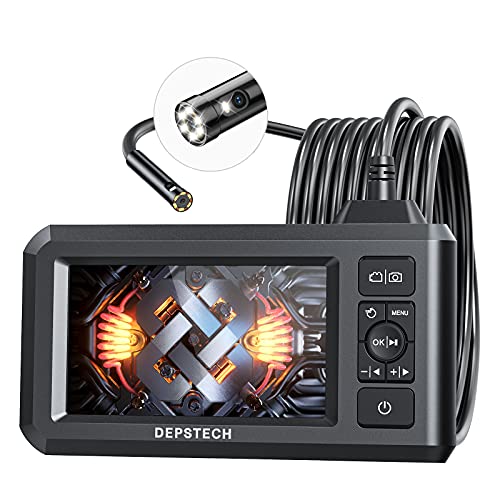
The DEPSTECH DS300 provides dual-lens viewing in a more compact general-purpose format. Its front camera and side camera can be switched with a button, and a 70° field-of-view control provides another way to frame a narrow inspection. The front camera’s listed focal range is 3 to 8 cm, while the side camera’s is 2 to 6 cm, giving buyers useful guidance about where the image should be sharpest.
A 16.5-foot semi-rigid cable supplies long reach, and the 4.3-inch IPS screen keeps the system self-contained. The listing identifies 1080p video, 2MP images, seven adjustable LEDs, a four-hour battery, 180° camera orientation, and IP67 protection for the inspection camera. No TF card is listed in the package information, so buyers who need saved inspection records should confirm how storage is handled before ordering.
Pros
- Front and side cameras provide two genuine viewing directions.
- 16.5-foot semi-rigid cable supports extended inspection paths.
- Published focal ranges help set realistic working distances.
- 4.3-inch IPS screen operates without a phone or app.
- Product information lists 1080p video, adjustable LEDs, and a four-hour battery.
Cons
- The package information states that no TF card is included.
- The dual-lens system does not offer active articulation.
This is a good fit for drains, ducts, walls, machinery, and vehicle areas where a side-facing view can save time. It sits below the articulating options because changing the camera view is different from steering the tip. Choose it when the inspection path is long and the main frustration is seeing the side wall rather than navigating a sharp bend.
To buy this product, click here.
8. 1920P Phone-Connected Endoscope Camera – Best for Broad Connector Support

This phone-connected camera takes a different route from the self-contained models. The 7.9 mm probe connects through Type-C, Micro-USB, or a Lightning adapter, and the listing describes iOS and Android use through an app. That can be convenient for someone who already carries a compatible phone and wants the phone’s familiar screen and storage, though a physical connector alone does not prove compatibility with every device.
The 16.4-foot semi-rigid cable is long enough for drains, ducts, wall cavities, and many automotive paths. Eight adjustable LEDs illuminate the probe view, and the probe is listed as IP67 waterproof. The package includes a magnet, hook, protective cap, side-view mirror, and the three connection options. The mirror can provide a side view, but it should not be treated as a second camera or as active articulation.
Pros
- 16.4-foot semi-rigid cable supports long inspection paths.
- Includes Type-C, Micro-USB, and Lightning connection options.
- 7.9 mm probe and eight adjustable LEDs suit common confined-space work.
- Package includes hook, magnet, protective cap, and side-view mirror.
- Phone display can provide a familiar interface and convenient file handling.
Cons
- Requires a compatible phone, app, and operating setup.
- The side-view mirror is not a second camera or articulating mechanism.
This is the better route for buyers who specifically want phone operation and broad connector coverage. Before ordering, verify the phone’s operating-system support, connector behavior, and app requirements rather than assuming that Type-C or Lightning guarantees a working connection. Buyers who want immediate use without a personal device should choose an integrated-screen model.
To buy this product, click here.
9. 1920P HD Screen Borescope – Best for Long-Reach Phone-Free Inspections

A 16.5-foot cable and integrated 4.3-inch IPS screen make this camera a straightforward option for long inspection paths. The 7.9 mm probe uses eight adjustable LEDs, and the listing gives a 2 to 10 cm focusing distance. That combination suits pipe walls, drains, HVAC passages, and cavities where the camera may need to travel well beyond arm’s length.
The device starts without Wi-Fi, an app, or a phone, which keeps the setup simple around dirty plumbing or dusty repair work. Image flip and brightness adjustment help with orientation and dark surfaces, while the package includes a hook, magnet, and side mirror. The main limitation is significant for anyone building inspection records: the product information says the camera cannot take or store photos.
Pros
- 16.5-foot semi-rigid cable provides substantial reach.
- Integrated 4.3-inch IPS display avoids phone and app dependency.
- 7.9 mm probe and 2 to 10 cm focus range suit close pipe and cavity viewing.
- Eight adjustable LEDs support dark-space inspection.
- Includes hook, magnet, side mirror, and Type-C cable.
Cons
- The product cannot take or store photos according to the listing.
- The semi-rigid cable is not an active articulating probe.
This model is a sensible choice for visual troubleshooting where the main question is “what is in there?” rather than “how do I document it?” It can be useful for checking a clogged drain, following a wall cavity, or looking through an HVAC route without risking a personal phone. If photos, video, narrow access, or controlled steering are central to the job, move up to a more capable model.
To buy this product, click here.
Buying Guide
Probe Diameter Determines Access
Probe diameter is a physical constraint, not a marketing detail. The FOXWELL’s listed 6.2 mm probe and Anykit’s 0.22-inch probe may enter openings that an 8 mm or 8.5 mm camera cannot. Measure the access point, account for the camera head and connector area where relevant, and leave room for the probe to move rather than assuming a nominal diameter tells the entire story.
Active Articulation Is Different From Cable Bending
A semi-rigid cable can hold a curve, but it does not actively steer the camera tip. Articulating models such as the FOXWELL, Anykit, Teslong, DXZtoz, and Acoath use a documented control to direct the distal camera in two directions. That matters after insertion, especially when the opening cannot be rotated easily. Dual-lens cameras solve a different problem by changing the viewing direction.
Match Cable Length to the Inspection Path
A five-foot articulating scope can be easier to control in an engine bay, while a 16.5-foot cable reaches farther into walls, ducts, or drains. Extra length is not automatically better. Loose cable can snag, coil, or make fine positioning harder, so choose enough reach for the task with a manageable amount left in hand.
Choose an Integrated Screen or Phone Workflow
An integrated display avoids app setup, phone compatibility questions, and the risk of putting a personal device near dirty work. Phone-connected cameras can be convenient and may provide familiar file handling, but Type-C, Micro-USB, or Lightning hardware does not guarantee software support. Confirm the listed operating-system and app requirements before treating a phone camera as plug and play.
Check Recording Before You Need Evidence
Some cameras save photos and video, while others provide live viewing only. The 1920P HD Screen Borescope is explicitly listed as unable to take or store photos, whereas products such as the FOXWELL, Anykit, Acoath, and DEPSTECH list capture or recording functions. If the inspection supports a repair estimate, maintenance record, or conversation with another person, storage is a core feature rather than a bonus.
Read IP Ratings as Component Claims
An IP67 statement generally needs to be understood in context. The supplied listings apply water protection to the probe or inspection camera, not automatically to the screen, handle, phone, connectors, or charging port. Avoid using any borescope in hot, moving, pressurized, energized, or hazardous equipment unless the product instructions and safe working procedures support that use.
Best Professional Borescope FAQ
What makes a borescope professional enough for serious inspection work?
Look for a combination of access, control, lighting, viewing, and documentation features. A narrow probe helps it enter restricted openings, active articulation helps aim the tip, and a semi-rigid cable helps push through a cavity. An integrated screen, adjustable LEDs, recording, storage, and suitable environmental protection can make the workflow more practical, but no single feature proves professional performance by itself.
Is a dual-lens borescope better than an articulating borescope?
They answer different problems. A dual-lens model can switch between forward and side views, which is useful for examining nearby pipe walls or components. An articulating model changes the camera tip’s direction, which is more useful when the probe must navigate around an obstacle. The Acoath combines both systems, while the Teslong 5-inch and DEPSTECH DS300 focus on dual-lens viewing without documented active articulation.
Can these borescopes inspect an engine?
Several listings identify engine inspection as an intended use, including the FOXWELL, Anykit, Teslong, DXZtoz, and long-reach screen models. Fit still depends on the access opening, probe diameter, working distance, and engine design. Let machinery cool as appropriate, avoid moving components, and do not treat a water-resistant probe as proof that the entire inspection system is suitable for fuel, oil, heat, or hazardous conditions.
Do more LEDs guarantee a clearer image?
No. Adjustable lighting can help, but image usefulness also depends on focus distance, lens position, reflections, surface condition, display quality, and camera stability. Too much light can create glare on shiny metal, while too little light can hide surface detail. Models with brightness adjustment give the operator more control, but LED count alone is not a reliable ranking method.
Can a side-view mirror replace a dual-lens camera?
A mirror can provide a side-facing view, but it is an attachment that redirects the image from a single camera. A dual-lens system uses separate forward and side viewing paths and can switch between them electronically or through a control. A mirror may be useful for occasional work, but it can change the probe’s profile and may be less convenient in a narrow passage.
Is a 16.5-foot cable suitable for every inspection?
It provides useful reach for walls, ducts, drains, and long cavities, but extra cable can be harder to control in a short engine inspection. A shorter articulating probe may be more precise in a confined workspace, while a long semi-rigid cable is better when the target is far from the access point. Match cable length to the route, not to the largest number in the product title.
Should I buy a phone-connected borescope or one with its own screen?
A phone-connected model can suit buyers who want app-based viewing and already have a compatible device. A self-contained model is easier to deploy without checking operating-system support or placing a phone near water, oil, dust, or debris. If the camera will be shared across different users or work sites, an integrated screen usually creates fewer compatibility questions.
Final Verdict
The FOXWELL Y400 is the strongest overall choice for professional-style inspection because it brings together the features that tend to matter during difficult access: a narrow 6.2 mm probe, 220° two-way steering, a self-contained display, adjustable lighting, zoom, storage, and documented overheat protection. It is a particularly strong fit for engine, HVAC, machinery, and plumbing work where the operator needs to aim the tip and preserve inspection evidence.
The Anykit is the better match for especially tight openings, while the Acoath is more compelling for buyers who want articulation and forward or side camera views in one unit. The Teslong 5-inch and DEPSTECH DS300 make more sense for long-reach dual-lens work, and the phone-connected model suits users who prefer a device-based workflow. Before ordering, measure the access point, decide whether active articulation or side viewing matters more, verify recording requirements, and confirm phone or environmental compatibility from the current listing.
