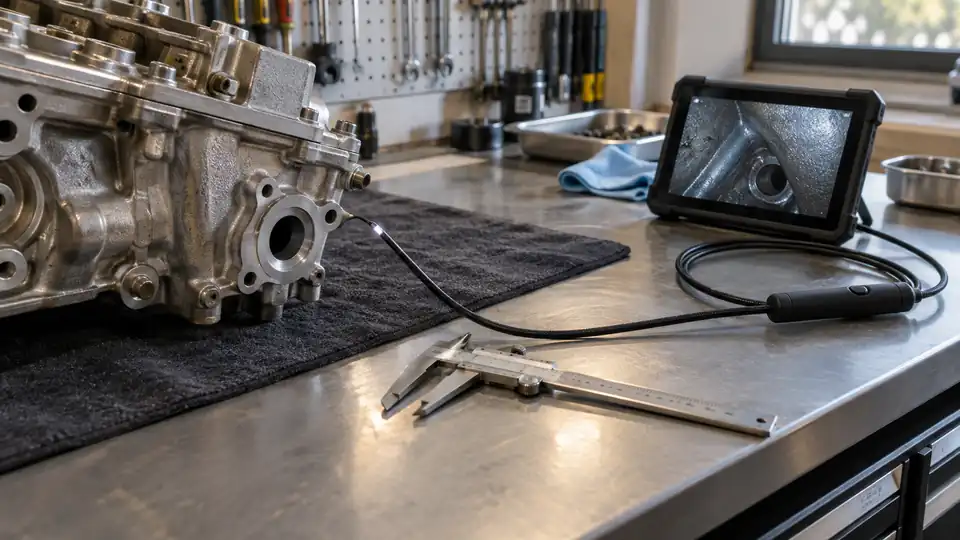
A 5.5mm borescope sits in a useful middle ground. Its probe is slim enough for many spark-plug openings, injector ports, ducts, pipes, appliance cavities, and wall voids, while still allowing room for lighting and a practical camera head. The difficult choice is deciding whether you need a self-contained screen, a phone or scanner connection, a semi-rigid cable, or genuine tip articulation.
Probe diameter is only the first filter. A long cable can reach farther, but it may be harder to guide in a short engine bay. A high-resolution listing claim does not automatically mean better inspection detail if the focus range, lighting, or display is weak. Active articulation also deserves careful attention because a cable that bends and holds its shape is different from a camera tip controlled by a joystick or steering mechanism.
This comparison weighs access, cable control, viewing direction, lighting, recording, display design, connectivity, and documented application fit. Some options are aimed at engine work, while others make more sense for pipes, HVAC cavities, appliances, or general maintenance. The products below are ranked by how much useful inspection capability they provide at the 5.5mm size.
Quick Answer
Best Overall: Teslong 5.5mm Slim Probe Two-Way Articulating Borescope. Its 180-degree joystick-controlled tip, 5-inch IPS screen, magnification, adjustable lighting, and 5mm-class probe create the most complete phone-free inspection setup in this group.
Best for Long Reach: 5.5mm Endoscope Camera with 16.4-Foot Cable. Its semi-rigid 16.4-foot cable suits ducts, wall cavities, long pipe paths, and other locations where a short probe cannot reach.
Best for Two-Way Steering: MOTOCOCHE 2-Way 220° Articulating Borescope. The 220-degree steering range and integrated display are useful when the camera must look around an obstruction after insertion.
Best for Scanner Integration: Autel MV105S Inspection Camera. It is a focused choice for compatible Autel diagnostic tablets and computers, with a 90-degree view and a stated 0.8 to 4-inch focal range.
Best 5.5mm Borescope Comparison Table
| Product | Best For | Viewing System | Probe or Cable |
|---|---|---|---|
| Teslong 5.5mm Slim Probe | Overall inspection and engine work | 180° active articulation, 5-inch screen | 5-foot probe cable |
| MOTOCOCHE 2-Way 220° | Steerable automotive inspection | 220° two-way articulation, 3.5-inch screen | 5.5mm probe |
| NIDAGE 5.5mm Articulating | Close-access steering | Up to 210° two-way articulation | 4.3-foot gooseneck |
| DEPSTECH DS300 | Long-reach screen-based inspection | 4.3-inch screen, 180° rotation | 16.5-foot semi-rigid cable |
| 5.5mm Endoscope Camera | Phone-connected general use | Phone app, single lens | 16.4-foot semi-rigid cable |
| Autel MV105S | Compatible Autel scanners | 90° view through USB device | 39.4-inch semi-rigid cable |
| THINKCAR TES102 | Thinkcar scanner compatibility | Scanner or PC display | 35.43-inch cable |
| Triplett BR75 | Walls, drains, and general use | 4.3-inch screen, 3x zoom | 6.6-foot flexible cable |
| MUCAR E021 USB | USB-connected inspection | Scanner, phone, or computer | 35.4-inch cable |
The detailed reviews explain where each 5.5mm camera earns its position and which limitations may matter during actual inspection work.
1. Teslong 5.5mm Slim Probe Two-Way Articulating Borescope — Best Overall

The Teslong earns the top position because it addresses the part of inspection that a fixed camera cannot solve easily: changing the camera direction after the probe is already inside. Its joystick controls a tip with up to 180 degrees of two-way articulation, so a user can look around pistons, behind valves, or across a cylinder wall without repeatedly withdrawing and repositioning the probe. That distinction matters in cramped engine areas where the access opening gives very little room to rotate a cable.
A 5-inch IPS display keeps the system independent of a phone, Wi-Fi connection, or app. The listing identifies a 1280×720 screen, 1.3x and 1.5x digital magnification, six adjustable LEDs, a 3,000mAh battery, a 5-foot probe cable, and an SD card. That combination suits documented inspection work where live viewing, saved images, and controlled lighting matter more than simply having the highest advertised pixel figure.
Pros
- Genuine joystick-controlled 180-degree two-way tip articulation
- Large 5-inch IPS display with stated 1280×720 resolution
- 1.3x and 1.5x digital magnification for closer viewing
- Adjustable six-LED lighting for dark cavities
- Includes a storage case, USB-C charging cable, and SD card
Cons
- The 5-foot cable is shorter than the long-reach options in this comparison
- The listing does not specify the SD card capacity
This is the strongest fit for engine inspection, valve-area checks, and other tasks where tip direction matters more than extreme reach. It also makes sense for someone who wants a complete handheld system instead of a camera that depends on a separate phone or diagnostic tablet. A buyer focused on wall cavities or long plumbing paths may prefer the DEPSTECH or 16.4-foot phone model, but the Teslong is the more capable choice for controlled close inspection.
To buy this product, click here.
2. MOTOCOCHE 2-Way 220° Articulating Borescope — Best for Broad Tip Steering

MOTOCOCHE focuses on steerability. Its 5.5mm probe provides two-way rotation up to 220 degrees, a wider stated range than the Teslong, and the listing identifies a 32mm steering radius. That extra movement can help when an inspection opening sits beside a component rather than directly above it. Instead of twisting the whole cable and hoping the lens faces the right direction, the operator can steer the distal camera toward the area of interest.
The built-in 3.5-inch IPS screen shows a 90-degree field of view and a stated 15 to 100mm depth of field. The camera supports photos and video, with storage up to a 32GB TF card, while six LEDs provide four lighting levels. A 2,000mAh battery is listed with up to four hours of continuous use. Those details make it a self-contained option for engine carbon checks, narrow pipelines, mechanical gaps, and wall maintenance.
Pros
- Documented 220-degree two-way steerable probe
- Integrated 3.5-inch IPS display for phone-free viewing
- Photo and video capture with support for up to 32GB TF storage
- Specified 15 to 100mm depth of field
- IP67 camera lens and stated four-hour battery runtime
Cons
- The screen is smaller than the Teslong and DEPSTECH displays
- The listing identifies a 1MP camera, which may provide less image detail than some higher-resolution claims
MOTOCOCHE is a good match for close mechanical inspection where directional control is the main obstacle. Its screen and recording features avoid the extra steps of connecting a phone, and the 220-degree range gives it a clear purpose beside fixed-probe models. It is less appealing for a deep cavity that requires many feet of reach, where a long semi-rigid cable will be more practical.
To buy this product, click here.
3. NIDAGE 5.5mm Articulating Borescope — Best for Close-Access Articulation

The NIDAGE uses a 5.5mm probe and an articulated camera head that the listing says can rotate up to 210 degrees. That makes it suitable for inspection points where the camera must look around an edge, such as an engine cylinder, HVAC path, plumbing bend, or wall cavity. Its 4.3-foot gooseneck is shorter than the long-reach cables below, but the reduced length can be easier to manage around a vehicle or workbench.
Image capture is supported by a listed 1080P system, eight adjustable LEDs with three brightness levels, and up to 8x digital zoom. The built-in 32GB TF card gives the user a stated place to save inspection material, while the 2,800mAh battery and carrying case support portable use. The product information also identifies an IP67 waterproof tip, though that rating should be treated as applying to the documented camera tip rather than the entire handheld system.
Pros
- Two-way articulating camera head with a stated 210-degree range
- 5.5mm probe for narrow access points
- 8x digital zoom and 1080P listing claim
- Eight adjustable LEDs with three brightness levels
- Includes 32GB TF storage and a portable case
Cons
- The 4.3-foot gooseneck offers less reach than 16-foot-class alternatives
- The product information does not specify the screen size or display resolution
NIDAGE fits buyers who want active steering without moving up to a longer, more cumbersome inspection cable. Its useful balance is between a compact work area and a tip that can be redirected after insertion. A long-distance pipe inspection calls for something else, while close automotive, HVAC, and household inspection tasks are a better match for this design.
To buy this product, click here.
4. DEPSTECH 5.5mm Industrial Endoscope DS300 — Best for Long-Reach Screen Use

DEPSTECH takes a different route from the articulating models. Its 5.5mm camera uses a 16.5-foot semi-rigid cable that can be shaped and then held in position, making it more suitable for long ducts, appliance interiors, wall cavities, and pipe paths. The cable does not provide documented active tip articulation, so it should not be chosen for steering around a component after insertion. Its advantage is reach combined with a self-contained viewing system.
The 4.3-inch display supports photo and video capture, and the product information lists a 1080P camera, a 170-degree horizontal viewing angle, six adjustable LEDs, and a stated focal range of 1.96 to 3.93 inches. A one-button 180-degree orientation function is also listed. That orientation feature can help position the image, but it should not be confused with active mechanical steering. A 32GB TF card, hooks, magnets, and a side-view mirror are included.
Pros
- 16.5-foot semi-rigid cable for extended inspection reach
- Integrated 4.3-inch display with photo and video capture
- Specified 1.96 to 3.93-inch focal range
- Six adjustable LEDs and a stated 170-degree horizontal viewing angle
- Includes 32GB storage, hook, magnet, and side-view mirror
Cons
- The semi-rigid cable is not a substitute for active tip articulation
- The product has a shorter stated battery runtime of up to four hours
This is a strong choice for reach-first inspections where the camera may need to travel through a cavity rather than turn tightly around an engine component. The integrated screen keeps the setup straightforward, and the included accessories broaden its usefulness around a home or workshop. Buyers who need joystick steering should move up to Teslong, MOTOCOCHE, or NIDAGE instead.
To buy this product, click here.
5. 5.5mm Endoscope Camera with 16.4-Foot Cable — Best for Broad Connector Support

This phone-connected camera is built around reach and connector flexibility. The listing identifies Type-C, Lightning, and Micro-USB interfaces, along with iOS and Android support through the Useeplus app. That combination can reduce adapter hunting, but physical connector fit does not guarantee compatibility with every phone. Android devices may require OTG support, and the app remains part of the operating process.
The 5.5mm probe is described as semi-rigid and 16.4 feet long, so it can be manually shaped for a wall cavity, duct, undercarriage, or long pipe route. Eight adjustable LEDs illuminate the single-lens camera, while the listing describes 1920P image and video capture. IP67 protection is identified for the probe, making it suitable for damp inspection environments within the limits of the product instructions and the protected component.
Pros
- 16.4-foot semi-rigid cable for long inspection paths
- Type-C, Lightning, and Micro-USB interfaces are listed
- Compatible listing claims for iOS, Android, and iPad devices
- Eight adjustable LEDs for dark cavities
- IP67 probe and 12-month warranty are identified in the product information
Cons
- Requires a compatible phone or tablet and the Useeplus app
- Android operation may require OTG support, and exact device compatibility should be confirmed
This option makes sense for someone who already wants to view and save inspection footage on a phone. It is especially useful when a long cable matters more than a built-in display. A user who needs immediate operation without an app should choose a screen-based model such as the Teslong or DEPSTECH.
To buy this product, click here.
6. Autel MV105S Inspection Camera — Best for Autel Scanner Integration

The Autel MV105S is a specialized USB camera rather than a self-contained borescope. It connects to listed Autel scanners and PCs, allowing the larger device screen to handle the live view. The product information specifically lists compatibility with several Autel Ultra, MS, MK, MP, MX, and related scanner families, while also stating that it is not compatible with smartphones, TS608, or TS508. That makes compatibility checking a necessary step before purchase.
For engine inspection, the camera has a 5.5mm probe, a stated 90-degree view, and a focal range of 0.8 to 4 inches. Its 39.4-inch semi-rigid cable should hold a chosen shape better than a loose flexible lead, and eight LEDs provide adjustable illumination. The IP67 claim applies to the probe and cable in the supplied product description. A magnet and side-view mirror are included, but the mirror is an attachment, not a second camera or an articulating tip.
Pros
- Purpose-built 5.5mm probe for listed engine inspection tasks
- Documented 0.8 to 4-inch focal range
- 90-degree view can show more of a cylinder wall from a close position
- 39.4-inch semi-rigid cable and eight adjustable LEDs
- Includes a magnet and side-view mirror
Cons
- Requires a compatible Autel scanner or PC for viewing
- Not compatible with smartphones, TS608, or TS508 according to the listing
The MV105S is a logical addition to an existing compatible Autel setup, especially for cylinder, oil-pan, and coolant-passage inspection. Its short-to-moderate cable and defined focal range favor automotive work over long building or plumbing routes. Anyone without a supported Autel scanner should select a complete screen-based unit instead.
To buy this product, click here.
7. THINKCAR TES102 Endoscope Inspection Camera — Best for Thinkcar Scanner Users

The TES102 is aimed at a buyer who already works with Thinkcar diagnostic equipment. Its listing identifies compatibility with Thinkcar Thinktool and Thinkscan products, along with PC use, so the inspection image can appear on an existing workstation rather than a dedicated borescope screen. That arrangement keeps the camera compact, though it also means the viewing device is a separate part of the setup.
The 5.5mm camera uses a 2MP sensor, six LEDs, and a 35.43-inch cable. The product information describes 1280×720 visuals and an IP67 camera head with operation up to 3.3 feet underwater. A hook, magnet, and mirror are included for retrieval and alternate viewing. The cable is flexible and suited to engine cylinders, pipes, drains, and household inspection points, but its reach is modest beside the 16-foot models.
Pros
- 5.5mm probe with a stated 2MP sensor
- Compatibility is listed for Thinkcar scanners and PC use
- Six LEDs provide illumination in narrow spaces
- Includes hook, magnet, and mirror attachments
- IP67 camera head with a stated 3.3-foot underwater limit
Cons
- Requires a compatible scanner or computer for viewing
- The 35.43-inch cable is relatively short for deep cavities and long pipes
This camera fits a diagnostic workstation that already supports it. It can also serve as a compact PC-connected inspection tool for short paths where a built-in screen is unnecessary. Buyers seeking a complete independent kit, active articulation, or much longer reach will find better alignment elsewhere in the ranking.
To buy this product, click here.
8. Triplett BR75 High Definition Borescope — Best for General Screen-Based Inspection

The Triplett BR75 keeps operation simple with a 4.3-inch color display and a 6.6-foot flexible cable. It is aimed at general inspection points such as behind walls and inside drains, where a user may want a screen in hand instead of a phone app. The 5.5mm IP67 camera gives it access to narrow areas, while the moderate cable length is easier to handle than a 16-foot line in a small workspace.
The display has a listed 480×272 resolution, with color and black-and-white viewing modes and 3x digital zoom. Three LED brightness levels help illuminate the target, and the rechargeable battery is listed as a 3.7V lithium-polymer unit. A mirror, magnet, and hook are included. The product information does not identify active articulation, so the cable should be treated as flexible rather than steerable at the tip.
Pros
- Integrated 4.3-inch color display
- 5.5mm IP67 camera for narrow and damp inspection areas
- Color and black-and-white viewing modes
- 3x digital zoom and three LED brightness levels
- Includes mirror, magnet, hook, and rechargeable battery
Cons
- The listed 480×272 display resolution is lower than several alternatives
- The flexible cable has no documented active articulation
Triplett is a straightforward choice for occasional wall, drain, appliance, and general maintenance checks. Its screen and accessories make it ready for use without a separate phone, while the 6.6-foot reach covers many household tasks. It is less suited to detailed engine work where focal range, steering, or a higher-detail display carries more weight.
To buy this product, click here.
9. MUCAR E021 USB Endoscope Borescope — Best for Broad USB Connectivity

The MUCAR E021 USB model is built for direct connection to supported scanners, Android devices, and Windows computers. Its product information lists Type-C, Micro-USB, and USB 2.0 interfaces, along with compatibility across several MUCAR and THINKSCAN devices. That is useful for a mixed workshop, although the exact phone or computer software environment still needs to match the stated support.
The 5.5mm probe uses a listed 2.8mm sensor, six adjustable LEDs, a 74-degree field of view, and a 3 to 8cm focal length. Its 35.4-inch cable has a stated 50mm bending radius, while the separate 47.2-inch USB cable provides extra connection reach. Photos and 30fps AVI video are listed, with JPEG stills and automatic white balance and exposure. A hook, magnet, and mirror are included.
Pros
- 5.5mm probe with stated 1280×720 HD output
- Type-C, Micro-USB, and USB 2.0 connection options are listed
- Specified 3 to 8cm focal length and 74-degree field of view
- Photo capture and 30fps AVI video are identified
- Includes hook, magnet, mirror, and compatible cables
Cons
- Requires a supported phone, scanner, or computer for viewing
- The 35.4-inch probe cable is short for long-distance pipe or cavity inspection
MUCAR is a sensible fit for users who want one USB inspection camera to move between supported diagnostic tools and computers. Its specified focal range gives buyers more useful information than a broad “HD” label alone, while the moderate cable length keeps it focused on close work. A self-contained screen or active steering system will be more suitable for independent operation or complex engine access.
To buy this product, click here.
Buying Guide
Probe Diameter Determines Where the Camera Can Fit
A 5.5mm probe is useful because it can enter openings that are too narrow for many larger inspection cameras. That does not mean every 5.5mm model fits every spark-plug hole, pipe bend, or access port. Check the complete camera-head dimensions and the opening shape before insertion, especially when the cable or protective sleeve may be larger than the stated camera diameter.
Active Articulation Is Different From a Bendable Cable
Teslong, MOTOCOCHE, and NIDAGE list mechanical control of the camera tip. That lets the operator change viewing direction after insertion. A semi-rigid cable, such as the one on the DEPSTECH, can be shaped before use and may hold its route well, but it does not provide the same distal steering. Choose articulation for obstacles and close mechanical inspection. Choose a longer semi-rigid cable for reach.
Match Cable Length to the Inspection Path
A 35-inch cable is easier to manage around an engine bay or appliance. A 16-foot cable is more useful for a duct, wall void, or extended pipe route. Extra length can create loops and make the camera harder to position, so the longest available probe is not automatically the best choice. Think about where the display or phone will sit and how much cable must be guided by hand.
Focus Range Matters Beside Resolution
A camera may carry an HD or 1080P listing claim and still be difficult to use if the target sits outside its useful focus distance. Autel lists a 0.8 to 4-inch focal range, MOTOCOCHE lists 15 to 100mm depth of field, and MUCAR identifies a 3 to 8cm focal length. These details help show where the camera is expected to produce its clearest view.
Choose the Viewing System Before the Camera
An integrated screen removes phone, app, and software compatibility questions. A USB or phone-connected camera can be convenient when the existing device provides a larger display or stores files easily. Confirm the exact connector and supported software. USB-C, Lightning, or Micro-USB fit alone does not prove that every phone will display the live image.
Check What the IP67 Rating Covers
Several products identify IP67 protection for the camera, probe, or cable. Treat that as a component-specific claim unless the product information clearly covers the complete system. A protected camera tip does not make the display, handle, phone, charging port, or connector waterproof. Follow the product instructions for liquid exposure, and do not use a borescope around energized electrical equipment or moving machinery without suitable precautions.
Best 5.5mm Borescope FAQ
What does a 5.5mm probe size mean in practice?
It describes the approximate diameter of the camera probe identified by the product information. A smaller probe can enter tighter openings, but access also depends on the camera head, protective sleeve, cable stiffness, and the shape of the route. Probe diameter does not by itself determine image quality or steering control.
Are all 5.5mm borescopes suitable for engine cylinders?
No. Engine inspection also depends on the focal range, viewing angle, lighting, cable control, and the specific access opening. Autel, Teslong, MOTOCOCHE, NIDAGE, and the Thinkcar model provide information that directly supports automotive or engine-related use. Confirm the opening size and inspect only equipment that has been safely shut down and cooled as appropriate.
Does a semi-rigid cable articulate the camera tip?
No. A semi-rigid cable can be bent into a route and may hold that shape, but it does not necessarily steer the camera head after insertion. Active articulation requires documented directional control of the distal tip, such as the joystick or steering mechanism listed for the articulating models in this comparison.
Is a side-view mirror the same as a second camera?
No. A side-view mirror redirects the image from a single camera and may help inspect a nearby surface. It does not provide a second lens, independent camera, or active articulation. The Autel, DEPSTECH, Thinkcar, and MUCAR accessories should be understood as attachments rather than dual-camera systems.
Can a phone-connected borescope work with every USB-C phone?
No. The phone must support the required software and camera connection method. Android devices may require OTG support, and app compatibility can vary. Check the product listing and your phone specifications before ordering. A Type-C plug establishes physical connection only.
Do integrated-screen borescopes record images and video?
Some do, and some product listings state photo or video capture directly. DEPSTECH, MOTOCOCHE, and the phone-connected models list recording functions, while the Triplett information emphasizes live viewing, zoom, display modes, and included accessories. Confirm recording support and storage details rather than assuming that a built-in screen includes it.
Is IP67 protection suitable for every underwater inspection?
No. IP67 does not mean unlimited underwater operation or protection for every part of the system. One product may identify a waterproof camera head, another may state a specific immersion depth, and the display or connector may remain unprotected. Use the documented limits and avoid extending the rating to the phone, computer, or control unit.
Final Verdict
The Teslong 5.5mm Slim Probe Two-Way Articulating Borescope is the strongest overall choice because it combines the features that matter most in close inspection: a slim probe, genuine joystick control, a self-contained 5-inch display, adjustable lighting, magnification, and saved-image support. It is particularly well matched to engine and component inspection where looking around an obstruction is more useful than carrying several extra feet of cable.
MOTOCOCHE and NIDAGE are the closest alternatives for buyers who want active two-way steering, while DEPSTECH and the 16.4-foot phone camera make more sense for long paths and cavities. Autel and Thinkcar are specialized picks for compatible diagnostic systems, and Triplett remains a straightforward screen-based option for general maintenance. Match the probe to the access opening, the cable to the inspection distance, and the viewing system to the devices already in your workspace.
