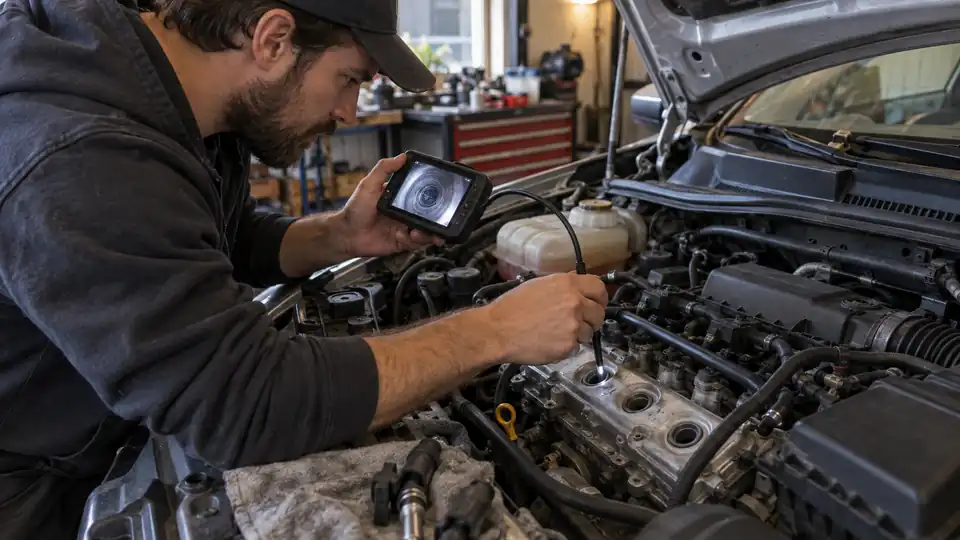
A borescope earns its place in a DIY garage when a normal flashlight, mirror, or phone camera stops short. Looking through a spark-plug opening, tracing a suspected leak, checking behind an HVAC panel, or finding a dropped fastener all demand the same basic combination: a probe that reaches the space, a camera that can be aimed, and a screen that remains usable while your hands are busy. The strongest options for this work tend to combine active tip control, a semi-rigid cable, adjustable lighting, and an integrated display.
Probe diameter and viewing control deserve more attention than a headline resolution number. A slim 3.9 mm camera can enter places an 8 mm probe cannot, while a two-way articulating model can look around an obstruction after insertion. Dual-lens viewing solves a different problem by offering front and side perspectives, but it does not replace mechanical articulation. Cable length matters too. A 16.4-foot cable is useful for pipes and cavities, yet a shorter 4 or 5-foot probe can feel easier to guide around an engine bay.
This comparison focuses on products that suit automotive maintenance while remaining useful around plumbing, HVAC systems, machinery, and household repairs. It weighs access, articulation, viewing direction, lighting, display independence, recording, and practical limitations, so a casual inspection does not get confused with a task that needs a specialized industrial videoscope.
Quick Answer
- Best Overall: Teslong Articulating Borescope with Dual Lens Endoscope and 8+1 LED Lights combines two-way articulation, front and side cameras, an integrated 4.5-inch screen, and direct photo and video capture.
- Best for Tight Access: DXZtoz 3.9mm Ultra-Slim Articulating Borescope is the most access-focused choice, with a 3.9 mm probe, 220-degree two-way rotation, close focusing, and a 5-inch display.
- Best for Long Reach: Dual Lens Endoscope Camera with Light pairs front and side cameras with a 16.4-foot semi-rigid cable and onboard recording.
- Best for Simple Phone-Free Inspection: Anykit 210° Two-Way Articulating Borescope offers a slim 0.22-inch probe, a 4.3-inch screen, a thumb-controlled tip, and a listed overheat alarm.
Best Borescope for DIY Mechanics Comparison Table
| Product | Best For | Probe and Reach | Viewing System |
|---|---|---|---|
| Teslong Dual Lens Articulating Borescope | Best overall automotive versatility | 5 ft, two-way articulating | Front and side cameras, 4.5-inch screen |
| DXZtoz 3.9mm Ultra-Slim Articulating Borescope | Tight engine openings | 3.9 mm, 5 ft, two-way | 220-degree rotation, 5-inch screen |
| Anykit 210° Two-Way Articulating Borescope | Slim access and controlled positioning | 0.22 inch, 4 ft | 210-degree articulation, 4.3-inch screen |
| Ralcam Two-Way Articulating Borescope | Longer automotive and HVAC reach | 8.5 mm, 10 ft | 210-degree articulation, 5-inch screen |
| Teslong Articulating Borescope | General garage inspection | 5 ft, two-way articulating | 4.5-inch screen, single camera |
| Dual Lens Endoscope Camera | Pipes, cavities, and long runs | 8 mm, 16.4 ft | Front and side cameras, 4.3-inch screen |
| SATA Articulating Borescope | Documenting inspections | 8.5 mm, 5 ft | 210-degree articulation, 4.3-inch screen |
| NIDAGE 3.9mm Endoscope Camera | Small openings and live viewing | 3.9 mm, 5 ft | Fixed probe, IPS screen |
| Two-Way Articulating Dual Lens Borescope | 6 mm access and dual-angle viewing | 6 mm, 5 ft | Two-way articulation, front and side lenses |
The detailed reviews below show where each design earns its place, where its limitations appear, and which type of inspection benefits most from its particular combination of access and control.
1. Teslong Articulating Borescope with Dual Lens Endoscope and 8+1 LED Lights — Best Overall

Around an engine, the hard part is often seeing the side of a component after the probe has reached the right area. This Teslong addresses that problem with two-way articulation plus separate front and side cameras. The side view can reduce the need to pull the probe back and reposition it, while the articulating control helps aim the tip around nearby parts. That combination gives it a broader practical range than a conventional fixed camera.
The 4.5-inch IPS display operates without a phone or app, which suits a dirty garage where a smartphone is better kept in a pocket. Its 5-foot semi-rigid gooseneck is long enough for many engine, appliance, HVAC, and wall-cavity checks while remaining easier to manage than a very long cable. The listing also identifies adjustable probe lighting and direct photo and video capture. A joystick centered for one-handed operation adds useful control when the other hand is holding a flashlight, panel, or tool.
Pros
- Combines two-way active articulation with front and side camera views.
- Includes a standalone 4.5-inch IPS color screen with no app requirement.
- 5-foot semi-rigid cable balances reach with manageable probe control.
- Adjustable camera lighting helps in dark engine and mechanical spaces.
- Supports photo and video capture through a rear multifunction button.
Cons
- The listing does not clearly specify the probe diameter.
- A 5-foot probe is less suitable for long pipe or deep cavity inspections.
This is the strongest all-around fit for someone who wants one inspection camera for automotive work and occasional household jobs. The dual-lens arrangement is particularly useful around brackets, hoses, cylinder-adjacent spaces, and enclosed machinery where a forward view alone leaves blind spots. Buyers who need a very small probe for narrow openings, or a cable longer than 5 feet, should look elsewhere. For general garage use, though, the combination of steering, alternate viewing, recording, and phone-free operation is unusually well balanced.
To buy this product, click here.
2. DXZtoz 3.9mm Ultra-Slim Articulating Borescope — Best for Tight Engine Access
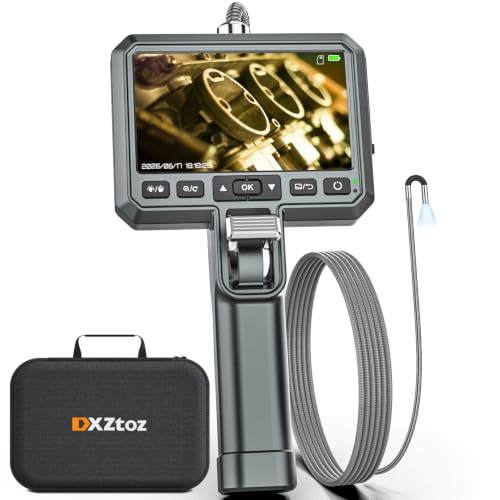
When the access point is narrow, probe diameter becomes the gatekeeper. The DXZtoz uses a 3.9 mm articulating probe, a dimension suited to smaller openings than the 8 or 8.5 mm cameras elsewhere in this group. That can matter around engine components, compact mechanisms, robots, and 3D printers. Its listing describes two-way rotation up to 220 degrees, so the slim tip is also intended to be aimed after insertion rather than simply pushed forward.
The camera is built around a 5-inch IPS display, a close-focus distance of about 1 cm, 10X zoom, and six adjustable LEDs. Those features can help when a defect sits close to the lens, although zoom and resolution do not guarantee a clearer image in every situation. The product information lists 1080P viewing, photo and video recording with sound, a pre-installed 32GB card, and a 3000mAh battery with a stated 5 to 6 hours of operation. Its stainless steel probe is presented as more wear-resistant than a standard gooseneck, but the supplied information does not fully define its operating limits.
Pros
- 3.9 mm probe reaches openings that larger inspection cameras may miss.
- Two-way articulation provides documented directional control at the tip.
- 5-inch IPS screen offers a larger viewing area than several compact models.
- Close-focus capability, zoom, and adjustable LEDs support detailed live inspection.
- Includes photo and video recording with sound and 32GB storage.
Cons
- The slim probe may be less robust for rough cable-pushing through difficult routes.
- The listing’s wear-resistance and heat claims should be checked against the task before use.
This is the specialist pick for tight engine access, especially when a wider camera simply cannot enter the opening. It gives up some broad-purpose convenience because the small probe and more technical feature set are aimed at precision access rather than casual household viewing. A buyer inspecting pipes or wall cavities may get better control from a longer cable, while someone checking compact mechanical spaces can benefit greatly from this model’s reach into narrow entry points.
To buy this product, click here.
3. Anykit 210° Two-Way Articulating Borescope — Best for Slim Controlled Access

The Anykit takes a compact approach to steering. Its listed 0.22-inch probe is slim enough for crowded engine spaces, while the 210-degree two-way mechanism lets the operator change the camera’s direction after entry. A thumb slider supports ambidextrous control, which is handy when access to the inspection point is awkward and the display must remain close to eye level.
The 4.3-inch IPS screen shows the live image without a phone, and the product information lists 1920 by 1080P viewing, three zoom levels, and a 180-degree image flip. That flip changes the displayed orientation, not the physical direction of the probe, but it can make a sideways image easier to interpret. The kit includes an 8GB TF card, a 3000mAh battery with a listed five-hour runtime, USB-C charging, adjustable LEDs, and IP67 protection for the inspection camera. A built-in temperature sensor displays an overheat warning in high-temperature surroundings, though the warning should not be treated as permission to inspect hot or moving machinery.
Pros
- 0.22-inch probe provides useful access in crowded automotive spaces.
- 210-degree two-way articulation supports deliberate tip positioning.
- Thumb-slider control is suited to one-handed, ambidextrous operation.
- Includes a phone-free 4.3-inch IPS display, storage card, and USB-C charging.
- Product information lists an overheat alarm and IP67 camera protection.
Cons
- The 4-foot cable offers less reach than longer inspection cameras in this roundup.
- The smaller 8GB card provides less listed storage than several 32GB-equipped models.
This model fits buyers who value a narrow probe and straightforward controls more than long reach or a larger display. It should feel at home around engines, HVAC components, and wall cavities where the entry point is restricted but the inspection path is relatively short. For deep drains or long pipe runs, the 4-foot cable is the limiting factor, and a longer fixed or dual-lens camera will be more appropriate.
To buy this product, click here.
4. Ralcam Two-Way Articulating Borescope — Best for Long Articulating Reach

A 10-foot semi-rigid cable changes the type of inspection this Ralcam can handle. It reaches farther into HVAC runs, wall cavities, machinery, and pipe paths than the short probes intended mainly for engine bays. The trade-off is control. More cable must be guided and supported, so it is useful for planned reach but may feel cumbersome around a compact engine where only a few feet are needed.
At the tip, the product information lists an 8.5 mm probe, two-way 210-degree articulation, angle locking, six LEDs, and three brightness levels. The angle lock is especially useful when the camera must stay pointed at a suspected crack, leak, or corroded area while the operator studies the 5-inch IPS screen. Eight-times zoom and voice recording are also listed, allowing findings to be narrated while video is captured. A 4400mAh replaceable battery is described with up to four hours of operation.
Pros
- 10-foot semi-rigid cable offers substantially more reach for cavities and ducts.
- Two-way 210-degree articulation includes an angle-lock function.
- 5-inch IPS display and listed 8X zoom support close inspection from a distance.
- Voice recording can accompany video documentation of findings.
- 4400mAh replaceable battery is listed with up to four hours of operation.
Cons
- 8.5 mm probe cannot enter openings suited to the slimmer 3.9 mm and 6 mm models.
- The long cable may be harder to control in tight engine-bay work.
Choose this Ralcam for reach and stationary viewing rather than maximum access. It makes sense for a garage that also tackles ducts, wall cavities, and longer mechanical paths, especially where documenting a finding with spoken notes is useful. Someone working mainly through small automotive openings may find the probe too large and the cable unnecessarily long, but those limitations reverse once the inspection extends beyond a nearby component.
To buy this product, click here.
5. Teslong Articulating Borescope for Mechanic Automotive HVAC Wall Inspection — Best for General Phone-Free Use

Some inspections need a camera that behaves predictably without adding a phone, wireless connection, or app to the process. This Teslong uses a standalone 4.5-inch IPS display and a 5-foot semi-rigid gooseneck, giving it a familiar handheld format for automotive, HVAC, wall, and appliance work. The two-way articulating probe can be guided with a centrally positioned joystick, a useful arrangement when the camera needs repeated small corrections around an obstruction.
Its single-camera design keeps the viewing system simpler than the dual-lens options above. Adjustable LEDs illuminate dark areas, and the listing identifies buttons for photo and video capture. That makes it suitable for saving a view of a damaged component or sharing a finding after the inspection. The published information does not clearly state the probe diameter, so buyers should confirm that measurement if the camera must pass through a specific opening.
Pros
- Two-way articulation helps direct the camera around automotive and household obstructions.
- Standalone 4.5-inch IPS screen eliminates phone and app dependency.
- 5-foot semi-rigid gooseneck provides a balanced length for nearby inspections.
- Adjustable probe LEDs support work inside dark cavities.
- Photo and video capture are identified in the product information.
Cons
- Uses a single camera, so it lacks the alternate side-view perspective of dual-lens models.
- The probe diameter is not clearly identified in the available product information.
This is a sound choice for routine garage use where a controllable tip and simple screen matter more than an especially slim probe. It suits inspections behind panels, around engine components, and inside household equipment. Skip it when a second viewing direction would save repeated repositioning or when the entry opening has a strict diameter limit that cannot be checked before purchase.
To buy this product, click here.
6. Dual Lens Endoscope Camera with Light — Best for Long Pipe and Cavity Runs

The 16.4-foot semi-rigid cable puts this camera in a different lane from short articulating models. It is aimed at longer paths through pipes, cavities, HVAC spaces, and machinery, where the problem is reach rather than precise tip steering. The 8 mm probe is wider than the slim engine-focused choices, yet it remains a reasonable size for the broader inspection tasks described in the listing.
Two actual camera views, front and side, let the operator check ahead and inspect a nearby wall without changing the probe position. That is useful inside a pipe or behind a panel, although the dual-lens system should not be confused with active articulation. The 4.3-inch IPS screen displays live 1920P video, while an included 32GB card supports photo and video recording. The camera probe is listed as IP67 rated, with eight LEDs on the front lens and one on the side, each using adjustable brightness levels.
Pros
- 16.4-foot semi-rigid cable reaches farther into pipes, cavities, and ducts.
- Front and side cameras provide two viewing directions without a mirror attachment.
- Includes a 4.3-inch IPS display and 32GB storage for recorded findings.
- IP67 protection is listed for the 8 mm camera probe.
- Accessory kit includes hooks, magnets, a protective cover, and a reset pin.
Cons
- The 8 mm probe is less suitable for very narrow automotive access points.
- A long semi-rigid cable can be harder to manage around short, crowded inspection paths.
This model is the better fit for a DIY garage that also investigates drains, ducts, wall cavities, or long runs behind equipment. It provides reach and alternate viewing, but it does not offer active tip steering, so the cable must be positioned carefully from outside the opening. For checking a confined engine component through a small access port, a shorter articulating camera will be easier to aim.
To buy this product, click here.
7. SATA Articulating Borescope Camera with Light — Best for Inspection Documentation

The SATA gives its strongest case through a combination of controlled positioning and record keeping. Its 8.5 mm articulating probe uses a dial lock to hold the viewing angle, while the 5-foot semi-rigid cable provides enough structure to guide the tip around engine parts, HVAC components, or plumbing paths. The listing identifies a 210-degree articulation range, a 4.3-inch IPS display, and a 4X zoom function.
The published camera information includes a 30 to 70 mm focal range, a 90-degree wide-angle lens, and a CMOS sensor described as 1600 by 1200. It also lists Full HD 1920 by 1080 image and video output, a 32GB TF card, playback, and a 2200mAh battery with up to three hours of operation. An overheat protection feature is described as shutting down the probe at 194 degrees Fahrenheit. That is a protective feature, not a reason to insert the camera into hot machinery, which should be cooled and made safe before inspection.
Pros
- Dial lock holds the two-way articulating tip at the selected angle.
- Listed focal range and 4X zoom support close inspection of components.
- Includes photo, video, playback, and 32GB storage capabilities.
- IP67 protection is identified for the camera probe.
- Overheat protection and adjustable six-LED lighting are listed features.
Cons
- The 8.5 mm probe is too large for openings suited to ultra-slim cameras.
- Listed battery operation of up to three hours is shorter than several alternatives.
This is a practical choice for someone who wants to save images or video rather than rely on memory after the inspection is over. The angle lock can keep a suspect area in view while the operator studies the screen, which is useful for documenting wear or damage. The narrower battery claim and larger probe make it less attractive for long sessions or tiny openings, but its controls and recording workflow are well matched to routine automotive diagnosis.
To buy this product, click here.
8. NIDAGE 3.9mm Endoscope Camera with Light — Best for Live Viewing Through Small Openings

The NIDAGE keeps the probe slim without adding an articulating control system. Its listed 3.9 mm camera can enter compact areas around vehicle engines, machinery, printers, instruments, and appliances, while the 5-foot semi-rigid cable offers some push control after the camera is inside. That makes it a useful live-view tool for locating a component or checking a narrow passage, provided the inspection does not require the tip to turn around an obstruction.
A built-in IPS screen removes the need to expose a phone to oil, dust, or awkward working conditions. Six adjustable LEDs are listed for dark spaces, and the camera probe carries an IP67 rating in the product information. The important limitation is clear: this model does not take pictures or record video. It is therefore better for immediate visual checking than for documenting a finding for a repair estimate, a parts discussion, or a later comparison.
Pros
- 3.9 mm probe can enter narrow openings that larger cameras cannot.
- 5-foot semi-rigid cable provides a useful balance of flexibility and support.
- Integrated IPS display supports live inspection without a phone or app.
- Six adjustable LEDs are listed for dark inspection areas.
- IP67 protection is identified for use in damp inspection environments.
Cons
- Fixed probe lacks active articulation for steering around obstructions.
- The product information states that it cannot capture photos or videos.
This NIDAGE is a sensible fit for a buyer who wants to see inside a tight area and make a decision on the spot. It can help locate debris, inspect a narrow engine passage, or check a hidden cavity before disassembly. Choose an articulating recorder instead if the camera must be aimed precisely or if inspection evidence needs to be saved.
To buy this product, click here.
9. Two-Way Articulating Dual Lens Borescope — Best for 6mm Dual-Angle Access

This Level Up Auto model occupies a useful middle ground between ultra-slim fixed cameras and larger 8 mm dual-lens systems. The listing identifies a dual 6 mm lens system, two-way articulation controlled by a roller, and a 5-foot semi-rigid gooseneck. A front camera and an additional side camera can show what lies ahead and beside the probe, while six LEDs on the front and an extra side light support inspection in dark areas.
The 4.3-inch IPS display is listed with 1080P visuals and a focus range of 2 to 10 cm. The system records photos and video to an included 32GB card, and the 2000mAh battery is described with up to four hours of operation. The product information also lists a carrying case, hooks, a magnet, a mirror set, USB charging, and no app or Wi-Fi requirement. IP67 and oil-resistant lens claims apply to the camera lens, so the display and handle should still be kept away from liquids.
Pros
- 6 mm dual-lens system offers front and side viewing in a relatively slim format.
- Two-way articulation is controlled by a roller for deliberate tip positioning.
- Includes 32GB storage for photos and video recordings.
- Listed 2 to 10 cm focus range supports close inspection of nearby components.
- Includes a case, retrieval accessories, and phone-free operation.
Cons
- The 5-foot cable provides less reach than long-cable plumbing-oriented cameras.
- Its dual-lens system adds capability but does not provide four-way articulation.
This model suits a garage that wants alternate viewing angles without moving up to an 8 mm probe. The 6 mm format may help around tighter automotive access points, while the dual-lens and recording features keep it useful for plumbing and HVAC checks. Buyers who need the smallest available entry diameter should look at a 3.9 mm camera, and those tackling deep runs will need a longer cable.
To buy this product, click here.
Buying Guide
Probe Diameter Determines Which Openings Are Usable
The camera head must physically pass through the access point before any other specification matters. The 3.9 mm DXZtoz and NIDAGE models offer the narrowest listed probes in this group, while the 6 mm Level Up Auto design provides a compromise between access and dual-lens functionality. Models with 8 or 8.5 mm probes may offer a larger housing or longer reach, but they can be excluded by a small opening. Measure the entry point rather than assuming a camera will fit through a spark-plug hole, inspection port, or narrow duct.
Active Articulation Is Different From a Bendable Cable
A semi-rigid cable can be bent before insertion and may hold a shape, but that does not mean the camera tip can be steered after it enters the cavity. Articulating models use a joystick, slider, roller, or dial to change the distal camera direction. This matters around engine parts where the probe can reach the area but cannot see the target from a straight-ahead position. Fixed slim cameras remain useful for direct paths, but they need more repositioning when the view is blocked.
Dual-Lens Viewing Reduces Repositioning
A front camera looks ahead, while a side camera looks across the nearby surface. That second view is valuable inside pipes, behind panels, and around machinery because it can reveal a wall or component beside the probe. It is separate from articulation. A dual-lens camera may show more directions, yet the tip still needs mechanical control or careful cable positioning if the target lies around a bend.
Match Cable Length to the Inspection Path
Five feet is a useful length for many engine-bay, appliance, HVAC, and wall inspections because the probe stays relatively easy to control. The Ralcam’s 10-foot cable and the dual-lens camera’s 16.4-foot cable extend farther into cavities and pipe paths. More reach can also mean more cable to support, clean, and steer. A long probe is not automatically better for short automotive work, where excess cable can bunch up around the vehicle.
Working Distance Can Matter More Than Resolution Labels
Product listings use terms such as 1080P, 1920P, HD, and 10X zoom, but those labels do not independently establish practical image quality. Focus range, lighting, camera position, screen clarity, and probe stability all affect what appears on the display. A close-focus specification can be helpful for examining a nearby crack or valve, while excessive zoom may magnify a soft image. Use resolution as one part of the decision rather than the entire decision.
Integrated Screens Keep the Inspection Self-Contained
Every selected model here uses a built-in display, so the operator does not need to assume phone compatibility or keep a smartphone near grease and moisture. Screen size varies from 4.3 to 5 inches, and several models add image flip, zoom, or playback. A screen alone does not guarantee recording, however. The NIDAGE model is described as live-view only, while other products list photo, video, memory-card, or voice-recording functions.
Check Which Part the Environmental Rating Covers
Several listings identify an IP67 rating for the camera probe or lens. That does not automatically make the display, handle, charging port, or complete system suitable for immersion. It also does not establish suitability for fuel, pressurized lines, energized electrical systems, or hot machinery. Treat the rating as a feature of the documented component, keep the control unit protected, and follow safe inspection procedures for the environment.
Best Borescope for DIY Mechanics FAQ
What probe diameter is useful for automotive inspection?
There is no single best diameter for every vehicle. A 3.9 mm probe offers the greatest access among the selected products, while 6 mm and 8 mm cameras can provide a different balance of housing size, viewing features, and cable construction. Confirm the opening size and leave clearance for the probe to move. A camera that fits through an opening may still be difficult to aim if the passage is tight.
Is a dual-lens borescope better than a single-lens articulating model?
They solve different problems. Dual lenses provide front and side viewing, which helps inspect nearby walls or components without withdrawing the probe. Articulation mechanically changes the camera tip direction, which helps aim around obstructions. For engine work, a combination of both can be useful, but a slim single-lens articulating camera may still be the better choice when the access point is especially narrow.
Can these cameras inspect a hot engine?
Do not insert a consumer inspection camera into hot or moving machinery unless the product instructions explicitly support that exact condition. An overheat warning or temperature sensor may protect the probe, but it does not make an unsafe inspection safe. Let the engine and surrounding components cool, disable movement hazards, and keep the camera away from energized or pressurized systems unless an appropriate procedure permits inspection.
Do integrated-screen borescopes record photos and video?
Some do and some do not. The NIDAGE product information specifically says it cannot take pictures or videos, while the Teslong, SATA, Ralcam, DXZtoz, dual-lens long-cable, and Level Up Auto models list recording features. Check whether storage is included, whether the product records still images, video, audio, or a combination, and whether the advertised resolution refers to the live display or saved file.
Is a longer cable useful for engine work?
Usually, a moderate cable is easier to control around an engine. A 5-foot probe can reach many nearby components without leaving a large loop of cable to manage. A 10-foot or 16.4-foot model becomes more useful for ducts, wall cavities, drains, and longer pipe paths. Select length based on the route from the display to the inspection point, not on reach alone.
Can an IP67 probe be used in a pipe or drain?
An IP67 listing can support damp inspection work when it applies to the camera probe, but it does not define unlimited underwater use or prove that the entire device can get wet. The pipe’s contents, pressure, temperature, and contamination also matter. Keep the handle and display dry, clean the probe after use, and confirm the product’s instructions before using it in standing water or a contaminated line.
Does 10X zoom make a borescope better for finding engine damage?
Zoom can enlarge a portion of the image, but it cannot replace focus, lighting, and a stable camera position. The DXZtoz lists 10X zoom, while other models list 4X or 8X functions. A lower zoom level with a well-focused, properly lit image may reveal more useful detail than a highly enlarged image that becomes soft or shaky.
Final Verdict
The Teslong dual-lens articulating borescope is the strongest overall choice for a DIY garage that wants one tool for engine areas, HVAC spaces, appliances, and general mechanical inspection. Its combination of two-way tip control, front and side cameras, a standalone 4.5-inch display, adjustable lighting, and photo and video capture addresses more everyday inspection problems than a fixed camera or a single-view model. The 5-foot cable also keeps it manageable for nearby work.
The DXZtoz is the better specialist option for very small openings, thanks to its listed 3.9 mm articulating probe and close-focus features. The Ralcam and 16.4-foot dual-lens camera make more sense for longer paths, while the Anykit offers a slim controlled probe with an overheat warning and phone-free operation. Before ordering, measure the access point, decide whether saved documentation matters, and choose cable length according to the actual inspection route. Those details will shape the result more than a larger resolution number on the package.
