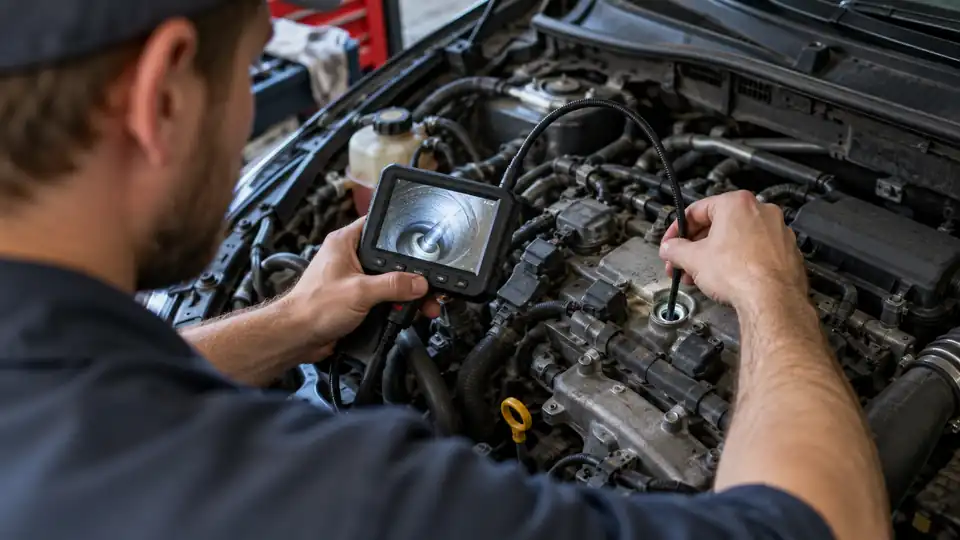
Looking inside an engine without removing major components calls for more than a camera and a long cable. The probe must fit through the available opening, hold a useful position, focus at close range, and illuminate oily or carbon-covered surfaces without washing out the image. A borescope with active tip control can be especially helpful around cylinder walls, valves, piston crowns, and other areas where a straight probe leaves the camera facing the wrong direction.
Probe diameter and maneuverability usually matter more than a headline resolution number. An 8 mm camera may work through some spark-plug openings, while a 6 mm or 6.2 mm probe offers more access in tighter spaces. A semi-rigid cable provides pushability, but it is different from a mechanically articulating tip. Dual-lens viewing can show forward and side perspectives, but it does not steer the camera. Buyers also need to decide whether they require recordings, an integrated screen, temperature protection, or a phone-based setup.
The products below range from compact articulating scopes to longer dual-lens inspection cameras. The comparison weighs engine access, tip control, viewing direction, lighting, close-focus information, recording, and practical handling so you can match the tool to the inspection rather than chase the largest specification on the box.
Quick Answer
Best Overall: The FOXWELL Y400 combines a 6.2 mm probe, 220-degree two-way articulation, an integrated display, zoom, storage, and overheat protection. It is the most balanced choice for detailed engine access among these options.
Best for Dual-View Inspection: The DXZtoz Dual Lens Articulating Borescope adds a side camera to active articulation, which can reduce repeated repositioning around cylinders and nearby angled surfaces.
Best for Tight Access: The Anykit 210° Articulating Borescope uses a listed 0.22-inch probe, a useful size for openings where a larger camera may struggle.
Best for Long Reach: The Teslong 5-inch Dual Lens Borescope pairs a 16.5-foot semi-rigid cable with front and side cameras for engine bays, ducts, and other deeper inspection paths.
Best Borescope for Engine Inspection Comparison Table
| Product | Best For | Probe / Cable | Viewing System |
|---|---|---|---|
| FOXWELL Y400 | Overall engine inspection | 6.2 mm, articulating | 220° tip control, 4.3-inch screen |
| DXZtoz Dual Lens Articulating | Forward and side views | 0.25 inch, 5 feet | 210° articulation, dual lens |
| Anykit 210° Articulating | Tight openings | 0.22 inch, 4 feet | 210° articulation, 4.3-inch screen |
| Teslong Articulating | Controlled short insertion | 5-foot semi-rigid gooseneck | Two-way articulation, 4.5-inch screen |
| Elitech Articulating | Temperature-aware inspections | 6 mm, 3 feet | 180° articulation, 4.3-inch screen |
| DXZtoz 220° Articulating | Close engine views | 8.5 mm, 5.5 feet | 220° articulation, 4.3-inch screen |
| 2-Way Articulating Auto Borescope | Recorded automotive inspections | 0.24 inch, 5.3 feet | 210° articulation, 4.3-inch screen |
| Teslong 5-inch Dual Lens | Long-reach viewing | 8 mm, 16.5 feet | Front and side cameras |
| Daxiongmao 1080P Borescope | Phone-free basic inspection | 8 mm, 16.5 feet | Fixed camera, 4.3-inch screen |
The detailed reviews explain how each camera handles access, orientation, lighting, documentation, and the compromises that matter around an engine.
1. FOXWELL Y400 — Best Overall

The Y400 makes a strong case for engine work because its listed 6.2 mm probe balances access with a control system meant for directional inspection. The 220-degree two-way articulation is operated with a thumb wheel, so the camera tip can be steered after insertion rather than relying entirely on twisting a cable. That distinction matters inside a cylinder or around a valve, where a small change in camera direction can reveal a surface that would otherwise remain hidden.
The integrated HD IPS display keeps the setup self-contained, while listed 2X and 4X zoom settings can help examine carbon buildup, gasket edges, or surface marks without moving the probe closer. Six adjustable LEDs with three brightness levels address dark cavities, and the product information lists IP67 protection for the probe along with overheat shutdown at 158°F. The stated 5 to 7 hour battery range and 32GB storage also make it suitable for documenting several inspections without a phone or app.
Pros
- 6.2 mm probe is suited to relatively tight engine access points.
- 220-degree two-way articulation provides direct tip control.
- Integrated screen works without Wi-Fi, pairing, or a phone.
- Listed zoom, adjustable lighting, and onboard storage support documentation.
- Overheat shutdown and probe protection add useful safeguards for inspection work.
Cons
- The 5 to 7 hour runtime is a published range rather than a guaranteed figure for every use.
- Two-way articulation does not provide full four-direction steering.
This is the most complete fit for someone who wants to inspect engine internals, save images or videos, and control the camera direction with one hand. The smaller probe and overheat feature give it an edge over larger fixed cameras, while the screen avoids phone compatibility concerns. Buyers who need very long reach or a side-facing camera may prefer another model, but for regular cylinder, valve, and spark-plug-area work, the Y400 offers the strongest overall mix.
To buy this product, click here.
2. DXZtoz Dual Lens Articulating Borescope — Best for Forward and Side Viewing

Some engine inspections require two different views in quick succession. A forward camera can examine the surface directly ahead, while a side camera can look across a cylinder wall or into an angled passage. This DXZtoz combines that dual-lens arrangement with a 0.25-inch probe and 210-degree articulation, giving it a useful combination of alternate viewing and directional control.
The listing describes a 5-foot probe, a 5-inch 1080P display, 10X zoom, seven LEDs, and a 32GB memory card for photos and videos with sound. Its thumb-stick control is intended to lock the tip at a chosen angle, and the front-exit cable design may be helpful when guiding the probe upward or forward. The side camera does not replace articulation, but together the two systems can reduce the amount of probe repositioning needed around engine cylinders and adjacent components.
Pros
- Combines a genuine side camera with 210-degree two-way articulation.
- 0.25-inch probe is relatively compact for engine access.
- 5-inch display gives a larger viewing area than many 4.3-inch units.
- Listed 10X zoom and 32GB storage support close inspection and records.
- Includes a front-exit cable design, carrying case, hook, and magnet according to the listing.
Cons
- The 0.25-inch probe is still larger than the 6 mm and 6.2 mm options in this guide.
- The product combines two viewing directions, but its articulation remains two-way rather than four-way.
This suits detailed work where a forward view alone leaves too many blind spots. The larger screen and dual-lens switching are especially useful for comparing a direct view with a side view, while the recording function can support before-and-after documentation. It is less appealing for the smallest openings, where the slimmer Anykit, Elitech, or FOXWELL probes offer more clearance.
To buy this product, click here.
3. Anykit 210° Two-Way Articulating Borescope — Best for Tight Access

The listed 0.22-inch probe is the headline reason to choose this Anykit. In engine work, a few millimeters can determine whether the camera passes through an opening at all. Once inside, its 210-degree two-way articulation and thumb slider give the user more control than a plain semi-rigid snake camera. A four-foot cable keeps the setup focused on short inspection paths rather than deep plumbing runs.
The 4.3-inch IPS screen operates without an app, and the listing includes 180-degree image flipping, three zoom levels, adjustable LED lighting, an 8GB TF card, and a 3000mAh battery with up to five hours of stated use. An overheat alarm can display a warning in high-temperature areas such as exhaust components. That feature is useful, but it does not mean the probe should be inserted into hot or moving machinery without following appropriate procedures and allowing equipment to cool as needed.
Pros
- 0.22-inch probe prioritizes access through narrow openings.
- 210-degree two-way articulation helps orient the camera after insertion.
- 180-degree image flip can correct an awkward viewing orientation.
- Includes an integrated screen, 8GB card, and adjustable lighting.
- Published overheat alarm adds information during warm-area inspections.
Cons
- The four-foot cable offers less reach than the longer cameras in this guide.
- The listing does not describe a dual-camera viewing system.
Choose this model when access is the first hurdle and the inspection will happen relatively close to the handle. It gives up cable length and the larger storage capacity of the FOXWELL, but the narrow probe may reach an opening those cameras cannot. For long engine bays, pipes, or wall cavities, a longer option will be easier to manage.
To buy this product, click here.
4. Teslong Articulating Borescope — Best for Controlled Short Insertion

A five-foot semi-rigid gooseneck is a practical middle ground for engine-bay inspections. It can be shaped before insertion and should hold enough form to reduce cable flop, while the central joystick gives two-way tip control. The 4.5-inch IPS display is larger than the compact screens used by some basic scopes, and the listing states that photos and videos can be captured from the handle.
This Teslong is aimed at situations where the camera needs to move around a tight path without relying on a phone. Adjustable probe lighting is useful around dark engine compartments, where reflective metal and oily surfaces can make a fixed brightness setting inconvenient. The supplied information does not identify a specific probe diameter, so buyers should verify the current listing before assuming it will fit a particular spark-plug opening.
Pros
- Two-way articulation provides more directional control than a fixed snake camera.
- Five-foot semi-rigid gooseneck offers manageable short-range reach.
- 4.5-inch IPS screen operates without an app.
- Adjustable probe LEDs help manage dark or reflective surfaces.
- Listing states that photos and videos can be captured.
Cons
- The supplied product information does not clearly identify the probe diameter.
- It offers two-way rather than four-way articulation.
This is a sensible choice for users who value a familiar integrated-screen workflow and a controllable probe for engine-bay access. Its unknown probe dimension is the main purchasing checkpoint. If the camera must pass through a specific small opening, confirm that measurement first. For broader access through an engine compartment, its gooseneck format should be easier to position than a loose flexible cable.
To buy this product, click here.
5. Elitech Articulating Borescope — Best for Temperature-Aware Inspection

The Elitech takes a compact approach with a listed 6 mm probe, 180-degree two-way steering, and a three-foot semi-rigid cable. That short reach can be an advantage around a bench or an exposed engine opening because there is less cable to coil and control. Its listed 15 to 100 mm focal range is also relevant to close inspection, where the camera may need to sit near a piston crown, valve, or cylinder surface.
A 90-degree field-of-view claim, adjustable LEDs, and a 4.3-inch 1080P IPS screen round out the viewing system. The product information lists a temperature sensor and automatic shutdown above 194°F. This provides a warning and a protective function for the tool, but it should not be interpreted as permission to inspect hot components casually. The probe is also listed as IP67 rated, which applies to the probe rather than automatically to the entire display and handle.
Pros
- 6 mm probe prioritizes access in narrow spaces.
- Listed 15 to 100 mm focal range suits close inspection.
- 180-degree two-way steering provides genuine tip control.
- Temperature display and shutdown are useful during warm-area work.
- Integrated 4.3-inch screen avoids phone or app dependence.
Cons
- Three-foot cable limits reach compared with longer inspection cameras.
- 180-degree articulation offers less directional range than several competing models.
The Elitech fits short, close engine inspections where probe diameter and temperature information matter more than reach. It is especially appealing for users who want a slim camera with a direct display and a documented focal range. For deep engine bays or tasks requiring extensive cable travel, the short probe will feel restrictive.
To buy this product, click here.
6. DXZtoz Two-Way Articulating Borescope — Best for Close Engine Views

The DXZtoz is built around a 220-degree steering system and a 5.5-foot gooseneck, making it a useful option for short insertion paths that require the camera to look back or around an obstruction. Its 8.5 mm probe is larger than the slim articulating models above, so the access point deserves careful checking before purchase. Once the probe fits, the control wheel can help place the camera more precisely than simply bending a cable.
The listing identifies a 2.0MP camera, 1 to 15 cm focal distance, eight LEDs with four brightness levels, 8X zoom, and a 4.3-inch IPS monitor. It also lists IP67 and oil resistance for the probe, along with a 3000mAh battery rated for four hours. A case, hook, magnet, and side mirror are included according to the product information. The mirror is an accessory for an alternate view, not a second camera or a replacement for active articulation.
Pros
- 220-degree steering gives useful two-way directional control.
- 1 to 15 cm focal distance is suited to close engine views.
- Eight LEDs and four brightness levels offer lighting adjustment.
- 5.5-foot gooseneck provides more reach than short probes.
- Integrated screen and supplied accessories support phone-free work.
Cons
- The 8.5 mm probe may not fit openings suited to slimmer cameras.
- The included side mirror is not a second camera.
This DXZtoz makes sense for larger access points and users who want a longer articulating probe without moving to a plumbing-length cable. Its close-focus information and lighting controls support detail work, while the larger probe limits where it can go. Confirm the opening size before choosing it for a cylinder or spark-plug inspection.
To buy this product, click here.
7. 2-Way Articulating Auto Borescope — Best for Recorded Automotive Inspections

This automotive-focused scope pairs a listed 0.24-inch probe with 210-degree articulation and a 5.3-foot cable. The arrangement should suit engine inspection paths that need moderate reach and controlled tip direction. A 4.3-inch IPS screen keeps operation independent of a phone, and the handle wheel is intended to let one hand manage the viewing unit while the other guides the cable.
The product information lists 1080P imaging, three LED brightness levels, a 32GB TF card, a 3000mAh battery with four hours of stated operation, and photo and video capture. It also identifies IP67 protection, oil resistance, and a high-temperature warning. Those features make it well suited to documenting findings, although the warning system should be treated as a tool-protection aid rather than a substitute for safe engine-handling procedures.
Pros
- 210-degree two-way articulation supports controlled engine viewing.
- 0.24-inch probe is smaller than the 8 mm and 8.5 mm options.
- Five-foot-plus cable offers useful moderate reach.
- 32GB storage and stated photo and video capture support records.
- Integrated screen requires no app.
Cons
- The listed four-hour battery life is shorter than the range stated for the FOXWELL Y400.
- It does not provide a second camera for side viewing.
Choose this model if documentation is part of the job and the inspection path needs more than a short probe. It gives up the Y400’s slimmer 6.2 mm access and longer stated runtime, but the included storage and automotive-oriented controls remain useful. A side-view camera may be preferable where nearby cylinder surfaces are difficult to face with a forward lens.
To buy this product, click here.
8. Teslong 5-inch Dual Lens Borescope — Best for Long Reach

A 16.5-foot semi-rigid cable changes the assignment for this Teslong. It can reach through an engine bay, duct, wall cavity, or extended pipe path where a five-foot articulating probe may fall short. The forward and side cameras switch on the handle, and each has its own LEDs according to the listing. That can help inspect a surface beside the probe without physically steering the tip.
The trade-off is the 8 mm probe and the absence of active articulation. The gooseneck holds its shape, which helps with pushing and positioning, but it cannot steer the camera tip like the FOXWELL, Anykit, or DXZtoz models. A 5-inch IPS display, 5000mAh battery with approximately 4.5 hours of stated use, adjustable lighting, and a hard case make it a practical long-reach inspection system.
Pros
- 16.5-foot semi-rigid cable provides substantial reach.
- Forward and side cameras offer two genuine viewing directions.
- 5-inch IPS screen operates without a phone or Wi-Fi.
- 5000mAh battery is listed with approximately 4.5 hours of use.
- Includes a hard case, hook, magnet, and mirror according to the listing.
Cons
- The 8 mm probe is larger than the slim articulating options.
- It has dual-lens viewing but no active tip articulation.
This is the right kind of tool for reach-first inspections, such as following a cable into a large engine bay or investigating a hard-to-access cavity. It is less suitable when the camera must pass through a particularly narrow opening or turn sharply after insertion. Buyers should view dual-lens switching as a different solution from articulation, with each feature solving a separate access problem.
To buy this product, click here.
9. Daxiongmao 1080P Borescope — Best for Phone-Free Basic Inspection

The Daxiongmao keeps the workflow straightforward: switch on the 4.3-inch color display, guide the 16.5-foot semi-rigid cable, and adjust the eight LEDs as needed. The listing specifically identifies an 8 mm probe that can pass through a spark-plug hole for combustion-chamber inspection. That makes the camera relevant to basic engine checks, provided the opening and vehicle access are suitable.
It is a fixed-camera system rather than an articulating one, so the cable must be shaped and rotated to change the view. The listed observation distance is 1.5 to 5 inches, which is useful context for close work. IP67 protection is identified for the probe, and the package includes a hook, magnet, and side mirror. The product does not record photos or videos, so it is best for live viewing rather than creating an inspection report.
Pros
- 16.5-foot semi-rigid cable provides long reach.
- Integrated 4.3-inch screen avoids phone and app requirements.
- Eight adjustable LEDs support dark engine cavities.
- Listing identifies an 8 mm probe for spark-plug-hole access.
- Includes hook, magnet, and side mirror accessories.
Cons
- The camera does not capture photos or videos according to the listing.
- It has no active articulation and uses a relatively large 8 mm probe.
This is a practical live-view tool for someone who wants to look inside an engine without pairing a phone or managing an app. Its length is useful, but its fixed tip and 8 mm diameter limit maneuverability compared with the leading articulating models. Choose it for basic visual checks and reach, not for detailed documentation or precise tip steering.
To buy this product, click here.
Buying Guide
Probe Diameter Determines Where the Camera Can Fit
Engine access points vary, and the listed diameter should be checked against the opening before ordering. The FOXWELL’s 6.2 mm probe and Elitech’s 6 mm probe offer more clearance than the 8 mm Daxiongmao or Teslong fixed camera. A smaller probe can reach a narrower passage, but it does not automatically provide better image quality, lighting, or cable control.
Active Articulation Is Different From a Semi-Rigid Cable
A semi-rigid cable can bend and hold a general shape, but active articulation changes the direction of the camera tip after insertion. That is why the FOXWELL, Anykit, Elitech, and DXZtoz articulating models are more suitable for looking around a cylinder or valve. A fixed camera can still work well when the access path is straight and the inspection does not require precise orientation.
Choose Viewing Direction for the Surface You Need to See
A forward camera faces the area directly ahead. A side camera can inspect a nearby wall or angled surface without requiring the entire probe to be repositioned. The Teslong dual-lens model and DXZtoz dual-lens model provide that second view. Dual-lens switching does not steer the camera, so it should be evaluated separately from articulation.
Working Distance Matters More Than Resolution Alone
Engine surfaces can look soft or overly bright if the camera is too close, too far away, or poorly illuminated. The DXZtoz lists a 1 to 15 cm focal distance, the Elitech lists 15 to 100 mm, and the Daxiongmao lists a 1.5 to 5 inch observation distance. These details can be more useful than comparing broad HD or 1080P labels without knowing the lens behavior.
Longer Cables Add Reach and Cable Management
A 16.5-foot cable can reach deep into a cavity, but extra length also creates more cable to coil and guide. A three-foot or four-foot probe is easier to control around a close work area. Match length to the inspection path. Reach is helpful only when the camera can still be positioned accurately at the far end.
Check Whether Recording Is Included
The Y400, DXZtoz dual-lens model, and automotive articulating model list storage or image and video capture. The Daxiongmao and the dual-lens inspection camera reviewed in the source information do not record photos or videos. If the inspection needs to be shared with a customer or retained for later comparison, confirm that recording and storage are part of the exact product configuration.
Read IP and Temperature Claims Narrowly
An IP67 claim in these listings applies to the probe or camera portion, not automatically to the screen, handle, connector, or phone. Temperature warnings and shutdown systems can help protect the tool, but they do not make an engine safe to inspect while hot or moving. Follow the vehicle and equipment safety procedure before inserting any camera.
Best Borescope for Engine Inspection FAQ
What Probe Diameter Is Best for Engine Inspection?
There is no single ideal diameter. A 6 mm or 6.2 mm probe offers more access than an 8 mm probe, which can matter through tight openings. Larger cameras may provide different handling or viewing features, so match the diameter to the specific access point rather than choosing the smallest option automatically.
Is an Articulating Borescope Better Than a Fixed Camera?
It is usually more useful when the camera must change direction after insertion. A fixed camera can be adequate for a straight path or a broad engine compartment. Articulation adds control, but it does not solve every access problem, especially if the probe itself is too large for the opening.
Can These Borescopes Inspect a Running Engine?
The supplied product information does not establish that these cameras are suitable for inspection around moving engine parts. A temperature warning or heat protection feature is not permission to work around moving components. Shut down equipment and follow appropriate cooling and handling procedures before inspection.
Do Dual-Lens Borescopes Replace Articulation?
No. A dual-lens model switches between separate forward and side cameras, while an articulating model physically changes the direction of the distal camera tip. A dual-lens camera can reduce repositioning for nearby side surfaces, but it does not provide the same steering control.
Do Integrated-Screen Borescopes Need a Phone?
The integrated-screen models in this guide are described as operating without an app, Wi-Fi, or phone. That removes many compatibility concerns. It does not guarantee that every model records images or video, so check the product’s capture and storage features separately.
Is IP67 Suitable for Any Engine Fluid?
No. IP67 is a defined protection claim for the rated component under specified test conditions, and it should not be treated as unlimited protection from fuel, solvents, oil, heat, or every other fluid. The product information should be checked for the exact component and environment covered.
Final Verdict
The FOXWELL Y400 is the strongest overall choice for engine inspection because it combines a relatively slim 6.2 mm probe with 220-degree two-way articulation, an integrated display, adjustable lighting, zoom, storage, and listed overheat protection. That combination addresses the main challenges of engine work: reaching the opening, facing the surface, seeing close detail, and saving useful evidence.
The Anykit is a strong alternative for especially tight access, while the DXZtoz dual-lens articulating model is better suited to inspections that benefit from both forward and side views. For long paths, the Teslong 5-inch dual-lens camera provides substantially more reach, though its 8 mm fixed probe gives up the directional control of the articulating models. Before ordering, measure the access point, decide whether recordings matter, and choose cable length based on the inspection path rather than the largest number in the listing.
