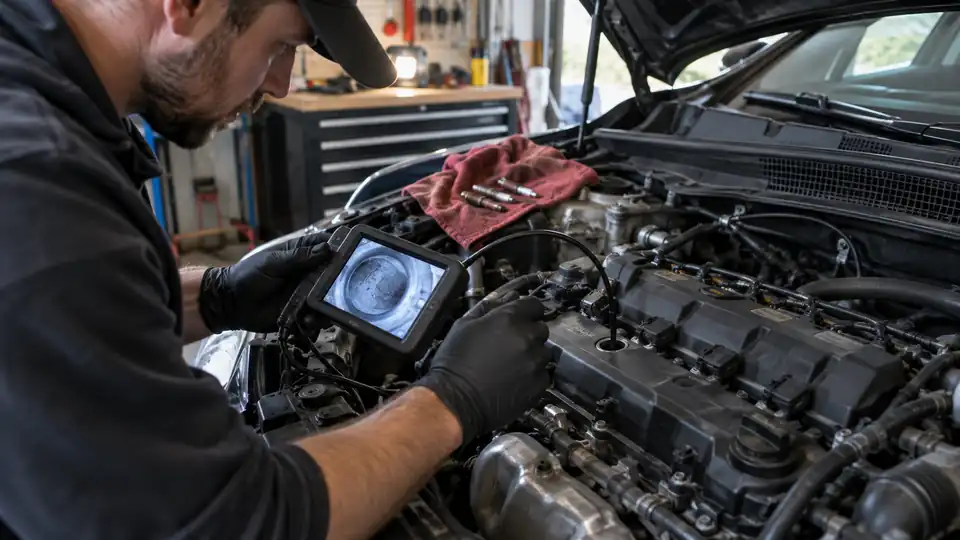
A spark plug hole is a narrow doorway into a much larger problem. Through it, a borescope may reveal cylinder-wall scoring, piston damage, carbon buildup, valve trouble, or broken ceramic before the cylinder head comes apart. The right choice depends on more than image quality. Probe diameter, tip control, lighting, viewing direction, screen independence, and the ability to document what you see all affect whether the camera is genuinely useful inside an engine.
A slim probe can fit an opening that defeats a bulkier camera, but a narrow cable may be harder to guide. Active articulation helps aim around a piston or valve, while a dual-lens design can provide a side view without physically steering the tip. Those are different features. Buyers should also check whether the advertised waterproofing applies to the probe only, whether storage is included, and whether the product is intended for inspection alone or for retrieving debris.
The products below range from compact articulating borescopes to a specialized spark plug debris retrieval system. The comparison emphasizes access through tight openings, control inside the cylinder, viewing flexibility, and practical automotive use rather than headline claims alone.
Quick Answer
Best Overall: The Teslong 5.5mm Slim Probe Two-Way Articulating Borescope offers a strong balance for spark plug hole inspections. Its 5.5 mm probe, joystick-controlled 180-degree tip, integrated 5-inch display, adjustable lighting, and included SD card create a self-contained inspection setup.
Best for More Tip Control: The FOXWELL Y400 provides a 6.2 mm probe with 220-degree two-way articulation, a thumb-wheel control, 4X zoom, onboard storage, and a stated IP67 rating for the probe.
Best for Forward and Side Viewing: The FOXWELL Y406D Dual Lens Borescope adds front and side cameras, which can reduce the need to reposition the probe while looking at cylinder walls, valves, and nearby surfaces.
Best for Broken Spark Plug Debris: The Cylinder Rescue Spark Plug Debris Extraction Kit is specialized for locating and retrieving loose ceramic, porcelain, carbon, dirt, and compatible metal fragments through the spark plug opening.
Best Borescope for Spark Plug Holes Comparison Table
| Product | Best For | Probe or Reach | Viewing System |
|---|---|---|---|
| Teslong 5.5mm Slim Probe Two-Way Articulating Borescope | Overall engine inspection | 5.5 mm, 5-foot cable | 180° articulation, 5-inch screen |
| FOXWELL Y400 220° 2-Way Articulating Borescope | Controlled tip direction | 6.2 mm ultra-slim probe | 220° articulation, 4X zoom |
| FOXWELL Dual Lens 2-Way Articulating Borescope | Forward and side views | 6.5 mm ultra-slim probe | 220° articulation, dual cameras |
| Broescope Re-7A Inspection Camera Endoscope | Very narrow access | 3.9 mm, 1.2 m insertion tube | Compact camera, flexible tube |
| Cylinder Rescue Spark Plug Debris Extraction Kit | Debris inspection and retrieval | Flexible retrieval probe | Live-view camera with LED lighting |
| Teslong TD500 3.9mm Articulating Borescope | A 3.9mm Head for Tight Plug Access | 3.9 mm camera; two-way articulation; Slim articulating inspection probe | 5-inch IPS display; integrated lighting |
| DXZtoz AGC900D Dual-Lens Articulating Borescope | Combined Side Viewing and Articulation | Approximately 6.35 mm dual-lens probe; Semi-rigid articulated probe | 5-inch screen; front/side/split views |
| Teslong 4.5-Inch Articulating Borescope | A Compact Standalone Steering Setup | Two-way articulating camera; 5 ft semi-rigid cable | 4.5-inch IPS screen; adjustable LEDs |
| DEPSTECH DS300 Dual-Lens Inspection Camera | Saved Front-and-Side Cylinder Views | Dual-lens probe; 16.5 ft semi-rigid cable | 4.3-inch IPS screen; front/side views |
The detailed reviews explain how each system handles access, camera control, lighting, documentation, and the particular problems that can arise inside a cylinder.
1. Teslong 5.5mm Slim Probe Two-Way Articulating Borescope — Best Overall

The Teslong brings together the features that matter most during a spark plug hole inspection without forcing the operator to rely on a phone. Its 5.5 mm probe is slim enough for tight automotive access, and the listing specifically identifies spark plug holes, injector ports, and valve seats as intended inspection areas. That diameter does not guarantee compatibility with every engine, so the opening should still be checked before purchase, but it gives this model a useful access advantage over thicker inspection cameras.
Once inside, the joystick-controlled tip provides 180 degrees of two-way articulation. That matters when a straight-ahead view leaves the piston edge or cylinder wall hidden in shadow. The integrated 5-inch IPS display shows a 1280×720 image, while 1.3X and 1.5X digital magnification can bring carbon deposits or wear patterns closer without pulling the probe back. Six adjustable LEDs help with dark cavities, and the 3,000mAh battery, USB-C charging, storage case, and included SD card make the kit easy to keep ready for repeated inspections.
Pros
- 5.5 mm slim probe is specified for spark plug holes, injector ports, and valve seats.
- Joystick-controlled tip provides 180-degree two-way articulation.
- Integrated 5-inch IPS display works without a phone, Wi-Fi connection, or app.
- Six adjustable LEDs and two digital magnification levels support dark-cylinder inspection.
- Includes a 5-foot probe cable, SD card, USB charging cable, and hard storage case.
Cons
- Two-way articulation does not provide the same directional freedom as a four-way tip.
- The product description does not identify the probe’s focus range or camera field of view.
This is the most balanced choice for someone who wants to inspect cylinder walls, piston tops, valves, and carbon deposits with a self-contained tool. The screen avoids the uncertainty of phone compatibility, while the joystick offers more control than a simple flexible cable. A buyer who needs a side-facing camera, a much smaller 3.9 mm probe, or a tool for physically removing debris may be better served elsewhere, but for routine spark plug hole viewing, the Teslong combines access and control in a practical way.
To buy this product, click here.
2. FOXWELL Y400 220° 2-Way Articulating Borescope — Best for Controlled Tip Direction

The Y400 is aimed at inspections where the probe needs to be directed deliberately rather than simply pushed into place. Its 6.2 mm probe remains compact for spark plug holes, and the thumb-wheel control is intended to steer the tip through 220 degrees. That added articulation range can help when the camera needs to look along a cylinder wall or toward a valve seat, although two-way movement still means the tip does not steer freely in every direction.
Its integrated HD IPS screen keeps the inspection independent from a phone or app. The listing also identifies 2X and 4X zoom, six adjustable LEDs with three brightness levels, and onboard 32GB storage for photos and video. Those features are useful when a carbon mark needs to be documented rather than merely observed. The probe is described as IP67 waterproof, dustproof, and oil-resistant, while overheat protection is stated to shut the unit down at 70°C. That rating applies to the probe claim presented in the listing, so it should not be treated as protection for the complete display and handle.
Pros
- 6.2 mm probe is identified for spark plug holes and other narrow inspection openings.
- 220-degree two-way articulation gives the tip a broad steering range.
- Built-in screen, 4X zoom, and adjustable LEDs support phone-free inspection.
- 32GB onboard storage is listed for capturing photos and videos.
- Product information lists probe protection against water, dust, and oil, plus overheat protection.
Cons
- The 6.2 mm probe is larger than the Teslong and much larger than the Re-7A.
- The listing does not clearly identify the probe’s focus range or exact recording resolution.
The Y400 suits inspections where tip steering and documentation matter more than having the narrowest possible probe. The textured grip and thumb-wheel layout may be useful when one hand must guide the insertion tube while the other changes the view. Choose another model if the engine has an unusually tight opening or if a side camera would be more useful than two-way steering. For standard access with a need to save evidence, this is a capable alternative to the Teslong.
To buy this product, click here.
3. FOXWELL Dual Lens 2-Way Articulating Borescope — Best for Forward and Side Viewing

The Y406D takes a different approach to visibility inside a cylinder. Its 6.5 mm probe combines 220-degree two-way articulation with front and side cameras, allowing the operator to switch viewing directions at the probe. A side camera can be useful when a straight-ahead lens is aimed at a piston crown but the real concern is a nearby cylinder wall. It does not replace tip articulation, though. The two systems solve separate problems, and this model includes both.
The integrated IPS display, adjustable LED illumination, 2X and 4X zoom, and stated 32GB storage create a documentation-friendly setup. The product information lists one-touch photo and video capture, USB-C charging and file transfer, and an IP67 protection claim for the inspection camera. A CMOS sensor and large-aperture lens are also described, but the product description does not provide a directly comparable sensor resolution or focus range. Buyers should therefore judge this model primarily by its dual-view layout and steering system rather than assume that marketing terms alone guarantee a sharper image.
Pros
- Combines a front camera and side camera in one 6.5 mm probe.
- 220-degree two-way articulation helps aim the tip around internal components.
- 2X and 4X zoom can enlarge areas without moving the probe.
- Integrated screen and 32GB storage support photo and video documentation.
- USB-C charging and file transfer are listed, with adjustable LED lighting for dark spaces.
Cons
- The 6.5 mm probe is larger than the Teslong and may not suit the tightest spark plug openings.
- Dual-lens viewing adds capability but does not provide four-way mechanical steering.
This is a strong fit for inspections where the operator frequently needs to alternate between the piston area and the cylinder wall. It can reduce the repeated push, pull, and twist routine that comes with a single forward-facing camera. The Y406D makes less sense if the primary challenge is fitting through a very small opening, or if the inspection only requires a straightforward view. In those situations, a slimmer probe may matter more than the second camera.
To buy this product, click here.
4. Broescope Re-7A Inspection Camera Endoscope 3.9mm 1.2M — Best for Very Narrow Access

Some spark plug openings leave very little room for a camera head. The Re-7A addresses that access problem with a listed 3.9 mm probe, considerably narrower than the other general-purpose options here. The product information specifically identifies fuel injectors, spark plug holes, thin pipes, engines, and cavities as intended uses. That makes its physical size the central reason to choose it, especially when a 5.5 mm or 6.5 mm probe may be too large for the opening.
The 1.2-meter insertion tube provides more reach than the five-foot cable listed with the Teslong, although reach and maneuverability are separate concerns. A long flexible tube can enter deeper areas, yet the product description does not identify active articulation, a joystick, a side camera, a display specification, recording functions, or probe protection rating. Those omissions matter for buyers who need precise tip positioning or saved inspection evidence. The Re-7A is best understood as a narrow-access inspection camera rather than a feature-rich articulating system.
Pros
- 3.9 mm probe is the narrowest listed camera option in this comparison.
- Product information specifically identifies spark plug holes and fuel injector inspection.
- 1.2-meter insertion tube provides useful reach inside engines, ducts, and piping.
- Flexible tube can maneuver around bends and behind components.
- Suitable applications include engines, pipes, HVAC systems, wall cavities, and machinery.
Cons
- The available product information does not identify active tip articulation or a steering control.
- Screen, recording capability, lighting controls, and environmental protection are not clearly specified.
Choose the Re-7A when access is the problem you need to solve first. A 3.9 mm probe can open inspection paths that larger cameras cannot reach, and the 1.2-meter tube can extend farther into a cavity. It is a weaker fit for work that depends on controlled viewing direction, saved photos, or clearly documented screen features. Before ordering, confirm the complete display and recording arrangement in the current listing, especially if inspection images must be shared with someone else.
To buy this product, click here.
5. Cylinder Rescue Spark Plug Debris Extraction Kit — Best for Debris Retrieval

A conventional borescope can show that a piece of broken porcelain is sitting inside a cylinder, but seeing the fragment is only half the job. Cylinder Rescue is built around that specific situation. The kit combines a live-view camera and LED illumination with a vacuum extraction probe, flexible claw, expandable catch basket, magnetic retrieval tip, and spark plug adapters. The transparent collection chamber lets the operator see material that has been recovered, which is useful when checking whether loose debris has actually left the cylinder.
The kit is also intended for inspection before and after extraction. Its guides are described as accommodating common spark plug opening sizes, while the flexible probe is intended to reach around the piston or into difficult positions. The magnetic attachment is for compatible ferrous fragments, so it should not be expected to collect ceramic or porcelain. Likewise, the claw and catch basket are mechanical retrieval tools, not substitutes for careful inspection. This is a specialized solution rather than a general-purpose articulating borescope, but its camera-guided retrieval function directly addresses a problem ordinary inspection cameras do not solve by themselves.
Pros
- Combines camera-guided inspection with vacuum-assisted debris extraction.
- Includes a flexible claw and expandable catch basket for non-magnetic fragments.
- Magnetic retrieval attachment can address compatible ferrous metal debris.
- Multiple spark plug guides are listed for common opening sizes.
- Supports inspection before extraction and a follow-up check afterward.
Cons
- It is specialized for spark plug debris retrieval rather than broad engine inspection.
- The product description does not identify the camera probe diameter, display size, or image resolution.
This kit makes the most sense after a broken spark plug, damaged ceramic insulator, or loose fragment has created a retrieval problem. It offers a more complete response than a camera alone because the operator can locate material and attempt removal through the same general access point. Buyers seeking routine cylinder-wall imaging, valve inspection, or documentation across many inspection tasks may prefer the Teslong or FOXWELL units. Use the retrieval attachments carefully and follow appropriate engine service procedures rather than treating the camera as proof that every fragment is accessible.
To buy this product, click here.
6. Teslong TD500 3.9mm Articulating Borescope — Best for A 3.9mm Head for Tight Plug Access

The Teslong TD500 uses a 3.9 mm camera head, making it a useful alternative where a standard 8 mm inspection probe cannot enter. Two-way articulation changes the viewing direction beyond the opening, and a 5-inch IPS display provides an independent working image.
This TD500 is an alternative when a particularly restrictive opening defeats a larger camera. Its thin head and two-way aiming control address entry and viewing direction separately; check the route and allow room for the bending section beyond the opening.
The small diameter addresses entry clearance, while steering addresses what the camera can see once inside. That distinction matters when the target lies beside the insertion path rather than directly in front of it. The kit includes an installed 32GB microSD card, charging/data cable, carrying case, and built-in wireless sharing for viewing with a colleague. The thin probe should still be guided gently and used only where the bending section has room to move. This is a precision-access choice rather than a reason to force a camera through a restriction; measure the opening and choose an inspection route that leaves clearance for both insertion and withdrawal.
Pros
- 3.9 mm head fits narrower openings than common 8 mm probes.
- Two-way articulation redirects the camera beyond the entry point.
- 5-inch screen and included storage support independent recording.
Cons
- The bending section needs clearance even when the head fits.
- Two-way movement is more limited than four-way articulation.
Choose this configuration for a 3.9mm Head for Tight Plug Access.
To buy this product, click here.
7. DXZtoz AGC900D Dual-Lens Articulating Borescope — Best for Combined Side Viewing and Articulation

The DXZtoz AGC900D combines two useful ways to change an inspection view: a two-way articulating head and a separate side camera. The approximately quarter-inch probe feeds a 5-inch screen, with forward, side, and combined viewing modes.
A spark-plug opening may admit the probe while leaving the forward camera aimed away from a nearby valve or wall. The DXZtoz adds both a side lens and physical steering, giving two ways to inspect the adjacent area once the head is inside.
A side camera can examine a nearby wall while the tip remains straight, whereas articulation physically aims the head toward a different part of the cavity. Having both controls is useful when one angle shows the location of a feature and another shows its surface more clearly. The camera control can hold an angle, and the screen bracket helps organize the display during a stationary check. Keep the probe straight when passing a restrictive opening, then steer it only where there is sufficient room. The larger display and dual viewing system make this more substantial to carry than a simple phone-connected cable, but they provide a convenient independent working arrangement.
Pros
- Articulating head and side camera offer different viewing options.
- 5-inch display supports front, side, and combined views.
- Angle holding and a screen bracket help steady inspections.
Cons
- Quarter-inch head still requires adequate access clearance.
- More equipment to carry than a basic phone-connected camera.
Choose this configuration for combined Side Viewing and Articulation.
To buy this product, click here.
8. Teslong 4.5-Inch Articulating Borescope — Best for A Compact Standalone Steering Setup

The Teslong articulating borescope uses a centrally positioned joystick to redirect the camera after insertion. Its 4.5-inch IPS display, adjustable probe lighting, and 5-foot semi-rigid cable create a compact inspection setup that does not need a phone or an app.
The compact Teslong is useful for short, controlled inspections where the available opening accepts its head. A central joystick and independent screen simplify handling around an engine bay without adding a phone connection.
The important advantage is control near the end of the probe. A fixed cable can point toward an empty space while the feature you need to examine sits behind or beside it; two-way articulation lets you change that angle without withdrawing the whole cable. A rear capture button supports saving inspection images and video. The shorter cable is easier to organize during nearby work, although it cannot replace a long pipe camera. Two-way movement also differs from a four-way joystick: the operator may still need to rotate the cable to align the steering plane with the target.
Pros
- Joystick-controlled camera direction after insertion.
- Compact built-in screen avoids phone compatibility problems.
- Five-foot cable is manageable for nearby inspections.
Cons
- Shorter reach than 16-foot or reel-based cameras.
- Two-way steering does not provide independent four-way movement.
Choose this configuration for a Compact Standalone Steering Setup.
To buy this product, click here.
9. DEPSTECH DS300 Dual-Lens Inspection Camera — Best for Saved Front-and-Side Cylinder Views
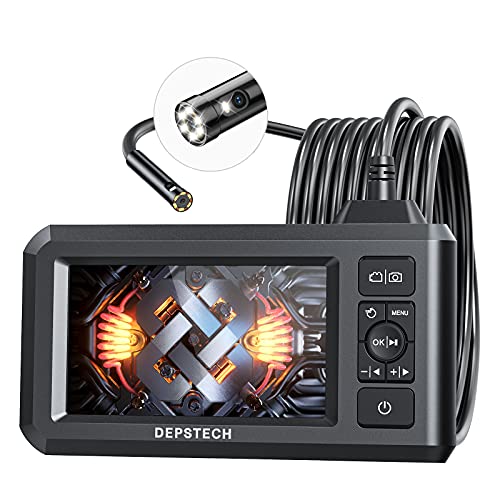
The DEPSTECH DS300 combines a 16.5-foot semi-rigid cable with a 4.3-inch IPS display and separate forward and side cameras. A button changes the viewing mode, including a split-screen option, so the operator can inspect a nearby surface without fitting a mirror to the tip.
Choose the DS300 when the opening and access angle accept a fixed dual-camera assembly. Its recording function is useful for retaining a visible finding, while an articulating model remains preferable when the camera must actively look back toward the entry point.
Its recording functions make it useful when a finding needs to be reviewed after the probe comes out. The front camera focuses at roughly 3–8 cm and the side camera at 2–6 cm, so positioning matters more than digital magnification when examining a nearby surface. Adjustable LEDs help control glare. The camera assembly is positionable, but the DS300 does not mechanically steer its tip; plan the route with the cable before insertion. Add a compatible microSD card if you intend to save photos or video, because this package does not include one.
Pros
- Forward, side, and split-screen viewing modes.
- Built-in screen and 16.5-foot cable suit independent inspections.
- Photo and video capture support repeat checks and documentation.
Cons
- No mechanical tip articulation.
- A microSD card must be supplied separately for recording.
Choose this configuration for saved Front-and-Side Cylinder Views.
To buy this product, click here.
Buying Guide
Probe Diameter Determines Whether the Camera Can Enter
For spark plug hole inspections, probe diameter is often the first specification to check. The Re-7A lists a 3.9 mm probe, the Teslong lists 5.5 mm, and the FOXWELL models list 6.2 mm and 6.5 mm. A smaller probe may fit openings that reject a larger camera, but diameter alone does not tell you how easy the camera will be to guide or how clearly it will show a surface. Check the vehicle or engine access dimensions before ordering, and do not assume that every spark plug hole has the same clearance.
Active Articulation Helps Aim Around Internal Parts
A straight camera may show the piston but leave the cylinder wall or valve area outside the frame. Active two-way articulation lets the distal tip bend under control, as seen on the Teslong and FOXWELL models. The Teslong lists 180 degrees, while the Y400 and Y406D list 220 degrees. These are two-way systems, so the tip should not be treated as a four-direction articulating probe. A flexible cable that bends during insertion is also not the same as a mechanically controlled tip.
Dual-Lens Viewing and Articulation Solve Different Problems
The Y406D uses front and side cameras, which can provide a second viewing direction without physically turning the entire probe. That can be handy beside a cylinder wall or valve seat. It still differs from articulation. A side camera does not steer the probe, and an articulating tip does not automatically provide a side-facing lens. Decide whether your inspection problem is poor camera direction, limited tip control, or both.
Integrated Screens Avoid Phone Compatibility Questions
The Teslong and FOXWELL units use built-in displays, so there is no need to pair a phone or install an app. That removes one possible failure point during a vehicle inspection. A screen does not automatically mean that every product records photos or video, so check the storage and capture details separately. The Re-7A listing supplied here does not clearly specify its display or recording features, which makes that part of the purchase worth confirming.
Lighting and Focus Matter Inside a Cylinder
Combustion chambers can contain dark carbon deposits, reflective metal, and tight surfaces that produce glare. Adjustable LEDs can help, but more lights do not automatically guarantee a better image. Focus range, lens position, working distance, display quality, and camera stability also shape what can be seen. The Teslong lists six adjustable LEDs and modest magnification, while both FOXWELL models list adjustable lighting and zoom. The product description does not give comparable focus ranges, so avoid treating zoom claims as a substitute for close-focus performance.
Separate Inspection From Retrieval
A normal borescope helps you see inside the cylinder. Cylinder Rescue adds tools for attempting to remove accessible debris. Those are different jobs. If the concern is a scored wall, carbon buildup, valve condition, or piston damage, an articulating camera may be the more useful everyday tool. If a broken plug has dropped ceramic or metal fragments into the chamber, a camera-guided retrieval kit addresses a more specific need. Either way, confirm that the engine is in a safe condition for inspection and follow the relevant service procedure.
Best Borescope for Spark Plug Holes FAQ
What probe size is best for a spark plug hole?
The correct size depends on the engine and the opening, so there is no universal answer. A 3.9 mm probe offers more access margin than a 5.5 mm or 6.5 mm probe, while a larger probe may have a more useful camera layout or easier cable handling. Measure the relevant access path when possible and check the product’s stated probe dimension before purchase.
Can a borescope show cylinder-wall scoring?
It may help reveal visible marks, scratches, discoloration, and deposits on accessible cylinder surfaces. The result depends on the camera’s position, lighting, focus, and viewing angle. A digital zoom feature can enlarge the display, but it does not create detail that the lens did not capture.
Is two-way articulation enough for engine inspection?
Two-way articulation can be useful for directing the tip toward a cylinder wall, valve seat, or piston edge. It gives less freedom than four-way articulation because the tip bends along one control axis. A dual-lens camera may supplement two-way movement by providing a side view, but it is not the same as four-direction steering.
Does an IP67 probe mean the entire borescope is waterproof?
No. An IP rating may apply to the probe or camera section rather than the display, handle, charging port, or complete system. The FOXWELL listings describe protection for the inspection probe. Keep the control unit and connectors away from fluids unless the product information specifically covers those parts.
Can a borescope retrieve broken spark plug porcelain?
A standard borescope is primarily an inspection tool and may not include a retrieval mechanism. Cylinder Rescue lists a flexible claw, expandable catch basket, vacuum extraction probe, and camera-guided operation for loose ceramic and porcelain fragments. Retrieval depends on the fragment’s position, size, and accessibility, so the presence of an attachment does not guarantee that every piece can be removed.
Is a built-in screen better than a phone-connected camera?
A built-in screen simplifies setup and avoids app, operating-system, connector, and phone-battery concerns. It may also be easier to use while working around a vehicle. Phone-connected systems can offer convenient sharing when compatibility is confirmed, but the products reviewed here with integrated screens provide a more self-contained workflow.
Final Verdict
Additional options: Teslong TD500 3.9mm Articulating Borescope suits a 3.9mm Head for Tight Plug Access; DXZtoz AGC900D Dual-Lens Articulating Borescope suits combined Side Viewing and Articulation; Teslong 4.5-Inch Articulating Borescope suits a Compact Standalone Steering Setup; DEPSTECH DS300 Dual-Lens Inspection Camera suits saved Front-and-Side Cylinder Views. Choose the configuration that fits the access route and your recording needs.
The Teslong 5.5mm Slim Probe Two-Way Articulating Borescope is the strongest overall choice for general spark plug hole inspection. Its slim probe, joystick-controlled tip, integrated screen, adjustable lighting, magnification, battery, storage case, and included SD card cover the main tasks involved in viewing cylinder walls, piston surfaces, valves, and carbon deposits. It offers a more complete everyday inspection setup than a narrow fixed camera, while remaining less specialized than a debris retrieval kit.
The FOXWELL Y400 is a strong alternative for buyers who place extra emphasis on tip control, zoom, storage, and stated probe protection. The Y406D is the better fit when switching between forward and side views can save repeated repositioning. The Re-7A deserves attention where a very narrow 3.9 mm probe is the deciding factor, while Cylinder Rescue is the specialized choice for locating and attempting to remove loose spark plug debris. Match the camera to the opening, the viewing direction, and the actual repair task, then confirm the current listing details for any specification that affects fit.
