
A dual-lens borescope earns its place when a forward-facing camera leaves too much unseen. A front lens helps follow the path into an engine, wall cavity, duct, or pipe, while a side lens can inspect a nearby surface without repeatedly twisting the probe. The useful comparison is therefore about more than advertised resolution. Camera arrangement, probe control, focal range, lighting, cable length, display type, and recording options all affect what you can actually see.
Dual-lens viewing should also be separated from active articulation. A side camera gives another viewing direction, but it does not automatically steer the tip. A semi-rigid cable can hold a curve, yet it does not provide the controlled movement of an articulating probe. Phone-connected models may capture convenient photos and video, while integrated-screen units avoid app setup and keep a work phone out of a damp or greasy inspection area.
The products below cover several useful approaches, from compact screen-based cameras to articulating systems with a second lens. They differ in reach, control, documentation, and device dependence, so the strongest choice for an engine inspection may not be the best fit for a drain, HVAC duct, or wall cavity.
Quick Answer
Best Overall: The DXZtoz Dual Lens Articulating Borescope combines genuine dual-lens viewing with two-way articulation, a slim 0.25-inch probe, a 5-inch screen, recording, and included storage.
Best for Long-Reach Screen Viewing: The Teslong 5-inch Dual Lens Borescope offers a 16.5-foot semi-rigid cable and a self-contained display for walls, engines, ducts, drains, and other extended inspections.
Best Phone-Connected Option: The DEPSTECH 2K Endoscope Camera uses front and side cameras, a 7.9 mm probe, a 16.5-foot cable, and both Type-C and Lightning adapters, though it requires the DEPSTECHCAM app.
Best Dual Lens Borescope Comparison Table
| Product | Best For | Viewing System | Probe or Cable |
|---|---|---|---|
| DXZtoz Dual Lens Articulating Borescope | Controlled engine and machinery inspection | Front and side lens, two-way articulation | 0.25-inch probe, 5 feet |
| Teslong 5-inch Dual Lens Borescope | Long-reach screen-based inspection | Forward and side cameras | 8 mm, 16.5 feet |
| Teslong Articulating Borescope With Dual Lens | Compact controlled viewing | Front and side cameras, two-way articulation | 5-foot semi-rigid gooseneck |
| DEPSTECH 2K Endoscope Camera | Phone-based photo and video | Front and side cameras | 7.9 mm, 16.5 feet |
| DEPSTECH DS300 Endoscope Camera | Integrated-screen versatility | Dual lens and three viewing modes | 16.5-foot semi-rigid cable |
| Ginocaco Dual Lens Borescope | Phone-free general inspection | Front and side cameras | 16-foot semi-rigid cable |
| Daxiongmao Dual-Lens Borescope | Engine and household inspection | Dual lens with integrated screen | 8 mm, 16.4 feet |
| Acoath Dual-Lens Endoscope Camera | Phone-connected field work | Front and side cameras | 7.9 mm, 16.4 feet |
| Elecshion Dual-Lens Endoscope Camera | Phone-based plumbing and home checks | Dual lens with 360-degree rotation claim | 8 mm, 16.5 feet |
The detailed reviews explain how each viewing system, probe design, and connection method changes the inspection experience.
1. DXZtoz Dual Lens Articulating Borescope — Best Overall

The DXZtoz stands apart because it combines two genuinely useful forms of control. Its dual-lens system provides front and side views, while the listing describes two-way articulation with a 210-degree range. That distinction matters in a tight engine cavity. A side camera can show a nearby wall or component, but articulation lets the operator direct the probe tip rather than relying only on cable bending.
The 0.25-inch probe is one of its strongest specifications for access. The product information specifically describes use through engine spark-plug openings and inspection of cylinder walls, piston rings, valves, turbocharger components, and injectors. Its 5-inch 1080P display is larger than the 4.3-inch and 4.5-inch screens used by several alternatives, and a stated 10X zoom function plus included 32GB memory card support documentation. This is the most capable setup here for a buyer who needs more than a quick visual check.
Pros
- Genuine dual-lens viewing with a front camera and a 90-degree side camera.
- Two-way articulation with a stated 210-degree range for controlled tip direction.
- Very slim 0.25-inch probe for narrow engine and machinery access.
- 5-inch 1080P screen with stated 10X zoom.
- Photo and video recording with an included 32GB memory card.
Cons
- The 5-foot probe is much shorter than the 16.4-foot and 16.5-foot cables on several fixed dual-lens models.
- The listing does not provide a specific camera focal range or detailed recording resolution.
This model makes the most sense for detailed work where tip direction matters, especially engine internals and compact machinery. Its shorter probe is a limitation for long ducts or deep drains, but it gives the system a more controlled, purpose-built feel for close inspection. Choose it over a fixed semi-rigid camera if steering around an obstruction is more important than maximum reach.
To buy this product, click here.
2. Teslong 5-inch Dual Lens Borescope — Best for Long-Reach Screen Viewing

A 16.5-foot semi-rigid cable changes the kind of inspection this Teslong can handle. It can reach farther into wall cavities, HVAC runs, ducts, drains, and engine bays than the short articulating models, while the cable retains enough shape to help guide the camera. The forward and side cameras each have independent LEDs, so changing the viewing direction also changes where illumination comes from.
The self-contained design is equally practical. Its 5-inch IPS screen avoids Wi-Fi, an app, and phone compatibility questions, which is useful when gloves, dust, water, or oily work make a personal phone inconvenient. The 5000mAh battery is listed for approximately 4.5 hours of continuous use, and the hard carrying case, hook, magnet, and mirror keep the kit organized between jobs. The 8 mm probe is a reasonable general-purpose size, but it will not enter openings meant for a slimmer scope.
Pros
- Forward and side cameras provide two inspection directions.
- 16.5-foot semi-rigid gooseneck offers substantial reach.
- 5-inch IPS display operates without a phone, Wi-Fi, or app.
- Independent LEDs for the forward and side cameras.
- 5000mAh battery, hard case, and retrieval accessories are listed.
Cons
- The 8 mm probe is less suitable for very narrow openings than the DXZtoz 0.25-inch probe.
- The approximately 5-hour charging time may require planning between extended inspections.
This is a strong match for broad inspection routes where reach and phone-free operation matter more than active steering. The cable can be shaped before insertion, but a long semi-rigid scope still takes more care around sharp bends than a short articulated probe. It suits walls, ducts, engine compartments, and accessible plumbing paths particularly well.
To buy this product, click here.
3. Teslong Articulating Borescope With Dual Lens — Best for Compact Controlled Viewing

This Teslong pairs a front-view lens and side-view lens with a two-way articulating probe. That combination is useful when an obstruction sits only a few inches beyond the access point. The side camera can inspect a surface beside the probe, while the joystick lets the operator angle the tip toward a target. It is a more controlled arrangement than simply pushing a bendable cable and hoping the camera faces the right way.
The 5-foot semi-rigid gooseneck keeps this model compact and manageable for close work. A 4.5-inch IPS screen removes the need for an app, and the product information lists adjustable probe lighting plus a rear multifunction button for switching lenses or capturing photos and video. Its short reach is a clear trade-off, but it can be an advantage in an engine bay or workshop where excess cable would bunch up and get in the way.
Pros
- Dual front and side cameras reduce the need to reposition the probe.
- Two-way articulation provides active directional control.
- 5-foot semi-rigid gooseneck is suited to close inspection work.
- 4.5-inch IPS screen works without a phone or app.
- Rear control supports lens switching and photo or video capture.
Cons
- The 5-foot probe limits reach in long ducts, drains, and deep cavities.
- The supplied information does not specify a probe diameter.
Pick this model for controlled short-range access rather than long-distance exploration. It is especially compelling when the inspection target sits around a corner and active tip movement can save repeated insertion and withdrawal. Buyers who need a narrow, deeply inserted probe should confirm the diameter before ordering, since that specification is not clearly identified in the listing information.
To buy this product, click here.
4. DEPSTECH 2K Endoscope Camera — Best Phone-Connected Option

The NTC55 takes a different route from the screen-based cameras above. It connects to a phone or tablet through Type-C or the included Lightning adapter, then uses the DEPSTECHCAM app for live viewing, photo capture, video, 2X zoom, and 90-degree image rotation. The product information lists support for iOS 11.0 and later and Android 9.0 and later, while also warning that Android devices need OTG support and enabled OTG.
Its dual 7.9 mm lenses provide front and side perspectives, and the 16.5-foot semi-rigid cable gives it useful reach for HVAC, wall wiring, automotive, drains, and outdoor inspection tasks. The listing describes a 2560 by 1440P image claim and 8+1 adjustable LEDs. Those numbers may appeal to buyers seeking detail, but practical visibility still depends on working distance, focus, lighting, and the phone display. The app requirement is the main workflow trade-off.
Pros
- Front and side cameras provide two viewing directions.
- Type-C and Lightning adapters support a range of listed iOS and Android devices.
- DEPSTECHCAM app supports photos, video, 2X zoom, and image rotation.
- 16.5-foot semi-rigid cable provides useful reach.
- 7.9 mm probe, IP67 listing, and 8+1 adjustable LEDs suit varied inspections.
Cons
- The camera requires the DEPSTECHCAM app and a compatible phone or tablet.
- Android users must verify OTG support and enable OTG before use.
This is the right direction for someone who wants inspection files stored directly on a phone and prefers a compact camera head. It is less convenient in wet or dirty work than a self-contained screen, and a physical connector alone does not guarantee compatibility. Check the operating-system and OTG requirements before purchase, especially if the inspection device is an older Android phone.
To buy this product, click here.
5. DEPSTECH DS300 Endoscope Camera — Best Integrated-Screen Versatility
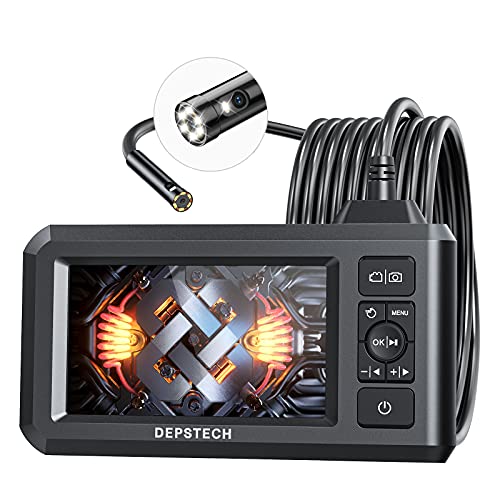
The DS300 is built around quick changes in viewing perspective. Its dual-lens arrangement can switch between front and side views, while a stated 70-degree field-of-view button and three observation modes give the operator more ways to frame a confined target. That can be handy inside a duct or machinery compartment where the probe cannot be rotated freely and a narrow straight-ahead view misses the nearby surface.
A 4.3-inch TFT IPS screen provides a phone-free workflow, and the listing describes 1080P video, 2.0MP images, adjustable lighting, and a second CMOS chip intended to reduce picture delay. The 16.5-foot semi-rigid cable reaches farther than the short articulated Teslong, while the front and side focal ranges are separately listed as 3 to 8 cm and 2 to 6 cm. No TF card is included, so storage and documentation details deserve attention before ordering.
Pros
- Dual lens with three stated observation modes.
- 16.5-foot semi-rigid cable for ducts, walls, machinery, and plumbing paths.
- 4.3-inch IPS display avoids phone and app dependency.
- Separate front and side focal ranges are provided.
- Photo and 1080P video capability are listed.
Cons
- The product information states that no TF card is included.
- The 4.3-inch screen is smaller than the 5-inch display on the Teslong long-reach model and DXZtoz.
The DS300 fits buyers who want a long cable, integrated display, and more viewing modes than a simple front-or-side switch. It is a capable general inspection layout, though it lacks the active tip steering found on the two articulating models. For long paths with moderate curves it offers useful reach, while close engine work may benefit from a shorter probe that is easier to control.
To buy this product, click here.
6. Ginocaco Dual Lens Borescope — Best for Phone-Free General Inspection
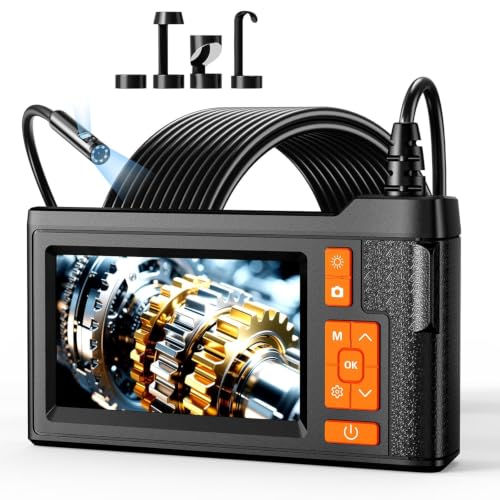
The Ginocaco keeps the setup straightforward: power on the 4.3-inch screen, insert the semi-rigid probe, and switch between front and side cameras from the handle. No Wi-Fi, smartphone, or app is required. That simplicity makes sense for a quick look behind a wall, around an engine, or inside a vent when pulling out a phone and setting up software would slow the job down.
The 16-foot cable offers solid reach for general maintenance, and the listing describes eight adjustable LEDs, IP67 protection for the probe, and a 2000mAh battery with up to four to six hours of use. The fixed-focus camera needs the target to sit roughly 3 to 8 cm away for a clearer image. That is a practical limitation rather than a flaw, but it means moving the probe slowly and keeping the lens clean matters more than simply pushing it toward the object.
Pros
- Front and side cameras switch without a phone or app.
- 16-foot semi-rigid cable supports extended general inspections.
- 4.3-inch screen provides live viewing at the work area.
- Eight adjustable LEDs and a listed IP67 probe rating support dark or damp spaces.
- Photo and video capture, hook, magnet, and side mirror are listed.
Cons
- Fixed focus requires a suitable 3 to 8 cm working distance.
- The cable is not recommended for sharp 90-degree bends, fully blocked drains, or long underground sewer lines.
This is a practical choice for homeowners and general maintenance work where phone-free operation matters. It is less suitable for severe bends or long sewer routes, and the fixed-focus design rewards patience during positioning. Buyers who want a simple dual-lens kit with a screen and useful accessories may prefer it over a phone-connected camera.
To buy this product, click here.
7. Daxiongmao Dual-Lens Borescope — Best for Engine and Household Inspection

The Daxiongmao focuses on immediate usability. Its 4.3-inch color LCD shows the live image without Wi-Fi or a driver application, and the 16.4-foot semi-rigid cable can be shaped to hold a useful direction. The product information specifically describes access through a spark-plug hole for combustion-chamber inspection, along with wall, HVAC, electrical, plumbing, and home maintenance uses.
The 8 mm probe gives it the same broad access profile as several other screen-based models in this group. Eight adjustable LEDs help illuminate dark areas, while the listing gives an observation distance of roughly 1.5 to 5 inches. A hook, magnet, side mirror, and Type-C charging cable are included. The side mirror is useful as a retrieval or viewing accessory, but it should not be confused with the built-in second camera that makes this a dual-lens system.
Pros
- Dual-lens camera system with an integrated 4.3-inch screen.
- 16.4-foot semi-rigid cable supports walls, engines, ducts, and plumbing.
- Eight adjustable LEDs provide controllable illumination.
- IP67 rating is listed for use in wet environments.
- Hook, magnet, and side mirror are included.
Cons
- The 8 mm probe may not fit very narrow openings.
- The supplied information does not clearly describe photo or video recording capability.
Choose this model for live inspection rather than documentation-heavy work. It offers the convenience of a self-contained screen and a long cable, but buyers who need saved photos or videos should confirm that capability before ordering. Its stated engine and home inspection applications make it a sensible general-purpose option where immediate viewing is the priority.
To buy this product, click here.
8. Acoath Dual-Lens Endoscope Camera — Best for Phone-Connected Field Work

The Acoath uses a 7.9 mm dual-lens probe with a 16.4-foot semi-rigid cable, then sends the live view to an iOS or Android device through the SUP-ANESOK app. The listing identifies iOS 9.0 and later and Android 7 or later, plus Android, Lightning, and Type-C connectors in the package. That broad stated device coverage is useful, but compatibility still depends on the individual phone, operating system, and app support.
The camera listing gives a 1920 by 1440 resolution claim, eight adjustable LEDs, and an IP67 rating with a stated immersion limit of up to 3.28 feet for one hour. It also includes a hook, magnet, mirror, and protective cap. The phone workflow makes image and video sharing convenient, while the cable length suits pipes, walls, HVAC, vehicle areas, and other moderate-distance inspections. The probe is not heat-resistant, so an engine must cool before inspection.
Pros
- Front and side lenses provide two viewing directions.
- 16.4-foot semi-rigid cable offers useful reach.
- Listed support for iOS 9.0 or later and Android 7 or later.
- Android, Lightning, and Type-C connectors are listed in the package.
- Hook, magnet, mirror, and protective cap are included.
Cons
- Use requires the SUP-ANESOK app and a compatible mobile device.
- The probe is not heat-resistant and must not be used in a hot engine.
This model suits someone who already prefers a phone display and wants stored inspection media without buying a separate screen unit. The app and connector requirements add setup steps, while the stated immersion limit should be treated as a defined boundary rather than a general underwater guarantee. It is a reasonable fit for mobile home, automotive, HVAC, and pipe checks.
To buy this product, click here.
9. Elecshion Dual-Lens Endoscope Camera — Best for Phone-Based Plumbing Checks

The Elecshion is aimed at close-range inspection through a phone, with front and side cameras, a stated 8 mm probe, and an optimal viewing range of approximately 1.2 to 4 inches. Its 16.5-foot semi-rigid cable can hold a bend, and the product information describes a 360-degree rotation feature for exploring different angles. That language describes viewing flexibility, but it should not be treated as active articulation of the camera tip.
The listing also gives a 1920 by 1440 resolution claim, adjustable lighting, and IP67 protection with a stated underwater limit of up to 3.28 feet for one hour. It is presented for automotive, pipe, drain, wall, wiring, and mold inspections. The phone-based design can make photo and video sharing convenient, but the probe is not heat-resistant and the waterproof claim should be applied within the listed limits.
Pros
- Dual front and side cameras support close-range viewing from two directions.
- 16.5-foot semi-rigid cable provides reach for pipes, walls, and vehicle areas.
- 8 mm camera head is suitable for many general access points.
- Adjustable brightness supports dark inspection spaces.
- IP67 and a stated immersion limit are provided in the product information.
Cons
- The phone-connected design depends on device and software compatibility.
- The probe is not heat-resistant and requires a fully cooled engine for inspection.
This is best for buyers who want a compact phone-based tool for occasional pipe, drain, wall, or automotive checks. It gives up the convenience of an integrated display and active articulation, but the long cable and dual cameras cover many routine tasks. Confirm the required connector and app behavior before purchase, then stay within the stated environmental limits.
To buy this product, click here.
Buying Guide
Dual-Lens Viewing Is Different From Articulation
A dual-lens borescope normally uses a forward camera and a side-facing camera. Switching lenses changes the direction of the view, which can reduce the need to rotate or withdraw the probe. It does not necessarily move the camera tip. The DXZtoz and Teslong articulating models add documented two-way tip control, making them better suited to targets that require steering around an obstruction.
Probe Diameter Determines Access
The DXZtoz lists a 0.25-inch probe, while several general-purpose models list 7.9 or 8 mm camera heads. A slimmer probe may enter a spark-plug opening or narrow machinery gap that a larger camera cannot, but diameter alone does not determine image quality or control. Check the actual access opening before choosing a camera, especially for engine-cylinder work.
Long Cables Add Reach, but Control Still Matters
Most of the screen-based and phone-connected models here use cables between roughly 16 and 16.5 feet. That reach helps with walls, ducts, drains, and larger engine compartments. A long semi-rigid cable can also be harder to guide in a short path or around sharp bends. The 5-foot articulating models give up distance for easier close-range handling, while the DXZtoz uses articulation to improve control at the tip.
Working Distance Affects Image Usefulness
Several listings provide a focal or observation range. The Ginocaco is listed at roughly 3 to 8 cm, the DEPSTECH DS300 gives separate front and side ranges, and the Elecshion lists approximately 1.2 to 4 inches. These details matter because a fixed-focus lens can look soft when pressed against the target or held too far away. Move the probe gradually, adjust the LEDs, and clean the lens before deciding that a view lacks detail.
Choose an Integrated Screen or Phone Workflow
An integrated screen avoids app installation, OTG settings, and phone compatibility checks. It also keeps a personal device away from water, oil, dust, and tight workspaces. A phone-connected camera can make sharing photos and videos easier, though the connector alone does not guarantee that the app will work with every iPhone, iPad, or Android device. Check the listed operating-system requirements and OTG needs.
Check What the IP Rating Covers
The product information generally describes IP67 protection for the probe or camera system, not unrestricted protection for every component. IP67 should not be treated as unlimited underwater use. The Acoath and Elecshion listings state specific immersion limits, while other products describe wet-environment use without the same level of detail. Keep the screen, handle, charging port, phone, and connectors away from conditions not covered by the listing.
Recording Capability Is Not Automatic
Some models list photo and video capture, while the T TAKMLY product excluded from this selection specifically states that it cannot take or store photos and videos. A built-in screen only confirms live viewing unless recording is separately identified. If the inspection needs before-and-after evidence, client documentation, or maintenance records, confirm the storage method, memory card support, and capture controls.
Best Dual Lens Borescope FAQ
What Is the Main Benefit of a Dual-Lens Borescope?
The main benefit is access to two viewing directions from one probe. A forward camera helps follow the insertion path, while a side camera can inspect an adjacent wall, pipe surface, engine component, or cavity. This can reduce the need to rotate the cable, but it does not provide the same tip control as active articulation.
Is a Dual-Lens Borescope the Same as an Articulating Borescope?
No. Dual-lens models switch between separate camera views. An articulating model mechanically changes the direction of the distal probe tip through a joystick or similar control. Some products combine both features, such as the DXZtoz and the articulating Teslong, while many long-reach cameras rely on dual lenses and a bendable semi-rigid cable.
Can These Borescopes Inspect a Car Engine?
Several are listed for engine, spark-plug-hole, combustion-chamber, or engine-compartment inspection. The probe must fit the access opening, and the engine must be cool unless the product information expressly supports another condition. Avoid moving components and follow safe inspection procedures. A small probe such as the DXZtoz model offers a different access profile from the 8 mm general-purpose cameras.
Do Phone-Connected Models Work With Every USB-C or Lightning Device?
No. A Type-C or Lightning connector is only one part of compatibility. The required app, operating-system version, OTG support, and device settings also matter. The DEPSTECH phone model lists iOS and Android requirements and requires OTG on compatible Android devices. Check the current product listing against the exact phone or tablet before ordering.
Can an IP67 Probe Be Used in Any Drain or Pipe?
No. An IP67 rating describes a level of protection under defined conditions, and some listings provide specific immersion limits. It does not mean the entire kit is suitable for unlimited underwater work, long sewer runs, blocked drains, or every chemical environment. Cable stiffness, probe diameter, bends, and the camera’s stated application limits also affect suitability.
Which Option Is Better for Saving Inspection Photos and Videos?
The DXZtoz specifically lists photo and video recording with an included 32GB memory card. The DEPSTECH phone-connected model supports photo and video capture through its app, which can make sharing convenient. The DS300 also lists photo and 1080P video capability, though its product information states that no TF card is included. Verify storage requirements before starting a documentation-heavy job.
Is a Longer Cable Always Better?
A longer cable helps reach deep wall cavities, HVAC ducts, drains, and large machinery, but it can be harder to guide in a short inspection path. Excess cable may bunch up, and a semi-rigid cable still may not handle sharp bends well. Choose reach based on the inspection route, then weigh it against probe control and storage.
Final Verdict
The DXZtoz Dual Lens Articulating Borescope is the strongest overall choice in this group because it combines the central benefit of dual-lens viewing with genuine two-way articulation. Its slim 0.25-inch probe, 5-inch display, zoom, recording, and included memory card give it a particularly strong position for detailed engine and machinery inspections. The shorter 5-foot probe is the trade-off, so it is less suitable for deep ducts or long pipe paths.
For reach and phone-free operation, the Teslong 5-inch Dual Lens Borescope is the better fit, with a 16.5-foot cable and large integrated screen. The DEPSTECH 2K model is the more suitable alternative for buyers who prefer phone-based capture and can confirm app and OTG compatibility. Match the camera to the access opening, inspection distance, need for steering, environmental conditions, and documentation workflow. Those practical details matter more than choosing a model solely because its listing uses a larger resolution number.
