
A four-way articulating borescope earns its keep when a straight camera reaches the opening but cannot turn toward the defect. Inside an engine, pipe bend, HVAC duct, or machinery housing, the useful view may sit above, below, or around a corner. A joystick-controlled tip can change that inspection dramatically, but the best choice depends on more than a “1080P” label. Probe diameter, cable behavior, articulation control, lighting, viewing direction, screen design, and recording features all affect what you can actually see.
The biggest specification on the box may not be the most useful one in the field. A slim 6.2 mm probe can enter spaces that a larger camera cannot, while a longer semi-rigid cable may reach farther but require more effort to position. Dual-lens models add a side-facing view, yet dual-lens viewing does not replace active articulation. Buyers who inspect engines may value a narrow probe and heat warnings, while someone documenting pipe or HVAC problems may prefer longer reach, storage, and a larger display.
The nine models below all offer genuine four-way articulating inspection capability, with meaningful differences in probe size, reach, viewing systems, displays, and documentation features. The comparison starts with a quick answer, then moves through detailed reviews so you can match the camera to the access problem rather than choosing by headline resolution alone.
Quick Answer
- Best Overall: VEVOR 4-Way Articulating Borescope combines four-way control, a 6-inch screen, a 4.9-foot probe, a slim listed camera head, IP67-rated camera protection, and a large stated battery capacity.
- Best for Dual-Lens Viewing: Ralcam 360° Articulating Borescope Dual Lens adds front and side cameras, split-screen viewing, a 6.5 mm probe, and replaceable-battery convenience.
- Best for Long Reach: Ralcam 360° Articulating Borescope pairs four-way articulation with a 10-foot semi-rigid cable, making it the more suitable choice for deeper wall, HVAC, and pipe paths.
- Best for Extended Operation: Zealtron 360° Joystick Articulating Borescope uses dual battery packs and a resilient gooseneck cable for inspection sessions where frequent charging would be inconvenient.
Best 4 Way Articulating Borescope Comparison Table
| Product | Best For | Probe / Cable | Viewing System |
|---|---|---|---|
| VEVOR 4-Way Articulating Borescope | Overall inspection use | 0.32-inch listed camera head, 4.9 ft | 1080P claim, 6-inch IPS screen |
| Ralcam M5 Series 4-Way Articulating Borescope | Frequent industrial work | 6.2 mm probe, replaceable cable system | 5-inch screen, 4X zoom |
| THINKCAR 4-Way Articulating Borescope | Compact engine inspection | 6.2 mm probe, 1.5 m metal hose | 5-inch IPS screen, 5X zoom |
| MR CARTOOL N180 | Detailed close access | 6.2 mm probe, 4 ft semi-rigid cable | 5-inch screen, 8X zoom |
| Ralcam 10-Foot Articulating Borescope | Long-reach inspections | 6.2 mm probe, 10 ft | 4.3-inch IPS screen, 4X zoom |
| Teslong Dual Lens 4-Way Borescope | Front and side viewing | Dual camera probe | 5-inch screen, 1080P recording claim |
| Ralcam Dual-Lens Articulating Borescope | Split-screen inspection | 6.5 mm probe, 5 ft | 5-inch IPS screen, dual lens |
| Teslong TF600 | Rugged documentation | 6.5 mm dual-lens probe | 6-inch 1080P IPS screen |
| Zealtron Joystick Articulating Borescope | Long operating sessions | 6.2 mm probe, 1.5 m gooseneck | 5-inch monitor, dual batteries |
The detailed reviews explain how the articulation, probe dimensions, viewing direction, cable design, and recording features translate into practical inspection advantages.
1. VEVOR 4-Way Articulating Borescope — Best Overall

The VEVOR leads with a well-balanced combination of access, control, and self-contained viewing. Its listing identifies a four-way articulating probe, a 6-inch IPS display, and a 4.9-foot flexible cable. That combination suits the classic inspection problem where the camera must travel through a confined route, then turn toward a crack, leak, worn surface, or hidden component. The larger display should also be easier to share with someone standing nearby than a small phone screen.
The listed camera head measures 0.32 inches, and the camera is described as IP67-rated for wet, oily, and submerged environments. That rating applies to the camera claim, not automatically to the monitor, handle, or connectors, so the surrounding electronics still deserve protection. A stated 7,000mAh battery capacity and claimed five to six hours of operation make it appealing for several vehicle checks or a longer maintenance session, while the 1080P listing claim gives the device a useful documentation-oriented profile.
Pros
- Four-way articulating control supports viewing around bends and obstacles.
- Large 6-inch IPS screen is useful for close inspection and shared viewing.
- 4.9-foot cable balances reach with manageable handling for many jobs.
- Listing identifies a 0.32-inch camera head and IP67-rated camera.
- Stated 7,000mAh battery capacity is suited to extended inspection sessions.
Cons
- The listed camera-head diameter is larger than the 6.2 mm probes found on several alternatives.
- The IP67 claim should not be extended to the monitor or complete system.
This is the strongest general-purpose choice for someone who wants genuine directional control without moving to a dual-lens system. It makes sense for engines, machinery, wall cavities, and moderate pipe work where four-way steering and a generous display matter more than extreme cable reach. Choose a slimmer probe if the access opening is especially tight, or a dual-lens model if a side-facing camera will save repeated repositioning.
To buy this product, click here.
2. Ralcam M5 Series 4-Way Articulating Borescope — Best for Replaceable Probe Flexibility

A replaceable snake-cable system gives the Ralcam M5 a practical distinction for repeated inspection work. The product information describes a modular cable design that can accept different cable sizes, which may help users adapt the system to changing access requirements rather than replacing the complete unit after a probe problem. Its 6.2 mm IP67-listed probe is a useful middle ground for engine openings, machinery gaps, and confined industrial spaces.
The stainless-steel joystick is specified for the control system, while six front LEDs and one additional light offer three brightness levels. The 5-inch display supports real-time viewing, photo and video storage, and transfer through the included 32GB memory card. A detachable 5,000mAh battery, four-times digital zoom, 180-degree image flip, and a high-temperature warning at or above the listed threshold round out a feature set aimed at repeatable documentation rather than casual one-off checks.
Pros
- Replaceable snake-cable system can adapt to different inspection requirements.
- 6.2 mm probe offers access through relatively narrow openings.
- Six front LEDs plus an additional light provide adjustable illumination.
- Includes stated support for photo and video storage on a 32GB card.
- Detachable battery and high-temperature warning support ongoing field use.
Cons
- The display is smaller than the 6-inch screens on the VEVOR and Teslong TF600.
- The listing does not clearly specify the length of the supplied cable.
The M5 is a sensible fit for maintenance teams that care about serviceability and cable options. Its replaceable design matters most when the scope will see frequent insertion, bending, or exposure to dirty work areas. Buyers who want a clearly stated cable length or a larger screen may prefer another model, but the M5’s modular approach gives it a reason to stand apart from fixed-probe systems.
To buy this product, click here.
3. THINKCAR 4-Way Articulating Borescope — Best for Compact Engine Access

Engine cavities and equipment housings often punish awkward controls. The THINKCAR addresses that with an ergonomic joystick, one-hand operation, and a 6.2 mm slim probe. The product information describes a 1.5-meter wear-resistant metal hose, enough for many vehicle and equipment tasks without turning the scope into a long, unwieldy cable system. Four-way movement lets the tip look around corners after insertion, which is the central reason to choose this type of borescope.
A 5-inch IPS screen, six adjustable LEDs, and five-times zoom give the operator several ways to inspect a dark cavity. The zoom claim can help enlarge a small area on the display, but it should not be treated as proof of greater optical detail. The listing also identifies an IP67 water-resistant lens and direct photo and video capture, giving the THINKCAR a straightforward workflow for checking components and saving findings.
Pros
- 6.2 mm probe supports access through narrow engine and equipment openings.
- Joystick and one-hand controls suit close, hands-on inspection tasks.
- 1.5-meter wear-resistant metal hose provides useful reach.
- Five-inch IPS display and six adjustable LEDs support low-light viewing.
- Photo and video capture are available directly on the device.
Cons
- The listing does not provide a specific battery capacity or runtime.
- The 5-inch screen gives less viewing area than the largest options here.
This model fits users who want a compact, direct inspection camera for engines, machinery, HVAC spaces, and similar access points. Its probe size and one-hand layout are more important than its zoom number. Those seeking a dual-lens view, much longer reach, or documented extended runtime should look elsewhere, while buyers handling routine confined inspections may appreciate the simpler setup.
To buy this product, click here.
4. MR CARTOOL N180 4-Way Articulating Borescope — Best for Zoom and Resolution Selection

The N180 focuses on control at a narrow access point. Its listed 6.25 mm probe, 4-foot semi-rigid cable, and joystick-controlled four-way articulation suit spark-plug openings, cylinder walls, pipes, and precision parts. The semi-rigid construction can hold a chosen path better than a loose flexible cable, though a shorter cable also limits how far the camera can travel into a wall or duct.
Three listed resolution modes, a 5-inch 1080P IPS screen, and eight-times digital zoom give the operator control over the viewing workflow. The unit also records to a built-in 32GB card and can connect to iPhone and Android devices, but the product information specifically says iOS app support is currently unavailable. That makes the integrated screen the dependable primary display, while phone connectivity should be treated as a configuration detail to verify before purchase.
Pros
- 6.25 mm probe is suited to narrow access points.
- Four-way joystick control supports multi-angle inspection.
- Three listed resolution modes let users adjust the viewing format.
- Eight-times digital zoom and 32GB storage support close documentation.
- Probe includes IP67 oil- and water-resistant claims plus temperature warning features.
Cons
- The 4-foot cable offers less reach than several longer alternatives.
- Product information states that iOS app support is currently unavailable.
The N180 is a good match for close automotive work where the camera must fit through a small opening and the operator wants a short, controllable assembly. Its screen, storage, and adjustable modes are more useful than the zoom label alone. Skip it for deep pipe routes or jobs that depend on iPhone app operation, and choose a longer or dual-lens model for those tasks.
To buy this product, click here.
5. Ralcam 360° Articulating Borescope — Best for Long Reach

A 10-foot semi-rigid cable changes the kind of inspection this Ralcam can attempt. It can reach farther into HVAC ducts, walls, pipe bends, and large equipment than the four- to five-foot models, while its shape-holding design helps the operator aim the probe instead of watching it sag immediately. Long reach has a cost, though. Extra cable needs more room to manage, and a compact engine bay may feel easier with a shorter assembly.
The 6.2 mm probe is listed as IP67-rated, with the qualification that the rating applies to the probe only. Six LEDs with three brightness levels illuminate the target, while the 4.3-inch IPS screen provides live viewing. Four-times zoom, 180-degree image rotation, a rechargeable battery, and 32GB storage make the unit useful for recording findings, although the smaller screen may be less comfortable for shared viewing than the six-inch alternatives.
Pros
- 10-foot semi-rigid cable provides the longest stated reach in this group.
- 6.2 mm probe supports access through relatively narrow openings.
- Semi-rigid construction can hold a selected shape during insertion.
- Probe is listed with IP67 protection, with the rating limited to that component.
- Includes adjustable lighting, image rotation, zoom, and 32GB storage.
Cons
- Long cable can be harder to manage in short, tight inspection areas.
- 4.3-inch display is smaller than several competing integrated screens.
Choose this Ralcam when the inspection path matters more than compact storage. It is better suited to longer routes through ducts, cavities, and pipe sections than a short probe, while still retaining four-way tip control. A shorter model will feel less cumbersome around an engine, and users should protect the monitor and handle because the supplied IP67 statement is limited to the camera probe.
To buy this product, click here.
6. Teslong Dual Lens 4-Way Articulating Borescope — Best for Forward and Side Viewing

This Teslong combines two distinct advantages that are easy to confuse: active four-way articulation and dual-camera viewing. The joystick steers the tip through 360 degrees with stated 210-degree bending, while the front and side cameras let the operator switch perspectives without constantly repositioning the probe. That side view can be valuable beside a cylinder wall, pipe surface, or machinery edge where the forward camera points past the area of interest.
The product information lists dual 1.0MP cameras, a focus range from 1 cm to infinity, six front LEDs, one side LED, and a 5-inch IPS display. It records 1080P photos and video to an included 32GB card and supports audio notes through a built-in microphone and speaker. The 3,000mAh battery is smaller by stated capacity than some alternatives, but the included case, hook, magnet, and Type-C charging cable give the kit a practical documentation and retrieval setup.
Pros
- Genuine four-way articulation works alongside front and side cameras.
- Dual 1.0MP cameras provide forward and side viewing options.
- Listed 1 cm-to-infinity focus range supports varied inspection distances.
- Includes photo, video, and audio recording with a 32GB memory card.
- Case, hook, magnet, and Type-C charging cable are identified as included.
Cons
- The 5-inch screen is smaller than the 6-inch displays on some alternatives.
- Listed 3,000mAh battery capacity is lower than the stated capacities of several competitors.
This is a strong fit for inspections where the defect may sit beside the probe rather than directly ahead. A single-lens articulating scope can reach the same area, but it may require more steering and repositioning. Buyers focused on straightforward forward viewing may prefer a simpler model, while side-wall inspection, engine component checks, and documentation benefit from this combination of cameras and articulation.
To buy this product, click here.
7. Ralcam 360° Articulating Borescope Dual Lens — Best for Split-Screen Inspection

The Ralcam dual-lens model takes the side-view concept and adds a split-screen option. Its 6.5 mm probe is slightly larger than the 6.2 mm designs in this roundup, but it still targets narrow engine, pipe, and HVAC access points. The five-foot semi-rigid cable should hold a useful curve during insertion, while four-way joystick control provides active directional movement instead of relying on cable twisting.
Front and side lenses can be viewed separately or together, and the listing identifies adjustable brightness, four-times zoom, photo and 1080P video recording, and a 32GB card. The replaceable battery is useful for longer sessions because a spare can be swapped rather than waiting for the internal unit to recharge. The probe carries the IP67 claim, but that protection should remain limited to the camera component unless the current listing states otherwise.
Pros
- Front and side cameras support single-view or split-screen inspection.
- Four-way joystick articulation helps steer around corners and obstacles.
- 5-foot semi-rigid cable balances reach with shape retention.
- Includes adjustable brightness, four-times zoom, and 32GB recording storage.
- Replaceable battery can support longer work with a spare available.
Cons
- The 6.5 mm probe is slightly larger than the 6.2 mm alternatives.
- Five-foot reach is less suitable for deep ducts or long wall cavities.
This Ralcam suits anyone who regularly needs to compare what lies ahead with what sits beside the camera. The split-screen function may shorten the process of checking a pipe wall or engine surface, while the semi-rigid cable offers more positional stability than a loose flexible line. Select a slimmer or longer model where the access opening or inspection route is the limiting factor.
To buy this product, click here.
8. Teslong TF600 — Best for Rugged Documentation

The TF600 places its emphasis on a large display and recorded inspection evidence. Its four-way articulating probe uses joystick control with stated 360-degree rotation and 210-degree flexion, while the dual-lens camera system provides forward and side views. A 6.5 mm probe is a reasonable compromise for many openings, though the larger diameter may rule it out where a 6.2 mm camera is already a tight fit.
A 6-inch 1080P IPS screen gives the operator more room to examine a saved image or show a finding to another person. The listing also describes dual 1.0MP cameras, six front LEDs, one side LED, a 6,000mAh rechargeable battery, 32GB storage, audio recording, a hard plastic case, and toughened glass on the monitor. These details favor maintenance records and repeated review, although advertised resolution still depends on lighting, focus, and the condition of the target.
Pros
- Four-way articulation provides active tip control around complex components.
- Dual-lens system offers front and side viewing.
- Large 6-inch 1080P IPS display supports inspection and shared review.
- 6,000mAh stated battery capacity is substantial for longer sessions.
- Includes 32GB storage, audio recording, hard case, and Type-C charging cable.
Cons
- The 6.5 mm probe is not the slimmest option in the roundup.
- The listing identifies a 12-month warranty, which may be less extensive than some alternatives.
The TF600 is a good choice for users who need to save images, videos, and spoken observations as part of a maintenance record. Its larger display and dual-lens setup make it especially useful when the inspection result must be reviewed later. A smaller, simpler scope may be easier for occasional engine checks, while the TF600 earns its place where documentation and viewing comfort carry real weight.
To buy this product, click here.
9. Zealtron Joystick Articulating Borescope — Best for Extended Operation
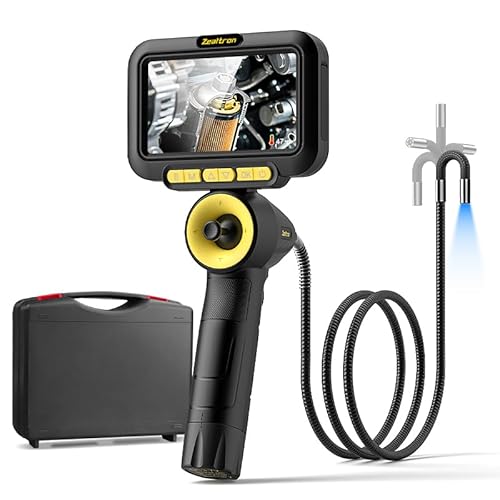
Zealtron takes a different approach to cable behavior. Its 1.5-meter gooseneck is described as a resilient, shape-recovering design built from silicone and spring-steel reinforcement, while the joystick direction corresponds to camera movement. That may appeal to users who need a cable that bends into position and recovers after being coiled, rather than a semi-rigid tube that holds one manually formed shape.
The 6.2 mm camera includes six adjustable LEDs, an oil-repellent lens coating, and a stated close-focus range from 2 cm to 10 cm. The package includes two 4,000mAh battery packs, with the listing describing hot-swappable operation and more than ten hours of combined runtime. Thermal alerts and shutdown at the stated 85°C threshold add a useful warning during hot-component inspection, but machinery should still be cooled and secured according to appropriate procedures before inserting a camera.
Pros
- Four-way joystick control supports directional inspection in confined spaces.
- 6.2 mm probe suits many narrow openings.
- Resilient gooseneck cable is designed to recover its shape after bending.
- Dual battery packs support extended use and hot swapping according to the listing.
- Close-focus range, adjustable LEDs, and thermal alerts support detailed inspection work.
Cons
- The listing does not clearly identify a dual-lens viewing system.
- The product information does not specify the monitor resolution or storage capacity.
Zealtron is most attractive for repeated inspection sessions where battery interruptions and cable fatigue are frustrating. Its cable design differs from the semi-rigid systems above, and the close-focus information gives a clearer sense of its intended near-target use. Buyers who need dual-lens viewing, a large display, or clearly documented recording storage should choose a model that states those features directly.
To buy this product, click here.
Buying Guide
Four-Way Articulation Must Mean Active Tip Control
A bendable cable is useful, but it is not the same as a mechanically articulating probe. Four-way systems use a control, commonly a joystick, to steer the camera tip in multiple directions after insertion. That matters inside a cylinder, pipe elbow, or machinery housing where rotating the entire cable is awkward. Check the listing for explicit directional control and articulation details rather than treating “flexible” as proof of four-way movement.
Probe Diameter Determines Access
A 6.2 mm probe can enter some openings that a larger camera cannot, but smaller does not automatically mean better. The camera still needs suitable lighting, focus, and tip control, and a narrow probe may be less appropriate for a task that requires longer reach or a side-facing view. Measure the actual access opening first, especially for spark-plug holes, compact engine passages, and narrow equipment gaps.
Match Cable Length to the Inspection Route
A four-foot cable is easier to manage around a vehicle than a ten-foot assembly, while a long cable becomes valuable inside HVAC runs, walls, and extended pipe paths. Extra reach can create loops and make the camera harder to guide in a small workspace. The Ralcam 10-foot model is aimed at deep access, while shorter systems suit close inspection where control matters more than distance.
Dual-Lens Viewing Solves a Different Problem
Active articulation changes the direction of the camera tip. A dual-lens system adds a second viewing direction, commonly forward and to the side. The two features can work together, but they are not interchangeable. Choose dual lenses when the target often lies beside the probe, and choose four-way steering when the camera must be directed around obstacles.
Screen Size Affects Shared Inspection
An integrated display avoids phone compatibility questions and gives immediate feedback during insertion. A 6-inch screen, such as those listed for the VEVOR and Teslong TF600, offers more viewing area than a 4.3-inch display, though screen size alone does not establish image quality. If one person is steering while another reviews the picture, a larger display can make the workflow less cramped.
Read Recording and Zoom Claims Carefully
Photo and video recording are useful for maintenance records, but a live-preview resolution, still-image setting, and video setting may differ. Digital zoom enlarges the displayed image and does not create optical detail. Lighting, focus distance, lens condition, and the target surface can matter just as much as the advertised resolution number.
Check Which Component Has the IP Rating
Several products identify an IP67-rated or water-resistant camera probe. That statement does not automatically protect the monitor, handle, cable connection, charging port, or phone. Keep the control unit dry unless the product information specifically covers it, and treat the rating as a boundary for use rather than permission for unlimited immersion.
Best 4 Way Articulating Borescope FAQ
What makes a borescope four-way articulating?
A four-way articulating borescope has active directional control for the camera tip in four directions. The control is often a joystick or similar mechanism. A cable that bends, rotates, or holds a curve is not automatically four-way articulating unless the listing describes mechanical tip movement.
Is a dual-lens borescope better than a single-lens model?
It depends on the inspection. A dual-lens model can provide forward and side views without moving the probe as often, which helps with pipe walls, cylinder surfaces, and components beside the camera. A single-lens four-way model may be preferable where the smallest probe, simpler controls, or lower system complexity matters more.
Can these borescopes inspect a hot engine?
Some listings include temperature warnings or automatic shutdown thresholds, but those features do not make every inspection safe at any temperature. Allow machinery to cool, prevent movement, and follow the product instructions before insertion. A temperature warning is a protection feature, not a substitute for safe work procedures.
Does IP67 mean the entire borescope can be submerged?
No. In the product information used here, IP67 protection is generally assigned to the camera or probe. The monitor, handle, connectors, and charging components may not share that rating. Confirm the exact protected component and any immersion conditions in the current listing before using the equipment around water.
How much cable length is suitable for engine inspection?
Many engine tasks can be handled with a shorter probe and cable because the access point is close to the target. A four- to five-foot design may be easier to control around an engine bay, while a ten-foot model is more useful for walls, ducts, or long pipe routes. The right length is the shortest one that reaches the inspection area without creating unnecessary loops.
Do these models require a phone?
The reviewed products use integrated screens, so their basic viewing workflow does not depend on a phone. Some models also describe phone connectivity, but a connector alone does not guarantee compatibility with every iPhone or Android device. Check the current listing for operating-system and app support before treating phone viewing as a primary feature.
Is higher advertised resolution always better?
No. Resolution can help with recorded detail, but useful inspection also depends on focus range, lighting, lens design, viewing distance, screen quality, and camera stability. A well-lit, properly focused image from a controllable probe may be more useful than a higher-numbered setting that produces glare or soft detail.
Final Verdict
The VEVOR 4-Way Articulating Borescope is the strongest overall choice for a broad mix of automotive, machinery, wall, HVAC, and pipe inspection tasks. Its combination of active four-way control, a large 6-inch screen, a 4.9-foot reach, a listed slim camera head, and stated extended battery capacity gives it a balanced profile. The MR CARTOOL N180 is a better fit for close access where a 6.2 mm probe, short semi-rigid cable, and detailed zoom controls matter more than reach.
For side-facing inspection, the Ralcam dual-lens model and Teslong dual-lens options provide a genuine second camera view, while the Ralcam 10-foot version is the more natural choice for long routes through ducts, walls, and pipe sections. Zealtron earns attention for extended operation with dual batteries and a resilient cable design. Before ordering, measure the access opening, estimate the route length, decide whether a side view is useful, and verify which components carry any water-resistance claim. Those details will determine whether the scope helps you see the problem or merely reaches it.
