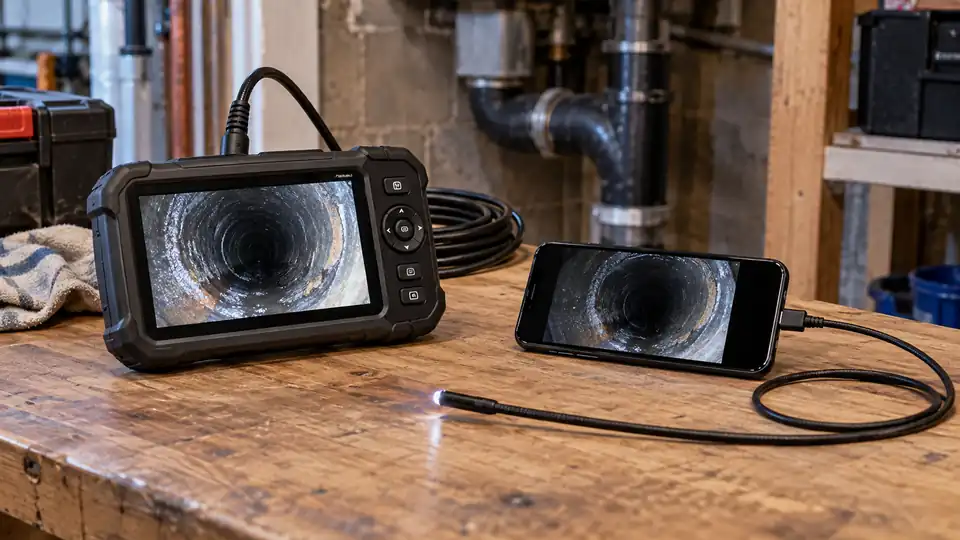
A large screen changes the feel of a borescope inspection. Instead of squinting at a phone or passing a small display between two people, you can keep the image in view while guiding a probe through an engine, wall cavity, duct, drain, or appliance. The strongest options pair a readable integrated screen with useful probe control, adjustable lighting, and a cable that suits the inspection path.
Screen size alone does not settle the choice. A 5-inch display can be easier to share, while a 4.3-inch unit may offer a longer cable or dual-camera viewing. Active articulation can steer the camera tip around an obstruction, but a semi-rigid cable simply holds the shape you give it. Recording also varies widely. Some models provide photos and video, while others offer live viewing only, which matters if you need to document a finding for later.
This comparison focuses on integrated-screen borescopes for non-medical inspection work. The selection weighs display size, viewing direction, probe control, reach, lighting, recording, waterproofing claims, and practical limitations. Different buyers will favor different features, so the reviews explain where each model fits rather than treating every specification as equally valuable.
Quick Answer
Best overall: The DXZtoz Dual Lens Articulating Borescope combines a 5-inch screen with dual-lens viewing, two-way articulation, a 5-foot probe, photo and video recording, and a supplied 32GB memory card. It is the most complete choice for buyers who want a genuinely large display and strong directional control.
Best for long-reach inspection: The Teslong 5" Dual Lens Borescope Camera offers a 5-inch IPS screen, forward and side cameras, and a 16.5-foot semi-rigid cable. It suits walls, ducts, engine bays, and other spaces where reach matters more than active tip steering.
Best for controlled tip direction: The Teslong Articulating Borescope uses a two-way articulating probe and a central joystick, making it easier to redirect the camera after insertion without relying entirely on cable bending.
Best for compact tip control: The Teslong 4.5-Inch Articulating Borescope combines a central joystick with a manageable five-foot cable for nearby automotive, HVAC, and wall inspections.
Best Borescope With Large Screen Comparison Table
| Product | Best For | Screen | Probe / Cable | Viewing System |
|---|---|---|---|---|
| DXZtoz Dual Lens Articulating Borescope | Overall capability | 5-inch IPS | 5-foot, 0.25-inch probe | Dual lens, 210° two-way articulation |
| Teslong 5" Dual Lens Borescope | Long-reach work | 5-inch IPS | 16.5-foot, 8mm cable | Forward and side cameras |
| Teslong Articulating Borescope | Controlled tip direction | 4.5-inch IPS | 5-foot semi-rigid gooseneck | Two-way articulation |
| DXZtoz Two-Way Articulating Borescope | Close automotive inspection | 4.3-inch IPS | 5.5-foot rigid gooseneck | 220° two-way articulation |
| Daxiongmao Endoscope Camera | Long cable and wet areas | 4.3-inch color LCD | 16.5-foot semi-rigid cable | Front camera |
| Dual Lens Borescope Inspection Camera | Recording on a modest setup | 4.3-inch HD | 16-foot semi-rigid cable | Front and side cameras |
| 1920P Dual Lens Endoscope Camera | Side viewing without steering | 4.3-inch IPS | 16.5-foot semi-rigid cable | Dual lens |
| 1920P HD Endoscope Camera | Long-reach live viewing | 4.3-inch IPS | 16.6-foot semi-rigid cable | Front camera |
| 1080P HD Endoscope Camera | Basic home and plumbing checks | 4.3-inch IPS | 16.5-foot semi-rigid cable | Front camera |
The detailed reviews below separate large-screen convenience from probe control, reach, viewing direction, and documentation features.
1. DXZtoz Dual Lens Articulating Borescope — Best Overall

A large display is useful, but a large display paired with genuine tip control is far more useful in a cramped engine bay or behind a wall. This DXZtoz model brings those features together with a 5-inch 1080P HD screen, a 0.25-inch probe, and two-way articulation listed at 210 degrees. The slim probe can enter tight access points, while the thumb-stick control lets the user redirect the camera after it is inside.
The dual-lens design adds a second way to look at a target without pulling the probe back and repositioning it. A button switches to the side camera, while the front camera handles straight-ahead viewing. The 5-foot probe is shorter than the long-reach models below, but that shorter path can be easier to manage around an engine or machinery component. Photo and video recording, sound capture, a 32GB memory card, a screen bracket, and a 3000mAh battery make this the most complete documentation setup in the group.
Pros
- Large 5-inch IPS screen for easier viewing and sharing.
- 0.25-inch probe supports access through tight openings.
- Two-way articulation provides active directional control.
- Dual front and side cameras reduce the need to reposition the probe.
- Supports photo and video recording with a supplied 32GB memory card.
Cons
- The 5-foot probe offers less reach than the 16-foot-class models.
- The listing does not establish that the entire handheld system is waterproof, so the IP67 claim should be treated as applying to the probe.
This is the strongest choice for close automotive, machinery, wall, and pipe inspection where the operator needs to see a larger image, steer the tip, and save evidence. It may be more capability than a homeowner needs for an occasional dropped-object search, and the short probe is a poor match for deep cavities. For controlled short-range inspection with documentation, however, its combination of screen size, articulation, dual viewing, and recording is difficult to match.
To buy this product, click here.
2. Teslong 5" Dual Lens Borescope — Best for Long Reach

For a wall cavity or HVAC duct, reach can matter more than tip articulation. This Teslong uses a 16.5-foot semi-rigid cable, giving it a much longer working path than the compact articulating options. The cable holds its shape as it is guided, which can help the camera travel through a wall opening, duct, drain, or engine bay without immediately flopping back toward the access point.
Its 5-inch IPS screen is among the largest in this comparison, and the forward and side cameras provide two viewing directions. Each camera has its own lighting, with six front LEDs and one side LED. There is no app or phone requirement, which keeps the workflow simple when the probe is dirty or the inspection takes place away from a workbench. The built-in 5000mAh battery is listed for approximately 4.5 hours of continuous use, while the included hard case adds useful protection during transport.
Pros
- 5-inch IPS display offers a generous integrated viewing area.
- 16.5-foot semi-rigid cable reaches deep cavities and ducts.
- Forward and side cameras support different inspection angles.
- Independent lighting for the two cameras helps illuminate the viewed area.
- Includes a hard case, hook, magnet, and mirror.
Cons
- The semi-rigid cable is shapeable but is not an actively articulating probe.
- The product description does not identify photo or video recording capability.
This model suits buyers who need to travel farther into a space and prefer a large screen that works independently of a phone. It gives up active steering, so a sharp bend or a target behind an obstruction may require careful cable positioning. Choose it for long straight or gently curving routes, particularly walls, ducts, drains, and engine compartments where 5 feet would leave the camera short.
To buy this product, click here.
3. Teslong Articulating Borescope — Best for Controlled Tip Direction

A two-way articulating probe addresses a problem that cable stiffness cannot fully solve: changing the camera’s direction after the probe has passed through the access point. The Teslong uses a central joystick to control the articulating tip, allowing one-handed operation from either side. Its 5-foot semi-rigid gooseneck is short enough for close inspection and firm enough to hold a guided position.
The 4.5-inch IPS color screen is slightly smaller than the 5-inch displays here, but it remains considerably more practical than a tiny phone window during a hands-on inspection. Adjustable high-brightness LEDs help in dark cavities, and the rear photo button is positioned for quick capture. The available product information describes photo and video capture, though it does not specify included storage. That makes this a good fit for short automotive, HVAC, wall, and appliance checks where directional control matters more than extreme reach.
Pros
- Genuine two-way articulation provides active camera-tip control.
- Central joystick supports one-handed operation with either hand.
- 4.5-inch IPS screen works without an app or smartphone.
- 5-foot semi-rigid gooseneck balances reach and positional control.
- Adjustable probe lighting and photo controls support inspection documentation.
Cons
- The 5-foot probe is too short for many deep wall, duct, and drain routes.
- The display is smaller than the 5-inch screens on the top long-reach models.
This is a strong middle ground for close-up work behind panels, around engine components, or inside HVAC sections. It makes more sense than a long fixed cable when the target is nearby but hidden around a corner. Buyers needing a broad view of a long pipe should choose a longer model instead, while those who value camera positioning over raw reach will find the joystick more useful than another few feet of cable.
To buy this product, click here.
4. DXZtoz Two-Way Articulating Borescope — Best for Close Automotive Inspection

The 220-degree two-way articulation listed for this DXZtoz model gives it a useful role in close engine work. A control wheel changes the tip direction, which can help the operator look around a piston, valve, spark plug opening, or other obstruction without repeatedly withdrawing the probe. The 8.5mm camera and 5.5-foot probe keep the package focused on short insertion rather than deep infrastructure inspection.
A 4.3-inch IPS monitor shows the live image without an app, and the listing identifies 2MP imaging, 8X zoom, adjustable LED brightness, and a stated 1 to 15cm focal distance. Those details are especially relevant for close targets, where moving the probe a little can change clarity. The IP67 and oil-resistant claims apply to the probe as described, not automatically to the screen or handle. A 3000mAh battery, protective case, hook, magnet, and side mirror round out the kit.
Pros
- 220-degree two-way articulation supports directional inspection around obstacles.
- 1 to 15cm stated focal distance suits close targets.
- 8X zoom and adjustable lighting assist with small engine details.
- 4.3-inch IPS screen operates without a phone or app.
- Includes a case, retrieval accessories, and a side mirror.
Cons
- The 8.5mm camera is less suitable for very narrow openings than the 3.9mm and 0.25-inch options.
- The 5.5-foot probe provides limited reach for long ducts or deep wall cavities.
Choose this unit for close, directional work where a semi-rigid cable would leave the camera facing the wrong way. It is especially logical for engine components and compact machinery. A different model is preferable for documentation-heavy jobs because the product description does not clearly identify photo or video storage. Its strength is the control wheel, not long-distance exploration.
To buy this product, click here.
5. Daxiongmao Endoscope Camera — Best for Long Cable Reach

Some inspections begin with a small access hole and continue far beyond arm’s reach. The Daxiongmao addresses that job with a 16.5-foot semi-rigid cable and an integrated 4.3-inch color display. The 8mm probe is substantial enough that buyers should check the opening before ordering, but it can suit drains, plumbing paths, engine access points, HVAC work, and wall cavities where that diameter is acceptable.
Eight adjustable LEDs bring light into dark spaces, while the product information lists an IP67 waterproof rating for the probe. The screen starts directly from the device, so there is no Wi-Fi pairing, app installation, or concern about placing a phone near grime and moisture. A hook, magnet, and side mirror are included. The major trade-off is documentation: the listing explicitly says this model cannot take photos or videos, making it a live-view tool rather than a reporting camera.
Pros
- 16.5-foot semi-rigid cable provides useful reach.
- 4.3-inch color display works without a smartphone or app.
- Eight adjustable LEDs support dark-space inspection.
- Probe is listed with IP67 waterproof protection.
- Includes a hook, magnet, and side mirror.
Cons
- The 8mm probe may not fit smaller openings.
- It cannot capture or store photos and videos.
This is a practical choice for live inspections where the operator mainly needs to see what is inside and decide what to do next. It is less suitable for claims documentation, before-and-after records, or sharing a finding after the job. The long cable is valuable, but it is still semi-rigid rather than actively steerable, so sharp bends can remain difficult.
To buy this product, click here.
6. Dual Lens Borescope Inspection Camera — Best for Recording on a Long-Reach Setup
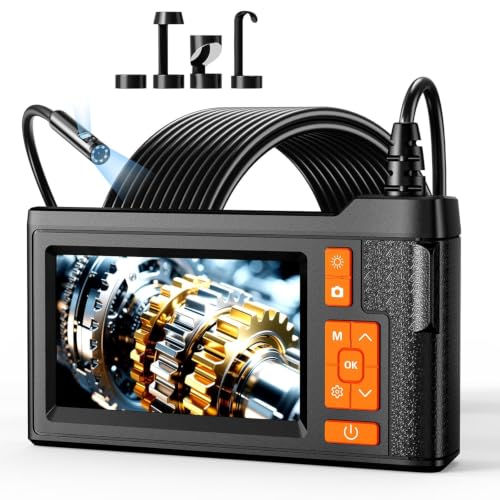
The appeal here is straightforward: a dual-lens camera, a 4.3-inch display, a roughly 16-foot semi-rigid cable, and photo and video recording in one handheld unit. Pressing and holding the photo button switches between the front and side cameras. That side view can reveal a pipe wall or cavity surface without requiring the probe to be physically articulated.
Fixed-focus operation requires a little discipline. The product information gives an ideal viewing distance of roughly 3 to 8cm, so a blurry image may mean the camera is too close or too far rather than a display problem. Eight adjustable LEDs help manage dark areas, and the probe is listed as IP67 rated. The 2000mAh battery is described as providing up to 4 to 6 hours of use, with charging guidance that calls for a standard 5V/2A charger rather than a high-power fast charger.
Pros
- Front and side cameras provide two viewing directions.
- Photo and video recording support inspection documentation.
- 16-foot semi-rigid cable reaches beyond short engine probes.
- 4.3-inch screen works without Wi-Fi, an app, or a phone.
- Includes a hook, magnet, side mirror, and Type-C charging cable.
Cons
- Fixed focus requires keeping the lens within its useful viewing distance.
- The semi-rigid cable is not a substitute for active articulation around sharp turns.
This model suits someone who wants to save evidence from a long-reach inspection without stepping up to a more complex articulating unit. It is useful for wall gaps, HVAC paths, engines, and general maintenance, but it should not be treated as a professional sewer camera simply because the cable is long. Buyers who frequently inspect targets at awkward angles may prefer active articulation.
To buy this product, click here.
7. 1920P Dual Lens Endoscope Camera — Best for Side Viewing Without Steering
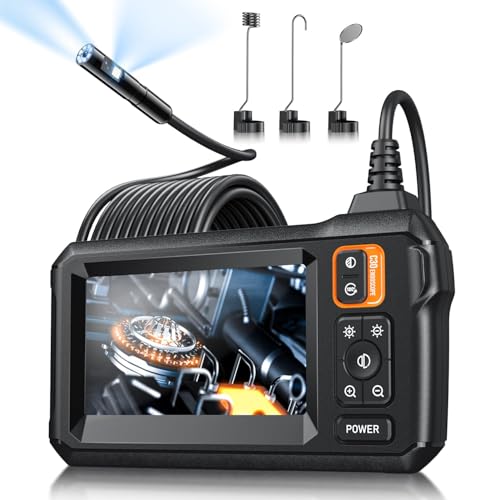
There is a useful difference between steering a camera tip and switching to a second camera. This model takes the second approach. Its front and side cameras can be selected from the 4.3-inch IPS display, giving the operator a direct look at a nearby wall or surface without attaching the included mirror or twisting the cable into position.
The 16.5-foot semi-rigid cable supports longer inspection paths, and the short 1.29-inch lens is described as helping with difficult angles. Eight adjustable LEDs and a stated 2cm to 10cm focus range support close viewing. The product information lists IP67 protection for wet environments, but it also says that the camera cannot take or store photos. That makes the unit best suited to immediate visual checks rather than records that need to be sent to a customer or saved for comparison.
Pros
- Dual-lens system supplies front and side viewing modes.
- 16.5-foot semi-rigid cable offers extended reach.
- 4.3-inch IPS display provides a phone-free inspection workflow.
- Eight adjustable LEDs help illuminate confined spaces.
- Includes a hook, magnet, side mirror, and Type-C cable.
Cons
- It does not capture or store photos and videos.
- Dual-lens switching does not provide mechanical tip articulation.
Consider this option for plumbing, ducts, wall gaps, and machinery where a side camera can reveal the needed surface quickly. The long probe and second viewing direction offer more flexibility than a basic forward-only camera, but the system cannot curve around an obstacle under joystick control. If your inspection reports require saved footage, choose a recording model instead.
To buy this product, click here.
8. 1920P HD Endoscope Camera — Best for Long-Reach Forward Viewing

A forward-facing camera can be the cleanest choice when the inspection path is relatively direct. This model uses a 16.6-foot semi-rigid cable and a 7.9mm probe, so it is aimed at reaching far into pipes, wall gaps, ducts, and vehicle spaces rather than turning around tight corners. The cable can be bent and retains enough shape to help guide the camera during insertion.
The 4.3-inch IPS display provides a broad viewing angle listed at approximately 170 degrees, and the screen supports color flip and brightness adjustment. Eight LEDs illuminate the target, while the listed 2cm to 10cm focus range gives the operator a useful working distance for pipe-wall checks. It is a live-view model without photo or video storage. A hook, magnet, and side mirror are included, although the mirror does not turn this single-camera unit into a dual-lens system.
Pros
- 16.6-foot cable provides substantial reach for a handheld inspection camera.
- 4.3-inch IPS display offers a wide stated viewing angle.
- 7.9mm probe balances access with a semi-rigid cable format.
- Eight adjustable LEDs support dark pipe and cavity viewing.
- Color flip and brightness controls help adapt the live image.
Cons
- It cannot capture or store photos.
- The single forward camera offers less viewing flexibility than dual-lens models.
This model fits a buyer who values reach and a straightforward live image over recording or directional switching. It can make sense for a long wall cavity or a mostly straight pipe route, while sharp 90-degree bends remain a poor match for a semi-rigid probe. The included side mirror may help with occasional side checks, but it requires an accessory change rather than an electronic camera switch.
To buy this product, click here.
9. 1080P HD Endoscope Camera — Best for Basic Home and Plumbing Checks

This 1080P model keeps the workflow uncomplicated. Power it on, guide the 16.5-foot semi-rigid cable, and view the live feed on the integrated 4.3-inch IPS screen. There is no phone connection, Wi-Fi setup, app, or driver download, which is handy when the inspection takes place beside a drain, appliance, or dusty wall opening.
The probe is listed as IP67 waterproof, and eight adjustable LEDs help bring light into pipes, vents, engines, and wall gaps. The package includes a hook, magnet, mirror, charging cable, and three fixing clips. The camera cannot take photos or videos, so it is best used for deciding whether a problem is present rather than building a visual record. A zoom function and wide viewing angle are listed, but the product description does not give precise values for either.
Pros
- 16.5-foot semi-rigid cable supports extended reach.
- 4.3-inch IPS display works without a phone or app.
- Eight adjustable LEDs support dark-space inspection.
- Probe is listed with IP67 waterproof protection.
- Includes retrieval accessories and three fixing clips.
Cons
- It cannot capture or store photos and videos.
- The front-facing camera has no active articulation or electronic side-camera switch.
This is a sensible live-view tool for routine checks around a home, vehicle, drain, vent, or appliance. It may be all that is needed to locate a blockage or see whether a hidden space contains a loose part. Buyers who need to prove a finding, inspect around corners, or guide the camera through a very small opening should move up to a recording, dual-lens, or slimmer-probe option.
To buy this product, click here.
Buying Guide
A Larger Screen Helps, but Display Size Is Only One Part of the Workflow
A 5-inch display is easier to share and can make small details more comfortable to inspect than a 4.3-inch screen. The difference is most useful when a second person needs to see the live image or when the operator is working in bright surroundings. Still, a larger display cannot compensate for a probe that cannot reach the target or a camera that is facing the wrong direction.
Look at screen size alongside the camera’s focus range, lighting controls, image orientation, and viewing angle. The screen is where you see the result, but the probe and lens determine what reaches it.
Choose Active Articulation for Directional Control
A joystick or control wheel that changes the distal tip is genuine articulation. It allows the operator to steer after insertion, which can be valuable around engine components, valves, walls, or machinery. The Teslong and DXZtoz articulating models use this approach.
A semi-rigid cable is different. It can be bent before insertion and may hold its shape, but it does not automatically steer the camera tip. That design works well for relatively direct routes and long reach, while articulation is more useful for short, complicated paths.
Dual-Lens Viewing Does Not Mean the Probe Articulates
A dual-lens unit places two cameras in different orientations, usually forward and side-facing. Switching cameras can expose a wall or pipe surface without attaching a mirror. It does not move the probe around a corner, and it does not provide the same control as a mechanically articulating tip.
For a long cavity with a mostly straight path, dual-lens viewing can be efficient. For a target hidden behind an obstruction, articulation is usually the more direct solution.
Match Cable Length to the Inspection Path
Long cables reach farther, but extra length can become awkward in a confined workspace. A 16.5-foot cable is useful for walls, ducts, and longer plumbing routes. A 5-foot probe is easier to manage around an engine or workbench when the target is close.
Before choosing, estimate the distance from the control unit to the access point, then add enough working length for bends and handling. A long cable does not automatically navigate sharp turns, particularly when it is semi-rigid rather than actively steerable.
Check the Probe Diameter Before Ordering
Probe diameter determines whether the camera can enter a particular opening. The NIDAGE model lists a 3.9mm probe, while several other products use approximately 7.9mm, 8mm, or 8.5mm camera assemblies. The DXZtoz dual-lens articulating model lists a 0.25-inch probe.
A smaller probe may access narrower spaces, but diameter alone does not guarantee a better image, greater durability, or easier control. Measure the access point and check the exact product listing before purchase.
Decide Whether You Need Saved Photos and Video
Several integrated-screen cameras here provide live viewing only. That is sufficient for a quick decision, such as checking whether a drain contains an obstruction. It is less useful when you need to show a customer what was found, compare conditions later, or document a repair.
The DXZtoz dual-lens articulating model lists photo and video recording with a supplied 32GB memory card. The dual-lens 4.3-inch model also lists photo and video capability. Confirm recording and storage features rather than assuming that every screen-based borescope saves files.
Read IP67 Claims as Probe Protection, Not Whole-System Protection
An IP67 claim may apply to the camera probe rather than the display, handle, connectors, or charging port. It does not mean unlimited underwater use, and it does not establish suitability for every liquid or work environment.
Keep the screen and controls away from moisture unless the product information specifically covers them. Follow the device instructions, and never insert a probe into moving, energized, pressurized, or hot equipment unless the relevant conditions are explicitly supported.
Best Borescope With Large Screen FAQ
Is a 5-inch screen much better than a 4.3-inch screen?
A 5-inch screen gives a larger viewing area and can be easier for two people to share. It may also make small features more comfortable to examine. A 4.3-inch model can still be perfectly usable, particularly if it has better probe control, a longer cable, or a dual-camera system. Screen size should be weighed against the inspection task rather than treated as the sole measure of quality.
Can an integrated-screen borescope work without a smartphone?
Yes. The products in this comparison use built-in screens and are described as operating without a phone, app, or Wi-Fi connection. That can simplify work in wet or dirty areas and avoids phone compatibility concerns. Check the individual listing because phone-free operation does not automatically mean that the unit can record files.
Which feature helps most with inspecting around a corner?
Active articulation provides the most direct control because it changes the camera tip’s direction after insertion. A dual-lens camera can show a side-facing view, and a mirror can provide another angle, but neither electronically steers the probe. Cable bending can help on gentle curves, although it is less predictable around obstructions.
Can these borescopes be used inside an engine?
Several models here suit accessible engine checks, spark plug openings, cylinders, and valves. Check the probe diameter and access route before ordering. Allow machinery to cool, keep clear of moving parts, and follow the vehicle or equipment service procedure. An IP rating alone does not establish protection from heat, fuel, oil, pressure, or energized components.
Do all dual-lens borescopes record video?
No. Dual-lens viewing and recording are separate features. The DXZtoz articulating model and the 4.3-inch dual-lens recording model list photo and video capability. Other dual-lens products in this comparison are described as live-view cameras that cannot capture or store files. Verify the recording feature for the exact model.
Is a longer cable better for plumbing inspection?
A longer cable can reach farther into a wall, duct, or pipe, but it may be harder to control. Semi-rigid cables can also struggle with sharp bends or blocked paths. For a short under-sink check, a compact probe may be easier to handle. For a longer route, reach becomes more valuable, provided the cable diameter, camera protection, and viewing distance suit the job.
What should I do if the live image looks blurry?
Move the camera slowly toward or away from the target. Fixed-focus models have a useful working distance, and the dual-lens 4.3-inch model lists approximately 3 to 8cm as a preferred range. Adjust the LEDs to reduce glare, clean the lens, and check whether the selected camera has a different focus behavior. A higher advertised resolution cannot correct a lens that is too close or too far from the subject.
Final Verdict
The DXZtoz Dual Lens Articulating Borescope is the strongest overall choice for buyers who specifically want a large screen without giving up directional control or documentation. Its 5-inch display, slim probe, two-way articulation, front and side cameras, recording support, and supplied memory card create a well-rounded inspection setup. The shorter 5-foot probe is the main trade-off, so it is best for close work rather than deep infrastructure routes.
For longer spaces, the Teslong 5" Dual Lens Borescope trades active articulation for a 16.5-foot cable and a large integrated display. The Teslong Articulating Borescope is a better fit for short, complicated inspection paths, while the compact Teslong articulating model suits nearby checks where joystick control matters. Before ordering, match the probe diameter and cable length to the actual route, then decide whether you need a second viewing direction or saved video. A bigger screen makes inspection easier, but the right probe is what gets the image where it needs to go.
