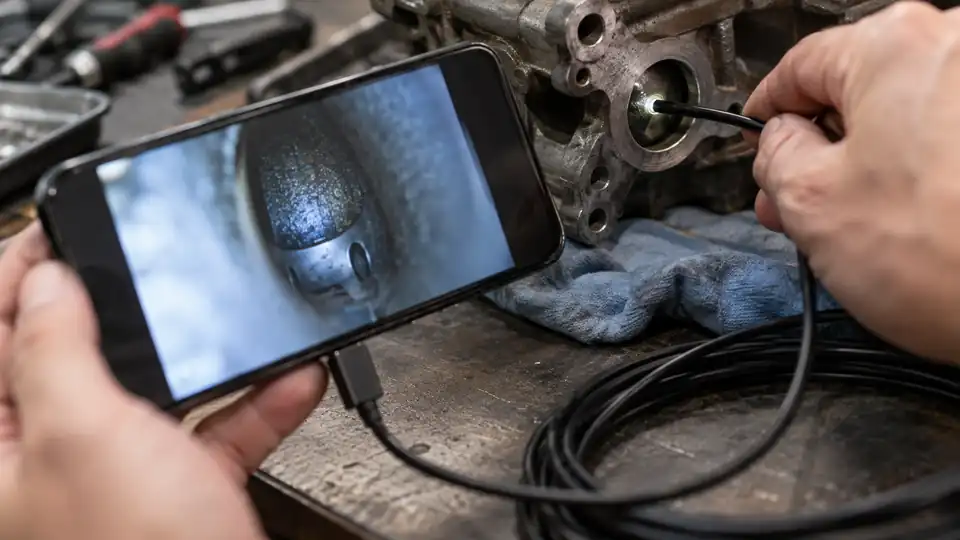
A USB-C borescope can turn a phone into a small inspection monitor for places your eyes cannot reach. That makes it useful for checking engine bays, plumbing traps, HVAC ducts, wall cavities, appliances, and machinery without immediately taking everything apart. The connection is only the starting point, though. Probe diameter, cable behavior, lighting, phone support, viewing angle, and recording features determine whether the camera is genuinely useful once it disappears into a dark opening.
A narrow probe may reach a spark-plug opening that a larger camera cannot, while a long cable can reach farther but become harder to guide in a cramped workspace. Active articulation is another major dividing line. A semi-rigid cable can hold a bend, but it does not steer the camera tip like a joystick-controlled articulating probe. USB-C also requires checking software and operating-system support, since a matching connector does not guarantee compatibility with every phone, tablet, or computer.
The products below cover several practical approaches, from compact articulating cameras to long-reach dual-lens inspection tools. The comparison focuses on the information supplied for each model, with particular attention to USB-C connectivity, device support, probe access, cable length, lighting, recording, and inspection use.
Quick Answer
For the broadest combination of USB-C phone support, cable reach, lighting, and straightforward operation, the Teslong 10FT USB C Endoscope Camera is the strongest general-purpose choice in this selection. Its 10-foot semi-rigid cable gives it more reach than the short articulating options, while compatibility with newer USB-C iPhones, USB-C iPads, and Android devices with OTG support makes it useful across several phone setups.
If controlled tip direction matters more than reach, the Teslong USB-C Two-Way Articulating Borescope offers joystick control and a 180-degree articulation range. The Ralcam Two-Way 210° Articulating Borescope is a useful alternative with a slimmer 6.2 mm probe and a wider stated articulation range. For narrow openings and long pipe or cavity runs, the CleerView combines a 3.9 mm lens with an 11.5-foot cable.
Best USB-C Borescope Comparison Table
| Product | Best For | USB-C Support | Probe or Cable | Viewing Features |
|---|---|---|---|---|
| Teslong 10FT USB C Endoscope Camera | General phone-based inspection | iPhone 15/16/17, USB-C iPad, Android OTG | 10 ft semi-rigid cable | 8 LEDs, IP67 probe |
| Teslong USB-C Two-Way Articulating Borescope | Controlled tip direction | iPhone 15+ and Android USB-C | 5 ft semi-rigid gooseneck | 180° articulation, 8 LEDs |
| Ralcam Two-Way 210° Articulating Borescope | Tight access and engine work | iPhone iOS 12+, Android 10+ OTG | 6.2 mm probe, 3.3 ft tube | 210° articulation, 8 LEDs |
| CleerView 3.9mm HD USB-C Endoscope | Narrow gaps and pipe inspection | Compatible Android OTG | 3.9 mm lens, 11.5 ft cable | 6 LEDs, IP67 lens |
| MUCAR E021 USB Endoscope Borescope | Automotive tools and computers | Type-C, USB 2.0, Micro-USB | 5.5 mm camera, 35.4 in cable | 720P, 30 fps, accessories |
| BlueFire 16.4FT Endoscope Borescope | Long-reach inspections | Type-C, USB, iOS interfaces | 16.4 ft semi-rigid cable | Dual lens, 9 LEDs, IP67 |
| BlueFire 11.5FT Endoscope Borescope | Long reach with less cable to manage | Type-C, USB, iOS interfaces | 11.5 ft semi-rigid cable | Dual lens, 9 LEDs, IP67 |
| DEPSTECH NTC55 2K Phone Borescope | USB-C Dual-View Recording on a Phone | USB-C and Lightning adapter; Android OTG required | 7.9 mm front/side camera head; 16.5 ft semi-rigid cable | Phone display; dual cameras; 8+1 LEDs |
| 7.9mm Dual-Lens Phone Borescope | Multiple Connectors With Dual Views | USB-C, Lightning, and Android connector options | 7.9 mm dual-lens camera; 16.4 ft semi-rigid cable | Phone screen; front and side cameras |
The detailed reviews explain how each USB-C inspection camera handles access, control, lighting, phone compatibility, and documentation.
1. Teslong 10FT USB C Endoscope Camera — Best Overall

The Teslong 10FT earns the top position by covering the everyday inspection jobs most people have in mind when searching for a USB-C borescope. Its 10-foot semi-rigid cable can reach behind appliances, into vehicle spaces, through wall cavities, and along plumbing paths while retaining enough shape to help guide the camera. That reach is more useful for larger spaces than a short probe, although extra cable can take more effort to coil and control in a small work area.
Compatibility is clearly defined rather than left to the connector alone. The product information lists iPhone 15, 16, and 17 models, USB-C iPads, and Android devices running Android 8.0 or later with OTG enabled. It does not support older Lightning iPhones and iPads, Windows PCs, or MacBooks. Eight LEDs and integrated white balance support visibility in dark cavities, while the IP67 rating applies to the camera area described by the listing, so the phone and connector should still be kept away from water.
Pros
- 10-foot semi-rigid cable provides useful reach for walls, vehicles, plumbing, and appliances.
- Supports listed USB-C iPhone 15, 16, and 17 models and USB-C iPads.
- Android compatibility includes devices running Android 8.0 or later with OTG support.
- Eight LEDs and integrated white balance help illuminate dark inspection areas.
- IP67-rated camera design is suited to inspections involving dust or damp areas.
Cons
- It does not support older iPhones or iPads with Lightning ports.
- The listing does not identify support for Windows PCs or MacBooks.
This is the sensible starting point for a reader who wants one USB-C inspection camera for several household and automotive tasks. It gives up active tip steering, so it may require more repositioning inside a sharply curved path than either articulating Teslong or Ralcam model. Buyers should confirm phone support and enable Android OTG before ordering, but those who want reach and broad current USB-C phone coverage will find a well-balanced setup here.
To buy this product, click here.
2. Teslong USB-C Two-Way Articulating Borescope — Best for Controlled Tip Direction

A joystick-controlled tip changes the experience dramatically in an engine bay or behind a wall. The Teslong articulating model provides 180-degree two-way movement, allowing the operator to redirect the camera after insertion instead of repeatedly twisting the entire cable. That feature is particularly useful around pipe bends, HVAC spaces, cylinder interiors, and crowded mechanical assemblies where the opening is easy to reach but the target sits off to one side.
The five-foot semi-rigid gooseneck is shorter than the 10-foot Teslong, yet the reduced length can improve handling over a workbench or beneath a vehicle. The product description lists a 1.0MP camera, 1080P photo and video capture, eight adjustable LEDs, and three brightness levels. The free SmartEndoscope app handles viewing and recording without an account or subscription, while the phone holder may require removal of a thick case on some larger phones.
Pros
- Joystick provides documented 180-degree two-way tip articulation.
- Five-foot semi-rigid gooseneck balances reach with manageable cable control.
- Supports 1080P photo and video capture through the app.
- Eight adjustable LEDs offer three brightness levels for dark or reflective surfaces.
- USB-C support covers iPhone 15 and newer models and Android phones.
Cons
- Five-foot reach is limited for long pipes, deep cavities, or large equipment.
- Thick phone cases may need to be removed from some larger devices.
This model fits inspections where the camera needs to look around an obstruction rather than travel a long distance. It is a stronger choice than a fixed semi-rigid snake for controlled viewing, but the shorter probe should be treated as a deliberate trade-off. Choose it for directional control near the access point, and look elsewhere if the main challenge is reaching far down a pipe or cavity.
To buy this product, click here.
3. Ralcam Two-Way 210° Articulating Borescope — Best for Tight Access

The Ralcam takes a more compact approach to directional inspection. Its listed 6.2 mm probe and two-way 210-degree articulation make it suited to spaces where a larger camera head or fixed cable would struggle to get a useful view. An engine opening, wall gap, or narrow mechanical passage can present a frustrating target just beyond a bend. Active steering helps place the camera without pulling the probe back and starting over.
Its 3.3-foot flexible snake tube is relatively short, so this is a close-access tool rather than a long-range pipe camera. The USB-C connection supports iPhones running iOS 12 or later and Android 10 or later with OTG, while the app provides live viewing, photos, video, and sharing. Eight LEDs with three brightness settings address dark or reflective surfaces, and the listed IP67 protection applies to the probe lens area rather than automatically covering the phone or the full connection.
Pros
- Documented 210-degree two-way articulation helps steer around obstacles.
- 6.2 mm probe is suited to relatively narrow access points.
- Supports photos, videos, live viewing, and sharing through the phone app.
- Eight LEDs provide three brightness settings for different inspection conditions.
- One-hand operation and a 3.3-foot tube support close-range work.
Cons
- Short 3.3-foot reach is less suitable for deep cavities or extended pipe runs.
- Android support requires Android 10 or later and OTG compatibility.
The Ralcam is a good fit for buyers who value access and steering over cable length. Its narrower probe and broader stated articulation range give it a strong role around engines, hoses, and machinery, while the short tube keeps it from becoming unwieldy. A long-reach fixed camera remains more appropriate for a drain or wall cavity that extends several feet beyond the entry point.
To buy this product, click here.
4. CleerView 3.9mm HD USB-C Endoscope — Best for Narrow Gaps

A 3.9 mm lens is the defining reason to look at the CleerView. Narrow drain paths, wall gaps, appliance spaces, and small mechanical openings can reject bulkier inspection cameras before the inspection even begins. The 11.5-foot semi-rigid cable adds reach for plumbing and HVAC work, though a long cable needs room to be laid out and guided. Its shape-holding design should help with positioning compared with a completely loose cable.
The product information describes a 1280P camera, six adjustable LEDs, and a free app for live viewing, photos, and video on a compatible Android phone. USB-C connection is direct and requires Android OTG support. The IP67 claim is attached to the lens, which is useful around damp inspection points, but it should not be treated as protection for the Android phone, connector, or complete system.
Pros
- 3.9 mm lens provides access to narrow gaps and wet, tight spaces.
- 11.5-foot semi-rigid cable reaches farther than short inspection probes.
- Six adjustable LEDs help control glare and shadows in dark cavities.
- App supports live viewing, photos, and video recording.
- USB-C connection requires no Wi-Fi or separate camera battery.
Cons
- The supplied compatibility information is specific to Android devices with OTG support.
- It does not provide active tip articulation.
Choose the CleerView when the opening itself is the main obstacle. It has the reach and narrow lens for pipe, wall, and appliance work, but it cannot redirect the camera tip once inserted. Buyers who inspect around tight corners may prefer the Ralcam, while those tracing a longer, mostly accessible path may benefit more from CleerView’s slender lens and extended cable.
To buy this product, click here.
5. MUCAR E021 USB Endoscope Borescope — Best for Broad Connector Support

The MUCAR E021 stands apart through its broad connection options. The listing identifies Type-C, USB 2.0, and Micro-USB support, along with compatibility across several MUCAR and THINKSCAN diagnostic tools, Android phones, and Windows computers. That makes it more adaptable for a workbench containing scanners and older devices, although buyers should match the exact connector and software requirements to their equipment before purchase.
Its 5.5 mm camera uses a listed 2.8 mm sensor and six adjustable LEDs, with a 74-degree field of view and a stated 3 to 8 cm focal range. The 35.4-inch flexible cable is shorter than the long-reach choices, but the kit includes a mirror, magnet, and hook for viewing around corners or retrieving small objects. Still images are listed as JPEG and video as AVI at 30 frames per second, giving the system a practical documentation role.
Pros
- Supports Type-C, USB 2.0, and Micro-USB connection formats.
- Compatibility includes listed MUCAR and THINKSCAN diagnostic tools.
- 5.5 mm camera and 3 to 8 cm focal range suit close inspection work.
- Included mirror, magnet, and hook add retrieval and alternate-view capability.
- 30 fps video and JPEG still-image capture support inspection records.
Cons
- 35.4-inch cable provides less reach than the 10-foot and longer models.
- The included mirror is an attachment and does not create a second camera or active articulation.
The E021 makes the most sense for a mixed USB workbench, especially where an inspection camera needs to connect to diagnostic equipment as well as a phone. Its accessory set is practical for retrieving a dropped metal item or looking around a corner, but it should not be mistaken for a dual-lens or articulating system. Select it for connector flexibility and documentation, not for maximum reach.
To buy this product, click here.
6. BlueFire 16.4FT Endoscope Borescope — Best for Long Reach

When the inspection point is far beyond arm’s reach, the BlueFire 16.4FT offers the longest stated cable in this selection. That extra distance can help with wall cavities, extended duct paths, vehicle spaces, and other locations where a five-foot probe stops short. The trade-off is handling. More semi-rigid cable can be useful when it needs to push forward, yet it can also create loops and require more workspace during setup.
The listing describes a dual-lens camera, a 1920×1440 resolution claim, nine adjustable LEDs, and a 3 to 10 cm focal length. Dual-lens viewing can provide another camera perspective, but it is different from active articulation and does not necessarily steer the tip. USB, Type-C, and iOS interfaces are listed, along with an app supporting Android 4.2 or later and iOS 9.0 or later. The product information also identifies IP67 protection for inspection in damp settings.
Pros
- 16.4-foot semi-rigid cable offers the longest stated reach here.
- Dual-lens design provides more than one viewing perspective.
- Nine adjustable LEDs allow brightness control in dark areas.
- Type-C, USB, and iOS interfaces broaden connection options.
- Listed 3 to 10 cm focal length supports close inspection of nearby details.
Cons
- Long cable length may be harder to manage in small workspaces.
- Dual-lens viewing does not provide active mechanical articulation.
This BlueFire is the reach specialist. It is a better match for a distant inspection path than the compact articulating models, while its second viewing perspective may reduce the need to withdraw and reposition the probe. Buyers should verify which connector and app combination fits their phone, and should avoid assuming that the IP67 claim covers the entire connected setup.
To buy this product, click here.
7. BlueFire 11.5FT Endoscope Borescope — Best for Balanced Long Reach

The 11.5-foot BlueFire keeps the same general dual-lens and lighting approach as the longer model while reducing the amount of cable to manage. That can be helpful under a vehicle, around an appliance, or near a wall opening where 16.4 feet would leave extra loops on the floor. It remains a semi-rigid snake camera, so the operator guides the cable physically rather than using a joystick to steer the distal tip.
The product information lists a 1920×1440 camera resolution claim, a 3 to 10 cm focal length, nine adjustable LEDs, and IP67 protection. It also lists Type-C, USB, and iOS interfaces, with app support for Android 4.2 or later and iOS 9.0 or later. As with the 16.4-foot version, the dual-lens system should be understood as a viewing feature rather than articulation. It can show another perspective, but it does not bend the camera tip around a corner.
Pros
- 11.5-foot semi-rigid cable offers substantial reach with less excess than the 16.4-foot version.
- Dual-lens viewing can provide an additional perspective during inspection.
- Nine adjustable LEDs support brightness changes in dark spaces.
- Type-C, USB, and iOS interfaces provide several connection paths.
- Listed app compatibility covers Android 4.2 or later and iOS 9.0 or later.
Cons
- It does not offer active articulation for steering the camera tip.
- The product information does not specify the exact phone model compatibility for every listed interface.
This version suits readers who want long reach but expect to work in a more contained area than the 16.4-foot model serves. It gives up some distance while retaining the stated dual-lens and nine-LED configuration. Confirm the required app and connector before ordering, especially if the inspection will rely on a particular iPhone or Android device.
To buy this product, click here.
8. DEPSTECH NTC55 2K Phone Borescope — Best for USB-C Dual-View Recording on a Phone

The DEPSTECH NTC55 uses a 7.9 mm dual-camera head and a 16.5-foot semi-rigid cable, sending the image to a compatible phone. A USB-C connector and Lightning adapter cover different devices, while the DEPSTECHCAM app handles the viewing and capture controls.
The NTC55 uses a USB-C connector with an additional Lightning option, making it useful for a supported phone that will also store inspection images. Android buyers should check OTG and app requirements rather than assuming that the connector shape alone guarantees operation.
The front and side cameras are useful for checking both the route ahead and a surface beside the probe. Phone-based capture makes it convenient to retain a reference image or compare the same area later. The app also provides image rotation and zoom, and the cable holds a prepared shape while remaining flexible enough to coil for storage. Compatibility deserves attention before ordering: the supported systems are iOS 11 or later and Android 9 or later, with OTG support required on Android. There is no separate monitor in the kit, so the phone must remain accessible and protected throughout the inspection. The cameras switch direction electronically; the tip itself is not mechanically steered.
Pros
- Forward and side cameras provide two perspectives.
- Photo and video capture use the phone’s viewing workflow.
- USB-C and Lightning connection options suit different devices.
Cons
- Requires DEPSTECHCAM and a supported phone; Android needs OTG.
- No mechanical tip articulation or separate display.
Choose this configuration for uSB-C Dual-View Recording on a Phone.
To buy this product, click here.
9. 7.9mm Dual-Lens Phone Borescope — Best for Multiple Connectors With Dual Views

This dual-lens phone borescope combines a 7.9 mm head with a 16.4-foot semi-rigid cable. The front and side views let the operator examine the route ahead and the adjacent surface through a compatible phone using the SUP-ANESOK app.
The supplied USB-C option suits a compatible phone running SUP-ANESOK, with other connectors available in the kit. The front and side cameras make this more versatile than a basic forward-only cable, but it still depends on a supported host device.
A phone connection keeps the inspection kit compact while providing a convenient place to view and retain images. The cable can be shaped before feeding it into the opening, and adjustable lighting helps when a nearby surface reflects too much light. The supplied connector options include USB-C, Lightning, and an Android connection, but the phone still needs to support the app and camera connection. Keep the viewing device away from water and dirt even when the camera head is being used in a damp space. The side camera changes the viewpoint without changing the physical shape of the tip; a tight bend may still require a different access point.
Pros
- Front and side viewing in a compact phone-connected kit.
- 16.4-foot semi-rigid cable supports a prepared inspection route.
- Multiple connectors accommodate different supported phones.
Cons
- Viewing depends on the phone and SUP-ANESOK app.
- The camera tip does not mechanically articulate.
Choose this configuration for multiple Connectors With Dual Views.
To buy this product, click here.
Buying Guide
USB-C Requires Device and Software Compatibility
A USB-C plug tells you how the camera connects physically, not whether every USB-C device can run it. The Teslong 10FT model lists specific newer iPhone and iPad support, while its Android requirement includes OTG. The Ralcam and CleerView also require particular Android conditions. Check the operating system, OTG support, app, and connector before ordering, especially if the camera will be used with a work phone rather than a personal device.
Probe Diameter Determines Access
The CleerView’s listed 3.9 mm lens targets narrow gaps, while the Ralcam lists a 6.2 mm probe and the MUCAR E021 lists a 5.5 mm camera. A smaller camera can enter more openings, but diameter alone does not establish image quality, focus, or ease of control. Match the camera size to the actual access hole rather than choosing the smallest number automatically.
Active Articulation Is Different From Cable Flexibility
The Teslong and Ralcam articulating models use two-way tip movement controlled from the handle. That lets the operator change the camera’s viewing direction after insertion. A semi-rigid cable can bend and hold a shape, and a dual-lens system can provide another view, but neither feature should be treated as active articulation.
Long Cables Add Reach and Handling Demands
The BlueFire 16.4FT reaches farther than the Teslong 5FT articulating model, but the added cable needs more room to lay out and guide. The CleerView’s 11.5-foot cable suits longer pipe or cavity paths, while the Ralcam’s 3.3-foot tube is easier to manage around a close inspection. Cable length should follow the distance to the target, not serve as a quality score by itself.
Lighting Affects What the Camera Can Show
Every camera here uses built-in LEDs, but the count varies from six to nine. Adjustable brightness matters because a shiny metal surface can reflect too much light, while a dark cavity may need more illumination. White balance, focus distance, camera stability, and the phone display also affect the useful image, so a higher advertised resolution does not guarantee a clearer inspection.
Understand IP67 Claims
Several listings identify IP67 protection for the camera or lens area. That does not automatically make the phone, connector, handle, or complete connected system waterproof. Keep the phone and electrical connections away from water, and follow the product’s instructions for damp or submerged environments. A water-resistant probe is still a reason for caution around drains, plumbing, and other wet spaces.
Dual-Lens Viewing Does Not Mean Two-Way Steering
The BlueFire models list dual-lens cameras, which can provide more than one viewing perspective. This may reduce the need to withdraw and reposition the probe, but the system still uses a semi-rigid cable rather than a joystick-controlled articulating tip. Choose dual-lens viewing for perspective, and choose articulation for directional control.
Best USB-C Borescope FAQ
Do all USB-C borescopes work with every USB-C phone?
No. The phone must support the camera’s app and operating-system requirements, and Android devices may require OTG support. Some models list compatibility with specific iPhone generations or Android versions. Confirm the exact phone requirements before buying.
Can these cameras connect to an older iPhone with a Lightning port?
The Teslong 10FT model specifically excludes older iPhones and iPads with Lightning ports. A USB-C model should not be assumed to work through an adapter unless the product information clearly supports that arrangement. Buyers with a Lightning iPhone should select a camera with documented compatibility for that connector.
Which USB-C borescope is best for looking around corners?
The Teslong USB-C Two-Way model and Ralcam Two-Way model provide active tip articulation. The Teslong lists 180-degree movement, while the Ralcam lists 210-degree two-way articulation. These features help redirect the camera after insertion, unlike a standard bendable cable.
Can a USB-C borescope inspect a car engine?
Several models list automotive or engine inspection among their intended uses. The Ralcam identifies engine cylinders and hoses, while the Teslong models list automotive inspection. Allow machinery to cool, keep the camera away from moving parts, and confirm that the probe can fit the specific access opening before use.
Is a dual-lens borescope the same as an articulating borescope?
No. Dual-lens viewing provides multiple camera perspectives, while articulation changes the direction of the camera tip. The BlueFire models list dual lenses but use semi-rigid cables. The Teslong and Ralcam models list active two-way articulation.
Can these cameras record photos and videos?
Recording support varies by model and app. The Teslong articulating model lists 1080P photo and video capture, the Ralcam lists photos and video, and the CleerView lists both through its app. The MUCAR E021 lists JPEG still images and AVI video. Check the app and device requirements before relying on a recording feature for documentation.
Is a longer cable always better for plumbing inspection?
No. A long cable can reach farther into a pipe, wall, or duct, but it can also be harder to guide and store. The CleerView and BlueFire models suit longer paths, while shorter articulating models offer better control near an access point. Choose based on the distance and shape of the inspection route.
Final Verdict
Additional options: DEPSTECH NTC55 2K Phone Borescope suits uSB-C Dual-View Recording on a Phone; 7.9mm Dual-Lens Phone Borescope suits multiple Connectors With Dual Views. Choose the configuration that fits the access route and your recording needs.
The Teslong 10FT USB C Endoscope Camera is the strongest overall choice here because it combines substantial reach, eight LEDs, a semi-rigid cable, and clearly stated support for newer USB-C iPhones, USB-C iPads, and Android phones with OTG. It is the most balanced option for general vehicle, home, plumbing, and appliance inspections, provided the phone matches the listed requirements.
Choose the Teslong Two-Way model or Ralcam if steering the camera tip matters more than reach. The Ralcam’s listed 6.2 mm probe and 210-degree articulation suit tighter access, while the Teslong gives a longer five-foot articulating tube and a phone holder. For long paths, CleerView offers a slim 3.9 mm lens and 11.5-foot cable, and BlueFire provides dual-lens viewing with 11.5-foot or 16.4-foot reach. Match the camera to the opening, distance, phone, and viewing problem before placing an order.
