
A borescope earns its keep when a normal flashlight and a pair of eyes stop being useful. A camera needs to pass through a spark-plug opening, disappear into a drain, or look behind an HVAC panel while the screen shows what is hidden inside. For a 1080p model, the buying decision extends beyond the resolution label. Probe diameter, focus range, lighting, cable control, viewing direction, recording capability, and whether the unit has its own screen can matter more during an actual inspection.
A fixed semi-rigid probe is often enough for a pipe, wall cavity, or appliance. Engine work and machinery inspection can be more demanding because the camera may need to look around an obstruction after insertion. Dual-lens systems provide front and side views, while articulating models steer the camera tip mechanically. Those functions solve different problems, and a longer cable does not automatically make a borescope easier to control. Recording also deserves a close look. Several models provide a live 1080p view but do not capture photos or videos.
This comparison weighs the available 1080p inspection cameras by their documented viewing systems, probe reach, control method, screen setup, lighting, storage, and intended use. Some are better suited to quick household checks, while others provide the directional control or documentation features needed for repeated automotive and industrial work.
Quick Answer
- Best Overall: The FOXWELL Dual Lens Two-Way Articulating Borescope combines 220-degree two-way articulation, dual cameras, built-in storage, a screen, and a documented heat-protection feature.
- Best for Long Reach: The DEPSTECH DS300 uses a 16.5-foot semi-rigid cable with front and side cameras, making it useful for pipes, ducts, walls, and other extended paths.
- Best for Slim Engine Access: The TORQBEAST Ultra-Slim Borescope has a listed 6 mm probe, 210-degree articulation, dual-lens viewing, and included TF-card storage.
- Best for Basic Phone-Free Inspection: The 1080P HD Borescope with 4.3-inch IPS Screen offers direct viewing without a phone, app, or Wi-Fi connection.
Best 1080p Borescope Comparison Table
| Product | Best For | Probe or Cable | Viewing System |
|---|---|---|---|
| FOXWELL Dual Lens Two-Way Articulating Borescope | Overall inspection control | 5.3 ft semi-rigid probe | 220° articulation, dual lens |
| DXZtoz Two-Way Articulating Borescope | Close engine and HVAC work | 5.5 ft, 8.5 mm camera | 220° articulation, 4.3-inch screen |
| TORQBEAST Ultra-Slim Borescope | Small engine openings | 6 mm, 5 ft | 210° articulation, dual lens |
| DEPSTECH DS650 Articulating Borescope | Long articulating reach | 10 ft semi-rigid cable | 210° articulation, dual lens |
| DXZtoz Dual Lens Articulating Borescope | Large-screen viewing | Articulating probe | 5-inch screen, front and side cameras |
| DEPSTECH DS300 | Long cable, plumbing, and ducts | 16.5 ft semi-rigid cable | Front and side cameras |
| 5-Inch Dual-Lens Inspection Borescope | Basic pipe and drain checks | 16.4 ft semi-rigid cable | Front and side cameras |
| T TAKMLY Dual Lens Endoscope | Long runtime and broad access | 16.4 ft semi-rigid cable | Front and side cameras |
| 1080P HD Borescope with 4.3-Inch IPS Screen | Phone-free household checks | 16.5 ft semi-rigid cable | Single camera, integrated screen |
The reviews below look past the 1080p label to explain how each camera handles access, viewing direction, documentation, and wet or confined inspection work.
1. FOXWELL Dual Lens Two-Way Articulating Borescope – Best Overall
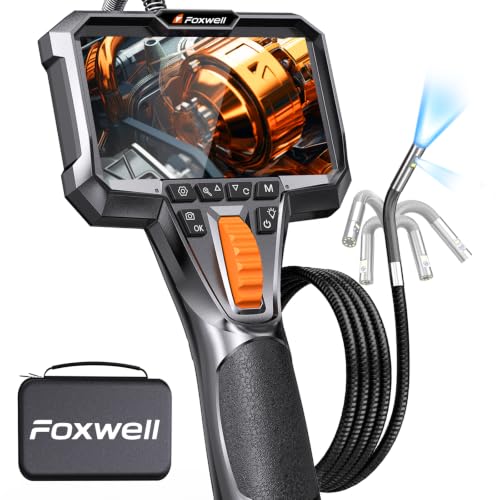
The FOXWELL model brings together the features that matter most when a camera must be positioned rather than merely pushed forward. Its documented 220-degree two-way articulation is controlled with a wheel, so the distal camera can be steered around an obstruction instead of relying on repeated cable twisting. A dual-lens setup adds front and side views, which is useful when a target sits beside the insertion path. That combination makes it a stronger fit for engine cavities, HVAC equipment, machinery, and awkward pipe paths than a basic fixed snake camera.
Its 5.3-foot semi-rigid probe is shorter than the long-reach DEPSTECH models, but the trade-off is easier control in close work. The listing describes six adjustable LEDs, an HD IPS screen, IP67 construction for the inspection camera, and built-in 32GB storage for photos and video. It also lists a 5-to-7-hour runtime and a heat-protection system that shuts the device down at 158°F. The included carrying case helps keep the handheld unit organized, although hooks, magnets, and side mirrors are not included.
Pros
- Documented 220-degree two-way mechanical articulation.
- Dual front and side cameras reduce the need to reposition the probe.
- Built-in 32GB storage supports photo and video documentation.
- 5.3-foot semi-rigid probe suits close machinery and engine inspections.
- Integrated heat protection and IP67-rated inspection camera construction are listed.
Cons
- Hooks, magnets, and side mirrors are not included.
- The shorter probe is less suitable for very deep pipe runs.
This is the most balanced choice for buyers who need directional control, dual viewing, and recorded evidence in one self-contained system. It is less compelling for a simple drain check where a 16-foot cable matters more than articulation. For repeated inspections, the storage and steering controls give it a clear advantage over fixed cameras.
To buy this product, click here.
2. DXZtoz Two-Way Articulating Borescope – Best for Close Controlled Viewing

A control wheel and 220-degree two-way articulation give this DXZtoz a useful advantage inside compact mechanical spaces. The product information lists an 8.5 mm camera, an adjustable focal distance from 1 to 15 cm, eight LEDs with four brightness settings, and 8X zoom. Those details point toward close inspection of valves, pistons, spark-plug areas, HVAC components, and wall cavities where the camera must be aimed at a particular surface.
The 5.5-foot metal gooseneck is long enough for many vehicle and equipment tasks without becoming a loose coil in the operator’s hands. Its 4.3-inch IPS monitor works without an app, and the listing gives the rechargeable 3000mAh battery a runtime of up to four hours. A hook, magnet tip, side mirror, and protective case are included. The mirror is an accessory for side viewing, so it should not be confused with the product’s mechanical articulation or with a second camera.
Pros
- 220-degree two-way articulation provides genuine tip steering.
- 1-to-15 cm focal distance supports close inspection work.
- Eight LEDs offer four listed brightness settings.
- Integrated 4.3-inch IPS monitor avoids phone and app dependence.
- Hook, magnet tip, side mirror, and carrying case are included.
Cons
- The 8.5 mm camera may not fit openings suited to slimmer probes.
- The listing does not identify built-in photo or video storage.
This model suits someone who wants a controlled, screen-based tool for engine bays and equipment rather than a long sewer camera. The probe is larger than the TORQBEAST’s listed 6 mm design, but the longer focal range and four-level lighting control may be more useful once the camera is inside a roomy cavity. Skip it if documentation is central to the job or if the access opening is especially narrow.
To buy this product, click here.
3. TORQBEAST Ultra-Slim Borescope – Best for Slim Engine Access

Access is the reason to look closely at the TORQBEAST. The listing identifies a 6 mm probe, which is slimmer than the 8.5 mm and 8 mm camera dimensions listed for several alternatives here. That can make a meaningful difference around glow-plug openings, narrow engine spaces, wall cavities, and small pipes. A slim probe does not guarantee a better picture, but it can reach inspection points that a larger camera cannot.
Once inserted, the 210-degree articulating head and dual-lens arrangement provide two ways to look around the target. The five-foot semi-rigid cable favors controlled close work rather than deep pipe runs. A built-in screen operates without Wi-Fi or a phone, while the included TF card is intended for saving photos and videos. Three adjustable LED levels are listed, along with IP67 protection for the probe and a 1080p display claim.
Pros
- Listed 6 mm probe supports access through smaller openings.
- 210-degree articulation helps aim the camera after insertion.
- Dual-lens design supplies front and side viewing.
- Included TF card supports saved photos and videos.
- Phone-free operation uses an integrated color display.
Cons
- The five-foot cable offers less reach than 10-foot and 16.5-foot models.
- Three LED brightness levels provide less adjustment than some competitors.
The TORQBEAST is the logical choice when the entry point is the limiting factor. It gives up cable length, but that is a reasonable exchange for a listed 6 mm probe and articulating head. Buyers checking long drains or distant ducts should choose a longer fixed or articulating model instead.
To buy this product, click here.
4. DEPSTECH DS650 Articulating Borescope – Best for Long Articulating Reach

The DS650 sits between a close engine probe and a long plumbing camera. Its 10-foot semi-rigid gooseneck provides more reach than the five-foot articulating models, while documented 210-degree bidirectional articulation keeps the tip steerable around obstacles. A side-mounted control wheel is intended for one-handed positioning. That matters in a cramped workspace where one hand guides the cable and the other manages the display or nearby equipment.
Two 78-degree lenses provide front and side views, and the 4.5-inch IPS screen works without Wi-Fi or an app. The listing also identifies manual focus from 3 to 8 cm, 1.5X zoom, three LED brightness levels, photo and video capture, and an included 8GB TF card. Its 2200mAh battery is listed for more than four hours of continuous operation. A high-temperature warning is included, but users should still follow equipment cooling and safe inspection procedures.
Pros
- 10-foot semi-rigid cable adds reach without giving up articulation.
- 210-degree bidirectional steering supports controlled positioning.
- Dual 78-degree lenses provide front and side views.
- Manual focus, 1.5X zoom, and photo or video capture are listed.
- Included 8GB TF card and carrying case support field use.
Cons
- The listing does not clearly state the probe diameter.
- Three brightness levels offer less lighting adjustment than some models.
This is a strong fit for inspections that go farther than an engine bay but still require directional control. The unspecified probe diameter deserves attention before ordering if a narrow opening is involved. For buyers who need a known slim probe, TORQBEAST is easier to evaluate; for reach and documentation together, the DS650 is more capable.
To buy this product, click here.
5. DXZtoz Dual Lens Articulating Borescope – Best With a Large Screen

A five-inch IPS display gives this DXZtoz a larger viewing surface than the 4.3-inch and 4.5-inch screens used by several alternatives. That can make small marks, corrosion, or deposits easier to inspect at a glance, although display size alone does not establish superior camera detail. The listing also identifies 10X zoom and a 90-degree side camera, creating a useful combination for looking beside the probe rather than repeatedly rotating the entire cable.
The articulating probe is intended for engine cylinders, turbochargers, gearboxes, turbine blades, combustion chambers, and HVAC blockages. A front-exit cable design is described as helping with probe handling, while IP67 and oil-resistant claims apply to the inspection camera according to the product information. The 3000mAh battery is listed for four to five hours, and hook and magnet tips are included. The listing does not clearly state onboard photo or video storage, so buyers needing inspection records should confirm that function.
Pros
- Five-inch IPS screen provides a larger live viewing area.
- Listed 10X zoom supports examination of small visible details.
- Articulating probe and side camera offer two viewing approaches.
- 3000mAh battery is listed for four to five hours of operation.
- Hook and magnet tips are included for retrieval tasks.
Cons
- The listing does not clearly identify photo or video recording capability.
- Probe diameter is not clearly stated in the product information.
Choose this model when screen size and side viewing matter more than a documented slim probe or long cable. It is especially suited to close machinery inspection where the operator can keep the display nearby. Buyers working through tiny access points or needing saved evidence should verify the missing details before purchase.
To buy this product, click here.
6. DEPSTECH DS300 Dual Lens Inspection Borescope – Best for Long Fixed-Cable Reach
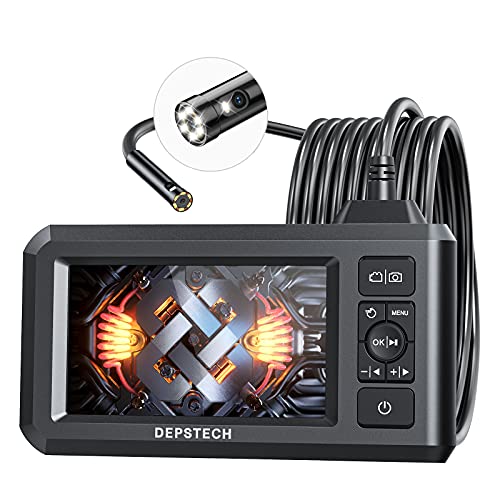
The DS300 is built around reach and viewing flexibility rather than active tip steering. Its 16.5-foot semi-rigid cable can hold a shaped path through ducts, walls, drains, and machinery, while the front and side cameras let the operator switch perspective without fitting a mirror. The listing gives the front camera a 3-to-8 cm focal range and the side camera a 2-to-6 cm range. Those close working distances are more useful when the lens is positioned near the surface being inspected.
A 4.3-inch IPS screen, 1080p live video claim, seven adjustable LEDs, and three observation modes make the unit self-contained. The product information also lists a 70-degree wider-view setting, 180-degree camera orientation, and about four hours of continuous operation. A hook and magnet are included, but no TF card is listed. The cable’s length is valuable for extended paths, although it cannot provide the same directional correction as a mechanically articulating probe.
Pros
- 16.5-foot semi-rigid cable supports extended inspection paths.
- Front and side cameras can be switched during inspection.
- Front and side focal ranges are listed for close viewing.
- Seven LEDs and three observation modes provide viewing adjustment.
- Integrated screen and approximately four-hour runtime support phone-free work.
Cons
- The probe is not described as mechanically articulating.
- No TF card is listed in the package information.
The DS300 makes sense for plumbing, duct, wall, chimney, and machinery checks where cable reach is the primary obstacle. Its dual-lens design improves viewing direction, but it should not be selected as a substitute for active articulation around complex engine components. If a long cable and side view solve the task, it is a more natural fit than a shorter steering model.
To buy this product, click here.
7. 5-Inch Dual-Lens Inspection Borescope – Best for Basic Pipe and Drain Checks

This inspection camera focuses on straightforward viewing in pipes, drains, HVAC paths, and automotive spaces. Its five-inch screen has a listed 170-degree viewing angle, while the dual-lens head switches between forward and side views. The 16.4-foot semi-rigid probe can be shaped as it enters a narrow path, and the listed 1.2-to-4-inch focus range is aimed at close inspection of cracks, corrosion, and other visible defects.
Eight adjustable LEDs and an IP67 claim for the camera probe support dark or damp inspection environments. The 2000mAh battery is listed for three to four hours, and operation requires no app or Wi-Fi. The important trade-off is documentation: the product information explicitly says this model cannot take photos or videos. That makes it suitable for live troubleshooting, but less useful when an inspection needs a saved record to send to a customer or compare later.
Pros
- Five-inch display provides a broad live viewing area.
- Front and side cameras support quick perspective changes.
- 16.4-foot semi-rigid probe reaches drains, ducts, and pipes.
- Eight adjustable LEDs are listed for dark inspection areas.
- No app or Wi-Fi is required for operation.
Cons
- The product cannot capture photos or videos.
- The listing does not describe active mechanical articulation.
This is a useful live-view tool for finding a blockage, checking a damp cavity, or looking for visible pipe damage without setting up a phone. It is less appropriate for condition reports, before-and-after records, or evidence that must be shared digitally. Buyers should also treat the IP67 statement as applying to the documented camera probe, not automatically to the screen or entire system.
To buy this product, click here.
8. T TAKMLY Dual Lens Endoscope – Best for Long Runtime

The T TAKMLY pairs a 16.4-foot semi-rigid cable with front and side cameras, making it a broad-access option for walls, vents, pipes, appliances, and vehicle spaces. The product information lists an 8 mm camera diameter and a 2-to-10 cm focal range. That range is useful when the lens may sit at different distances from the target, while the side camera can reveal a nearby wall or pipe surface without a mirror attachment.
A 4.3-inch display shows the listed 1080p live image, and eight adjustable LEDs illuminate the forward view. The integrated 2000mA battery is listed for up to five hours of standby time, with about three hours required for charging. Like the other fixed dual-lens models in this group, it cannot take photos or videos. A hook, magnet, and mirror are included, but those accessories do not turn the camera into an articulating system.
Pros
- 16.4-foot semi-rigid cable provides substantial reach.
- Front and side cameras can be switched during inspection.
- Listed 2-to-10 cm focal range covers varied working distances.
- Eight adjustable LEDs illuminate the forward camera view.
- Hook, magnet, and mirror are included.
Cons
- The product cannot take photos or videos.
- The listed 8 mm camera is larger than the 6 mm TORQBEAST probe.
The T TAKMLY is best for live inspection sessions where a long cable, broad focal range, and side viewing matter more than stored files. It can be a helpful household and maintenance tool, but the 8 mm camera may be too large for some small access points. For documented inspections, a model with a TF card or built-in memory is a better match.
To buy this product, click here.
9. 1080P HD Borescope with 4.3-Inch IPS Screen – Best for Phone-Free Operation

For a quick look behind an appliance, inside a vent, or down a damp drain, a direct screen can be refreshingly simple. This model starts without a phone, app, Wi-Fi connection, or driver download. Its 4.3-inch IPS display shows the live image, while eight adjustable LEDs and a 16.5-foot semi-rigid cable help illuminate and guide the probe through narrow spaces.
The package includes a hook, magnet, side mirror, charging cable, and fixing clips. Those accessories broaden the kinds of small retrieval and side-view tasks the camera can handle, but the product information describes a single camera rather than a dual-lens system. It also explicitly says the unit cannot take photos or videos. The IP67 rating is stated for the probe, so users should avoid treating the screen and handle as fully waterproof.
Pros
- Integrated 4.3-inch IPS screen works without a phone or app.
- 16.5-foot semi-rigid cable supports household and plumbing access.
- Eight adjustable LEDs provide control in dark spaces.
- Hook, magnet, side mirror, and fixing clips are included.
- IP67-rated probe is listed for damp inspection conditions.
Cons
- The product cannot capture photos or videos.
- The single-camera design does not provide instant dual-lens switching.
This model suits occasional inspection work where simplicity is more important than steering or documentation. It is easy to deploy for a drain, wall gap, appliance, or engine-bay check, and the long cable gives it practical reach. Choose a dual-lens camera for frequent side-wall viewing, or an articulating model when the probe must be aimed around internal obstacles.
To buy this product, click here.
Buying Guide
Probe Diameter Determines Where the Camera Can Fit
A 6 mm probe can enter openings that may reject an 8 mm or 8.5 mm camera, which is why diameter deserves attention before screen size. The TORQBEAST provides the clearest listed slim-probe specification in this group. A larger camera may still offer a wider focal range or sturdier handling, so the smallest option is not automatically the best choice. Measure the access point and account for the camera head, not just the cable.
Active Articulation Is Different From a Bendable Cable
A semi-rigid cable can hold a curve, but it does not steer the camera tip by itself. The FOXWELL, DXZtoz articulating models, TORQBEAST, and DEPSTECH DS650 list mechanical articulation with a wheel or control mechanism. Fixed dual-lens cameras can change viewing direction electronically or optically, yet they still need the cable to be repositioned when the target is around a corner.
Choose Cable Length for the Actual Inspection Path
A 16.4-foot or 16.5-foot cable is useful for a drain, duct, wall cavity, or extended pipe route. A five-foot probe is easier to manage around an engine or compact machine. Extra cable can bunch up on the floor and make precise control harder, so reach should match the distance from the display to the inspection point rather than being treated as a performance score.
Dual-Lens Viewing Helps With Side Walls
A front camera looks along the insertion path, while a side camera can show a nearby pipe wall, cavity edge, or engine surface. That is different from active articulation. It is also different from a detachable side mirror, which uses a single camera and an accessory. Dual-lens systems are useful when the probe cannot be rotated freely after it enters the inspection area.
Focus Range Can Matter More Than the Resolution Label
A 1080p claim describes a resolution category, but a clear view still depends on focus distance, lighting, camera position, and the display. The DS300 lists separate focal ranges for its front and side cameras. The DXZtoz articulating model lists a 1-to-15 cm focal distance, while the DS650 lists manual focus from 3 to 8 cm. A camera that focuses at the working distance can show more useful detail than one with a larger headline number but poor focus for the task.
Recording Changes the Inspection Workflow
Some units are live-view tools only. The 5-inch dual-lens model, T TAKMLY, and basic 4.3-inch model explicitly state that they cannot take photos or videos. The TORQBEAST includes a TF card, the FOXWELL lists 32GB storage, and the DS650 lists an 8GB TF card. If the inspection needs a maintenance record, customer documentation, or a before-and-after comparison, confirm capture and storage features before ordering.
Check What the IP Rating Covers
An IP67 statement for a probe does not automatically make the display, handle, charging port, or connected phone waterproof. These products are listed for damp or wet inspection tasks, but the camera should still be used within the documented conditions and kept away from unsafe electrical, pressurized, moving, or excessively hot equipment. Allow machinery to cool and follow the product instructions before inserting a probe.
Best 1080p Borescope FAQ
Is 1080p enough for engine inspection?
1080p can provide a useful live view when the camera is focused at the right distance and the LEDs illuminate the target. Engine inspection also depends on probe diameter, articulation, and access through the relevant opening. A narrow probe with controlled positioning may reveal more practical detail than a larger camera with a higher advertised resolution but poor access.
Which type is better for a drain, a long cable or an articulating probe?
A long semi-rigid cable is usually more useful for reaching farther into a drain or pipe. Articulation helps when the camera must be directed around a nearby obstruction, but it does not replace reach. For a long path, the 16.4-foot and 16.5-foot models provide more cable than the five-foot articulating designs.
Can a dual-lens borescope see in two directions at once?
That depends on the viewing mode. Dual-lens products in this group can switch between front and side cameras, and some listings describe split-screen viewing. Switching between views is different from having a single camera physically articulate. Read the product’s display and mode description if simultaneous viewing is important.
Do all of these cameras save inspection photos?
No. The 5-inch dual-lens model, T TAKMLY, and basic 4.3-inch model are described as unable to take photos or videos. The TORQBEAST, FOXWELL, and DEPSTECH DS650 list storage or capture features. A live screen alone does not mean that the device can save files.
Is an IP67 probe safe to leave underwater?
An IP67 rating should not be treated as permission for unlimited underwater use. It applies to the component identified in the product information and may depend on specified conditions. Keep the screen, handle, connectors, and charging areas dry unless the product documentation explicitly says otherwise.
What is the benefit of an integrated screen?
An integrated screen lets the borescope operate without a phone, app, or wireless connection. That is convenient in a wet or dirty workspace and avoids compatibility questions. It does not guarantee recording, a particular display quality, or a larger image, so those features still need to be checked separately.
Should I choose a shorter probe for engine work?
A shorter probe can be easier to control around an engine, especially when the inspection point is close to the access opening. A five-foot articulating model may be more manageable than a 16-foot cable in a crowded garage. The right length depends on the distance to the target and whether the probe must travel through a long passage before reaching it.
Final Verdict
The FOXWELL Dual Lens Two-Way Articulating Borescope is the strongest overall choice in this group because it combines documented 220-degree steering, front and side cameras, onboard storage, a self-contained display, and a listed heat-protection feature. It is a particularly capable fit for engine, HVAC, machinery, and other inspections where the camera must be aimed after insertion and the result may need to be recorded.
For a slimmer entry point, the TORQBEAST is the more targeted choice because its listed 6 mm probe pairs with 210-degree articulation and TF-card storage. The DEPSTECH DS300 is better suited to long fixed-cable routes, while the basic 4.3-inch model keeps occasional phone-free checks simple. Match the camera to the access opening, working distance, viewing direction, and need for saved files before ordering. A clear 1080p label is useful, but control and access determine what the camera can actually show.
