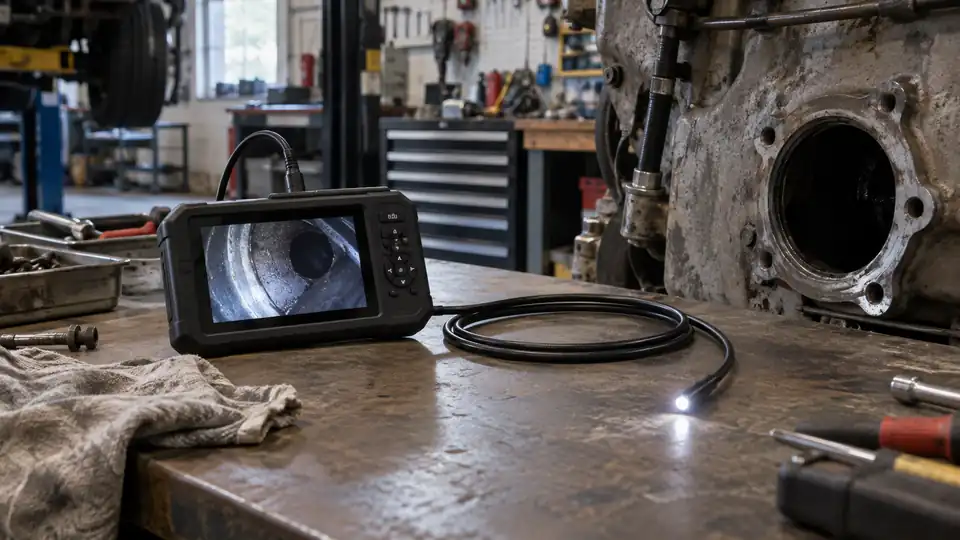
A 4K label can look persuasive on an inspection camera, but resolution alone does not determine whether a borescope will help you see inside a wall, engine bay, duct, pipe, or piece of machinery. Probe reach, camera control, lighting, display quality, and the physical shape of the inspection area usually matter just as much. A camera that reaches 16 feet with a pan-and-tilt head serves a very different purpose from a handheld close-up microscope.
The product type also deserves careful attention. A telescopic inspection camera is a genuine borescope-style tool for remote viewing, while a pocket microscope is intended for nearby specimens, slides, leaves, and insects. The latter products may use “4K” and magnification language, but they do not provide a long inspection probe, articulated camera head, or pipe-ready cable. Treating those categories as interchangeable can lead to a poor purchase, especially if you need to inspect a concealed cavity rather than a surface on a tabletop.
This comparison separates the full-length inspection camera from the compact digital microscopes in the available listings. It weighs reach, camera control, screen design, lighting, portability, recording, and the type of work each device can realistically handle. The distinction is sharp, so the comparison begins with the option that genuinely fits remote inspection.
Quick Answer
- Best Overall: Vividia TVS-500PT Telescopic Pole Pan-and-Tilt Inspection Camera, because it combines a pan-and-tilt 4K camera, a 5-meter telescopic carbon-fiber pole, a 7-inch touchscreen, white and infrared lighting, and more than three hours of stated battery life.
- Best for Portable Close-Up Observation: 1000X Handheld Microscope for Kids, although it is a microscope rather than a borescope.
- Best for Outdoor Specimen Viewing: Kids Handheld Microscope With 3-in-1 Bug Catcher, which combines a small display, camera, lighting, and a bug-catching format for educational use.
Best 4K Borescope Comparison Table
| Product | Best For | Viewing System | Reach or Magnification |
|---|---|---|---|
| Vividia TVS-500PT Inspection Camera | Remote inspection | Pan-and-tilt camera, 7-inch touchscreen | Up to 5 m / 16 ft |
| 1000X Handheld Microscope, B0GVFKLTX4 | Tabletop learning | 2.4-inch IPS screen, fixed close-up view | 200X to 1000X |
| 1000X Handheld Microscope, B0GVFCPYZ9 | Portable specimen viewing | 2.4-inch IPS screen | 200X to 1000X |
| 1000X Handheld Microscope, B0GWQHX9JK | Prepared-slide activities | 4K camera, IPS screen | 200X to 1000X |
| Handheld Microscope With Bug Catcher, B0HFS14LDX | Outdoor observation | Built-in screen and camera | Up to 1000X listed |
| Handheld Microscope With Bug Catcher, B0HFRYGT2F | Insect and leaf viewing | Built-in screen and camera | Up to 1000X listed |
| Handheld Microscope With Bug Catcher, B0HFRRMYJY | Recorded nature activities | IPS screen and 2MP camera | Up to 1000X listed |
| Handheld Microscope With Bug Catcher, B0HFR27YYM | Hands-on STEM play | Built-in screen and camera | Up to 1000X listed |
| Handheld Microscope With Bug Catcher, B0HFS7WP7Q | Portable close-up work | IPS screen and 2MP camera | Up to 1000X listed |
The detailed reviews explain where the full inspection camera fits and where the smaller microscope formats make more sense.
1. Vividia TVS-500PT Telescopic Pole Pan-and-Tilt Inspection Camera — Best Overall

The Vividia TVS-500PT is the only product in this comparison built around genuine remote inspection. Its carbon-fiber telescopic pole extends to a listed maximum of 5 meters, or 16 feet, allowing the camera to reach elevated, recessed, or otherwise awkward areas without requiring the operator to place a phone at the inspection point. That reach changes the job completely compared with a pocket microscope. A ceiling void, roof edge, large appliance, or distant structural area can be viewed from outside the immediate access zone.
The camera head provides pan-and-tilt control, while the 7-inch touchscreen gives the operator a larger viewing surface than the compact displays on the other products here. The listing identifies a 4K camera with bright white and infrared LED lighting, plus more than three hours of rechargeable battery operation. The pole collapses to approximately 1.1 meters, which makes transport more manageable, though the system remains specialized equipment rather than a small drawer-sized inspection camera.
Pros
- Pan-and-tilt camera head provides directional control at the inspection point.
- Telescopic carbon-fiber pole reaches up to 5 meters or 16 feet.
- 7-inch touchscreen is suited to viewing remote camera footage.
- White and infrared lighting support different inspection conditions.
- Rechargeable battery operation is listed at more than three hours.
Cons
- Its long-pole format is specialized and less convenient for tight, short inspection paths.
- The supplied information does not clearly identify probe diameter, waterproof rating, recording resolution, or operating-temperature limits.
This is the defensible choice for readers who genuinely need a remote inspection camera rather than a magnifying viewer. It suits elevated spaces and areas where a long pole matters more than pocket portability. Buyers needing a narrow flexible probe for an engine, drain, or wall opening should confirm the physical configuration before ordering, because the listed product is a telescopic pole system.
To buy this product, click here.
2. 1000X Handheld Microscope for Kids, B0GVFKLTX4 — Best for Portable Close-Up Observation

This compact unit is aimed at close-up observation rather than remote inspection. Its listed magnification range runs from 200X to 1000X, with manual focus controlled by a side wheel. A child examining a leaf vein, fabric thread, or prepared slide can move the device directly over the subject and use the 2.4-inch IPS screen for immediate feedback. That is a very different workflow from inserting a probe into a cavity.
The product information also lists a 4K HD camera, one-click photo capture, video recording, playback, eight LEDs with four brightness levels, and 12 prepared slides. The built-in storage can hold up to 200 photos, while video recording requires a microSD card sold separately. Its stated 0.38-pound weight, wrist strap, lanyard, and USB-C charging make it easy to carry around a home or classroom.
Pros
- Manual focus offers more control than a fixed-focus toy viewer.
- 2.4-inch IPS display provides live viewing without a separate monitor.
- Four brightness levels help adjust illumination for different specimens.
- Includes 12 prepared slides for immediate use.
- USB-C connection supports charging and computer connection.
Cons
- It is a handheld microscope, not a long-reach borescope or inspection camera.
- Video recording requires a separately purchased microSD card.
Choose this for educational close-up work, surface inspection, and small specimens. Skip it for pipes, engines, wall cavities, or any task requiring a flexible or telescopic probe. Its stated 4K terminology should be read as a listing claim for the camera rather than proof of borescope-grade image performance.
To buy this product, click here.
3. 1000X Handheld Microscope for Kids, B0GVFCPYZ9 — Best for Manual Focus Practice
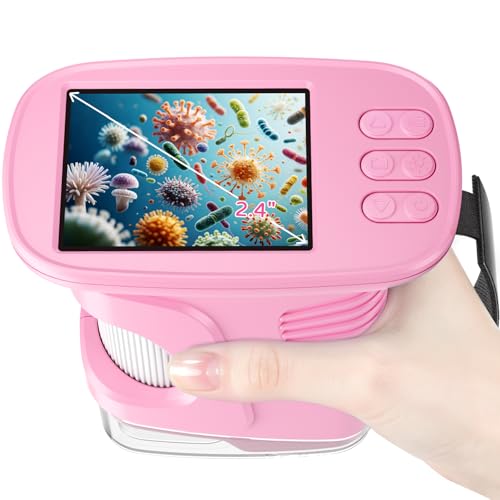
The B0GVFCPYZ9 listing describes the same useful close-up format: 200X to 1000X optical magnification, 1X to 4X digital zoom, and a manual focus wheel. That combination gives a young user something tangible to adjust. Instead of tapping through an app, the operator can turn the side control while watching details sharpen on the 2.4-inch screen.
Eight built-in LEDs and four brightness settings help with dark specimens, while the included prepared slides provide a simple starting point. The device stores up to 200 photos, supports photo and video capture, and connects to a computer through USB-C. The stated two-hour continuous-use period and two-hour charging time make it better suited to short activity sessions than extended field documentation.
Pros
- Offers both optical magnification and additional digital zoom.
- Manual focus wheel encourages hands-on adjustment.
- Includes prepared plant, insect, and animal-tissue slides.
- Built-in storage supports photo capture without immediate computer use.
- Compact body includes a wrist strap and neck lanyard.
Cons
- It has no listed inspection probe, long cable, or remote camera head.
- Video storage requires a microSD card sold separately.
This model belongs on a desk, in a backpack, or beside a science project. It does not belong in an engine bay or drain inspection kit. The distinction matters because high magnification is useful for a small nearby subject, while a borescope needs access, lighting, cable control, and a camera head that can reach the target.
To buy this product, click here.
4. 1000X Handheld Microscope for Kids, B0GWQHX9JK — Best for Prepared-Slide Activities

Prepared slides are the clearest use case for this handheld microscope. The listing includes 12 specimens and describes 200X to 1000X optical magnification, a 2MP camera, manual focus, and a 2.4-inch IPS display. A parent can place a slide on a table, hand over the compact unit, and let the child adjust focus while the illuminated image appears on screen.
The device also lists eight LEDs, four brightness levels, photo capture, video recording, and playback. Its 2000mAh rechargeable battery is described as providing up to two hours of continuous use. Photos can be stored internally, but the listing says they can be deleted but not downloaded, a limitation worth checking carefully if the goal is to build a digital collection.
Pros
- Prepared slides make the device usable immediately after charging.
- Four illumination levels provide control over bright and dim specimens.
- Manual focus is more useful for learning than a fully automatic viewer.
- Small dimensions make it easy to store or carry.
- USB-C supports charging and computer connection.
Cons
- It is not a borescope and cannot reach concealed inspection areas.
- The listing describes limitations around downloading stored photos.
For science activities, this is a straightforward choice. For remote inspection, it is the wrong shape and operating concept. A reader searching for a 4K borescope should avoid assuming that the camera label or magnification number compensates for the absence of a probe, cable, or directional inspection head.
To buy this product, click here.
5. Kids Handheld Microscope With 3-in-1 Bug Catcher, B0HFS14LDX — Best for Outdoor Specimen Viewing

This product shifts the focus from prepared slides to outdoor discovery. The listing describes a 3-in-1 bug catcher that lets children catch, observe, and record, alongside a built-in camera and screen. It also lists 500X magnification for insect viewing, a 2MP camera, 12 prepared slides, and LED illumination with four brightness settings.
The appeal is immediate and practical for a young explorer. A leaf, insect, or textured surface can become the subject of a short observation activity without a separate phone or computer. It remains a close-up microscope, however, so the product does not provide the probe reach or directional control required for inspecting hidden mechanical or building components.
Pros
- Bug-catcher format supports outdoor observation.
- Built-in screen allows live viewing without a phone.
- Includes a camera for photos and video recording.
- Prepared slides broaden use beyond insects.
- LED brightness controls help with changing subjects.
Cons
- It is a specimen microscope rather than a remote-access borescope.
- The supplied information does not identify a long probe, cable, or environmental rating.
This is a reasonable educational tool for children who want to inspect leaves and insects. It is unsuitable for plumbing, automotive, HVAC, or wall-cavity inspection. Buyers should treat the “4K” language carefully and focus on the actual use case, screen, lighting, and close-range design.
To buy this product, click here.
6. Kids Handheld Microscope With 3-in-1 Bug Catcher, B0HFRYGT2F — Best for Insect and Leaf Viewing

The B0HFRYGT2F version uses the same general educational format, with a 3-in-1 bug catcher, built-in camera, IPS screen, and listed 500X insect-viewing magnification. The broader feature description also gives a 200X to 1000X range, manual focus, digital zoom, and a 2MP camera. That makes it suitable for a child who wants to move between a captured specimen and a prepared slide.
Its eight LEDs and four brightness settings are useful because translucent leaves and darker insects need different illumination. Photos can be stored, while video recording requires a microSD card. USB-C charging and computer connection add convenience for supervised activities, although the supplied information does not establish universal compatibility with every computer.
Pros
- Combines specimen capture, viewing, and recording in one handheld unit.
- Manual focus gives the user control over image sharpness.
- Four brightness levels accommodate different subjects.
- Includes prepared slides for indoor activities.
- USB-C charging avoids an older charging interface.
Cons
- No probe or cable is listed for confined-space inspection.
- A microSD card is required for video recording.
This model makes sense for nature-based learning, with a parent nearby to guide handling of insects and small specimens. It should not be selected for a vehicle, pipe, appliance, or cavity simply because its listing includes 4K terminology. The viewing distance and physical design are fundamentally different from those of a borescope.
To buy this product, click here.
7. Kids Handheld Microscope With 3-in-1 Bug Catcher, B0HFRRMYJY — Best for Recorded Nature Activities

Recording is central to this version’s appeal. The listing describes one-click photo capture, video recording, playback, a built-in storage capacity of up to 200 photos, and a 2MP camera. A child can observe a leaf or insect, save a still image, and review it later on the device. That creates a simple record of an activity without the setup associated with a larger camera system.
The handheld body also includes manual focus, digital zoom, eight LEDs, four brightness levels, and a 2.4-inch IPS screen. It is a compact learning device, not a remote inspection instrument. There is no listed long probe, telescopic pole, active tip control, or pipe-oriented camera head, so the product’s useful range ends at subjects that can be reached directly by hand.
Pros
- Photo capture, video recording, and playback are built into the unit.
- Up to 200 photos can be stored according to the listing.
- Manual focus helps with uneven or small subjects.
- Bug-catcher design encourages outdoor observation.
- Multiple LED brightness settings aid close-up viewing.
Cons
- It cannot inspect distant or enclosed areas like a true borescope.
- Video recording requires a microSD card sold separately.
This is a better fit for a child building a small digital nature journal than for anyone searching for an inspection camera. The included screen and camera are convenient, but they do not replace the reach, cable management, or camera positioning required in mechanical inspection.
To buy this product, click here.
8. Kids Handheld Microscope With 3-in-1 Bug Catcher, B0HFR27YYM — Best for Hands-On STEM Play

This handheld microscope is built around interaction. The child holds the unit, adjusts focus, changes LED brightness, and views the subject on the integrated screen. Its listed feature set includes a 2MP camera, 500X insect viewing, a broader 200X to 1000X magnification range, prepared slides, and a bug-catching function.
The product can also capture photos and video, although the listing requires a microSD card for video recording. That detail matters for parents expecting a complete recording setup in the box. It is easy to imagine this device at a backyard table with leaves, small insects, and slides spread nearby, but its usefulness does not extend to hidden cavities or long-distance inspection.
Pros
- Interactive format gives children direct control over focus and lighting.
- Built-in display removes the need for a separate phone.
- Bug-catching design supports outdoor activities.
- Prepared slides provide a second type of subject.
- Camera functions allow photos and video recording.
Cons
- It is a close-range microscope with no listed inspection probe.
- Video storage depends on a separately purchased microSD card.
Choose this for supervised STEM play and casual specimen viewing. Do not choose it for automotive or building inspection. The word “microscope” in the product title is the important clue, while the 4K camera claim does not change the device’s short-range physical design.
To buy this product, click here.
9. Kids Handheld Microscope With 3-in-1 Bug Catcher, B0HFS7WP7Q — Best for Portable Close-Up Work

The B0HFS7WP7Q listing describes a compact microscope that can move easily between indoor and outdoor activities. Its feature set includes a 2MP camera, manual focus, 200X to 1000X magnification, four brightness levels, 12 prepared slides, and a 2.4-inch IPS screen. A wrist strap and lanyard are useful details for a handheld device that may be carried around during outdoor exploration.
As with the other bug-catcher models, the product can capture photographs and record video, but the listing says video requires a microSD card. The built-in rechargeable battery is listed for up to two hours of continuous use. That is enough for a short project or backyard session, but the product remains a microscope for nearby subjects rather than an inspection camera for remote access.
Pros
- Portable body is suited to short observation sessions.
- Includes a wrist strap and lanyard for handheld use.
- Manual focus and digital zoom provide viewing adjustments.
- Prepared slides support indoor learning.
- Screen, camera, and LED lighting are integrated.
Cons
- It does not provide the probe reach required for borescope work.
- The listing does not identify a waterproof rating or inspection-cable design.
This model is appropriate for a child who wants to examine insects, leaves, textures, and prepared specimens. It should be removed from consideration for engine, plumbing, HVAC, or wall inspection. A true borescope needs a camera head that can reach the target, while this product brings the target directly in front of a small lens.
To buy this product, click here.
Buying Guide
Probe Reach Matters More Than the 4K Label
For remote inspection, the first question is whether the camera can physically reach the target. The Vividia’s listed 5-meter telescopic pole is meaningful for elevated or distant areas. A handheld microscope has no comparable probe, regardless of its advertised magnification or camera resolution.
Pan-and-Tilt Control Changes Remote Viewing
A pan-and-tilt camera can redirect the view after the pole is in position. That is useful when the target is off-center or when the operator cannot easily reposition the entire assembly. The supplied information identifies this control on the Vividia, but it does not identify active articulation on the microscope products.
Separate Live-View Resolution From Practical Detail
Terms such as 4K and 1080p describe listing claims or display specifications, but they do not guarantee focus, brightness, or defect visibility. Lighting, viewing distance, camera stability, and the surface being examined all affect the image. A high magnification number on a microscope also does not make it suitable for a distant cavity.
Match the Display to the Inspection Distance
A 7-inch touchscreen is easier to study from a remote pole than a 2.4-inch handheld screen. Compact displays are convenient for close-up learning, while a larger screen can make a remote inspection easier to interpret. The display should be judged alongside camera reach and control rather than by size alone.
Check Recording Requirements Before Ordering
The microscope listings describe photo and video functions, but they also state that video recording requires a microSD card. The supplied information for the Vividia identifies its touchscreen and battery, but it does not clearly specify recording resolution or storage details. Confirm those points if documentation is central to your work.
Do Not Assume a Camera Is Waterproof
None of the supplied product information clearly establishes a complete waterproof or immersion rating for these products. Avoid using any of them in water, drains, fuel, energized equipment, or other hazardous conditions unless the current instructions specifically support that application.
Best 4K Borescope FAQ
Which product here is a genuine borescope-style inspection camera?
The Vividia TVS-500PT is the clear match. Its listing describes a pan-and-tilt inspection camera mounted on a telescopic pole reaching up to 5 meters. The other products are handheld digital microscopes intended for close-up specimens.
Can a handheld microscope inspect an engine or pipe?
These microscope listings do not identify a probe, flexible cable, camera head, or pipe-oriented design. They should not be treated as substitutes for an inspection camera intended to reach inside machinery or plumbing.
Does a 4K listing claim guarantee a sharper inspection image?
No. Resolution is only one part of image usefulness. Focus, lighting, camera stability, viewing distance, lens design, and display quality also affect what the operator can see. The supplied listings present 4K as a product claim, not as independently measured inspection performance.
What does pan-and-tilt provide on the Vividia camera?
Pan-and-tilt allows the camera view to change direction at the remote end of the system. That can reduce the need to move the entire pole when the target is offset. The supplied information does not give a specific articulation angle.
Are the microscope photos and videos easy to transfer?
The listings identify computer connection through USB-C and describe photo and video functions. They also state that video recording requires a microSD card. One listing says photos can be deleted but not downloaded, so confirm the current transfer behavior before buying for formal documentation.
Can the Vividia be used inside hot or moving machinery?
The supplied information does not state an operating-temperature limit or authorize use around moving machinery. Follow the product instructions, isolate equipment where appropriate, and avoid inserting the camera into conditions that exceed its documented limits.
Final Verdict
The Vividia TVS-500PT is the strongest overall choice here because it is the only listed product built for genuine remote inspection. Its pan-and-tilt camera, 5-meter telescopic carbon-fiber pole, 7-inch touchscreen, white and infrared lighting, and stated battery runtime give it a practical role in elevated or distant viewing. Confirm probe dimensions, environmental protection, recording functions, and operating limits before purchase because those details are not clearly supplied.
The remaining eight products are compact digital microscopes. They can be useful for children, prepared slides, leaves, insects, and close-up educational activities, but they should not be mistaken for borescopes. If your task involves an engine cavity, pipe, wall, appliance, or machinery, prioritize a real inspection camera with suitable reach and camera control. If the subject sits on a tabletop, one of the smaller microscope formats may be the more appropriate tool.
