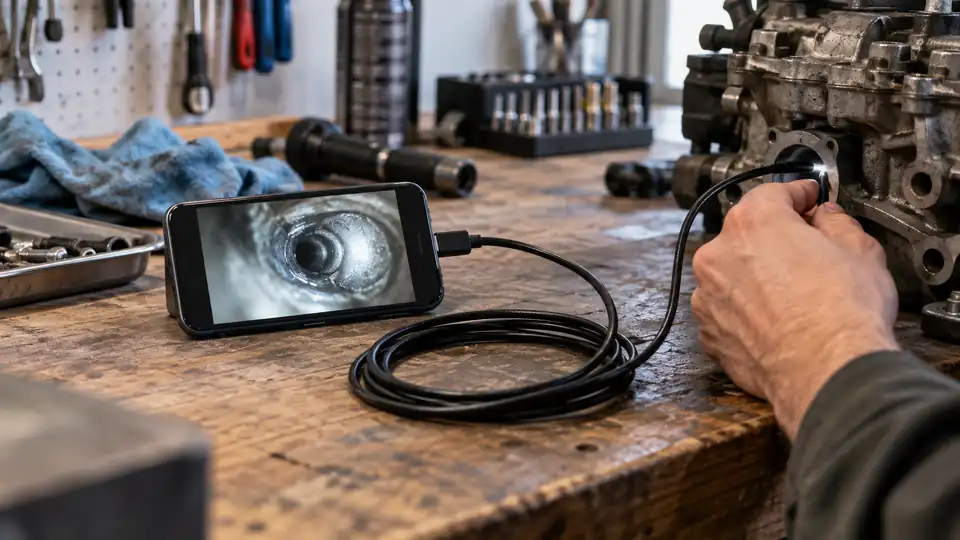
A borescope for Android can turn a frustrating teardown into a quick look inside a drain, engine bay, wall cavity, appliance, or HVAC passage. The useful choice depends on more than a large resolution number. Android version support, OTG requirements, connector type, app behavior, probe diameter, cable control, lighting, and the inspection environment all affect whether the camera is practical once it reaches the work area.
A phone-connected camera also needs the right kind of access. A semi-rigid cable can push through a short pipe or hold a useful curve, while an articulating probe gives the tip controlled directional movement. A dual-lens design can show forward and side views, but it does not steer the camera. Waterproofing claims require similar care because an IP67 probe does not automatically make the phone, connector, or control section waterproof.
The products below cover broad Android compatibility, slim probes, dual-lens viewing, long reach, and genuine two-way articulation. The comparison weighs supported Android versions, connection method, cable behavior, viewing system, and practical inspection fit rather than treating every advertised resolution claim as equal.
Quick Answer
Best overall: The DEPSTECH 2K Endoscope Camera offers a useful balance of dual-lens viewing, a 7.9 mm probe, adjustable lighting, Android support, and app-based photo and video capture.
Best for controlled tip direction: The Teslong USB-C Two-Way Articulating Borescope uses a joystick-controlled probe that bends through 180 degrees in two directions, a meaningful advantage around corners and inside awkward cavities.
Best for long reach: The Ralcam Two-Way Articulating Borescope combines two-way articulation with a 10-foot flexible cable and a built-in rechargeable battery.
Best for a slimmer probe: The BAZO Endoscope Camera lists a 6.9 mm probe, which may fit openings that 7.9 mm and 8 mm cameras cannot.
Best Borescope for Android Comparison Table
| Product | Best For | Connection and Android Support | Probe and Cable |
|---|---|---|---|
| DEPSTECH 2K Endoscope Camera | Overall inspection versatility | Type-C, Android 9+, OTG required | 7.9 mm, 16.5 ft semi-rigid |
| BAZO Endoscope Camera | Tighter openings and broad compatibility | App, Android 4.4+ | 6.9 mm, 18.04 ft semi-rigid |
| Teslong USB-C Articulating Borescope | Controlled tip direction | USB-C, Android devices | 5 ft semi-rigid gooseneck |
| Ralcam Two-Way Articulating Borescope | Long articulated inspections | USB-C, Android 7+ | 8.5 mm, 10 ft flexible |
| Acoath Dual-Lens Borescope | Forward and side viewing | Type-C, Micro-USB, Lightning, Android 7+ | 7.9 mm, 16.4 ft semi-rigid |
| CTEOUNPT Endoscope Camera | Broad connector support | Type-C, Micro-USB, Lightning, Android 4.2+ | 7.9 mm, 16.4 ft semi-rigid |
| Klein Tools ET16 | Android USB-C simplicity | USB-C, Android app | 8 mm, 10 ft armored gooseneck |
| 1920P Dual-Lens Endoscope | Pipe and HVAC inspection | Type-C, Micro-USB, Lightning | 7.9 mm, 16.4 ft semi-rigid |
| 1920P Endoscope Camera | General-purpose reach | Type-C, Micro-USB, Lightning | 7.9 mm, 16.4 ft semi-rigid |
The detailed reviews explain where each camera gains an advantage and where its connection, viewing, or cable design may limit the job.
1. DEPSTECH 2K Endoscope Camera — Best Overall

The DEPSTECH NTC55 earns the top position because it combines several useful features without depending on a separate monitor. Its listing identifies a 7.9 mm probe, front and side cameras, an 80-degree viewing angle, and a 16.5-foot semi-rigid cable. In a wall cavity or pipe bend, the side camera can reveal an adjacent surface without requiring the entire probe to be repositioned, while the cable provides enough reach for many home and vehicle inspections.
Android use requires the DEPSTECHCAM app, Android 9 or later, and OTG support. That is a meaningful compatibility checkpoint, but the app adds practical tools such as photo and video capture, 2x zoom, 90-degree rotation, and gallery review. The product information also lists 8+1 adjustable LEDs and IP67 protection for the probe. The advertised 2560×1440 image specification may help with recorded detail, although lighting, focus, and viewing distance still shape what appears on the phone.
Pros
- Front and side cameras provide two viewing directions.
- 7.9 mm probe reaches many narrow inspection spaces.
- 16.5-foot semi-rigid cable offers substantial reach.
- App supports photo capture, video capture, 2x zoom, and image rotation.
- Includes Type-C and Lightning connection options plus retrieval accessories.
Cons
- Android 9 or later and OTG support are required.
- The DEPSTECHCAM app is required for operation.
This is the strongest fit for someone who wants one Android inspection camera for pipes, engines, HVAC passages, and wall cavities. It is less suitable for an older Android phone that cannot use OTG or for anyone who wants a completely phone-free setup. The dual-lens system is the main reason to choose it over a conventional single-view camera, especially where turning the probe is difficult.
To buy this product, click here.
2. BAZO Endoscope Camera — Best for Tight Access

A 6.9 mm probe gives the BAZO a useful physical advantage in cramped openings. That difference may matter around small access holes, narrow appliance spaces, and selected automotive passages where a 7.9 mm or 8 mm head could struggle. Its 18.04-foot semi-rigid cable also reaches farther than most of the 16.4-foot options here, although extra cable can take more effort to manage in a short inspection.
The camera connects through the UseePlus app and does not require Wi-Fi or Bluetooth. The listing states support for Android 4.4 and newer, plus included adapters for several phone connections. Eight adjustable LEDs provide control over glare and shadows, while the probe is listed as IP67 waterproof. The included magnet, hook, mirror, and protective cap add practical utility, though the mirror is an attachment and should not be confused with a second camera.
Pros
- 6.9 mm probe may fit smaller openings.
- 18.04-foot semi-rigid cable provides extended reach.
- Supports Android 4.4 and newer according to the listing.
- Does not rely on Wi-Fi or Bluetooth.
- Includes a mirror, hook, magnet, and protective cap.
Cons
- The UseePlus app is required for viewing.
- The listing does not identify a dual-camera viewing system.
The BAZO is a good match for Android users who care more about access and reach than side-view inspection. It can make sense for a long wall cavity or pipe route, while the narrower probe helps at the entry point. Buyers needing a controlled camera direction should look toward the articulating Teslong or Ralcam instead.
To buy this product, click here.
3. Teslong USB-C Two-Way Articulating Borescope — Best for Controlled Tip Direction

The Teslong solves a different problem from the long semi-rigid cameras. Its joystick-controlled probe bends 180 degrees in two directions, allowing the user to aim the camera tip around an engine bay, behind an appliance, or inside a pipe bend without repeatedly withdrawing and twisting the cable. That is genuine active articulation, rather than simple cable flexibility.
The trade-off is reach. The semi-rigid gooseneck measures 5 feet, so it suits nearby access points better than long drain runs or deep cavities. The listing identifies USB-C connection, Android support, a SmartEndoscope app, and a 1.0MP camera producing 1080P photos and video. Three lighting levels help with dark ducts and reflective metal, while the phone holder and thumb-positioned controls support one-handed operation.
Pros
- Joystick provides two-way 180-degree tip articulation.
- One-hand controls include a photo button.
- App supports photo and video capture without an account or subscription.
- Three brightness levels help manage different surfaces.
- Phone holder supports a direct inspection setup.
Cons
- Five-foot probe length limits deep-reach inspections.
- USB-C connection is less broadly documented than multi-adapter designs.
Choose this model when aim control matters more than maximum cable length. It is particularly useful around corners where a fixed camera keeps facing the wrong wall. It may be the wrong tool for a long sewer route, but its active tip movement gives it a practical advantage in compact spaces that a higher-resolution fixed probe cannot reproduce.
To buy this product, click here.
4. Ralcam Two-Way Articulating Borescope — Best for Long Articulated Reach

Ralcam pairs active two-way articulation with a 10-foot flexible cable, giving it a different role from the shorter Teslong. The listing describes 180-degree movement in two directions, which can help navigate pipe elbows, HVAC coils, and engine cylinders while maintaining a longer path through the inspection area. The 8.5 mm lens is larger than the 7.9 mm cameras in several other entries, so opening size deserves attention before ordering.
Connection is through USB-C, with the listing identifying Android 7.0 and newer support. A rechargeable battery powers the system for extended inspections, and the product transmits 1080P video and images to a smartphone through its app. The probe is listed as IP67 waterproof, while the host is specifically identified as not waterproof. That distinction matters around wet work because the phone and control section still need protection.
Pros
- Two-way 180-degree articulation provides active directional control.
- Ten-foot cable reaches farther than the Teslong design.
- Rechargeable battery supports extended inspection sessions.
- Android 7.0 and newer support is identified.
- USB-C transmission provides a direct phone connection.
Cons
- 8.5 mm lens requires a larger access opening.
- The host is not waterproof, despite the probe’s IP67 rating.
Ralcam suits inspections that combine distance and directional control. It can be a strong choice for longer HVAC or plumbing paths where a 5-foot probe falls short. The larger lens and USB-C requirement narrow its compatibility compared with multi-adapter cameras, so verify the phone and access opening before purchase.
To buy this product, click here.
5. Acoath Dual-Lens Borescope — Best for Forward and Side Viewing

Acoath focuses on seeing around an inspection space rather than mechanically steering through it. Its 7.9 mm probe uses a dual-lens system, and the listing gives a 1920×1440 image specification for close-up photos and video. A forward view can show the path ahead, while a side view may reveal pipe walls, wiring areas, or adjacent engine surfaces when rotating the entire cable would be awkward.
The 16.4-foot semi-rigid cable balances reach with some shape control. Acoath lists Android 7 or later and support through the SUP-ANESOK app, with Type-C, Micro-USB, and Lightning connectors included. The probe is rated IP67, with a stated limit of up to 3.28 feet for one hour. The product information also warns that the probe is not heat-resistant, so a cooled engine is necessary before inspection.
Pros
- Dual-lens design supplies forward and side views.
- Includes Type-C, Micro-USB, and Lightning connectors.
- 16.4-foot semi-rigid cable offers useful reach.
- Eight adjustable LEDs support dark inspection areas.
- Includes hook, magnet, mirror, and protective cap.
Cons
- Requires Android 7 or newer according to the listing.
- The probe is not identified as heat-resistant.
This camera fits buyers who frequently need to inspect the side of a pipe or cavity without constant repositioning. It does not replace an articulating probe, and the 7.9 mm head may not enter every narrow access point. For Android users with several phones or adapters, its connector selection is especially convenient.
To buy this product, click here.
6. CTEOUNPT Endoscope Camera — Best for Broad Connector Support

The CTEOUNPT is built around straightforward phone connection. Its product information lists Type-C, Lightning, and Micro-USB adapters, along with Android 4.2 and newer compatibility. That broad stated range can help households that use different phones, although physical connector fit still needs to be matched with app and operating-system support on the specific device.
Its 7.9 mm probe and 16.4-foot semi-rigid cable suit general work around drains, engines, dryer passages, HVAC areas, and wall cavities. The camera is listed at 1920×1440, with eight adjustable LEDs and an IP67 probe rated for up to 3.28 feet of water for one hour. The direct wired design requires no Bluetooth, Wi-Fi, or separate power source, which keeps setup simple when a phone is already nearby.
Pros
- Includes Type-C, Lightning, and Micro-USB adapters.
- Android 4.2 and newer support is listed.
- 16.4-foot semi-rigid cable reaches deep inspection areas.
- Eight adjustable LEDs provide lighting control.
- No Bluetooth, Wi-Fi, or separate camera battery is required.
Cons
- Uses a single camera view rather than dual-lens viewing.
- Phone and app compatibility should be confirmed before ordering.
CTEOUNPT is a sensible general-purpose choice for users who value connector flexibility and simple wired operation. It lacks the side view of the dual-lens models and the tip control of the articulating models, but it covers routine inspections without adding a battery or wireless pairing step.
To buy this product, click here.
7. Klein Tools ET16 — Best for Android USB-C Simplicity

The ET16 takes a simpler approach than the high-resolution multi-adapter cameras. It connects directly through USB-C, uses the ET16 Borescope app, and requires no batteries according to the product information. Its 8 mm camera sits on a 10-foot armored gooseneck, a combination that may appeal to Android users who want a structured cable for work behind appliances, inside cavities, or around equipment.
The listed camera resolution is 640×480, lower than the 1920×1440 claims on several competing models. That does not make it unsuitable for every task, but buyers seeking fine surface detail should weigh the specification carefully. Six adjustable white LEDs help illuminate the target, and the camera is listed as IP67 waterproof. The package includes a hook, carrying case, and instructions.
Pros
- Direct USB-C connection keeps setup straightforward.
- Ten-foot armored gooseneck provides structured reach.
- Six adjustable LEDs help control illumination.
- No camera battery is required.
- Includes a carrying case and hook attachment.
Cons
- 640×480 listed resolution is lower than most cameras here.
- USB-C connection limits compatibility to suitable devices.
The Klein ET16 is best for basic viewing tasks where cable structure and simple Android operation matter more than high advertised resolution. It may be easier to justify for locating an obstruction or checking a route than for documenting small defects. Confirm that the Android phone supports the required USB-C connection and app.
To buy this product, click here.
8. 1920P Dual-Lens Endoscope — Best for Pipe and HVAC Inspection

This dual-lens endoscope is aimed at practical maintenance work, with the listing specifically describing pipes, HVAC, wall wiring, and engine compartments. Its 1920×1440 specification, adjustable LEDs, and semi-rigid cable give it the basic ingredients for viewing dark, curved spaces. The dual-lens wiring harness is useful where a side perspective can reveal a pipe corner or nearby surface that a forward-facing camera misses.
Connection uses detachable Type-C, Micro-USB, and Lightning connectors, and the product information describes plug-and-play phone viewing after installing the required app. The 16.4-foot cable can bend while retaining some shape, helping the user guide it through a curve. A one-year manufacturer support claim is included in the listing, but the available information does not provide further service details.
Pros
- Dual-lens system supports multi-angle observation.
- Includes Type-C, Micro-USB, and Lightning connectors.
- 16.4-foot semi-rigid cable suits longer paths.
- Eight adjustable LEDs support dim pipes and ducts.
- Includes retrieval accessories and protective cap.
Cons
- The listing does not give a precise probe diameter.
- It uses a fixed cable rather than active articulation.
This model is a practical fit for Android users inspecting pipes, HVAC passages, and other routes where viewing angle matters. The unclear probe dimension makes it harder to predict access through especially small openings, so measure the entry point first. For a known 7.9 mm fit, the other dual-lens listings provide clearer sizing information.
To buy this product, click here.
9. 1920P Endoscope Camera — Best for General-Purpose Reach

This endoscope takes the familiar fixed-camera route with a 7.9 mm probe, 16.4-foot semi-rigid cable, and eight adjustable LEDs. The listing positions it for clogged drains, HVAC ducts, engines, wall cavities, and general home maintenance. That broad application range makes it a reasonable all-around tool for occasional inspection, especially when the goal is to locate a leak, obstruction, rust spot, or visible damage.
The camera connects to Android and iOS phones through Type-C, Micro-USB, or Lightning adapters after installing the app. IP67 protection is listed for the probe, with the product information describing use in wet and dark spaces. A side-view mirror, magnet, hook, protective cap, and manual are included. The mirror can help redirect the view, but it remains an accessory rather than a second integrated camera.
Pros
- 7.9 mm probe suits many general inspection openings.
- 16.4-foot semi-rigid cable provides useful reach.
- Includes Type-C, Micro-USB, and Lightning adapters.
- Eight adjustable LEDs help illuminate dark spaces.
- Includes a side-view mirror and retrieval accessories.
Cons
- Fixed single-camera design lacks active articulation.
- The app and phone are required for viewing.
This camera makes sense for routine household and vehicle checks where broad reach and connector flexibility are more important than advanced steering. A dual-lens or articulating model will be more capable around blind corners, while this fixed design keeps the workflow familiar and relatively simple.
To buy this product, click here.
Buying Guide
Android Compatibility Requires More Than a Matching Connector
A USB-C plug establishes a physical connection, but it does not guarantee that every Android phone can display the camera feed. Check the listed Android version, required app, and OTG support where specified. The DEPSTECH model, for example, identifies Android 9 or later and OTG, while the CTEOUNPT listing gives a broader Android version range and includes several adapters. A phone case can also interfere with a snug connection during a quick inspection.
Probe Diameter Determines the Access Point
A 6.9 mm probe may enter a tighter opening than a 7.9 mm or 8 mm camera. That advantage matters before the cable moves anywhere because a camera that cannot pass the entry point cannot inspect the space behind it. Smaller diameter does not automatically mean a better image or easier control, so match the head size to the access hole rather than choosing the smallest number alone.
Dual-Lens Viewing Is Different From Articulation
A dual-lens camera gives the phone another viewing direction, often forward and sideways. It can reduce the need to reposition the cable, but the tip itself does not mechanically steer. Articulating models such as Teslong and Ralcam use a control mechanism to move the camera tip in two directions. Choose dual-lens viewing for visual coverage, or articulation when precise aim around a corner is the priority.
Longer Cables Add Reach and Cable Management
A 16.4-foot or 18.04-foot cable can reach farther down a route than a 5-foot probe, but unused cable can bunch up around the work area. Semi-rigid designs push more predictably through some openings, while flexible cables can follow curves with less resistance. The right length depends on the path, not on the largest number in the product title.
Lighting and Resolution Work Together
Advertised 1920P or 2560P figures describe an image specification, not a guarantee of sharp defect detection. A lens needs suitable focus, distance, and illumination before extra pixels become useful. Adjustable LEDs help control a dark cavity, but excessive brightness can create glare on shiny metal or wet surfaces. The Klein ET16 lists a lower 640×480 resolution, while its six adjustable LEDs and structured gooseneck may still suit basic route-finding tasks.
Check What IP67 Covers
An IP67 statement may apply to the probe rather than the full inspection system. The Ralcam listing specifically identifies the probe as IP67 while stating that the host is not waterproof. A phone, connector, app device, or battery section should be kept away from water unless its own protection is documented. Follow the stated immersion limits and avoid treating a consumer inspection camera as a replacement for specialized drain equipment.
Best Borescope for Android FAQ
Do Android borescopes need Wi-Fi?
No. Several cameras in this roundup use a wired connection and an app, so they do not require Wi-Fi or Bluetooth. A wired model can reduce pairing steps, but the phone still needs the required operating-system support, app, and connection features.
Will any USB-C Android phone work with a borescope?
Not automatically. The phone may need OTG support, a compatible Android version, and the correct app. A physical USB-C fit confirms only the connector shape. Check the product’s compatibility details against the exact phone before ordering.
Is a dual-lens camera better than a single-lens model?
It can be more useful when surfaces beside the probe matter, such as pipe walls or nearby engine components. A dual-lens design does not provide active steering, however. A single-lens articulating camera may be better when the main challenge is aiming around a bend.
Can these cameras inspect a hot engine?
The product information does not support treating these cameras as heat-resistant tools. One listing specifically warns that its probe is not heat-resistant and recommends allowing an automobile engine to cool before inspection. Keep the probe away from moving components and follow the product instructions.
Can an IP67 probe stay underwater indefinitely?
No. IP67 is a protection claim with defined conditions, not unlimited underwater operation. Some listings give a specific immersion depth and duration. Keep the phone, connector, and host section dry unless their protection is separately documented.
Do phone borescopes record photos and video?
Several products list photo and video capture through their apps, including the DEPSTECH and Teslong models. The exact controls depend on the app and phone. Review the product information for the specific camera rather than assuming every USB inspection camera records in the same way.
What probe size is suitable for engine inspection?
That depends on the access opening and the component being viewed. A 6.9 mm camera may fit tighter spaces than a 7.9 mm or 8 mm model, but the available opening should be measured first. Also account for cable control, lighting, and whether a forward, side, or articulated view is needed.
Final Verdict
The DEPSTECH 2K Endoscope Camera is the strongest overall choice here for Android inspection work because it combines dual-lens viewing, a 7.9 mm probe, a 16.5-foot semi-rigid cable, adjustable lighting, and app-based photo and video tools. Its Android 9 and OTG requirements deserve a check before purchase, yet the feature balance gives it broader practical use than a basic fixed-view camera.
Choose the Teslong when controlled tip direction matters most, or the Ralcam when active articulation needs to extend farther along a 10-foot route. The BAZO is the better access-focused alternative when a 6.9 mm probe and older stated Android support are useful. For routine inspections, match the camera to the entry opening, phone requirements, cable path, and viewing problem before giving headline resolution the final word.
