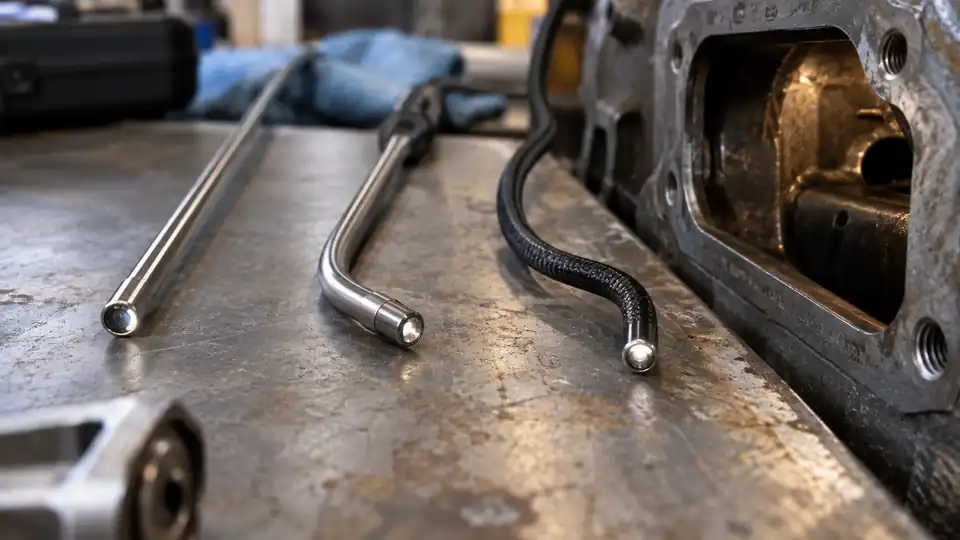
Choosing between a rigid, semi-rigid, and flexible borescope depends mainly on the path to the inspection target. A straight opening into an engine cylinder favors a rigid probe, while a pipe with several bends demands a flexible shaft. A semi-rigid probe sits between those extremes, offering enough bend to follow a route while retaining some push control. The right choice starts with the access path, not the most impressive feature list.
Rigid vs. Semi-Rigid vs. Flexible Borescope at a Glance
| Probe type | How it behaves | Best suited for | Main limitation |
|---|---|---|---|
| Rigid | Stays straight and keeps the camera pointed along a fixed axis | Straight-line access, engine cylinders, machinery openings, and shallow cavities | Cannot follow bends |
| Semi-rigid | Bends into a position and may hold a gentle curve | Automotive work, wall cavities, HVAC openings, and routes with broad bends | May resist tight turns and can be awkward in long curved paths |
| Flexible | Bends readily and follows curved or winding access routes | Plumbing, ducts, tubing, deep cavities, and paths with several bends | Can be harder to push, aim, and keep stable |
These categories describe the probe shaft or insertion tube, not the entire camera. A flexible borescope may have a fixed camera tip, while another flexible model may include active articulation controls. A semi-rigid probe may hold a curve without steering the camera head. Those are different behaviors, and separating them makes the comparison much clearer.
What Is a Rigid Borescope?
A rigid borescope uses a straight, solid or largely non-bending probe. Push it through a clear opening and the camera advances predictably, with little of the soft, springy movement found in a flexible cable. That direct feel can be excellent for inspecting through a spark plug opening, a machined port, or a straight access hole in equipment.
Imagine trying to examine a piston crown through a spark plug hole. The route is short and relatively direct, so a rigid probe can be easy to position and hold steady. A flexible cable may bow inside the opening, making small camera movements feel vague. The rigid design gives the operator a firm reference point and often makes close-up viewing easier.
Strengths of a Rigid Probe
- Provides stable, predictable positioning.
- Transfers pushing and rotating movements directly to the camera.
- Works well through straight openings.
- Can make close inspection easier when the target lies directly ahead.
- Usually resists unwanted looping inside a short cavity.
The tradeoff appears as soon as the access path bends. A rigid probe may stop at a corner, scrape against an opening, or point away from the target after entering a cavity. It can also provide a narrow viewing direction, so a target slightly off-axis may remain difficult to see without changing the access point.
What Is a Semi-Rigid Borescope?
A semi-rigid borescope has a probe that bends, but it generally retains enough stiffness to hold a position or follow a gentle curve. Think of a flexible drinking straw with more backbone. You can shape the probe before insertion, then use that curve to guide the camera toward a cavity or around a broad obstruction.
This behavior suits a wall cavity reached through a small opening. A semi-rigid probe can be curved toward the area of interest before it enters the wall, and its stiffness may help it advance past light insulation or along an open cavity. The same characteristic can help under a vehicle, where a probe needs to reach around a component without folding into a loose loop.
Strengths of a Semi-Rigid Probe
- Offers more control than a very soft flexible cable.
- Can hold a pre-formed curve.
- Handles straight sections and broad bends reasonably well.
- Often feels easier to aim in short or moderate access routes.
- Can be useful for general automotive, home, and HVAC inspection.
Stiffness can become a problem in tight turns. If the probe meets a sharp bend in a small pipe, pushing harder may kink the shaft, damage the camera, or cause the tip to press against the inner wall. A semi-rigid probe is a compromise, so it works best when the route needs some guidance but does not demand snake-like movement.
What Is a Flexible Borescope?
A flexible borescope uses a cable or insertion tube that bends readily along its length. This allows the camera to follow curved passages that would stop a rigid probe. Plumbing lines, HVAC branches, tubing, and deep cavities often favor this design because the access route matters more than straight-line stability.
For example, a flexible probe can travel farther into a pipe that turns behind a cabinet or loops through a machine. It may also reach through a duct opening and follow a gradual curve toward a branch connection. The ability to bend is valuable, but the cable can feel loose, especially when the route is long or contains friction.
Strengths of a Flexible Probe
- Follows curves and winding access paths.
- Can reach around obstructions that block a straight probe.
- Works well in pipes, ducts, tubes, and deep cavities.
- May reach targets from a single access point.
A flexible shaft does not automatically give you precise directional control. It may bend wherever the surrounding passage guides it, while the camera tip continues pointing along the cable’s current path. In a pipe with two nearby branches, the probe may enter the wrong route or rotate unpredictably. Gentle advancement, small rotations, and frequent image checks are usually more effective than forceful pushing.
Flexibility Is Different From Articulation
This distinction causes plenty of confusion. A flexible probe bends because the shaft follows the access route. An articulating borescope uses a control mechanism to move the camera tip in a defined direction. The two features can appear together, but they do different jobs.
A flexible probe entering a curved tube may eventually point toward the bend simply because the cable has followed it. An articulating probe can redirect its distal tip toward a target after the shaft is already inside. That controlled movement can help inspect the side of a valve, the wall of a cavity, or an area just beyond an opening.
Semi-rigid behavior is different again. A semi-rigid shaft may be shaped into a curve before insertion, yet the camera head may remain fixed relative to the shaft. Rotating the entire probe can change the view, but rotation is not the same as active tip articulation. A side-view camera or a mirror attachment also changes what can be seen without steering the tip.
Which Probe Type Fits Different Inspection Jobs?
Automotive and Engine Inspection
Rigid and semi-rigid probes are often practical for straight access through a spark plug hole or another approved opening. Their stability can help with close views of a piston crown, cylinder wall, or visible valve area. A flexible probe may work too, especially where the route is offset, but excess cable movement can make a small target harder to hold in frame.
A rigid probe suits a short, direct path. A semi-rigid model becomes more useful if the camera must angle around an internal feature or reach through a slightly offset opening. The image can show surface conditions, wet-looking residue, deposits, or a crack-like line, but the view alone cannot establish the cause or severity of what appears on screen.
Plumbing and Pipe Inspection
Flexible probes usually have the advantage inside curved pipe. A rigid probe may enter only a short distance before meeting a bend, while a semi-rigid probe may follow broad turns but struggle with tighter geometry. A flexible camera can travel farther, although water, debris, friction, and branch connections can make its path difficult to control.
Probe diameter still matters because the camera head must fit through the opening, but the smallest possible probe is not automatically the best choice. A very small camera may provide less stable handling or a narrower field of view, depending on its design. Check the access opening, expected bends, and the probe’s environmental limits before insertion.
Wall Cavities and Home Inspection
A semi-rigid probe often works well through a small inspection hole when the cavity is reasonably open. It can be aimed toward framing, pipes, or insulation and may hold a curve better than a soft cable. A flexible probe helps with deeper or more obstructed routes, but it may droop or curl inside the cavity.
None of these probe types can see through drywall, wood, masonry, or other opaque materials. The camera needs a real opening, and the image shows only the area reached by the lens. A clear view of one section of a cavity does not confirm the condition of the entire wall space.
HVAC Ductwork
Flexible probes are useful for ducts with gradual bends and longer runs, while semi-rigid models can be easier to aim through a nearby register or service opening. Rigid probes make sense only for short, straight sections. Dust, insulation, damp surfaces, and reflective metal can affect the image, so changing the camera angle may reveal more than simply increasing brightness.
A borescope image can show visible debris, damp-looking areas, damaged surfaces, or an obstruction-like object. It cannot measure airflow, refrigerant condition, gas concentration, indoor air quality, or system efficiency. Those questions require separate tests, regardless of probe style.
How to Choose Between the Three
Start by sketching the path from the access point to the target. A straight line favors rigid construction. One or two broad bends may suit a semi-rigid probe. Several bends, a long curved route, or a tube that turns out of sight points toward a flexible model.
- Choose rigid for short, direct access where stability and precise pushing matter most.
- Choose semi-rigid when you need to pre-shape the probe and retain moderate control through broad bends.
- Choose flexible when the camera must follow winding passages or reach around multiple turns.
- Look for articulation when the camera must be actively redirected after insertion.
Also think about how the probe will behave during withdrawal. A flexible cable may snag or loop in a cavity, while a rigid probe may come out smoothly but offer little chance to inspect a side area. The best match gives you a controlled route in, a useful viewing angle, and a manageable route back out.
Practical Limits to Keep in Mind
Probe construction is only one part of the inspection. Working distance, focus, camera stability, lighting, surface reflectivity, and lens cleanliness all affect the image. A rigid probe held too close to a shiny metal surface may produce glare, while a flexible probe that keeps moving can blur the view. Small changes in distance and angle often produce a clearer image than maximum brightness.
Do not force any probe through an obstruction or tight bend. Unexpected resistance can mean the route is blocked, the camera has entered the wrong branch, or the probe is pressing against a fragile component. Stop, withdraw slightly, reassess the path, and use a different access point or probe style if necessary.
The simplest decision is also the most reliable: match the probe’s behavior to the shape of the access route. Rigid probes favor straight, stable work. Semi-rigid probes balance shaping and control. Flexible probes reach farther through curves, but they demand more patience and handling skill. Once that physical difference is clear, the choice becomes far less mysterious.
