
A small-diameter borescope earns its place when a standard inspection camera simply cannot reach the opening. Spark-plug holes, narrow pipe bends, appliance cavities, machinery gaps, and wall voids can turn a routine check into a frustrating guessing game. The useful comparison is therefore about more than screen size or a headline resolution claim. Probe diameter, tip control, focus range, cable length, lighting, and the way images are viewed all shape what you can actually inspect.
A thinner probe can enter tighter spaces, but the smallest camera is not automatically the best choice. A 0.95 mm probe reaches places that a 4 mm model cannot, while a 2.8 mm or 4 mm articulating probe may give far better directional control once inside. A built-in screen also creates a simpler workflow, while USB or Wi-Fi models may suit buyers who want to save images on a computer or phone. The right balance depends on whether the job involves tight access, long reach, controlled steering, documentation, or a phone-free setup.
This guide compares nine small-diameter borescopes using the supplied probe sizes, articulation systems, displays, connections, lighting, and recording features. Some are specialized instruments for extremely narrow access, while others are more flexible tools for engine, pipe, appliance, and general maintenance inspections. The rankings favor genuine inspection capability and clear specifications rather than treating every flexible camera as interchangeable.
Quick Answer
Best overall: The Vividia VA-650 offers a strong balance of a 6.2 mm camera head, two-way articulation, a 5-inch display, IP67 probe protection, broad 15 mm to 200 mm focus, and included microSD recording.
Best for tight access with active control: The Vividia CF-2812 combines a 2.8 mm camera head with 360-degree joystick articulation and a self-contained 5-inch monitor.
Best for the smallest openings: The Vividia NP-0-09510 uses a 0.95 mm probe and a 2 mm to 30 mm focus range for highly restricted access, although its listed camera resolution is lower than the other leading options.
Best for long reach: The Vividia CF-4030 gives you a 4 mm camera head, 3 m probe, 360-degree joystick articulation, and an integrated display.
Best Small Diameter Borescope Comparison Table
| Product | Best For | Probe | Control and Viewing |
|---|---|---|---|
| Vividia VA-650 | Balanced general inspection | 6.2 mm, 1 m | Two-way, 5-inch LCD |
| Vividia CF-2812 | Small diameter with full tip control | 2.8 mm, 1.2 m | 360-degree joystick, 5-inch LCD |
| Vividia CT-2812 | Narrow access with phone connectivity | 2.8 mm, 1.2 m | Two-way, Wi-Fi |
| Vividia CF-4020 | Controlled 4 mm inspections | 4 mm, 2 m | 360-degree joystick, 5-inch LCD |
| Vividia CF-4030 | Long-reach inspection | 4 mm, 3 m | 360-degree joystick, 5-inch LCD |
| Vividia NP-0-09510 | Extremely tight openings | 0.95 mm, 1 m | Flexible, 5-inch LCD |
| Vividia D3145 | Engine-oriented USB inspection | 4.5 mm, 1 m | One-way, USB |
| Vividia D3160 | USB inspection with a larger probe | 5.9 mm, 1 m | One-way, USB |
| SCOPIX Articulating Borescope | Compact screen-based inspection | 0.24 inch, 3.3 ft | Two-way, 4.3-inch display |
The detailed reviews below show how each probe size, steering system, and viewing setup changes the kind of inspection the camera can handle.
1. Vividia VA-650 — Best Overall

The VA-650 lands in a useful middle ground for buyers who need a smaller camera without giving up a comfortable inspection workflow. Its 6.2 mm camera head is larger than the 2.8 mm and 4 mm options below, yet it remains considerably slimmer than many general-purpose inspection probes. A 1 m metal-braided probe gives enough reach for engine compartments, equipment cavities, and short pipe runs, while two-way articulation lets the operator redirect the tip instead of relying entirely on cable twisting.
The integrated 5-inch IPS monitor keeps the inspection independent from a phone or computer. That matters in a dim garage or beside a machine where handling a separate device can become awkward. The listed 15 mm to 200 mm focus range is broad, and eight LEDs provide adjustable illumination for dark spaces. The 1280×720 camera, rechargeable 3000 mAh battery, and included microSD card support photo and video documentation, so this is a practical choice for jobs where the findings need to be saved rather than viewed once and forgotten.
Pros
- 6.2 mm camera head remains relatively compact while offering a balanced general-purpose size.
- Two-way articulation provides documented directional control at the tip.
- Integrated 5-inch IPS monitor avoids phone or computer dependence.
- 15 mm to 200 mm focus range supports both close and moderate-distance viewing.
- Probe and camera head are listed as IP67, with microSD photo and video storage included.
Cons
- The 6.2 mm head cannot reach openings suited to the 2.8 mm, 2.8 mm, or sub-millimeter models.
- Two-way articulation offers less directional freedom than the 360-degree joystick systems.
The VA-650 makes the most sense for someone who wants one self-contained instrument for varied inspection work. It has more reach and maneuverability than a simple fixed camera, while its display and recording system keep setup straightforward. Buyers working through very narrow passages should step down to a smaller probe, and those who need to steer around obstacles in several directions may prefer the CF-series joystick models. For broad coverage without excessive complexity, this is the strongest balance in the group.
To buy this product, click here.
2. Vividia CF-2812 — Best for Full Tip Control

A 2.8 mm camera head changes the access equation, especially around narrow engine openings, compact machinery, and restricted pipe routes. The CF-2812 adds a feature that makes that slender probe easier to aim: 360-degree joystick articulation. Rather than pushing a flexible cable and hoping the lens faces the right direction, the operator can use the control system to steer the camera tip in all directions supported by the product description.
The 1.2 m metal-braided probe offers more reach than the VA-650, and the 5-inch heavy-duty LCD monitor keeps the setup self-contained. Six LEDs provide illumination, while the listed 1280×720 front-view camera gives a clearly identified image format. Its IP67 rating applies to the probe information provided, not automatically to the monitor or the complete system. That distinction matters around wet or oily inspection areas, where the camera end may encounter conditions the display should avoid.
Pros
- 2.8 mm camera head reaches openings that larger general-purpose probes may miss.
- 360-degree joystick articulation gives broad directional control.
- 1.2 m metal-braided probe adds useful reach for confined inspections.
- Integrated 5-inch LCD monitor supports phone-free operation.
- Six LEDs and a listed IP67 probe provide useful support for dark or damp inspection areas.
Cons
- The narrow probe and specialized steering system may be more capability than simple straight-line inspections require.
- The product information does not list a focus range or storage details for this exact model.
This model is a compelling choice where both access and directional control matter. It suits inspection paths that curve away from the entry point, particularly when rotating the entire cable would be clumsy. The 2.8 mm diameter is the headline advantage, but the joystick is what separates it from a small flexible camera that merely bends. Choose another model if an integrated screen is less important than Wi-Fi sharing, or if you need a much longer probe.
To buy this product, click here.
3. Vividia CT-2812 — Best for Narrow Wi-Fi Inspection

The CT-2812 takes a similar 2.8 mm approach but changes the viewing workflow. Its built-in Wi-Fi function is listed for connection to iPhone, iPad, and Android devices, which can be useful when the inspection needs to be viewed or shared on a familiar mobile screen. The 1.2 m probe gives room to reach beyond a shallow cavity, and two-way articulation helps redirect the camera when the path turns.
Its metal-braided probe is listed as IP67, with bright LEDs supported by a fiberoptic transmission bundle. That combination points toward close inspection in dark spaces where lighting has to travel with the camera head. The listing does not provide the same display, recording, battery, or resolution detail as several integrated-monitor models, so buyers who require a fully documented phone-free setup should examine the current listing carefully. Its appeal is access plus wireless viewing, rather than a long feature sheet.
Pros
- 2.8 mm probe diameter supports access through narrow openings.
- Two-way articulation gives the tip controlled movement after insertion.
- 1.2 m probe length suits more than very short cavity checks.
- Built-in Wi-Fi is listed for iPhone, iPad, and Android connections.
- IP67 probe protection and bright LED lighting support damp, dark inspection areas.
Cons
- The available product information does not clearly specify an integrated display or included recording storage.
- Two-way articulation provides less directional freedom than the CF-2812 joystick system.
The CT-2812 fits buyers who prefer a phone or tablet view and need a genuinely narrow probe. It can be a better match than a screen-based unit when the inspection images need to move quickly between people or be viewed on a larger mobile device. Buyers who want a self-contained recordable instrument should look closely at the VA-650 or CF models instead. The key trade-off is a slimmer access tool with Wi-Fi convenience versus a more completely specified standalone console.
To buy this product, click here.
4. Vividia CF-4020 — Best for 4 mm Controlled Access

Some inspection openings allow a 4 mm camera but leave little room to reposition the tip manually. The CF-4020 addresses that problem with 360-degree joystick articulation. Its 4 mm camera head is larger than the 2.8 mm models, yet still compact enough for many engine, appliance, machinery, and pipe access points. A 2 m flexible IP67 probe extends farther than the 1.2 m narrow models, making it useful when the entry point sits away from the area of interest.
The integrated 5-inch heavy-duty LCD keeps the system self-contained, and the listed 1280×720 front-view camera is paired with six LEDs. The extra reach is the central distinction from the CF-4030, which uses the same 4 mm format and control concept with a 3 m probe. A 2 m cable can be easier to manage in a short inspection path, though the available information does not specify a focus range or recording-storage details for this exact model.
Pros
- 4 mm camera head balances access with a useful probe size for general inspection.
- 360-degree joystick articulation supports controlled movement in multiple directions.
- 2 m flexible probe reaches beyond short cavities without the full length of the CF-4030.
- Integrated 5-inch monitor removes phone and app dependency.
- Six LEDs and a listed IP67 probe support dark or damp work areas.
Cons
- It cannot enter openings suited to the 2.8 mm and 0.95 mm probes.
- The product information does not clearly list focus range or storage capacity.
The CF-4020 is a sensible fit for inspections where the camera must turn after entering but extreme miniaturization is unnecessary. Its 2 m probe is long enough for many equipment cavities while remaining more manageable than a 3 m tube in a cramped workspace. If the inspection path regularly extends across a vehicle or deep structure, the CF-4030 offers more reach. If the camera needs to pass through a particularly small opening, the CF-2812 is the better direction.
To buy this product, click here.
5. Vividia CF-4030 — Best for Long Reach

A 3 m probe can change the job completely. Instead of working only within arm’s reach, the CF-4030 gives the camera more room to travel through extended cavities, equipment runs, and hard-to-reach inspection paths. Its 4 mm camera head remains smaller than the VA-650, while the 360-degree joystick articulation helps guide the tip once the flexible probe has traveled deeper into the workspace.
The 5-inch heavy-duty LCD means the operator does not need to place a phone or laptop beside the work area. Six bright LEDs are listed for illumination, and the probe carries an IP67 rating in the supplied product information. The trade-off is physical management. Three meters of flexible tube can be useful in a long path, but excess cable may be awkward in a short cavity. The product information also identifies a 1280×720 front-view camera but does not specify a focus range or storage system.
Pros
- 3 m probe provides the longest reach among the reviewed small-diameter models.
- 4 mm camera head offers a useful balance between access and general-purpose handling.
- 360-degree joystick articulation supports directional control deep inside a cavity.
- Integrated 5-inch monitor allows phone-free operation.
- Six LEDs and listed IP67 probe protection support dark, damp inspection environments.
Cons
- The long flexible probe may be harder to manage in compact inspection areas.
- The supplied information does not clearly specify focus range or image-storage features.
Choose the CF-4030 when distance is the problem and a small camera still needs to be steered. It has a clear advantage over the CF-4020 for long routes, while the 4 mm head remains more accessible than larger probes. For a short engine cavity or appliance check, the extra cable may feel like unnecessary baggage. For deeper equipment access, it can save repeated repositioning at the entry point.
To buy this product, click here.
6. Vividia NP-0-09510 — Best for Extremely Tight Openings

At 0.95 mm, the NP-0-09510 belongs to a different class of small-diameter inspection tool. Its probe is intended for access points that can reject a 2.8 mm camera outright, such as very narrow channels and highly restricted mechanical spaces. The 1 m flexible insertion tube carries an IP58 rating in the supplied information and uses a Teflon outer layer over a tungsten-braided sleeve, a construction detail aimed at protecting a remarkably thin probe.
The integrated 5-inch IPS screen supports a self-contained setup, and the unit includes rechargeable power, SD-card photo and video recording, image rotation, and HDMI output. Its listed 400×400 camera resolution is lower than the 1280×720 claims attached to several other products, and its 2 mm to 30 mm focus range is much more close-focused than the VA-650. This is a specialized access-first choice. It can see where larger probes cannot, but it is not the obvious pick for broad, distant viewing.
Pros
- 0.95 mm probe reaches exceptionally narrow inspection openings.
- 2 mm to 30 mm focus range is suited to close-range viewing.
- 5-inch IPS monitor provides an independent viewing system.
- SD-card recording and HDMI output support documentation and larger-screen viewing.
- Teflon outer layer and tungsten-braided sleeve are listed for probe durability.
Cons
- The listed 400×400 camera resolution is lower than the stated resolutions of several competing models.
- The probe is flexible but non-articulating, so the tip cannot be actively steered.
The NP-0-09510 is for the access problem that defeats ordinary borescopes. It makes sense where a larger camera simply cannot pass, and its close focus helps when the lens must work near the inspected surface. Buyers who need active steering, brighter general-purpose viewing, or a longer working distance should move toward the CF or VA models. Its value lies in its unusually thin probe, not in matching the broader control and image specifications of larger cameras.
To buy this product, click here.
7. Vividia D3145 — Best for USB Engine Inspection

The D3145 is built around a direct USB workflow rather than an integrated monitor. Its 4.5 mm probe and 1 m insertion length suit engine and machinery checks where a computer, Android device, or compatible phone can provide the viewing screen. The one-way articulation reaches up to 180 degrees, giving the tip a defined steering range, while the metal-braided insertion tube and stainless-steel bending section are listed for abrasion resistance.
Brightness adjustment is useful in an engine cavity where reflective metal and deep shadows can appear inches apart. The product information lists direct connection to Windows PCs, MacBooks, some Android devices, and Chromebook-type equipment, with free software or an app used for photos and video. It does not provide a built-in display, so compatibility and software requirements deserve attention before purchase. The D3145 gains a relatively slim probe and computer-based documentation, but gives up the self-contained simplicity of the VA and CF models.
Pros
- 4.5 mm probe offers a smaller access profile than the 5.9 mm D3160.
- One-way articulation reaches a listed maximum bending angle of 180 degrees.
- USB connection supports listed Windows, Mac, some Android, and Chromebook devices.
- Adjustable LED brightness helps manage changing inspection conditions.
- Metal-braided tube and stainless-steel bending section are listed for abrasion resistance.
Cons
- No integrated screen is listed, so viewing depends on a compatible connected device.
- One-way articulation provides less control than the two-way and 360-degree systems.
The D3145 is a good fit for a workstation where the computer is already part of the inspection process. A vehicle inspection can be documented directly through compatible software, and the 4.5 mm probe provides more access than the larger D3160. It is less convenient beside a machine without a nearby screen, and the listing’s use of “some” Android devices means universal compatibility should not be assumed. Confirm the device and app requirements before ordering.
To buy this product, click here.
8. Vividia D3160 — Best for Larger USB Probe Access

The D3160 takes the same general USB and one-way articulating approach as the D3145, but its 5.9 mm probe is larger. That extra diameter can be a drawback for tight openings, yet it may suit inspection points where a sturdier, slightly larger camera is acceptable. The 1 m insertion tube keeps the tool aimed at close and medium-range work rather than deep pipe runs or long equipment passages.
Its one-way tip control reaches up to 180 degrees, and the metal-braided tube with stainless-steel bending section is listed for abrasion resistance. The D3160 connects directly to listed Windows, MacOS, and some Android devices, with adjustable LED brightness and software or app support for pictures and video. Like the D3145, it requires a compatible viewing device. The practical choice between the two is straightforward: the D3145 provides a slimmer 4.5 mm probe, while the D3160 leaves more room for buyers who do not need the smallest access diameter.
Pros
- 5.9 mm probe provides a substantial inspection camera format for compatible openings.
- One-way articulation reaches a listed maximum angle of 180 degrees.
- Direct USB support is listed for Windows, MacOS, and some Android devices.
- Adjustable LED brightness supports inspection in mixed-light cavities.
- Metal-braided tube and stainless-steel bending section are listed for abrasion resistance.
Cons
- The 5.9 mm probe is less suitable for narrow openings than the D3145 and smaller models.
- No integrated display is listed, and device compatibility may vary.
The D3160 is best for USB users who can accept a larger probe and want one-way tip control. It can make sense for engine or equipment access points where a 2.8 mm camera is unnecessary and a computer-based workflow is preferred. Buyers focused on the narrowest possible entry should choose the D3145 or a smaller model. The D3160 is a straightforward tool, but its advantage comes from its particular access size and connection method rather than maximum maneuverability.
To buy this product, click here.
9. SCOPIX Articulating Borescope Camera — Best Compact Screen-Based Option
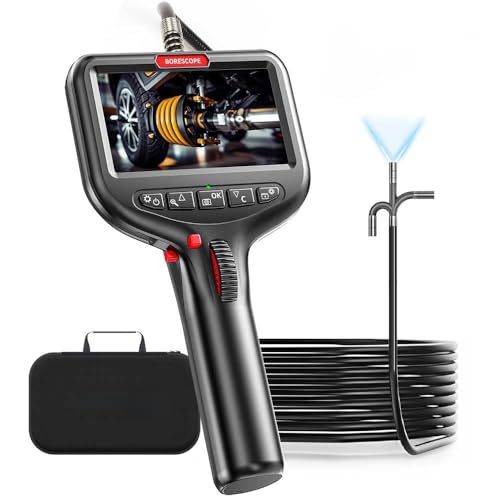
The SCOPIX combines a compact 0.24-inch probe with a 4.3-inch display and a flexible two-way articulating design. Its listed diameter is approximately 6.1 mm, placing it near the VA-650 in access size rather than alongside the 2.8 mm specialist models. The 3.3 ft cable is suitable for short engine, pipe, appliance, and equipment checks, especially when a nearby screen is more convenient than opening an app on a phone.
The listing describes a 1080P HD lens, adjustable LED lighting, and an IP67-rated probe. Those specifications support the intended inspection environments, but the product information does not clearly identify recording storage, battery runtime, or the exact articulation angle. The compact display and two-way control give it a practical layout for basic troubleshooting. It is less clearly specified than the VA-650 and lacks the all-way joystick control of the CF models, yet it remains a reasonable choice for straightforward confined-space viewing.
Pros
- Approximately 0.24-inch probe diameter suits many narrow engine and pipe openings.
- Two-way articulation provides active directional adjustment.
- Integrated 4.3-inch display supports phone-free inspection.
- Adjustable LED lighting helps illuminate dark cavities.
- The probe is listed as IP67 for wet or oily inspection environments.
Cons
- The 3.3 ft cable offers less reach than the 1.2 m and longer probes in this comparison.
- The available product information does not clearly specify recording, battery runtime, or articulation angle.
The SCOPIX suits routine checks where the camera needs to enter a modestly narrow opening and the operator wants a screen in the box. It is easier to approach as a compact inspection kit than a phone-dependent USB camera, while the two-way probe can help around simple bends. Choose a smaller-diameter model for severely restricted access, or a joystick model for complex directional work. Its appeal is the uncomplicated display and useful probe size, with fewer documented details than the higher-ranked alternatives.
To buy this product, click here.
Buying Guide
Probe Diameter Determines the Entry Point
Probe diameter is the first measurement to match to the access hole. A 0.95 mm probe can reach spaces that reject a 2.8 mm camera, while a 2.8 mm model can still provide more practical maneuverability than an ultra-thin specialist instrument. The 4 mm to 6.2 mm range is often more useful for general engine, appliance, and equipment work because it can combine manageable access with a broader feature set. Measure the opening and account for the camera head, not only the cable.
Active Articulation Is Different From Cable Flex
A flexible probe can bend as it travels, but that does not mean the camera tip is actively steerable. Two-way articulation controls movement across a defined pair of directions. The CF-2812, CF-4020, and CF-4030 add 360-degree joystick control, which can be valuable when the target sits around a corner. If the inspection requires the camera to face a particular surface after insertion, active articulation matters more than a cable that simply curves.
Match Probe Length to the Inspection Path
A 1 m probe works well for many engine compartments, appliances, and nearby machinery cavities. A 1.2 m probe adds modest reach without becoming excessively cumbersome, while the 2 m and 3 m models are better suited to longer paths. Extra length can become a handful in a short workspace, so more cable is useful only when the inspection actually needs it.
Choose the Viewing Workflow Before the Camera
Integrated-screen models such as the VA-650, CF series, NP-0-09510, and SCOPIX allow inspection without a separate phone or computer. USB models can be preferable at a workstation, but compatibility depends on the connected device and software. Wi-Fi models add mobile convenience, though the supplied information may not identify every app or operating-system requirement. A familiar connector does not guarantee that every phone will work.
Focus Range Can Matter More Than the Resolution Label
A resolution number describes an image specification, but it does not tell you whether a nearby defect will be in focus. The VA-650 lists a 15 mm to 200 mm focus range, while the NP-0-09510 lists 2 mm to 30 mm, showing how differently these tools are aimed. Close-focus performance can matter more than a larger headline number when the lens must sit near a component surface.
Read IP Ratings by Component
An IP67 or IP58 rating in a listing applies to the identified probe or camera head unless the information clearly says otherwise. It should not automatically be extended to the display, handle, connector, phone, or charging port. A protected probe can help around damp or oily areas, but it does not make the complete inspection system suitable for unlimited immersion or every liquid.
Plan for Image and Video Documentation
If the inspection needs a record, check whether the model lists photo and video capture, an SD or microSD card, software support, or HDMI output. The VA-650 and NP-0-09510 explicitly list storage-related features, while USB models rely on a compatible connected device and software. Do not assume that an integrated screen automatically means the unit can save images.
Best Small Diameter Borescope FAQ
What Probe Diameter Is Best for Small Openings?
Use the smallest probe that still provides the access, focus, lighting, and control needed for the job. The 0.95 mm NP-0-09510 is the strongest fit for exceptionally narrow openings. A 2.8 mm model offers a better balance when the opening allows it and active articulation is useful. For general work, 4 mm to 6.2 mm models can provide more handling and feature flexibility.
Is a 2.8 mm Borescope Better Than a 4 mm Model?
It depends on the opening and the inspection path. A 2.8 mm camera reaches smaller spaces, while a 4 mm camera may be easier to handle and can still fit many confined access points. The CF-2812 and CT-2812 add 2.8 mm access, while the CF-4020 and CF-4030 pair a 4 mm camera with all-way articulation and longer probes.
Can These Borescopes Inspect a Hot or Moving Engine?
The supplied product information does not establish operating-temperature limits or authorize use around moving machinery. Allow equipment to cool where appropriate, keep the camera away from moving parts, and follow the product instructions and safe inspection procedures. Probe diameter alone does not make a borescope suitable for a particular engine condition.
Does Wi-Fi Mean the Borescope Works With Every Phone?
No. The CT-2812 listing identifies Wi-Fi connection to iPhone, iPad, and Android devices, but it does not establish compatibility with every model or operating-system version. Confirm the current app and device requirements before ordering. USB models have the same general issue because physical connection and software support are separate questions.
What Is the Advantage of a Built-In Screen?
A built-in screen creates a self-contained inspection workflow. You can view the camera without bringing a phone, tablet, or computer into the work area, which is useful beside machinery or in a garage. It does not automatically mean that photos and videos can be saved, so check for listed storage or recording features.
Are IP67 Probes Safe to Submerge Indefinitely?
No. IP67 is a protection claim for the specified component under defined test conditions, not a promise of unlimited underwater use. The listing may apply the rating to the probe and camera head while the display, handle, and connectors remain outside the wet area. Follow the product instructions and avoid extending the rating beyond the stated component or conditions.
Which Model Is Best for Saving Inspection Evidence?
The VA-650 lists a microSD card for storing pictures and videos, and the NP-0-09510 lists SD-card recording plus HDMI output. USB models can also support photos and video through compatible software or apps. Before buying, verify the storage method and whether the card or recording accessory is included with the exact configuration.
Final Verdict
The Vividia VA-650 is the strongest overall choice for a broad range of small-access inspections. Its 6.2 mm camera head is not the smallest here, but two-way articulation, a 1 m probe, a 5-inch display, broad listed focus range, IP67 probe protection, and microSD recording create a well-rounded setup. It is easier to recommend for varied engine, appliance, equipment, and short pipe work than a highly specialized probe that sacrifices reach or control.
For tighter openings and more active steering, the Vividia CF-2812 is the stronger alternative, while the NP-0-09510 is the specialist choice when sub-millimeter access matters most. The CF-4030 earns attention when reach is the priority, and the D3145 suits a USB-centered engine inspection workflow. Match the camera head to the entry point, the probe length to the route, and the viewing system to the devices you actually plan to use. That practical fit matters more than choosing the smallest diameter or the largest resolution label in isolation.
