
A 3.9mm probe can reach openings that leave bulkier inspection cameras staring at the outside of the problem. That matters around spark-plug holes, fuel-injector ports, narrow pipes, wall cavities, and compact machinery, where a few millimeters can decide whether an inspection happens without disassembly. The best 3.9mm borescope should pair that slim access with useful lighting, manageable cable control, a clear viewing system, and enough documentation capability for the task.
Probe diameter is only the opening move. A semi-rigid cable can be easier to position in a short engine cavity, while an articulating probe gives better control after the camera is inside. A large integrated screen avoids phone pairing, but recording, storage, battery life, and environmental protection still vary considerably. Some models are better for quick visual checks, while others suit repeated engine or pipe inspections where saved photos and video matter.
This comparison focuses on genuine 3.9mm inspection cameras, including articulating models and integrated-screen systems. The rankings weigh access, tip control, display design, lighting, recording, cable length, environmental features, and practical limitations rather than treating a high resolution claim as a complete buying decision.
Quick Answer
Best overall: DXZtoz 3.9mm Ultra-Slim Articulating Borescope. Its 3.9mm articulating probe, 5-inch IPS screen, close-focus claim, photo and video recording, 32GB card, and 5 to 6 hour listed runtime create a balanced setup for detailed inspection work.
Best for four-way control: Hialemi 3.9mm 360° Articulating Borescope. Its four-way joystick control offers a broader range of tip direction than the two-way models in this group.
Best for large-screen viewing: NIDAGE 3.9mm Articulating Borescope. The 7-inch display is useful when a second person needs to see the inspection or when the operator is working under a vehicle or on a ladder.
Best for long reach: 3.9mm USB Interchangeable Borescope. Its included 5-meter semi-rigid cable reaches much farther than the short probes in the articulating models, and the included grabber adds a practical retrieval function.
Best 3.9mm Borescope Comparison Table
| Product | Best For | Probe And Control | Display And Recording |
|---|---|---|---|
| DXZtoz 3.9mm Ultra-Slim Articulating Borescope | Overall inspection work | 3.9mm, two-way, 5ft | 5-inch IPS, photo and video |
| NIDAGE 3.9mm Endoscope Camera | Basic visual checks | 3.9mm, semi-rigid, 5ft | IPS screen, no recording |
| Teslong TD500 3.9mm Articulating Borescope | Engine inspection | 3.9mm, two-way | 5-inch IPS, wireless sharing |
| Hialemi 3.9mm 360° Articulating Borescope | Four-way tip control | 3.9mm, four-way, 3.94ft | 5-inch IPS, photo and video |
| Zealtron Two-Way Articulating Borescope | Compact controlled inspections | 3.9mm, two-way, 1m | 5-inch IPS, photo and video |
| NIDAGE 3.9mm Articulating Borescope | Large-screen viewing | 3.9mm, two-way, 210° | 7-inch IPS, photo and video |
| 3.9mm USB Interchangeable Borescope | Long-reach pipe work | 3.9mm, semi-rigid, 5m included | 4.3-inch IPS, optional expansion |
| Teslong 6-Inch Screen 3.9mm Borescope | Extended inspections | 3.9mm, fixed probe | 6-inch IPS, Wi-Fi sharing |
| ZEENSUY 3.9mm Two-Way Articulating Borescope | Magnification and portability | 3.9mm, two-way, 5ft | 4.3-inch IPS, photo and video |
The detailed reviews below explain how each probe, control system, screen, and recording setup changes the inspection experience.
1. DXZtoz 3.9mm Ultra-Slim Articulating Borescope — Best Overall
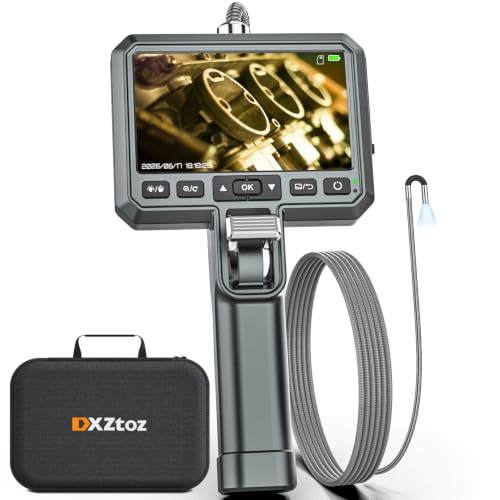
The DXZtoz brings together the features that matter most in a slim inspection camera without leaning on one headline specification alone. Its 3.9mm probe is paired with two-way articulation, giving the operator a way to redirect the tip after it enters a tight passage. The listing describes a close focal range down to about 1cm, which is especially relevant for looking at nearby engine components, piston areas, valves, cracks, or printed parts rather than viewing a distant cavity in soft focus.
A 5-inch IPS display keeps the system independent from a phone, and the listed 10X zoom can help enlarge a small area on the screen. Six adjustable LEDs address the familiar problem of a bright hotspot washing out an oily surface. Photos and videos can be saved to the included 32GB card, while the listed 3000mAh battery supports approximately 5 to 6 hours of use. For a garage inspection that turns into a documentation job, that combination feels much more complete than a camera that provides live viewing alone.
Pros
- 3.9mm probe with documented two-way articulation.
- Listed close-focus capability down to approximately 1cm.
- 5-inch IPS display with adjustable six-LED lighting.
- Photo and video capture with a pre-installed 32GB memory card.
- Listed 5 to 6 hour operating time and power-bank charging support.
Cons
- Two-way articulation offers less directional control than a four-way design.
- The listing describes the probe as heat-resistant up to 60, but the unit should still be used only within the applicable instructions and conditions.
This is the strongest all-purpose choice for buyers who need a narrow probe, controlled tip movement, an integrated display, and saved inspection records in one device. It makes particular sense for engine, machinery, robotics, and detailed maintenance work where a live image is useful but a captured file may matter later. Those who need four-direction steering or a much longer reach may prefer another model, yet the DXZtoz has the most balanced feature set here for varied 3.9mm inspection tasks.
To buy this product, click here.
2. NIDAGE 3.9mm Endoscope Camera — Best for Simple Visual Checks

Some inspections are quick, almost like shining a flashlight behind a cabinet and asking one question: is that part damaged, blocked, or intact? The NIDAGE 3.9mm Endoscope Camera suits that kind of work. Its 3.9mm probe uses a 5-foot semi-rigid cable, so it can be shaped and held in a narrow route while remaining easier to position than a floppy cable. The integrated IPS screen avoids the mess of bringing a phone into a greasy engine bay or damp utility space.
The six adjustable LEDs support viewing in dark areas, and the listing identifies the probe as IP67 waterproof for damp inspection work. This is a live-view tool, however. The product information specifically says it cannot take photos or videos, so it is better for immediate decisions than for building a visual service record. A homeowner checking a wall cavity or a vehicle owner looking for debris may appreciate the straightforward setup, while anyone who needs before-and-after evidence should move up the list.
Pros
- 3.9mm probe provides access through narrow openings.
- 5-foot semi-rigid cable balances reach with basic positioning control.
- Integrated IPS display works without a phone or app.
- Six adjustable LEDs support dark and damp inspection areas.
- IP67 protection is listed for the camera probe.
Cons
- The listing says the camera cannot capture photos or videos.
- The probe does not have documented active articulation.
Pick this model for live inspection rather than documentation. It can make sense for occasional automotive checks, appliance cavities, wall work, and damp areas where a slim camera and built-in display are the main requirements. Skip it if you need to send images to a customer, compare a defect later, or steer the camera tip around a valve or cylinder wall. Its simplicity is useful, but that simplicity sets a clear ceiling on the workflow.
To buy this product, click here.
3. Teslong TD500 3.9mm Articulating Borescope — Best for Engine Inspection

The TD500 is aimed squarely at the moment an inspection needs more control than a bendable cable can provide. Its 3.9mm, approximately 0.15-inch lens is intended for confined mechanical spaces, including cylinders and engine components. Two-way articulation lets the user change the viewing direction at the tip, a meaningful advantage if the camera enters through a small opening and cannot be rotated freely by hand.
A 5-inch true-color IPS display provides a self-contained viewing system, while the built-in wireless adapter allows inspection images to be shared with a tablet. The supplied kit includes a 32GB microSD card, carrying case, and Type-C charging and data cable. That makes the TD500 useful for a second set of eyes during a difficult inspection, although the available information does not describe the wireless connection as a replacement for the integrated display or specify every compatible device.
Pros
- 3.9mm probe is suited to narrow engine and machinery access points.
- Documented two-way articulation improves tip direction control.
- 5-inch IPS display offers a phone-free live-view workflow.
- Wireless adapter supports sharing inspection images with a tablet.
- Includes a 32GB microSD card, case, and Type-C cable.
Cons
- Two-way control is less comprehensive than four-way articulation.
- The available product information does not clearly specify the probe’s environmental rating.
The TD500 deserves attention from anyone who expects engine inspection to involve careful positioning rather than a quick peek. It is a sensible fit for cylinder, mechanical-equipment, and machinery work where sharing a view can help another person interpret what appears on screen. Buyers focused on wet pipe work may prefer a model with a clearly listed IP rating, while those seeking a broad all-purpose setup may favor the DXZtoz’s stated close-focus, recording, and battery details.
To buy this product, click here.
4. Hialemi 3.9mm 360° Articulating Borescope — Best for Four-Way Tip Control

Four-way articulation changes the feel of a tight inspection. Rather than steering primarily up and down, the Hialemi uses a four-way joystick to direct its 3.9mm tip in more directions inside engines, machinery, and narrow pipelines. The listed probe length is approximately 3.94 feet, shorter than the long-reach cable systems below but easier to manage in compact work areas where excess cable can coil around the operator’s hands.
The 5-inch IPS screen shows listed 1080P live video, and the rear-mounted controls are intended for one-handed photo and video capture. Six adjustable LEDs plus a built-in flashlight address both close camera lighting and broader workspace illumination. The listing also identifies IP67 protection for the camera probe and a high-temperature warning system. Those features are useful signals for demanding environments, but they do not remove the need to follow operating limits and keep the control unit and connectors away from conditions not covered by the rating.
Pros
- Genuine four-way articulation provides broad directional control.
- 3.9mm probe reaches narrow engine and machinery spaces.
- 5-inch IPS display supports direct viewing without a phone.
- Photo and video capture are available with a 32GB microSD card included.
- Probe listing includes IP67 protection and a high-temperature warning system.
Cons
- The approximately 3.94-foot probe is shorter than long-reach alternatives.
- The listing’s temperature protection does not make every hot or moving inspection environment appropriate.
This model is the clearest choice for a buyer who values steering range above cable reach. Four-way control can help when a target sits off-axis and repositioning the whole probe would be awkward. It may be more capability than needed for a simple drain or wall check, and the shorter reach limits deep pipe work. For engine and machinery access where the camera must look around internal structures, the added joystick control is the reason to choose it.
To buy this product, click here.
5. Zealtron Two-Way Articulating Borescope — Best for Modular Serviceability

The Zealtron takes a different approach to long-term practicality. Its 3.9mm tip uses a push-pull lever for two-way articulation, while the 1-meter tube is built around an oil-resistant silicone and spring-steel composite that the listing describes as self-returning. A short, self-resetting tube can be easier to guide around a compact engine bay or overhead fixture than a long loose cable that keeps folding across the floor.
Its unusual feature is a modular screen, battery, and handle design with hot-swappable core sections. The product information presents this as a way to replace an individual damaged module rather than discard the full unit. The camera also lists IP67 protection, six adjustable LEDs, temperature display, and an automatic warning and shutdown at 85°C ambient temperature. The 5-inch IPS display and photo-video controls round out a practical setup, although the short reach remains a major boundary for pipe routes.
Pros
- 3.9mm tip combines narrow access with documented two-way control.
- Self-returning 1-meter tube is suited to compact inspection paths.
- Modular screen, battery, and handle architecture may simplify component replacement.
- IP67 camera protection and listed thermal warning provide useful environmental information.
- 5-inch IPS screen supports photo and video capture.
Cons
- One-meter reach is limited for deep drains and long pipe runs.
- Two-way articulation offers less directional range than the Hialemi four-way model.
Choose the Zealtron for repeated short-range work where handling and serviceability matter more than maximum reach. It is a strong fit around compact machinery, engines, and assemblies that punish a loose cable with kinks and tangles. A plumbing buyer working far down a line should look toward the 5-meter option instead, while someone who wants a replaceable, modular inspection tool may appreciate the Zealtron’s unusual construction.
To buy this product, click here.
6. NIDAGE 3.9mm Articulating Borescope — Best for Large-Screen Viewing

A 7-inch screen can matter when the display sits a little too far away to read comfortably. The NIDAGE pairs that large IPS panel with a 3.9mm probe and two-way articulation listed at 210 degrees. A second person can follow the image more easily, and the operator working beneath a vehicle has more viewing area than a small handheld display provides. The probe’s six adjustable LEDs are listed for dark and wet areas, including drains and wall leaks.
This is a self-contained inspection camera with photo and video capture, transfer to a computer through the included charging cable, and an included hard-shell case. The anti-slip grip and one-handed buttons suit work that involves holding the probe steady while capturing a frame. The listing identifies IP67 protection for the probe, but the rating should not be treated as protection for the entire screen and handle assembly.
Pros
- Large 7-inch IPS screen is easy to share during an inspection.
- 3.9mm probe supports access through narrow openings.
- Documented 210-degree two-way articulation improves viewing direction.
- Photo and video files can be transferred to a computer by cable.
- Includes a hard-shell case and lists IP67 probe protection.
Cons
- The larger screen may be less convenient in cramped storage or tight work areas.
- Two-way articulation does not provide the directional coverage of four-way control.
The NIDAGE is a good match for collaborative inspections, training, and tasks where screen readability matters more than compactness. It can help when one person guides the probe and another watches for carbon buildup, wear, leaks, or damage. Buyers who usually work alone in very confined spaces may find a 5-inch unit easier to carry, while those who value a large live image will find this model’s screen is its clearest distinction.
To buy this product, click here.
7. 3.9mm USB Interchangeable Borescope — Best for Long Reach

The 5-meter semi-rigid cable makes this model a different kind of tool from the short articulating scopes. It can travel behind appliances, along wall cavities, and into longer pipe routes where a 1-meter probe would simply stop short. The 3.9mm camera is listed as IP67 protected, and the 4.3-inch IPS screen provides a phone-free view without Wi-Fi pairing or an app. The cable is semi-rigid rather than actively articulating, so reach improves while precise tip steering does not.
The USB-interchangeable design adds flexibility for future configurations. The included setup uses the 5-meter cable and 3.9mm camera, while the listing says a 15-meter cable with a triple-lens camera is sold separately. That optional component should not be confused with what arrives in the box. The included 1-meter drain grabber is a practical extra, allowing the operator to see a blockage and attempt retrieval, and the hard case keeps the long cable from becoming a tangled drawer snake.
Pros
- Included 5-meter semi-rigid cable provides substantial inspection reach.
- 3.9mm IP67 camera is suited to narrow and damp access points.
- USB-interchangeable design allows compatible future probe configurations.
- Includes a 1-meter drain clog remover grabber.
- 4.3-inch IPS screen and storage case support phone-free field use.
Cons
- The probe does not have documented active articulation.
- The optional 15-meter triple-lens setup is sold separately rather than included.
This is the most practical pick for long paths, especially drains, wall cavities, and areas behind bulky equipment. The extra cable brings reach, but it also asks for more management in a short inspection, and the semi-rigid design cannot steer around an internal obstruction like an articulating tip. Select it for distance and retrieval support, not for precise engine-cylinder viewing.
To buy this product, click here.
8. Teslong 6-Inch Screen 3.9mm Borescope — Best for Extended Inspections

Long inspection sessions put pressure on battery life and workflow more than a quick peek does. The Teslong lists a 6000mAh battery, USB-C fast charging, and a battery indicator on the screen. Its 6-inch IPS display gives more room for viewing than compact 4.3-inch units, while Wi-Fi sharing through the SmartEndoscope app lets a phone or tablet display the live feed for collaboration.
The fixed 3.9mm probe is aimed at engine gaps, fuel-injector ports, and narrow pipes. Six adjustable LEDs illuminate the camera view, and the built-in flashlight covers a broader area around the work point. The listed IP67 protection applies to the probe, and the kit includes a hard case, SD card, hook, magnet, and side mirror. Those accessories broaden the inspection workflow, but the side mirror is a viewing attachment rather than a second camera, and the probe is not described as articulating.
Pros
- 6000mAh battery is listed for extended inspection sessions.
- 6-inch IPS display provides a larger direct viewing area.
- Wi-Fi supports remote viewing through the SmartEndoscope app.
- 3.9mm probe, adjustable LEDs, and built-in flashlight suit narrow dark spaces.
- Includes an SD card, hard case, hook, magnet, and side mirror.
Cons
- The probe does not have documented active articulation.
- Remote viewing requires the listed app and a compatible phone or tablet.
This Teslong suits extended engine, HVAC, plumbing, and maintenance sessions where charging interruptions are irritating and a larger screen is welcome. It is also useful when another person needs to see the live view remotely, although the direct display remains the simpler path. Buyers who need to redirect the camera tip around internal components should select an articulating model instead.
To buy this product, click here.
9. ZEENSUY 3.9mm Two-Way Articulating Borescope — Best for Magnification

The ZEENSUY combines a 3.9mm two-way articulating probe with a 4.3-inch IPS display and selectable magnification from 1X through 5X. The listing gives an optimal imaging distance of 2 to 10cm, a useful reminder that moving the camera to the right working distance can matter as much as increasing magnification. A small object viewed too close may still look poor, while a steady image at the stated range can reveal more useful detail.
The 5-foot semi-rigid cable can be shaped to hold a route through an engine, wall, or pipe, and the one-handed joystick is intended to assist tip control. Six three-level LED settings, photo and video capture, a 32GB SD card, protective case, and Type-C cable create a complete field kit. The listing also identifies IP67 and oil-proof protection for the inspection camera, plus a high-temperature warning. Exact operating limits beyond those listing claims should be confirmed before demanding use.
Pros
- 3.9mm probe combines narrow access with documented two-way articulation.
- Selectable 1X to 5X magnification helps inspect small internal details.
- 5-foot semi-rigid cable supports stable positioning in complex spaces.
- Photo and video capture with a 32GB SD card are included.
- 4.3-inch IPS display, adjustable LEDs, and Type-C transfer support field use.
Cons
- The 4.3-inch screen is smaller than the displays on several alternatives.
- Two-way articulation provides less control than four-way systems.
ZEENSUY is a useful fit for buyers who want a compact articulated setup with magnification and straightforward recording. It can serve engine, HVAC, wall, and pipeline checks where five feet of semi-rigid reach is enough. A larger-screen buyer should look at the NIDAGE model, while someone needing four-way steering should choose the Hialemi. The ZEENSUY earns its place through the combination of a slim tip, joystick control, and adjustable enlargement.
To buy this product, click here.
Buying Guide
Probe Diameter Determines Access
A 3.9mm probe is the defining feature of this group because it can fit openings that standard 8mm cameras may miss. That does not mean every 3.9mm model reaches every spark-plug hole, fuel port, or pipe. Check the actual access opening, camera-head construction, and the route beyond it before ordering. A slim tip gets through the doorway, but cable behavior determines whether it can travel farther.
Active Articulation Is Different From Cable Bending
A semi-rigid cable can be shaped before insertion, but genuine articulation changes the distal camera direction through a control on the handle. Two-way systems generally provide up and down movement, while the Hialemi lists four-way joystick control. Choose articulation for engine components or offset targets where rotating the entire probe is difficult. Choose a fixed semi-rigid cable when reach and basic positioning matter more than tip steering.
Match Reach to the Inspection Path
Short probes are easier to manage around an engine bay, but they may stop before reaching a blockage deep inside a wall or pipe. The 1-meter Zealtron is aimed at compact work, while the 5-meter USB-interchangeable model offers much more reach. Long cable is useful in a drain, yet it can feel cumbersome in a small compartment. A longer number is helpful only when the inspection actually needs it.
Working Distance Affects Visible Detail
Resolution claims do not tell the entire image story. Focus distance, lighting, camera stability, lens position, and screen size all affect whether a crack or deposit is easy to interpret. The DXZtoz lists close focus to approximately 1cm, while the ZEENSUY lists an imaging range of 2 to 10cm. Keep the camera steady, adjust its distance, and reduce LED glare on shiny or oily surfaces.
Integrated Screens Reduce Setup Friction
Every model here includes a viewing screen, but recording and sharing differ. A built-in display avoids phone compatibility questions and keeps a dirty work area away from personal electronics. The NIDAGE fixed camera does not record photos or videos, while several other models include storage or file transfer. Wi-Fi sharing, such as the Teslong system describes, can help collaboration but adds an app and device-compatibility step.
Read IP Ratings Precisely
An IP67 claim in these listings applies to the camera probe or inspection camera, not automatically to the screen, handle, connectors, or phone. It can be useful for damp or wet inspection areas, but it does not mean unlimited underwater use or suitability for every liquid. Keep the control unit dry, follow the product instructions, and avoid inserting a probe into moving or dangerously hot equipment.
Recording Matters for Documentation
If an inspection may need to be reviewed later, saved photos and videos are more useful than a live image that disappears when the device powers off. Check whether storage is included, whether the product captures both stills and video, and how files move to a computer. The fixed NIDAGE model is intentionally limited to live viewing, while the DXZtoz, Hialemi, ZEENSUY, and several other models list recording support.
Best 3.9mm Borescope FAQ
Why choose a 3.9mm borescope?
The narrow probe can enter smaller openings than many standard inspection cameras. That can help with engine access points, tight machinery, narrow pipes, wall cavities, and appliance interiors. Probe diameter does not guarantee easy navigation, so cable control and camera-head dimensions still matter.
Are all 3.9mm borescopes articulating?
No. The DXZtoz, Teslong TD500, Hialemi, Zealtron, NIDAGE articulating model, and ZEENSUY list active articulation. The fixed NIDAGE camera, Teslong 6-inch model, and USB-interchangeable model use non-articulating probe arrangements according to the supplied information. A cable that bends or holds its shape is not the same as a mechanically controlled camera tip.
Can these cameras inspect a running engine?
Do not insert an inspection probe into moving machinery. Allow equipment to cool and follow the product instructions before inspection. Several listings describe engine use, and some include thermal warnings, but those details do not create a blanket authorization for hot, moving, pressurized, or hazardous equipment.
Does IP67 mean the whole borescope can be submerged?
No. The listed IP67 protection generally applies to the probe or camera portion. The screen, handle, charging connections, and storage media may have different limits. Keep the control unit protected and confirm the applicable instructions before using any model around water.
Which model is better for saving inspection evidence?
Choose a model that explicitly lists photo and video capture, storage, and file transfer. The DXZtoz includes a 32GB card, while the Hialemi and ZEENSUY also list recording and memory support. The basic NIDAGE 3.9mm camera specifically does not capture photos or videos, so it suits live checks rather than formal documentation.
Is a longer cable always better for pipe inspection?
No. A longer cable provides more reach, but it can be harder to guide through short or sharply curved routes. The 5-meter USB-interchangeable model is the strongest long-reach option here, while shorter articulating probes offer more control in compact spaces. Match the cable to the path rather than choosing the longest available option automatically.
Do these products work with every phone?
No phone compatibility should be assumed from a Type-C cable or a Wi-Fi feature alone. Several models avoid the issue by including their own screens. The Teslong 6-inch model lists Wi-Fi viewing through an app, but the supplied information does not establish compatibility with every phone or tablet. Confirm supported devices and software before relying on remote viewing.
Final Verdict
The DXZtoz 3.9mm Ultra-Slim Articulating Borescope is the strongest overall choice because it balances narrow access, two-way tip control, close-focus information, a 5-inch IPS screen, adjustable lighting, recording, storage, and listed 5 to 6 hour operation. It is a versatile fit for engine, machinery, robotics, and general maintenance inspections where the camera must reach a tight space and the result may need to be saved.
Choose the Hialemi if four-way steering is the deciding feature, or the NIDAGE articulating model if a 7-inch display will make shared viewing easier. For long pipe and drain routes, the 5-meter USB-interchangeable borescope makes more sense, while the basic NIDAGE is suitable for live checks without recording. Match the probe control, cable length, display, and documentation features to the inspection path, and treat waterproofing and temperature claims as limits to verify rather than permission to ignore safe working practices.
