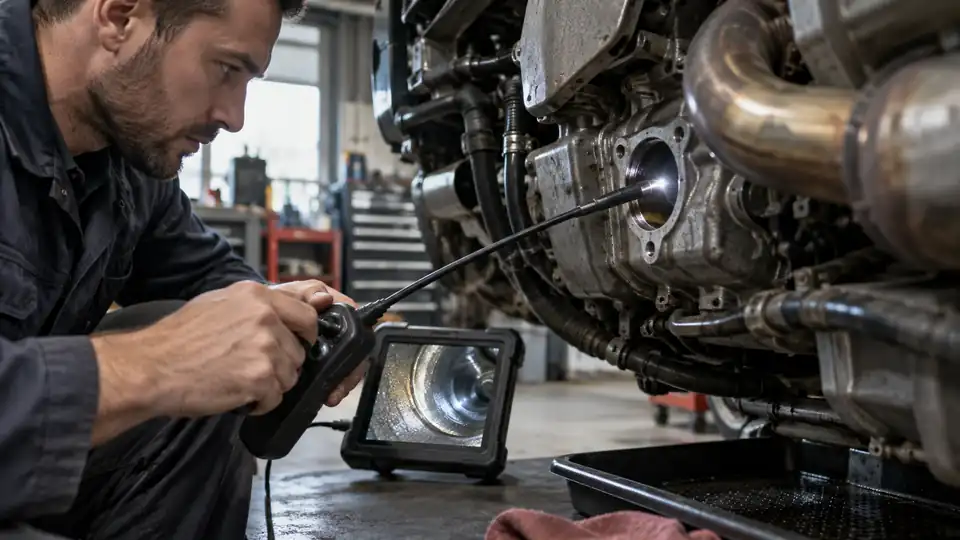
A borescope can reach the right area and still give you the wrong view. An articulating model solves that problem by letting you steer the camera tip after the probe is inside. This can make it easier to look toward a valve, around a bend, or across a confined cavity without repeatedly withdrawing and repositioning the probe. When comparing models, pay attention to the articulation itself as well as probe diameter, cable length, viewing direction, lighting, display quality, and recording capability.
Headline resolution figures can distract from the details that determine whether a scope is useful in a real inspection. A thin probe may reach a spark-plug hole that an 8.5 mm camera cannot, while a longer cable may help inside ductwork but become awkward in a short access path. Dual-lens viewing can reduce blind spots, but it is a separate feature from active tip steering. Buyers also have different priorities. An engine inspection favors a slim, controllable probe, while plumbing and HVAC work may benefit more from reach, environmental protection, and a semi-rigid cable.
The products below focus on genuine articulating inspection cameras with integrated screens. Some emphasize four-way control, others pair two-way articulation with front and side cameras, and several focus on narrow access or longer reach. The comparison gives a quick overview before the detailed reviews explain the trade-offs.
Quick Answer
Best Overall: The Ralcam 360° Articulating Borescope offers the broadest directional control in this group, with four-way articulation, dual lenses, a 6.5 mm probe, a 5-inch screen, and a replaceable battery.
Best for Dual-Lens Inspection: The FOXWELL Y406D-Elite combines a slim 6.5 mm probe with two-way articulation, front and side cameras, 32GB storage, and one-touch recording.
Best for Narrow Automotive Access: The Teslong 5.5mm Slim Probe Borescope is aimed at tight engine and transmission openings, including spark-plug holes, injector ports, and valve seats.
Best for Long Reach: The DEPSTECH DS650 pairs two-way articulation and dual-lens viewing with a 10-foot semi-rigid cable, making it a strong fit for deeper HVAC, plumbing, and cavity inspections.
Best Articulating Borescope Comparison Table
| Product | Articulation | Probe | Reach | Viewing System |
|---|---|---|---|---|
| Ralcam 360° Articulating Borescope | Four-way, 360° | 6.5 mm | 5 ft | Dual lens, split-screen |
| FOXWELL Y406D-Elite | Two-way, 220° | 6.5 mm | Not clearly stated | Dual lens |
| FOXWELL Y400 | Two-way, 220° | 6.2 mm | Not clearly stated | Single viewing system |
| Teslong 5.5mm Slim Probe | Two-way, 180° | 5.5 mm | 5 ft | Single viewing system |
| DEPSTECH DS650 | Two-way, 210° | 0.33 in | 10 ft | Dual lens, split-screen |
| Teslong Dual-Lens Borescope | Two-way | Not clearly stated | 5 ft | Front and side cameras |
| Anykit 210° Articulating Borescope | Two-way, 210° | 0.22 in | 4 ft | Single viewing system |
| Acoath 10FT Articulating Borescope | Two-way, 210° | 0.33 in | 10 ft | Dual lens |
| DXZtoz Dual-Lens Borescope | Two-way | Not clearly stated | Not clearly stated | Front and side cameras |
The detailed reviews below focus on how each scope handles direction control, tight access, viewing angles, reach, documentation, and demanding inspection environments.
1. Ralcam 360° Articulating Borescope — Best Overall

Four-way articulation is the reason this Ralcam model takes the top position. Its joystick controls movement in four directions, with the product information describing a full 360-degree range. That matters inside a cylinder, pipe junction, or HVAC cavity where a two-way tip may steer left and right but still require cable rotation to find the correct vertical angle. The 6.5 mm probe also keeps the camera reasonably slim for narrow access, while the 5-foot semi-rigid cable offers a useful balance between reach and control.
The dual-lens arrangement adds another layer of practical coverage. The front and side cameras can be viewed separately or in split-screen mode, and the 5-inch IPS display provides a larger viewing surface than many compact inspection units. Photos and 1080p video can be saved to the included 32GB card, while the replaceable battery is useful for extended field work. A probe rated IP67 is listed for wet, oily, and dusty conditions, but that rating should be treated as applying to the camera probe rather than the entire handheld system.
Pros
- Four-way articulation provides control across a full 360-degree range.
- Dual front and side cameras reduce the need to withdraw and reposition the probe.
- 6.5 mm probe reaches many narrow inspection openings.
- 5-inch IPS screen, 4x zoom, and split-screen viewing support detailed checks.
- Replaceable battery can be swapped for longer work sessions.
Cons
- The 5-foot cable is less suitable for deep pipe or duct runs than a 10-foot design.
- The product information does not clearly identify the exact focus range.
This is the strongest choice for buyers who value camera positioning above maximum cable length. It is especially compelling for complex spaces where a side view and four-way tip movement can work together. A longer-reach scope may be more appropriate for deep cavities, but the Ralcam gives up some distance in exchange for unusually broad directional control and a replaceable battery.
To buy this product, click here.
2. FOXWELL 2-Way 220° Articulating Borescope Camera with Dual Lens — Best for Controlled Dual-Lens Viewing
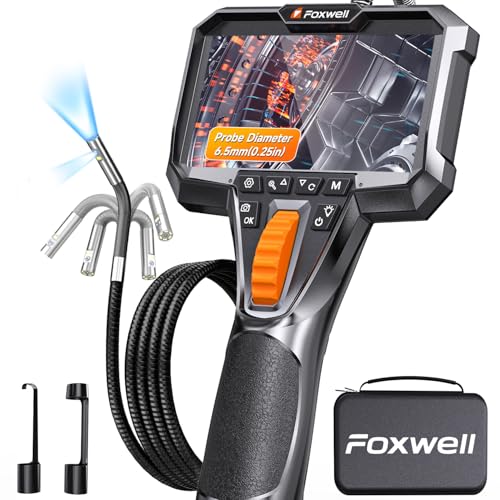
A 6.5 mm probe, 220-degree two-way articulation, and dual cameras make this FOXWELL a well-balanced inspection tool for tight automotive, HVAC, and plumbing spaces. The front and side lenses can be switched directly, so the operator can inspect forward and then look across a nearby surface without relying entirely on cable rotation. That arrangement is useful around valves, cylinder walls, and pipe interiors where the target may sit beside the insertion path.
The integrated IPS display is intended for phone-free operation, and the product information lists adjustable lighting, photo and video capture, USB-C charging, and 32GB of built-in storage. The listing also describes a CMOS imaging system and processing hardware intended to produce a clear live image, though those claims are not independent test results. A smart heat-protection system is listed to shut the device down above 70 degrees Celsius, so hot equipment should still be allowed to cool according to its own inspection requirements.
Pros
- 220-degree two-way articulation provides active tip direction control.
- Front and side cameras offer two viewing directions in a slim probe.
- 32GB storage supports recorded photos and videos.
- Integrated screen avoids phone, Wi-Fi, and app dependency.
- IP67-rated probe and listed heat protection suit demanding inspection environments.
Cons
- The listing does not clearly state the probe or cable length.
- Two-way articulation cannot steer vertically as freely as a four-way system.
The Y406D-Elite suits anyone who frequently needs a forward view followed by a side view in the same confined area. It gives up the Ralcam’s four-way steering, yet its dual-lens design can be more useful than extra articulation for surfaces positioned directly beside the probe. Buyers who need a known long reach should look toward the 10-foot models instead.
To buy this product, click here.
3. FOXWELL Y400 220° 2-Way Articulating Borescope — Best for Slim Controlled Access

The Y400 focuses on access and tip control. Its 6.2 mm probe is slimmer than the 8 mm-plus designs referenced in the listing, which can matter at spark-plug holes, narrow valves, HVAC openings, and compact pipe paths. Once inserted, the thumb-wheel provides 220-degree two-way steering. That combination helps the operator place the camera without pushing the semi-rigid cable around blindly.
The display system adds practical inspection tools rather than relying on a headline resolution figure. Six adjustable LEDs provide three brightness levels, and 2x and 4x zoom can enlarge an area already visible on the screen. The probe is listed as IP67-rated and oil resistant, with automatic overheat shutdown at 70 degrees Celsius. The device also lists 5 to 7 hours of battery operation and 32GB storage, although runtime can vary with use and lighting.
Pros
- 6.2 mm probe supports access through relatively narrow openings.
- 220-degree thumb-wheel articulation gives direct two-way steering.
- 2x and 4x zoom help inspect visible deposits, wear, or small surface details.
- 32GB storage allows photos and videos without an app.
- Textured grip and one-hand control leave the other hand available for cable positioning.
Cons
- The product information does not clearly state the probe or cable length.
- The listing does not identify a second camera for side viewing.
This model is a good match for inspections where getting through the opening is the first hurdle. Its slim probe is more relevant than a large display if the camera cannot reach the target in the first place. A dual-lens model gives better side coverage, while a four-way scope gives more vertical control, so the Y400 is best for forward-looking work that still needs active steering.
To buy this product, click here.
4. Teslong 5.5mm Slim Probe Two-Way Articulating Borescope — Best for Tight Engine Openings

At 5.5 mm, this Teslong has the narrowest stated probe in the group. The listing specifically identifies spark-plug holes, injector ports, and valve seats as target applications, so its strongest use is close-access automotive inspection rather than deep pipe work. A 180-degree articulating tip, controlled by a joystick, can look around pistons and behind valves while the 5-inch IPS display shows the live image.
The camera system includes six adjustable LEDs and 1.3x and 1.5x digital magnification. Those magnification levels are modest compared with some competing scopes, but they can help enlarge a feature that is already within suitable viewing distance. The 3000mAh battery, USB-C charging, hard case, and SD card make the kit convenient for repeated diagnostic work. The supplied information does not identify dual-lens viewing, so the camera should be treated as a single-view system.
Pros
- 5.5 mm probe is suited to narrow engine and transmission access points.
- Joystick-controlled 180-degree articulation supports deliberate tip positioning.
- 5-inch IPS display operates without a phone or app.
- Six adjustable LEDs support dark cylinder and cavity inspections.
- 3000mAh battery and hard case suit repeated field use.
Cons
- 180-degree articulation provides less directional range than the 210- and 220-degree options.
- No dual-lens viewing system is identified in the product information.
Choose this Teslong when probe diameter determines whether the inspection is possible at all. It makes more sense for engine access than for a long HVAC run, where its 5-foot cable may limit reach. Buyers who want the smallest documented probe and a straightforward integrated-screen workflow will likely appreciate its focused design.
To buy this product, click here.
5. DEPSTECH 10FT Articulating Borescope DS650 — Best for Long Reach

The DS650 brings a different priority to the category: reach. Its 10-foot semi-rigid gooseneck can extend farther into ductwork, wall cavities, and plumbing paths than the 4- and 5-foot designs. More length is useful only when the inspection requires it, since extra cable can be harder to manage in a tight workspace. The 210-degree two-way articulation and side-mounted control wheel help maintain direction once the probe is in position.
Two 78-degree lenses support a split-screen view, giving the operator front and side perspectives. The listing also identifies manual focus from 3 to 8 cm, with an optimal range of 3 to 5 cm, which is useful context for close inspection. The 4.5-inch IPS display, 1.5x zoom, three LED brightness levels, 8GB card, and 2200mAh battery create a self-contained system. A high-temperature warning is listed, but the product should not be treated as suitable for every hot or hazardous environment.
Pros
- 10-foot semi-rigid cable provides substantial reach for cavities, ducts, and pipes.
- 210-degree two-way articulation gives active directional control.
- Dual 78-degree lenses support front and side viewing with split-screen display.
- Manual focus range is clearly identified for close-up inspection work.
- Integrated screen, storage, case, and four-plus-hour listed runtime support field use.
Cons
- The 0.33-inch probe is wider than the 5.5 mm and 6.2 mm options listed above.
- 8GB storage is smaller than the 32GB capacity offered by several alternatives.
This DEPSTECH is the sensible pick for an inspection that begins several feet away from the operator. The long cable and dual-lens system can reduce repeated repositioning, yet the wider probe may rule out some narrow engine openings. It is a reach-first option, not the best choice for the smallest access points.
To buy this product, click here.
6. Teslong Articulating Borescope with Dual Lens — Best for Simple Front-and-Side Viewing

This Teslong combines a two-way articulating probe with front and side cameras, creating a useful middle ground between a conventional forward-view scope and a more complex four-way system. A side camera can reveal a nearby wall, valve, or pipe surface without requiring the entire probe to be twisted. The product information lists a 5-foot semi-rigid gooseneck, adjustable probe lighting, and a 4.5-inch IPS color display.
The controls are arranged for one-handed use, with a central joystick and a rear multifunction button for lens switching, photos, and video. That arrangement can make the workflow quicker when the operator needs to shift from forward inspection to a side view while holding the cable steady. The available information does not clearly state the probe diameter, focus range, storage capacity, or exact articulation angle, so buyers with a strict access requirement should confirm those details before ordering.
Pros
- Front and side cameras provide two genuine viewing directions.
- Two-way active articulation helps position the probe in confined spaces.
- 4.5-inch IPS display works without an app.
- Rear control supports quick lens switching and image or video capture.
- 5-foot semi-rigid cable balances reach with shape retention.
Cons
- The probe diameter is not clearly identified in the supplied product information.
- The exact articulation range and storage capacity are not clearly stated.
This model suits general automotive, household, and HVAC inspections where front-and-side coverage matters more than a particularly thin probe. It is less suitable for buyers who need a specified diameter for a known opening. Its appeal lies in a direct lens-switching workflow that can save probe movement during a close inspection.
To buy this product, click here.
7. Anykit 210° Two-Way Articulating Borescope — Best for Slim Probe Access

The Anykit’s stated 0.22-inch probe is its defining feature. This is a useful specification for engine openings, narrow wall cavities, HVAC paths, and compact plumbing access, where a larger camera head may stop before it reaches the target. Two-way articulation is controlled by a thumb slider, and the 4-foot semi-rigid cable holds its shape as the operator guides it through the opening.
The 4.3-inch IPS screen supports 1920×1080 listing resolution, three zoom levels, and a 180-degree image flip. Image flipping can be handy when the camera orientation makes the display appear upside down, though it does not physically steer the probe. An overheat alarm displays a warning icon in high-temperature conditions, while the 3000mAh battery, USB-C charging, and included 8GB card support mobile inspection work.
Pros
- 0.22-inch stated probe diameter is suited to narrow access points.
- 210-degree two-way articulation provides active tip control.
- 180-degree image flip helps correct display orientation.
- Overheat alarm provides a visible warning during hotter inspections.
- 3000mAh battery and USB-C charging support portable use.
Cons
- The 4-foot cable offers less reach than the 5- and 10-foot alternatives.
- The product information does not identify dual-lens viewing.
This Anykit is a strong fit for short-range inspections where probe size is the deciding factor. The short cable keeps the kit easier to manage around an engine bay or wall opening, although it will not reach as far as the long-cable models. Pick it for narrow access and simple phone-free operation rather than side-view coverage.
To buy this product, click here.
8. Acoath 10FT Two-Way Articulating Borescope — Best for Long Dual-Lens Coverage

Acoath pairs a 10-foot semi-rigid cable with two-way 210-degree articulation, making it suitable for inspections that move beyond a compact engine cavity. The 0.33-inch probe is wider than the thinnest models here, but it gives the system a useful reach-oriented profile for pipe bends, HVAC work, wall cavities, and larger mechanical spaces. The dual-lens camera switches between a 70-degree main lens and a 60-degree side lens.
The 4.3-inch IPS screen, eight adjustable LEDs, 32GB card, and included case create a self-contained kit that does not depend on an app or internet connection. A magnet, hook, and mirror are listed among the included accessories. The mirror is an accessory for viewing, not a second camera, so its presence should not be confused with the built-in dual-lens system. The probe is listed as IP67 waterproof, but the rating should not be extended to the display or controls.
Pros
- 10-foot semi-rigid cable reaches farther into ducts, cavities, and pipe paths.
- Two-way 210-degree articulation provides active directional control.
- Front and side cameras switch with a dedicated button.
- Eight adjustable LEDs and an integrated IPS screen support dark inspections.
- 32GB card, case, hook, magnet, and mirror are listed as included.
Cons
- The 0.33-inch probe is relatively wide for very narrow engine openings.
- Long cable length can be harder to manage in short inspection spaces.
The Acoath makes sense for readers who need reach and side coverage in the same tool. It is more at home in a long duct, cavity, or pipe bend than in the smallest spark-plug access point. The included retrieval accessories add practical utility, while the main buying decision remains the balance between 10-foot reach and a wider probe.
To buy this product, click here.
9. DXZtoz Dual-Lens Articulating Borescope — Best for Large-Screen Dual Views

The DXZtoz combines an articulating probe with front and side cameras, giving it a strong profile for engine, gearbox, HVAC, and machinery inspections. The side camera is identified as a 90-degree view, and a button switches between the two lenses. That arrangement can help inspect a surface beside the insertion path without treating a mirror attachment as a substitute for a second camera.
A 5-inch 1080p IPS screen provides a generous live viewing area, while the product information lists 10x zoom, adjustable lighting, a 3000mAh battery, and four to five hours of continuous operation. The probe is described as IP67 waterproof and oil-proof, and the kit includes hook and magnet tips. The exact probe diameter and cable length are not clearly stated, which makes this model harder to match to a particularly narrow opening or a fixed-depth inspection.
Pros
- Front and 90-degree side cameras support two viewing directions.
- 5-inch IPS display gives a broad surface for viewing inspection footage.
- 10x zoom is listed for examining visible details on the display.
- 3000mAh battery provides four to five hours of listed operation.
- Hook and magnet tips can assist with retrieving small items.
Cons
- The probe diameter and cable length are not clearly specified.
- The product information does not state the exact articulation angle.
This DXZtoz is a reasonable choice for buyers who prefer a large integrated display and dual-camera coverage. It offers useful viewing flexibility, but the missing probe and cable dimensions make it less predictable for tight, measured access points. Compare those details against the opening before choosing it for engine work.
To buy this product, click here.
Buying Guide
Probe Diameter Determines Where the Camera Can Fit
Probe diameter is often the first practical filter. A 5.5 mm or 6.2 mm probe may enter an opening that blocks a 0.33-inch camera, but a smaller probe does not automatically provide better imaging or stronger cable control. Measure the access point where possible, then leave enough clearance for the camera to move rather than selecting a diameter that barely fits.
Two-Way and Four-Way Articulation Solve Different Problems
Two-way articulation generally steers the tip across one axis, while four-way control can direct it vertically and horizontally. A four-way design is useful when the camera must look around obstacles without rotating the entire probe. Two-way articulation remains valuable for many engine, HVAC, and wall inspections, especially when a side camera provides an additional viewing direction.
Dual-Lens Viewing Is Separate From Active Steering
A front camera and a side camera can reduce blind spots, but they do not replace mechanical articulation. The operator still needs a controllable tip to position the camera, while the second lens changes the direction of the view. A mirror accessory is different again. It reflects a single camera’s image and should not be treated as a second camera.
Match Cable Length to the Inspection Path
A 4- or 5-foot semi-rigid cable is easier to manage around an engine bay, appliance, or short wall cavity. Ten feet of reach is more useful inside a duct or longer pipe path, though excess cable can form loops and make precise control harder. Longer reach helps only when the inspection requires it.
Focus Distance Can Matter More Than the Resolution Label
A camera needs to focus at a useful distance from the surface being inspected. The DEPSTECH listing identifies a manual focus range, while several other products provide less detail. Bright lighting, camera stability, lens design, viewing distance, and the display itself all affect practical visibility, so a higher advertised resolution should not be treated as proof of a sharper inspection.
Check What the IP Rating Covers
An IP67 claim attached to a probe does not automatically make the screen, handle, connector, or charging port waterproof. It also does not mean unlimited underwater use or suitability for every liquid. Keep the rated component within the conditions described by the current product information and protect the rest of the system from moisture.
Integrated Screens Reduce Compatibility Problems
Every product in this roundup uses an integrated display, so the inspection does not depend on a phone, app, operating system, or connector standard. That makes setup simpler in a workshop or field vehicle. Storage, recording controls, battery runtime, and card capacity still differ, so check those details if inspection evidence must be saved or shared.
Best Articulating Borescope FAQ
What makes a borescope articulating?
An articulating borescope has a control that moves the camera tip after insertion. A joystick, thumb wheel, or control knob changes the direction of the distal tip. A cable that bends, rotates, or holds its shape is not automatically an articulating probe.
Is a dual-lens borescope better than a single-lens model?
It depends on the inspection. A side camera can show a nearby wall or component without rotating the probe, which is helpful in tight spaces. A single-lens model with a smaller probe may still be preferable if access is extremely narrow or the inspection mainly requires a forward view.
What probe size is suitable for engine inspection?
There is no universal size because access points differ between engines and components. The listed 5.5 mm Teslong and 6.2 mm FOXWELL Y400 are aimed at narrow automotive openings. Confirm the opening dimensions and the scope’s exact camera-head specifications before inserting it.
Can these borescopes inspect hot machinery?
Do not assume that an overheat warning or shutdown feature makes a scope suitable for any hot machinery. Some listings identify temperature protection, but the equipment being inspected should still be handled according to its safety procedures. Avoid moving parts, energized hazards, and surfaces that exceed the product’s stated operating conditions.
Do all of these models record photos and videos?
The listed products describe photo and video capture, storage, or both, but the exact storage method varies. Several include a memory card or built-in storage. Confirm the current listing details if you need a particular file format, card size, transfer method, or recording resolution.
Is a 10-foot cable always better than a 5-foot cable?
No. A 10-foot cable reaches farther into ducts and pipe paths, while a shorter cable is easier to control around an engine bay or appliance. Excess length can make a short inspection cumbersome, so choose based on the path from the operator to the target.
Can an articulating borescope replace a professional sewer camera?
A consumer articulating borescope can help inspect accessible pipe sections and bends, but it should not automatically be treated as a professional sewer inspection system. Cable length, probe durability, lighting, centering, recording, and environmental limits vary widely. Match the tool to the scale and conditions of the inspection.
Final Verdict
The Ralcam 360° Articulating Borescope is the strongest overall choice for buyers who want the broadest directional control in a self-contained inspection system. Its four-way articulation, dual cameras, 6.5 mm probe, 5-inch screen, and replaceable battery address several common problems at once. The FOXWELL Y406D-Elite is a close alternative for front-and-side viewing with 32GB storage and a slim 6.5 mm probe, while the FOXWELL Y400 gives narrow-access work a thinner 6.2 mm probe and straightforward thumb-wheel control.
Different inspections call for different compromises. The Teslong 5.5mm model is the better fit for especially narrow automotive openings, while the DEPSTECH DS650 and Acoath are more suitable when a 10-foot cable matters. Before ordering, confirm the probe diameter, cable reach, articulation range, focus behavior, storage, and the component covered by any IP rating. A carefully matched scope will save more frustration than a larger resolution number or a longer feature list.
