
A two-way articulating borescope earns its place when a straight camera reaches the problem area but cannot point at it. Inside an engine, HVAC housing, wall cavity, pipe bend, or machine enclosure, the ability to steer the camera tip up and down can save repeated probing and unnecessary disassembly. The useful comparison is therefore about more than a 1080p label. Probe diameter, articulation control, cable length, lighting, viewing direction, and the presence of an integrated screen all change how practical the tool feels in a real inspection.
Dual-lens models deserve a separate look because a side-view camera can reveal a wall, pipe surface, or engine component without physically twisting the probe. That is different from active two-way articulation. A small 3.9 mm or 6 mm probe may enter tighter openings than an 8.5 mm head, while a longer semi-rigid cable can reach deeper but may be harder to manage in a cramped workspace. Phone-connected designs also bring a different trade-off from self-contained units, since compatibility and app operation become part of the buying decision.
The products below focus on genuine two-way articulating inspection cameras, with extra attention to models that add useful viewing options, narrow probes, long reach, or phone-free operation. Some are better for engine access, some for HVAC and plumbing, and others for documenting findings on a phone. The strongest choices are separated by the kind of inspection they support, rather than by headline specifications alone.
Quick Answer
Best Overall: FOXWELL 10FT Dual Lens Borescope combines two-way 220° articulation, front and side cameras, a 10-foot semi-rigid probe, an integrated display, storage, and heat protection. It is the most complete option for buyers who need reach and viewing flexibility in one unit.
Best for Precision Access: DXZtoz 3.9mm Ultra-Slim Articulating Borescope is the better fit for very small openings, close inspection, and applications that benefit from a 5-inch screen, 10X zoom, and a listed close focus of about 1 cm.
Best Dual-Lens Alternative: Acoath Two-Way Articulating Borescope pairs 210° articulation with front and side cameras, a 10-foot cable, 32GB storage, and a phone-free 4.3-inch display.
Best for Phone-Based Work: Hialemi 2-Way Articulating Borescope uses a phone display and includes Type-C and Micro-USB cables, making it useful for buyers who prefer to save inspection images directly to a compatible mobile device.
Best 2 Way Articulating Borescope Comparison Table
| Product | Best For | Articulation and Probe | Viewing System |
|---|---|---|---|
| FOXWELL 10FT Dual Lens Borescope | Long-reach inspections | 220°, 10 ft probe | Front and side cameras, integrated screen |
| DXZtoz 3.9mm Ultra-Slim Articulating Borescope | Very narrow access points | 220°, 3.9 mm, 5 ft | 5-inch screen, 10X zoom |
| Acoath Two-Way Articulating Borescope | Long reach with dual viewing | 210°, 0.33 inch, 10 ft | Front and side cameras, 4.3-inch screen |
| Dual Lens Two-Way Articulating Borescope | Compact dual-lens inspection | 210°, 0.25 inch, 5.3 ft | Front, side, and split-screen modes |
| Anykit 210° Two-Way Articulating Borescope | Tight access and short jobs | 210°, 0.22 inch, 4 ft | 4.3-inch screen, image flip and zoom |
| TORQBEAST Dual Lens Articulating Borescope | HVAC and automotive access | 210°, 6 mm, 5 ft | Dual lens, integrated display |
| Ralcam Two-Way Articulating Borescope | Reach and hands-free viewing | 210°, 0.33 inch, 10 ft | 5-inch screen, 8X zoom |
| Hialemi 2-Way Articulating Borescope | Phone-connected inspections | 220°, 6.2 mm, 5.3 ft | Phone display, 1080p listing claim |
| 3.9mm Modular Two-Way Articulating Borescope | Compact tool handling | Two-way, 3.9 mm, 1 m | 5-inch screen, thermal display |
The detailed reviews explain how each probe, display, viewing system, and cable design affects actual inspection work.
1. FOXWELL 10FT Dual Lens Borescope — Best Overall

Long access paths are where the FOXWELL model makes its case. Its 10-foot semi-rigid probe can reach through deep engine compartments, HVAC ducts, wall cavities, and longer pipe runs without immediately requiring an extension. The active tip provides two-way 220° control, so the operator can steer at the far end rather than relying entirely on cable twisting. That combination matters when the inspection path is deep and the target is off to one side.
The front and side cameras give this unit a second way to inspect a surface. A side camera can be useful when a straight-ahead view runs past a crack, corrosion spot, or obstruction. The 1080p display, adjustable eight-LED lighting, 32GB built-in storage, and stated five to seven hours of runtime create a self-contained workflow. The listing also identifies smart heat protection that shuts the system down at 158°F. That is a useful safeguard, but it does not mean the probe should be placed into hot or moving equipment without following appropriate procedures.
Pros
- Two-way 220° articulation provides active tip direction control.
- Front and side cameras reduce blind spots during inspections.
- 10-foot semi-rigid probe supports deep access through ducts, cavities, and machinery.
- Integrated screen, 32GB storage, and no-app operation simplify documentation.
- Listing identifies adjustable lighting, IP67 probe protection, and heat shutdown.
Cons
- The 10-foot probe can be more cable than a short engine or appliance inspection requires.
- Hook, magnet, and side mirror attachments are not included.
This is the strongest all-around choice for buyers who need reach, active steering, and more than one viewing direction. It may be excessive for a small access port where a four-foot probe is easier to position, and the large reach deserves careful cable management. For deep or varied inspection work, though, the FOXWELL combines several useful capabilities without requiring a phone.
To buy this product, click here.
2. DXZtoz 3.9mm Ultra-Slim Articulating Borescope — Best for Precision Access
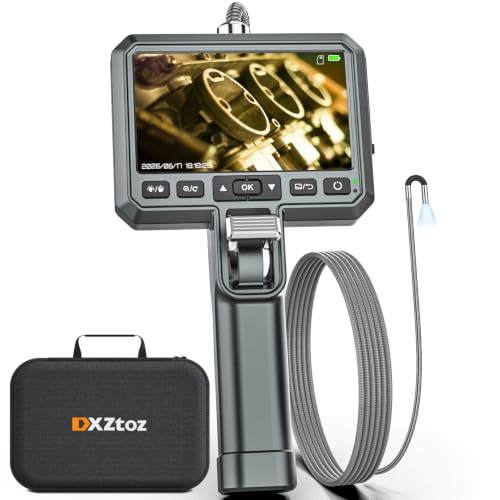
A 3.9 mm probe changes the access conversation. It can enter openings that exclude larger 6 mm, 6.2 mm, or 8.5 mm camera heads, which is especially relevant for small engine passages, precision machinery, robotics, and 3D printer assemblies. The DXZtoz listing pairs that narrow probe with 220° two-way articulation, allowing the tip to be aimed after insertion rather than simply pushed forward.
The five-inch IPS display gives the operator a larger viewing surface than many 4.3-inch units, while the listed 10X zoom can help examine a nearby feature without moving the probe. The product information also identifies a close focus of about 1 cm, six adjustable LEDs, 32GB storage, sound-enabled recording, and a five to six hour operating time. Those details suit careful close-up work, although zoom and advertised resolution should not be treated as a guarantee of defect visibility in every lighting condition.
Pros
- Very slim 3.9 mm probe reaches unusually narrow openings.
- Two-way 220° articulation supports controlled tip positioning.
- Five-inch IPS display provides a larger viewing area.
- Listing identifies close focus near 1 cm and 10X zoom.
- Includes 32GB storage and photo and video recording with sound.
Cons
- The five-foot probe offers less reach than the 10-foot models in this group.
- A narrow probe is specialized for access and may not suit every general inspection task.
Choose this model when the inspection begins with a difficult opening rather than a long route. It is a particularly focused option for small mechanical spaces where probe diameter matters more than accessory count. Buyers working mainly in broad cavities or long ducts may gain more from a longer, thicker dual-lens system.
To buy this product, click here.
3. Acoath Two-Way Articulating Borescope — Best for Long-Reach Dual Viewing

Acoath takes a broad inspection approach by combining a 10-foot semi-rigid cable with two-way 210° articulation and two cameras. The main lens looks forward with a listed 70° view, while the side lens provides a 60° lateral view. That arrangement can help when a camera must travel past the target and then inspect the nearby wall, pipe surface, or engine component without repeatedly repositioning the probe.
The four-way lighting adjustment across eight LEDs gives more control in dark spaces, and the 4.3-inch IPS screen keeps the tool independent of a phone or network connection. The listing identifies 1080p capture, a built-in 32GB TF card, IP67 protection for the probe, and included hook, magnet, mirror, protective cap, and carrying case. The 0.33-inch probe is slimmer than some larger heads, but it will not enter openings intended for the 3.9 mm or 6 mm models.
Pros
- Combines 210° active articulation with front and side cameras.
- 10-foot semi-rigid cable supports deep inspection paths.
- Built-in 32GB storage and integrated 4.3-inch screen avoid phone dependence.
- Eight LEDs offer four listed brightness levels.
- Includes a hook, magnet, mirror, protective cap, and case.
Cons
- The 0.33-inch probe is larger than the narrowest options here.
- Long cable length may be cumbersome for short, close-access inspections.
This is a good fit for varied maintenance work where the same tool may move from a long wall cavity to a damp pipe bend. The dual-lens arrangement adds useful surface coverage, while the 10-foot reach handles jobs that shorter scopes cannot. Select a slimmer model if the access opening is the primary obstacle.
To buy this product, click here.
4. Dual Lens Two-Way Articulating Borescope Camera — Best for Forward and Side Viewing

The appeal here is the balance between a slim 0.25-inch probe and a genuine dual-camera arrangement. The front camera looks along the insertion path, while the side camera can inspect adjacent surfaces. A control wheel provides two-way 210° articulation, so the viewing system gives both directional steering and an alternate camera angle. Those are separate functions, and having both can be useful in a cramped engine bay or behind a wall.
The 4.3-inch IPS display supports front, side, or split-screen viewing according to the listing. Six front LEDs, side-camera illumination, and a rear auxiliary flashlight address different lighting needs, while the 5.3-foot semi-rigid cable remains manageable for shorter jobs. The kit includes a 3000mAh battery, stated five-hour operation, case, hook, magnet, side mirror, and lens protector. The 1080p description is a listing claim, so lighting and focus still deserve attention during close inspection.
Pros
- Dual front and side cameras provide two genuine viewing directions.
- 0.25-inch probe offers a useful balance of access and handling.
- Two-way 210° articulation helps steer around obstructions.
- Supports front, side, and split-screen viewing modes.
- Includes storage accessories, case, hook, magnet, mirror, and lens protector.
Cons
- The 5.3-foot cable is shorter than the long-reach choices.
- A dual-camera system adds controls that may be unnecessary for simple forward-view inspections.
This model suits readers who want the side-view advantage without moving to a larger probe. It is especially relevant for inspection paths where the target may sit beside, rather than directly ahead of, the camera. For deep ducts or long pipe runs, a 10-foot model offers more reach.
To buy this product, click here.
5. Anykit 210° Two-Way Articulating Borescope — Best for Tight Access and Short Jobs

At 0.22 inches, the Anykit probe is one of the slimmer choices in this comparison. That small camera head can matter when inspecting through a narrow opening, though the product still needs enough clearance for the probe to move and articulate. A thumb slider controls the two-way tip, and the four-foot semi-rigid cable is short enough to keep close-access work from turning into a tangle of excess cable.
The 4.3-inch IPS screen includes three levels of zoom and a 180° image flip, which can make an upside-down or awkwardly oriented view easier to interpret. The listing also identifies adjustable lighting, a 3000mAh battery with up to five hours of operation, USB-C charging, IP67 construction, and an overheat warning icon. There is no phone or app requirement, which keeps the inspection workflow straightforward.
Pros
- 0.22-inch probe supports very tight access points.
- Two-way 210° articulation is controlled by a thumb slider.
- Four-foot semi-rigid cable is manageable for close inspections.
- Screen includes three-level zoom and 180° image flipping.
- Integrated display, USB-C charging, and overheat alert support phone-free use.
Cons
- The four-foot cable limits reach for deep cavities and longer pipe paths.
- It uses a single-camera viewing system rather than front and side cameras.
Anykit makes the most sense where access and portability outrank reach. It could be useful around compact engine openings, appliance housings, and short HVAC paths where a longer probe becomes awkward. Buyers who need to inspect a target beside the camera may prefer a dual-lens model instead.
To buy this product, click here.
6. TORQBEAST Dual Lens Two-Way Articulating Borescope — Best for HVAC Access

TORQBEAST targets the narrow service openings found around air-conditioning lines, evaporator housings, condensers, ventilation ducts, and engine compartments. Its 6 mm probe is slimmer than the 8.5 mm class while remaining larger than the micro 3.9 mm designs. The five-foot semi-rigid cable holds its shape, and the dual-lens head gives the operator another viewing direction when a straight camera angle is blocked.
The integrated 1920×1080 display and no-app operation keep the unit ready for field use without pairing a phone. Adjustable LED brightness helps with dark access points, and the listing identifies IP67 and oil-resistant camera construction. A built-in overheat alert displays a warning icon in hot environments. MicroSD expansion is supported, but the card is listed as sold separately, so storage arrangements should be checked before relying on recorded inspection files.
Pros
- 6 mm probe fits many narrow HVAC and automotive access points.
- Dual-lens design adds a side viewing option.
- Two-way 210° steering supports controlled tip placement.
- Integrated screen requires no Wi-Fi, phone, or app.
- Listing identifies adjustable LEDs, IP67 protection, and an overheat alert.
Cons
- MicroSD storage is supported, but the card is sold separately.
- Five-foot reach is limited for long ducts, walls, and pipe runs.
This is a sensible middle ground for service work that needs a relatively narrow probe and a second viewing direction. It avoids the access limitations of a larger head without going all the way to a highly specialized 3.9 mm system. For documentation-heavy work, plan for the separate storage card.
To buy this product, click here.
7. Ralcam Two-Way Articulating Borescope — Best for Long Reach and Angle Lock

Ralcam combines a 10-foot semi-rigid cable with a one-touch angle lock. That lock is the feature to notice when a long probe must stay pointed at one spot while the operator watches the screen, records video, or handles the surrounding equipment. The 210° two-way articulation provides active directional control, while the 0.33-inch probe gives the cable enough structure for longer insertion paths.
The five-inch IPS display is paired with 8X zoom and six LEDs with three brightness settings. Voice recording adds a documentation angle that many basic inspection cameras omit, since findings can be narrated while the video is captured. The stated battery capacity is 4400mAh, with up to four hours of continuous operation. That is a useful combination for longer inspection sessions, though the larger probe will not fit openings intended for the narrowest cameras.
Pros
- 10-foot semi-rigid cable supports deep inspection routes.
- Angle-lock control can hold the selected viewing direction.
- Five-inch screen and 8X zoom support close observation.
- Voice recording can accompany inspection video.
- 4400mAh rechargeable and replaceable battery is identified in the listing.
Cons
- The 0.33-inch probe is too large for some narrow access points.
- Listed runtime is up to four hours, shorter than some alternatives.
Ralcam is aimed at inspections where reach and stable observation matter more than the smallest possible camera head. The angle lock could be particularly useful when an inspection requires both hands near the access point. Pick a shorter or slimmer model for quick checks inside compact assemblies.
To buy this product, click here.
8. Hialemi 2-Way Articulating Borescope — Best for Phone-Connected Work

Hialemi takes a different route from the screen-based models. The camera connects to a phone, using the included Type-C and Micro-USB cables according to the listing, and the phone supplies the viewing surface and app interface. That can be convenient for users who already organize photos and videos on a mobile device. Compatibility still deserves a check before ordering, since a physical connector alone does not establish support for every phone or operating system.
The 6.2 mm probe uses a thumb wheel for 220° two-way articulation, while the 5.3-foot semi-rigid cable holds its shape during positioning. The product information identifies three brightness levels, a listed maximum output of 6800 lux, 1080p camera output, IP67 and oil-resistant probe construction, and one-year warranty coverage. With no separate borescope battery to charge, the phone-powered design is convenient, but the inspection session depends on the phone and its battery.
Pros
- 220° two-way articulation is controlled with a one-hand thumb wheel.
- 6.2 mm probe offers a narrower access profile than larger heads.
- Type-C and Micro-USB cables are included for listed device connections.
- Phone-based capture makes image and video sharing convenient on a compatible device.
- Listing identifies IP67 and oil-resistant probe construction.
Cons
- Phone and app compatibility must be confirmed for the specific device.
- It does not provide the same self-contained screen workflow as the integrated-display models.
This option fits buyers who prefer mobile documentation and already have a compatible phone. It is less suitable for a work environment where phones are inconvenient, restricted, or likely to run low during a long inspection. Check the required app and device connection before treating the included cables as universal compatibility.
To buy this product, click here.
9. 3.9mm Modular Two-Way Articulating Borescope — Best for Modular Handling

This compact model combines a 3.9 mm articulating camera tip with a shorter one-meter tube and a push-pull steering lever. The small probe is the headline practical feature because it can approach openings that reject larger camera heads. The shorter tube also keeps the tool easier to handle in a compact workspace, such as around a small assembly or overhead fixture, where 10 feet of cable would feel excessive.
The modular construction is unusual in this group. The listing describes hot-swappable screen, battery, and handle modules, allowing those sections to be replaced independently rather than replacing the entire unit. It also identifies a five-inch IPS screen, six adjustable LEDs, real-time temperature display, thermal shutdown at 85°C ambient temperature, a rechargeable battery with more than five hours of use, and IP67 camera protection. The product information describes a self-resetting tube, which may help manage bends, but the one-meter reach is clearly intended for close work.
Pros
- 3.9 mm probe supports very narrow inspection access.
- Push-pull lever provides two-way tip steering.
- Modular screen, battery, and handle are described as hot-swappable.
- Five-inch display and real-time temperature information aid inspection control.
- Short one-meter tube is easier to manage in compact workspaces.
Cons
- One-meter reach is unsuitable for deep cavities and long pipe paths.
- The product has a more specialized close-access role than a general long-reach scope.
This is a focused choice for narrow, nearby inspection points where serviceability and compact handling matter. The modular design may appeal to users who want replaceable core sections, while the 3.9 mm tip addresses access first. For broad general maintenance, a longer cable and larger display system may be easier to use.
To buy this product, click here.
Buying Guide
Probe Diameter Determines Where the Camera Can Fit
Probe diameter is a gatekeeper specification. A 3.9 mm tip can reach openings that a 6 mm or 8.5 mm camera cannot, but a smaller tip does not automatically produce a better image or provide more stable handling. Match the camera head to the access point first, then compare articulation, focus, lighting, and cable behavior.
Two-Way Articulation Needs Real Tip Control
A semi-rigid cable can bend and hold a shape, but it is not the same as active articulation. Look for a documented control wheel, joystick, slider, or lever that steers the distal camera tip. Two-way systems are useful when the camera needs to point up or down after insertion. They do not provide the same directional freedom as a four-way system.
Dual-Lens Viewing Is Different From Articulation
A front camera and a side camera solve a viewing problem, while articulation solves a steering problem. A dual-lens unit can switch from a forward view to a lateral view without twisting the probe, which is useful for inspecting nearby walls and surfaces. It still needs active articulation if the tip must be physically aimed around an obstruction.
Match Cable Length to the Inspection Route
Ten feet of reach is useful in a wall cavity, duct, deep engine compartment, or longer pipe path. It can feel cumbersome in a short appliance inspection, where four or five feet may provide better control. A longer cable also needs room to be coiled and guided, so reach should be matched to the task rather than treated as an automatic advantage.
Integrated Screens Remove Phone Dependency
A built-in display lets the operator inspect without pairing a phone, installing an app, or checking mobile compatibility. Phone-connected models can be convenient for sharing files, but the phone, app, connector, and battery become part of the system. Confirm those requirements before buying a camera that relies on a mobile device.
Resolution Does Not Tell the Whole Image Story
Listings commonly describe cameras or displays as 1080p, 1920p, or high definition. Those labels should be read alongside lighting, focus range, camera position, and screen quality. A camera with a useful close-focus range and controlled LEDs may show a nearby feature more effectively than a higher-numbered camera that is out of focus or overexposed.
Check What the IP Rating Covers
An IP67 statement usually refers to the camera probe or lens assembly in the supplied product descriptions, not automatically to the screen, handle, connectors, or phone. Treat the rating as a component-specific claim unless the product information clearly says otherwise. Keep charging ports, displays, and connected devices away from moisture, and follow the product instructions for wet inspections.
Best 2 Way Articulating Borescope FAQ
What makes a borescope genuinely two-way articulating?
A genuine two-way articulating borescope has a mechanical control that moves the camera tip in two directions, commonly up and down. A cable that bends, a lens that rotates, or an image that flips does not establish active articulation.
Is a dual-lens borescope better than a single-lens model?
It depends on the inspection. A dual-lens system adds a forward and side view, which can reduce the need to twist or withdraw the probe when examining an adjacent surface. A single-lens articulating model may be preferable when the access opening is very small or the main task requires simple forward viewing.
What probe size is suitable for engine inspection?
There is no universal size because access points differ among engines and components. The 3.9 mm and 6 mm models in this comparison suit narrower openings, while larger 8.5 mm or 0.33-inch probes may offer a more substantial cable and easier handling. Measure the relevant access point and check the product dimensions before ordering.
Can these borescopes inspect hot equipment?
Some listings identify overheat alerts or thermal shutdown features, but those features do not make every hot inspection safe. Avoid moving machinery and follow the equipment and borescope instructions. A warning system is a protection feature, not permission to insert the probe into any temperature or operating condition.
Do all of these models record photos and video?
The supplied product information identifies photo and video recording for several integrated-display models, including the FOXWELL, DXZtoz 3.9 mm, Acoath, and dual-lens 0.25-inch model. Storage differs, and the TORQBEAST listing identifies MicroSD expansion with the card sold separately. Phone-connected models depend on the compatible app and phone for capture.
Is a 10-foot probe always better than a five-foot probe?
No. A 10-foot probe reaches farther, but it also creates more cable to manage and can be awkward in a short inspection. Five-foot models are often easier to guide around an engine bay, appliance, or compact machinery enclosure. Choose the length that matches the route from the access point to the target.
What should I check before buying a phone-connected borescope?
Check the required app, operating-system support, connector type, and whether the phone supplies enough power for the camera. Type-C or Micro-USB hardware does not guarantee compatibility with every phone. The Hialemi listing identifies cables and broad device support, but the specific phone should still be confirmed.
Final Verdict
The FOXWELL 10FT Dual Lens Borescope is the strongest overall choice for broad inspection work because it brings together 220° two-way articulation, front and side cameras, 10 feet of reach, an integrated screen, built-in storage, and documented heat protection. It is a particularly capable fit for deep engine compartments, HVAC paths, wall cavities, and other jobs where both reach and viewing direction matter.
For narrow access, the DXZtoz 3.9mm is the more specialized pick, while the Acoath offers a strong dual-lens alternative with a similar long-reach emphasis. The Hialemi makes more sense for phone-based documentation, and the Anykit is easier to position in short, tight inspections. Match the probe diameter and cable length to the access point first, then choose between dual viewing, an integrated display, or phone connectivity based on how the inspection will actually be performed.
