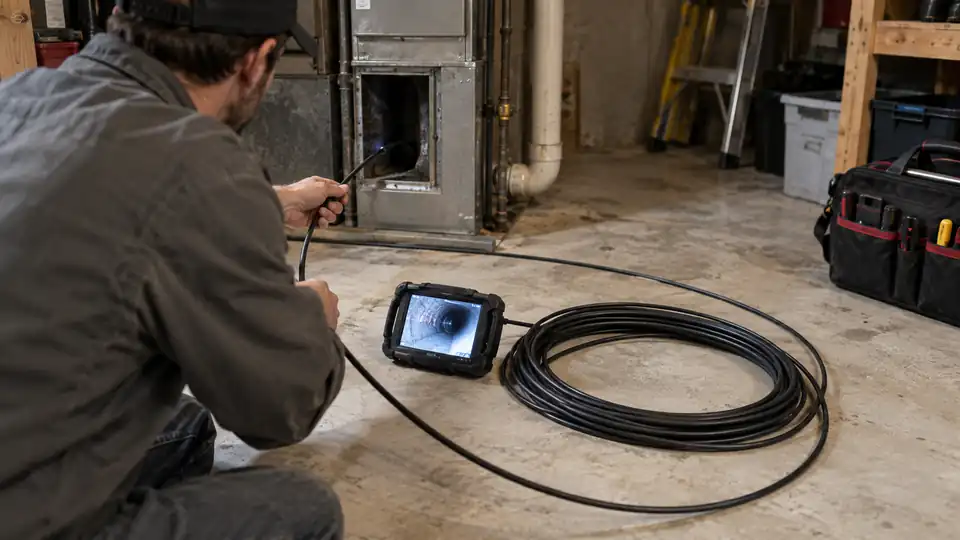
A long borescope earns its place when the inspection point sits far beyond the reach of a short handheld probe. Deep plumbing runs, vehicle cavities, HVAC paths, machinery housings, and overhead structures all create the same problem: the camera needs enough reach to get there, while still giving you useful control once it arrives. Cable length matters, but so do probe diameter, stiffness, lighting, viewing angle, recording, and whether the camera can steer at the tip.
A 15-meter semi-rigid cable can reach much farther than a 1-meter probe, yet extra length may be awkward in a tight workspace. A slim 1.8 mm probe can enter narrow openings, while a larger articulating camera may provide far better directional control. Integrated-screen systems avoid phone and app compatibility questions, whereas USB and smartphone models can be easier to share or connect to existing equipment. The right choice depends on whether your priority is deep reach, narrow access, active articulation, or a self-contained inspection setup.
This comparison focuses on long-reach borescopes and inspection cameras with meaningful differences in probe length, cable behavior, viewing control, display, and connectivity. The rankings weigh practical access against maneuverability, because the longest cable is not automatically the easiest camera to use in every inspection.
Quick Answer
Best overall for long, narrow access: The Vividia NP-1820 combines a very slim 1.8 mm probe, a 2-meter working tube, integrated 5-inch monitor, recording, and a stated 2 mm to 30 mm focus range.
Best for maximum reach: The Vividia TVS-800 extends up to 8 meters and includes a 7-inch screen with DVR recording, making it suited to large cavities and elevated inspection points.
Best for deep plumbing and general reach: The VEVOR Endoscope Camera uses a 15-meter semi-rigid cable, adjustable lighting, smartphone connectivity, and an IP67-rated camera listing.
Best for directional control: The Vividia VC-3815 has a 3.8 mm probe with joystick-controlled 360-degree articulation and a 1.5-meter probe configuration.
Best Long Borescope Comparison Table
| Product | Best For | Probe Or Cable | Viewing System |
|---|---|---|---|
| Vividia NP-1820 | Narrow, documented inspections | 1.8 mm, 2 m | 5-inch monitor, recording |
| Vividia TVS-800 | Maximum pole reach | Up to 8 m, 18 mm head | 7-inch monitor, DVR |
| VEVOR Endoscope Camera | Deep plumbing and general reach | 8.5 mm, 15 m | Phone app, 2X zoom |
| Vividia VC-3815 | Active tip control | 3.8 mm, 1.5 m | Monitor, 8 GB card |
| Vividia TVS-500DVR | Long pole inspections | Up to 4.6 m, 23 mm head | 5-inch monitor, DVR |
| Vividia ME-610i/ME-410i | Phone-connected articulation | 6 mm, 1 m listed probe | iOS and Android app |
| Vividia D3160 | USB inspection with one-way steering | 5.9 mm, 1 m | Computer or Android |
| Vividia D3145 | Diesel-engine access | 4.5 mm, 1 m | PC, Mac, Android, Chromebook |
| Vividia NP-2011 | Screen-based 1.1 m inspections | 2 mm, 1.1 m | 5-inch monitor, recording |
The detailed reviews below explain how reach, probe size, steering, displays, and phone or computer dependence change the buying decision.
1. Vividia NP-1820 — Best Overall

The NP-1820 makes a strong case for long borescope work where access is tight rather than merely distant. Its 1.8 mm probe is the slimmest among the main integrated-screen options here, and the listed 2-meter working tube gives it more reach than the shorter NP-2011. That combination can matter around small access holes, compact machinery, and enclosed assemblies where a thicker camera simply cannot enter.
The integrated 5-inch IPS monitor keeps the inspection self-contained. The product information lists a 1280 by 720 display, a 400 by 400 camera resolution, an 80-degree view angle, and a 2 mm to 30 mm focus range. Photos and AVI video can be recorded to an SD card, while HDMI output allows a larger display. The probe uses a PEBAX sleeve with a tungsten-braided outer layer and a stated IP65 rating, though that protection claim should be treated as applying to the documented probe assembly rather than the entire system.
Pros
- Very slim 1.8 mm probe for narrow access points
- 2-meter working tube provides useful long reach
- Integrated 5-inch monitor removes phone dependence
- Listed focus range starts at 2 mm
- Photo, video, SD card, and HDMI functions are included in the product information
Cons
- Non-articulating probe provides less directional control after insertion
- Camera resolution is listed as 400 by 400, so the display specification should not be mistaken for camera resolution
This is the strongest all-around choice for buyers who need a genuinely slim, moderately long probe with a dedicated screen and documentation features. It is less suitable where the camera must actively turn around corners, since the probe is described as non-articulating. For narrow cavities that reward access and close focusing more than joystick control, its balance is difficult to ignore.
To buy this product, click here.
2. Vividia TVS-800 — Best for Maximum Pole Reach

For inspections that happen several meters away, the TVS-800 operates in a different class from ordinary handheld snake cameras. Its telescopic system reaches up to 8 meters, or 26 feet, and the listed camera head measures 18 mm in diameter. That reach can suit high structures, large equipment, voids, and areas where bringing the operator physically close is difficult.
A 7-inch LCD screen gives the operator more viewing area than the 5-inch monitors used by several shorter systems. The listing also describes photo and video recording, a control box with DVR buttons, adjustable LED brightness, and support for an SD card up to 32 GB. Its 12 white LEDs and stated 90-degree field of view support broad scene coverage, but the long pole format is less nimble than a flexible probe in cramped bends.
Pros
- Reaches up to 8 meters for elevated or large-area inspections
- 7-inch LCD is the largest integrated display in this comparison
- Photo and video recording are listed
- 12 adjustable white LEDs support dark inspection areas
- 7500 mAh battery and approximately 5-hour working time are listed
Cons
- 18 mm camera head cannot enter openings suited to slim probes
- Long telescopic-pole design is less appropriate for tight, winding internal passages
Choose the TVS-800 when physical reach is the central problem and the inspection path is open enough for a pole-mounted camera. It is a poor match for spark-plug-sized openings, narrow pipes, or small machinery access points. The large screen and long extension make more sense for structural and overhead work than for delicate close-quarter probing.
To buy this product, click here.
3. VEVOR Endoscope Camera — Best for Deep Cable Reach

The VEVOR inspection camera stands out through sheer cable length. Its semi-rigid cable extends to 15 meters, or 49.2 feet, giving it the reach needed for long pipe paths, ducts, cavities, and other routes where a short probe runs out of cable almost immediately. Semi-rigidity can help the operator push the camera forward, although a cable this long will require more careful handling than a compact one-meter probe.
The 8.5 mm camera is listed with IP67 protection, eight adjustable LEDs, a 2.0 MP sensor claim, 1920 by 1440 image resolution, and 1X, 1.5X, and 2X zoom. It connects through an app using supplied 8-pin, Type-C, and Micro-USB adapters, with stated support for iOS 9 or later and OTG-enabled Android 6 or later. Those details are useful, but compatibility still depends on the particular phone, operating system, app, and adapter combination.
Pros
- 15-meter semi-rigid cable offers the greatest flexible reach here
- 8.5 mm camera suits larger access paths and pipe routes
- Adjustable eight-LED lighting is listed
- Zoom settings up to 2X are listed
- Adapters for 8-pin, Type-C, and Micro-USB connections are included according to the product information
Cons
- Requires a compatible phone or tablet and the UseePlus app
- 8.5 mm camera is too large for many narrow openings
This is the practical pick for deep cable runs where a phone-based workflow is acceptable. It has more reach than the integrated-screen systems here, but the long cable can be harder to guide and store. Confirm the connector and operating-system requirements before purchase, and treat the IP67 claim as a documented product listing claim for the camera system rather than a guarantee for every connected component.
To buy this product, click here.
4. Vividia VC-3815 — Best for All-Way Tip Control

Long reach helps the camera arrive at the inspection area, but directional control determines what happens next. The VC-3815 addresses that second problem with a joystick-controlled 3.8 mm probe and stated 360-degree all-way articulation. The listing gives an approximate maximum backward bend of 150 degrees, allowing the operator to steer the tip around internal components rather than repeatedly withdrawing and repositioning the probe.
This model is described for turbine and equipment inspection, and its protective construction is more substantial than the consumer-style phone cameras below. The product information lists a sapphire protective lens, titanium-alloy camera tip, metal-braided probe tube, IP67 probe protection, six LEDs with seven brightness levels, and 640 by 480 resolution. An 8 GB mini SD card is listed for photo and video recording. Its 1.5-meter probe is long enough for many machinery cavities, though it does not match the extreme cable reach of the VEVOR or TVS-800.
Pros
- Documented joystick-controlled 360-degree articulation
- 3.8 mm probe balances access with directional control
- Sapphire lens and titanium-alloy tip are listed
- Six LEDs provide seven brightness levels
- Monitor recording with an 8 GB mini SD card is listed
Cons
- 1.5-meter probe is shorter than the longest cable systems
- 640 by 480 resolution is lower than several phone-connected listing claims
The VC-3815 suits inspections where seeing behind or around a component matters more than covering a very long distance. It earns its position through genuine active articulation, rather than confusing a bendable cable with steerable camera-tip movement. Buyers needing a long pipe run should look elsewhere, while machinery inspections with difficult internal angles are its natural territory.
To buy this product, click here.
5. Vividia TVS-500DVR — Best for Long Pole Inspections

The TVS-500DVR fills the space between a compact borescope and the much longer TVS-800. Its telescopic system extends up to 4.6 meters, or 15 feet, while the flexible camera head is listed at 23 mm by 320 mm. That format is useful for reaching into broad cavities, overhead spaces, and equipment where a narrow insertion tube is less important than keeping the operator several feet away.
A 5-inch LCD, adjustable 12-LED lighting, DVR controls, SD-card support up to 32 GB, and photo or video selection create a self-contained inspection workflow. The listing states a 120-degree field of view and a camera resolution of 840 by 480. A 1400 mAh battery and approximately five hours of working time are also listed. The wide view can show more of an open area, but the large camera head limits access through small holes.
Pros
- Extends to 4.6 meters for elevated and distant inspection points
- 120-degree field of view is listed
- 12 adjustable white LEDs support dark areas
- Integrated 5-inch screen and DVR controls simplify operation
- SD-card support up to 32 GB is listed
Cons
- 23 mm camera-head dimensions limit narrow access
- Lower listed resolution than several digital phone-connected models
This system makes sense for broad, reachable spaces where the operator needs a long physical extension and a dedicated monitor. It should not be treated as a substitute for a slim flexible probe. Compared with the TVS-800, it gives up maximum reach but may be easier to manage in moderate-height inspections.
To buy this product, click here.
6. Vividia ME-610i/ME-410i — Best for Phone-Connected Articulation

The ME-610i/ME-410i brings active steering to a phone-connected format. The listing identifies a joystick with 360-degree all-way articulation, six adjustable LEDs, a 1280 by 720 front-view camera, and an IP67-rated probe tube. The selected configuration is described with a 6 mm, 2-meter probe in the product title, while the feature information also refers to a 1-meter probe, so buyers should confirm the exact configuration shown on the current listing.
Connection runs through the USee app on iOS or Android, which can be convenient for sharing images and using a familiar screen. The rechargeable battery reduces dependence on a nearby power source during an inspection. A 6 mm probe is considerably wider than the NP-1820, yet it offers more steering control through bends and around obstructions. That is a meaningful trade-off in vehicle compartments, machinery, and general maintenance work.
Pros
- 360-degree joystick articulation is listed
- 1280 by 720 front-view camera is listed
- Six adjustable LEDs provide lighting control
- Compatible with iOS and Android through the USee app
- IP67-rated probe tube and rechargeable battery are listed
Cons
- 6 mm probe requires a larger entry point than slim models
- Product information shows differing probe-length references, so configuration confirmation is important
Choose this model if phone operation is acceptable and active tip control matters more than the smallest possible probe. It offers a more maneuverable inspection experience than a fixed snake camera, but it cannot reach as far as the 15-meter VEVOR. Check the exact diameter and length before ordering because the ME-610i and ME-410i naming suggests more than one configuration.
To buy this product, click here.
7. Vividia D3160 — Best for USB One-Way Steering

The D3160 is a useful middle ground for inspections that need controlled tip movement but can stay within a computer or Android workflow. Its 5.9 mm probe is listed with one-way articulation through a maximum 180-degree bend. That is genuine directional movement, although it is much more limited than the VC-3815’s all-way joystick articulation.
The 1-meter insertion tube uses metal-braided outer layers, and the bending section is described as stainless steel for abrasion resistance. USB connectivity supports Windows PCs, Mac computers, and some Android devices, with free software or an app used for photo and video capture. Brightness can be adjusted through the lighting controls. The important limitation is device dependence, since the product does not include a dedicated monitor in the supplied information.
Pros
- One-way articulation reaches a stated 180-degree bend
- Metal-braided tube and stainless-steel bending section are listed
- USB connection supports Windows and Mac computers
- Some Android devices are supported
- Photo and video capture through software or app is listed
Cons
- 5.9 mm probe is less suitable for very narrow openings
- One-way articulation provides less directional freedom than all-way systems
The D3160 suits a workspace already equipped with a compatible computer or Android device. Its one-way steering can help position the view around a component, while the braided construction is relevant where the probe may rub against an access path. Buyers wanting a phone-free setup or full four-direction control should choose a different design.
To buy this product, click here.
8. Vividia D3145 — Best for Smaller Diesel-Engine Access

The D3145 follows the same basic USB and one-way articulation approach as the D3160, but its 4.5 mm probe gives it a narrower entry profile. The listing specifically identifies diesel engines, and that application focus helps explain its place here. A 1-meter insertion tube and 180-degree one-way bend provide a combination of reach and controlled viewing for access points that can accept the probe.
Windows PCs, MacBooks, some Android devices, and Chromebooks are listed as compatible platforms. The camera connects by USB, while free software or an app handles image and video capture. The insertion tube uses metal-braided outer layers, and the bending section is described as stainless steel. The smaller diameter improves access compared with the D3160, but the product remains limited to one-way movement and still requires a compatible host device.
Pros
- 4.5 mm probe provides narrower access than the D3160
- One-way articulation reaches a stated 180-degree bend
- Product information identifies diesel-engine use
- Supports Windows, Mac, some Android devices, and Chromebook platforms
- Metal-braided tube and stainless-steel bending section are listed
Cons
- Requires a compatible computer or mobile device for viewing
- One-way steering is less flexible than all-way articulating systems
This is the better choice between the two USB models when the access opening is tighter and the intended work involves diesel-engine components. It gives up some diameter-based robustness compared with the D3160, while gaining entry flexibility. Confirm device support before purchase, especially for Android hardware, since the listing says “some” devices rather than universal compatibility.
To buy this product, click here.
9. Vividia NP-2011 — Best for a Compact Integrated-Screen Setup

The NP-2011 is a straightforward screen-based borescope for inspections that need a slim probe and a self-contained display. Its 2 mm diameter and 1.1-meter working tube make it slightly less slender and shorter than the NP-1820, but the format remains suitable for narrow openings where a larger articulating camera would struggle. The fixed design keeps operation simple, though the tip cannot be actively steered.
The product information lists a 5-inch IPS monitor with 1280 by 720 display resolution, 400 by 400 camera resolution, an 80-degree view angle, and a 3 mm to 30 mm focus range. A rechargeable battery, SD-card photo and video recording, HDMI output, and image rotation or flipping are included in the listed features. IP58 protection is stated for the 2 mm probe, but the rating should not be extended automatically to the display or connectors.
Pros
- 2 mm probe supports narrow inspection openings
- Integrated 5-inch IPS monitor avoids phone or computer dependence
- Photo and video recording to an SD card are listed
- HDMI output supports a larger external display
- Rechargeable battery and image rotation functions are listed
Cons
- 1.1-meter probe is shorter than the NP-1820 and long-cable options
- Non-articulating design limits control around bends and obstructions
The NP-2011 makes sense for buyers who want a compact, dedicated-screen tool without moving into a phone app. It is easier to position than a very long cable, yet it will stop short in deep pipe or duct routes. Choose it for moderate-reach inspections where slim access and straightforward recording matter more than maximum distance or active steering.
To buy this product, click here.
Buying Guide
Probe Diameter Determines Where the Camera Can Fit
Probe diameter is often the first physical limit. The NP-1820’s listed 1.8 mm probe can reach openings that exclude the 8.5 mm VEVOR camera or the much larger heads on the telescopic systems. A smaller probe may provide access, but it does not automatically provide better control, lighting, or image detail. Match the diameter to the actual entry point before comparing resolution.
Long Cables Add Reach but Can Be Harder to Control
The VEVOR’s 15-meter cable is useful for deep routes, while the NP-2011’s 1.1-meter tube is easier to manage in a compact assembly. Long semi-rigid cable can push forward through a route, but bends, loops, and friction can make the camera harder to direct. Telescopic poles create another type of reach and work best where the path is open rather than winding.
Active Articulation Is Different From a Bendable Probe
A probe qualifies as articulating when the camera tip has documented directional control. The VC-3815 uses a joystick for all-way movement, while the D3160 and D3145 are limited to one-way articulation. A flexible or semi-rigid cable may bend, but that does not mean the camera head can be steered independently after insertion.
Integrated Screens Avoid Phone Compatibility Questions
The NP-1820, NP-2011, VC-3815, TVS-500DVR, and TVS-800 include dedicated screens in their listed configurations. That makes them convenient when a phone is unavailable, occupied, or unsuitable for the work area. Phone-connected models can be easier to share, but connector support, app installation, operating-system versions, and device compatibility all need checking.
Resolution Numbers Need Practical Context
A listed 1280 by 720 monitor resolution is not the same as a camera sensor resolution, and a “1920P” listing claim does not by itself guarantee sharper inspection results. Focus range, lighting, viewing distance, lens position, and screen quality affect whether a defect is actually visible. The NP-1820’s listed 2 mm to 30 mm focus range, for example, speaks to working distance in a way a headline resolution number does not.
Check What the IP Rating Covers
IP65, IP58, and IP67 appear in the product information for several probes. These ratings should be treated as applying only to the documented component and conditions. They do not automatically make the monitor, phone, connector, or charging port water-resistant. Avoid using a probe in a wet or hazardous environment unless the product instructions and actual inspection conditions support that use.
Best Long Borescope FAQ
What Is The Longest Borescope In This Comparison?
The VEVOR Endoscope Camera has the longest flexible reach, with a listed 15-meter semi-rigid cable. The Vividia TVS-800 reaches up to 8 meters through a telescopic pole, but it uses a larger pole-mounted camera head and serves a different type of inspection.
Is A Longer Cable Always Better?
No. Extra reach helps in long pipes, ducts, and distant cavities, but a long cable can be harder to guide, coil, and store. For a compact machine opening, a 1-meter or 2-meter probe may provide better handling than a 15-meter cable.
Which Long Borescope Has The Smallest Probe?
The Vividia NP-1820 has the smallest listed probe in this selection at 1.8 mm. The NP-2011 follows at 2 mm. These fixed probes favor narrow access, while the articulating models trade some diameter for directional control.
Do Long Borescopes Record Photos And Videos?
Several models list recording functions. The NP-1820 and NP-2011 list SD-card photo and video recording, the VC-3815 lists an 8 GB mini SD card, and the TVS-500DVR and TVS-800 list DVR recording. Phone and USB models use an app or computer software for image capture.
Can A Borescope Be Used In A Hot Engine?
The supplied product information does not establish operating-temperature limits for these models. Do not insert a camera into hot or moving machinery unless the applicable product instructions explicitly support those conditions. Allow equipment to cool and follow appropriate safety procedures before inspection.
Is IP67 Suitable For Any Underwater Inspection?
No. An IP rating should not be treated as unlimited underwater permission. The claim may apply to the probe rather than the full system, and the listing may not specify immersion depth or duration. Check the exact instructions before exposing the camera to water.
Which Option Is Best If I Do Not Want To Use A Phone?
The Vividia NP-1820, NP-2011, VC-3815, TVS-500DVR, and TVS-800 include integrated displays in the listed configurations. These systems avoid app and phone compatibility issues, while the VEVOR, ME, D3160, and D3145 depend on a compatible mobile device or computer for viewing.
Final Verdict
The Vividia NP-1820 is the strongest overall choice for a long borescope that needs to enter narrow spaces while remaining easy to operate from a dedicated screen. Its 1.8 mm probe, 2-meter working tube, close listed focus range, and recording functions create a balanced package for detailed access. The product is non-articulating, so it should not be chosen for inspections that require active steering around multiple bends.
For maximum distance, the Vividia TVS-800 reaches much farther through its telescopic design, while the VEVOR is better suited to deep flexible routes such as plumbing and larger cavities. The VC-3815 is the more capable choice for controlled tip direction, and the NP-2011 provides a shorter, compact screen-based alternative. Match the camera to the entry opening, route shape, viewing control, and documentation needs before giving headline resolution or cable length too much weight.
