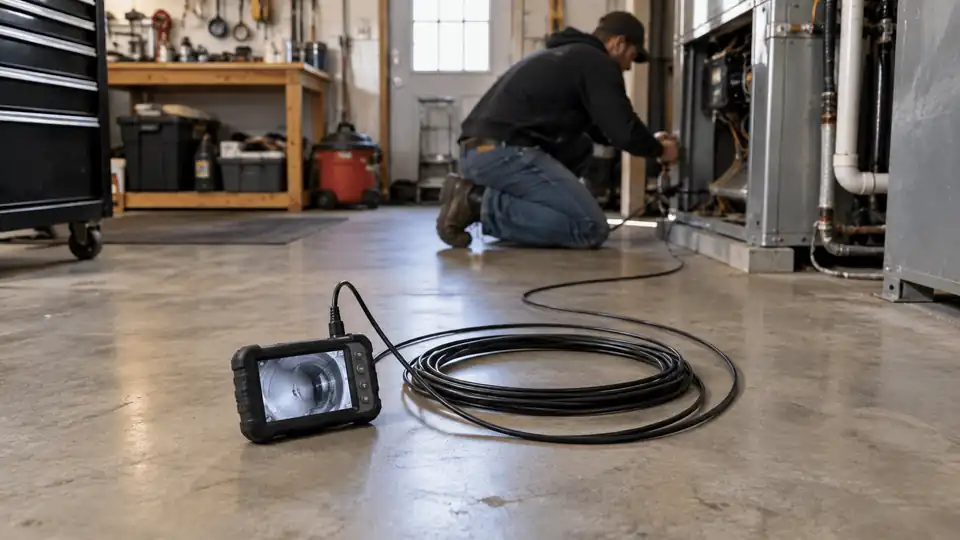
A 16-foot borescope gives you enough reach for engine bays, wall cavities, HVAC runs, drains, and other spaces where a short inspection camera quickly runs out of cable. The real choice is less about length alone and more about how that reach is controlled. A semi-rigid probe can hold a path through a cavity, a dual-camera head can show forward and side views, and an integrated screen can keep the inspection independent from a phone or computer.
Headline resolution can distract from more practical details. An 8 mm probe may be too large for a narrow access opening, while a long cable can become awkward in a short, winding passage. A side-view camera or mirror can reveal the wall of a pipe without repeatedly repositioning the probe, but neither feature provides active tip articulation. Buyers also need to check whether a product records images, which devices it supports, and whether an IP rating applies to the probe alone or the complete system.
The options below range from a professional telescopic pan-and-tilt system to straightforward handheld inspection cameras. Some are better suited to phone or computer use, while others provide a built-in display for quick work in a garage, utility room, or workshop. The comparison weighs reach, viewing design, cable behavior, display arrangements, and the practical limitations that matter after the camera enters the access point.
Quick Answer
- Best Overall: Vividia TVS-500PT for controlled long-reach inspection with a telescopic 16-foot pole, pan-and-tilt camera, touchscreen monitor, and white or IR lighting.
- Best Dual-Camera Phone and Computer Option: Vividia BD-8050i provides front and side cameras on a 16.4-foot semi-rigid probe with USB-C and Lightning output.
- Best for Phone-Free Operation: 1080P HD Endoscope Camera with Light has a 4.3-inch screen and does not require Wi-Fi, an app, or smartphone pairing.
- Best for Plumbing-Oriented Work: GOWENIC Plumber Inspection Camera combines a 16-foot snake, standalone screen, IP67-rated optical lens, and a desaturation mode intended to increase contrast.
Best 16 Foot Borescope Comparison Table
| Product | Best For | Probe or Cable | Viewing System |
|---|---|---|---|
| Vividia TVS-500PT | Controlled long-reach inspection | Telescopic pole, up to 16 ft | Pan-and-tilt 4K camera, 7-inch screen |
| Vividia BD-8050i | Phone and tablet users | 8 mm, 16.4 ft semi-rigid probe | Front and side cameras |
| Vividia BD-8050U | USB computer and Android use | 8 mm, 16 ft semi-rigid probe | Front and side cameras |
| 1080P HD Endoscope Camera | Phone-free inspections | 8 mm, 16 ft semi-rigid cable | 4.3-inch screen, 180-degree rotation |
| Industrial Endo P230 | General repair and automotive checks | 8 mm, 5 m bendable cable | Rotatable camera, side-view mirror |
| GOWENIC Plumber Inspection Camera | Drains and damp cavities | 16 ft semi-rugged snake | 4.3-inch LCD screen |
| Jameco Valuepro Inspector-T1 | Basic USB inspection | 16 ft cord | USB video borescope |
| DEPSTECH DS300 Dual-Lens Inspection Camera | A 16.5-Foot Recording Camera | Dual-lens probe; 16.5 ft semi-rigid cable | 4.3-inch IPS screen; front/side views |
| Teslong 5-Inch Dual-Lens Borescope | A 16.5-Foot Cable With a Larger Screen | 8 mm camera assembly; 16.5 ft semi-rigid cable | 5-inch IPS screen; front/side cameras |
The detailed reviews explain how each viewing system, cable design, and connection method changes the inspection experience.
1. Vividia TVS-500PT Telescopic Pole Pan-and-Tilt Inspection Camera — Best Overall

A 16-foot inspection system is far easier to use when the camera can be aimed from the handle rather than pushed blindly into a cavity. The Vividia TVS-500PT takes that approach with a carbon-fiber telescopic pole and a pan-and-tilt camera. The pole extends to a maximum of 5 meters, or about 16 feet, while collapsing to roughly 3.6 feet for storage and transport. That makes it a different kind of tool from a flexible snake camera. It is intended for reaching outward across a space, rather than threading a loose cable through a maze of tight bends.
The camera uses bright white and IR LED lighting and sends the view to a 7-inch touchscreen monitor with 1080p resolution. The listing describes the camera as 4K, though advertised camera and display resolutions should not be treated as identical measures of real-world image quality. The meaningful advantage here is control. Pan and tilt can help aim across a ceiling, high machinery, or a hard-to-reach structure without repeatedly withdrawing the pole. Rechargeable batteries are listed with more than three hours of working time, giving the system useful endurance for extended inspection sessions.
Pros
- Telescopic carbon-fiber pole reaches up to 16 feet.
- Pan-and-tilt camera provides controlled directional viewing.
- 7-inch touchscreen monitor operates as part of the system.
- White and IR lighting support inspection in dark spaces.
- Collapses to approximately 3.6 feet for easier storage.
Cons
- Its telescopic pole format is less suitable for winding passages than a snake-style probe.
- The product information does not clearly identify the camera’s recording features or storage method.
This is the strongest choice for inspections that require reach and controlled camera positioning, such as overhead structures, large equipment, and open cavities. It is a poor fit for a narrow pipe with repeated bends, where a semi-rigid cable can follow the route more naturally. The substantial price positioning also means buyers should choose it for the pan-and-tilt pole design, rather than simply for having a 16-foot reach.
To buy this product, click here.
2. Vividia BD-8050i Semi-Rigid Dual Camera Borescope — Best for Forward and Side Viewing

Inside a pipe, engine bay, or wall cavity, the view directly ahead is often only half the story. The BD-8050i addresses that problem with two 1280 by 720 camera sensors, one facing forward and one facing to the side. Its 8 mm probe is larger than the narrowest inspection-camera heads, but the extra viewing direction can reduce the need to twist and reposition the cable once it is inside.
The 16.4-foot semi-rigid probe holds a shape while still allowing the user to guide it around an opening. Adjustable LEDs are provided for both camera positions, which matters because a side-facing image can become useless if its light does not reach the inspection surface. The probe is listed as IP67 water- and dust-resistant, while the connection system offers USB-C and Lightning output for iPhone, iPad, Android, and Windows devices. Buyers should still confirm device and software compatibility for their exact hardware before ordering.
Pros
- Front and side cameras provide two viewing directions.
- 16.4-foot semi-rigid probe offers substantial reach.
- 8 mm probe diameter suits many general inspection openings.
- Adjustable lighting is listed for both camera views.
- USB-C and Lightning outputs broaden connection options.
Cons
- The 8 mm probe may not fit smaller access openings.
- Dual-camera viewing does not provide active mechanical articulation.
This model suits users who need to inspect both the path ahead and nearby surfaces, especially in cavities where rotating a single-lens camera is frustrating. It is more flexible in viewing direction than a basic forward-facing USB camera, but it still relies on the connected phone, tablet, or computer for the display. Choose it over the computer-focused BD-8050U when Lightning or broader mobile connectivity matters.
To buy this product, click here.
3. Vividia BD-8050U USB Dual Camera Borescope — Best for USB Computer Use

The BD-8050U follows a similar inspection idea to the BD-8050i, but its stated compatibility centers on Windows computers, MacBook, Chromebook, and Android devices. A USB 2.0 output feeds the camera to the viewing device, and the product description says images and video can be saved through the software. That documentation angle makes it useful for inspections where a computer is already part of the workbench and captured files need to be retained.
The 8 mm semi-rigid probe extends 16 feet and carries separate front and side cameras. The forward camera uses six bright LEDs, while the side camera has one LED, according to the listing. The product information also describes the ability to switch between front and side views or display both directions at once. That can help when checking a pipe wall, machinery housing, or cavity where a forward view misses a nearby defect.
Pros
- Front and side cameras support two viewing directions.
- 16-foot semi-rigid probe provides long reach.
- Listed compatibility includes Windows, MacBook, Chromebook, and Android.
- Software can save images and videos according to the product information.
- Front camera includes six listed LED lights.
Cons
- USB 2.0 connectivity may be less convenient than a standalone display.
- Compatibility depends on the connected computer or Android device and its software support.
This is a sensible choice for a workshop computer, Chromebook, or compatible Android setup, particularly when documenting findings matters. It gives up the independence of the screen-based cameras, so it is less convenient for a quick inspection away from a desk. Compared with the BD-8050i, it has a narrower stated mobile connection profile, but its software-based image and video saving is a useful distinction.
To buy this product, click here.
4. 1080P HD Endoscope Camera with Light — Best With a Phone-Free Screen

For a quick check under a sink, behind a wall opening, or around an engine, a built-in screen can be refreshingly simple. This inspection camera uses a 4.3-inch IPS display and does not require Wi-Fi, an app, or smartphone pairing. Its 16-foot semi-rigid cable can bend and hold its shape, which helps when the probe needs to be guided through a short run and kept pointed toward a target.
The 8 mm camera head has eight adjustable LEDs with three brightness levels, and the listing identifies a 4 to 10 cm focal distance. It also lists a 70-degree wide-angle lens, 180-degree rotation, and 2x zoom. Those controls can help frame a nearby component, but image rotation should not be confused with active tip articulation. The system does not support photo or video recording, a meaningful limitation for anyone who needs to document an inspection rather than simply view it.
Pros
- Integrated 4.3-inch display works without a phone or app.
- 16-foot semi-rigid cable holds its shape during insertion.
- Eight adjustable LEDs offer three brightness levels.
- Listing identifies a 4 to 10 cm focal distance.
- Includes a hook, magnet, side-view mirror, and Type-C charging cable.
Cons
- Does not support photo or video recording.
- The 8 mm probe may be too large for very narrow openings.
This model fits routine visual checks where speed matters more than creating a file or sharing footage. The standalone screen avoids the cable-and-app dance that can slow down a job, while the included mirror provides an alternate viewing angle without adding a second camera. Choose another model if inspection records are central to the work, or if you need genuine dual-camera viewing or active tip control.
To buy this product, click here.
5. Industrial Endo P230 Inspection Camera — Best for General Repair Work

The P230 is aimed at everyday inspection tasks that range from vehicle maintenance to home repair. Its listing describes a 5-meter bendable cable, an 8 mm lens, and a 360-degree rotatable camera. That rotation can help align the image, although it should not be read as mechanical articulation of the camera tip. A side-view mirror is also listed, giving the user another way to look across a surface without treating the mirror as a second camera.
The product information identifies a 1920 by 1080 display and eight dimmable LEDs. It also lists an IP67 rating for the lens and a 4 to 10 cm focal distance. A hook, magnet, and side-view mirror broaden the types of objects and surfaces that can be examined. The listing says the camera supports photo and video, though the product description does not clearly explain the storage method or display controls, so buyers should verify those details.
Pros
- 5-meter cable provides approximately 16 feet of reach.
- Eight dimmable LEDs support lighting adjustment.
- Side-view mirror offers an alternate viewing angle.
- Hook and magnet attachments can assist with retrieval tasks.
- Listing identifies a 4 to 10 cm focal distance.
Cons
- The 8 mm lens may not suit small access points.
- The product description does not clearly detail the recording storage system.
The P230 makes sense as a general repair camera for buyers who want a long cable, adjustable illumination, and basic attachments in one kit. It is less specialized than the dual-camera Vividia models and less self-contained in its documented display details than the screen-based alternatives. For automotive or wall-cavity work where a mirror and retrieval tip are useful, its accessory set may matter more than the headline resolution.
To buy this product, click here.
6. GOWENIC Plumber Inspection Camera 1080P Snake 16FT — Best for Damp Inspection Areas

A standalone display is handy when the inspection happens beside a drain, downpipe, or utility opening rather than near a computer. The GOWENIC uses a 4.3-inch LCD and does not require an app, Bluetooth, or Wi-Fi. Its 16-foot semi-rugged hose is described as flexible enough to navigate tight bends, while reinforced copper-core wiring is intended to maintain signal transmission through the cable.
The optical lens carries an IP67 rating according to the listing, and the product is positioned for damp cavities, drains, vents, HVAC areas, and automotive spaces. That rating should be understood as applying to the listed optical lens, not automatically to the handle, display, connectors, or the entire system. A desaturation mode removes color to increase contrast in some scenes, which may help separate debris or gaps when a full-color image looks visually muddy.
Pros
- 4.3-inch standalone display avoids phone and app dependence.
- 16-foot semi-rugged snake provides useful reach.
- IP67 rating is listed for the optical lens.
- Desaturation mode may improve contrast in difficult scenes.
- Product information describes use in drains, vents, HVAC spaces, and engines.
Cons
- The IP67 claim is identified for the optical lens and should not be extended to the entire unit.
- The product description does not clearly specify image or video recording capability.
This is a practical fit for damp inspection work where a phone-free workflow keeps the process simple. Its semi-rugged hose may be easier to guide through bends than a stiff telescoping pole, although any 16-foot cable can become difficult to manage in a cramped area. Buyers needing saved inspection files or a second viewing direction should look closely at the Vividia dual-camera options instead.
To buy this product, click here.
7. Jameco Valuepro Inspector-T1 USB Video Borescope — Best for Basic USB Inspection

The Jameco Valuepro Inspector-T1 is a straightforward USB video borescope with a listed 16-foot cord and waterproof description. That combination gives it the basic shape required for reaching into a cavity while keeping the viewing device separate from the probe. For a simple visual check at a computer, the long cord can provide the reach needed for an engine bay, appliance, or accessible wall cavity.
The Inspector-T1 is a USB video borescope for a host-device viewing setup. Match its camera-head clearance, cable reach, supported operating system, and capture software to the intended inspection before ordering. Choose a screen-based model when independent operation is the priority.
Pros
- Listed 16-foot cord supports long-reach inspection.
- USB video design connects the camera to a viewing computer.
- Waterproof description supports use around suitable damp inspection areas.
- Model number is clearly identified as Inspector-T1.
- Simple configuration may suit basic visual checks.
Cons
- Probe diameter, resolution, lighting, and operating-system compatibility are not clearly specified in the product description.
- The product requires a compatible USB viewing setup rather than providing a documented integrated screen.
This model is best reserved for buyers who need a basic USB inspection camera and can confirm compatibility before ordering. It lacks the documented dual-camera arrangement of the Vividia models and the clear standalone-screen workflow of the handheld options. The limited specifications make it harder to match with a tight opening or a particular recording requirement, so careful checking is more important here than with the better-documented alternatives.
To buy this product, click here.
8. DEPSTECH DS300 Dual-Lens Inspection Camera — Best for A 16.5-Foot Recording Camera
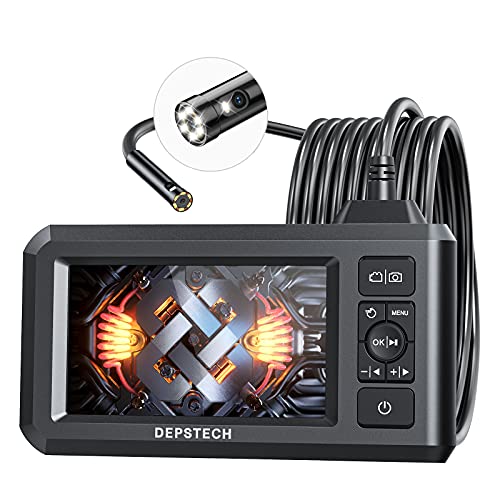
The DEPSTECH DS300 combines a 16.5-foot semi-rigid cable with a 4.3-inch IPS display and separate forward and side cameras. A button changes the viewing mode, including a split-screen option, so the operator can inspect a nearby surface without fitting a mirror to the tip.
The DS300 supplies roughly sixteen feet of working cable with a dedicated screen and recording. It is a practical alternative to a pole-style inspection system when the route is narrow and the cable can be guided from an access opening.
Its recording functions make it useful when a finding needs to be reviewed after the probe comes out. The front camera focuses at roughly 3–8 cm and the side camera at 2–6 cm, so positioning matters more than digital magnification when examining a nearby surface. Adjustable LEDs help control glare. The camera assembly is positionable, but the DS300 does not mechanically steer its tip; plan the route with the cable before insertion. Add a compatible microSD card if you intend to save photos or video, because this package does not include one.
Pros
- Forward, side, and split-screen viewing modes.
- Built-in screen and 16.5-foot cable suit independent inspections.
- Photo and video capture support repeat checks and documentation.
Cons
- No mechanical tip articulation.
- A microSD card must be supplied separately for recording.
Choose this configuration for a 16.5-Foot Recording Camera.
To buy this product, click here.
9. Teslong 5-Inch Dual-Lens Borescope — Best for A 16.5-Foot Cable With a Larger Screen

This Teslong pairs a 5-inch IPS screen with a 16.5-foot semi-rigid cable and separate front and side cameras. Six forward LEDs and an additional side light illuminate the two viewing directions, while the display keeps a phone out of the working area.
The Teslong combines roughly sixteen feet of cable with a 5-inch display. The front and side cameras suit reachable walls, ducts, and machinery spaces where a second viewing direction is more useful than active steering at the tip.
The larger monitor is useful when the camera has to be guided slowly and the operator wants to see changes in surface texture without repeatedly moving closer to the display. Switching to the side camera changes the viewing direction electronically; it does not bend the probe around an obstruction. The cable retains a prepared curve, which helps with controlled feeding but still requires a reachable access route. Its 8 mm camera assembly also needs more clearance than a slim 3.9 or 5.5 mm instrument. The rechargeable battery and carrying case make this a practical self-contained choice for longer visual checks.
Pros
- 5-inch IPS display offers a comfortable working view.
- Front and side cameras have their own illumination.
- 16.5-foot cable reaches beyond short handheld probes.
Cons
- The 8 mm camera will not fit every small opening.
- The tip is not mechanically articulating.
Choose this configuration for a 16.5-Foot Cable With a Larger Screen.
To buy this product, click here.
Buying Guide
Probe Diameter Determines Access
An 8 mm probe appears across several of these cameras. That diameter can work for many engine, wall, HVAC, and plumbing openings, but it will not fit every access point. Measure the opening before buying, including any lip or obstruction that could make the usable clearance smaller than the hole itself. A smaller camera may reach farther into a narrow space, while a larger head may offer a more substantial viewing system.
Choose Between a Pole and a Snake Cable
A telescoping pole and a semi-rigid snake solve different reach problems. The TVS-500PT is suited to extending across open areas, where pan-and-tilt control can aim the camera from the handle. Semi-rigid cables are better for guiding a camera through an opening and around moderate bends. Long reach does not automatically mean easier control, especially when unused cable gathers on the floor or catches against nearby objects.
Dual Cameras Are Not Active Articulation
A front-and-side camera system can show two directions without withdrawing the probe, which is useful beside a pipe wall or inside a machinery cavity. It does not mechanically steer the camera tip. Likewise, a side-view mirror changes the optical angle but does not create a second camera. Buyers who need to aim around an obstruction should look for mechanical articulation, and none of the semi-rigid products here is identified as an actively articulating borescope.
Integrated Screens Remove Phone Dependency
The screen-based cameras are convenient for work beside a vehicle, drain, or wall opening because they do not depend on an app or phone connection. That simplicity comes with a trade-off. The 1080P HD Endoscope Camera explicitly does not record photos or video, while the product description for some other display-based models does not clearly identify recording functions. If documentation matters, a computer-connected model with stated image and video saving may be a better fit.
Resolution Needs Working Context
Numbers such as 1080p or 4K describe a listed image specification, but they do not guarantee better inspection results. Focus distance, illumination, camera position, display quality, and surface contrast all affect what appears on screen. A well-lit image from a camera positioned close to the target can be more useful than a higher-resolution claim viewed through glare or poor focus.
Read IP Ratings Carefully
An IP67 claim should be tied to the component identified in the product information. The GOWENIC listing describes the optical lens as IP67-rated, which does not automatically make its handle, display, connector, or phone waterproof. Avoid using any inspection camera around energized equipment, moving machinery, hot components, or pressurized systems unless the product instructions and working conditions specifically support that use.
Best 16 Foot Borescope FAQ
Is a 16-foot borescope long enough for engine inspection?
For many engine-bay and vehicle-maintenance tasks, 16 feet provides more than enough reach. The more relevant questions are whether the probe fits the access opening, whether the cable can be guided without kinking, and whether the camera focuses clearly at the working distance. A long probe cannot compensate for an oversized camera head or poor access control.
Which type is easiest to use without a phone?
A model with an integrated screen is the simplest choice. The 1080P HD Endoscope Camera and GOWENIC camera both list built-in 4.3-inch displays, while the Vividia TVS-500PT uses a 7-inch touchscreen monitor. These systems avoid app pairing and phone compatibility issues, although their recording capabilities differ and should be checked before purchase.
Can a dual-camera borescope see around corners?
It can provide a forward view and a side view, which may reveal surfaces that a forward-only camera misses. It does not bend the camera tip around a corner. The probe still has to reach the area, and the side camera’s usefulness depends on its position, lighting, and the shape of the passage.
Does a semi-rigid cable mean the camera articulates?
No. A semi-rigid cable can bend and may hold a shape, but active articulation requires a documented mechanism that moves the camera tip through controlled directions. The products reviewed here are described as semi-rigid, flexible, rotatable, or dual-camera systems rather than as actively articulating probes.
Can these cameras record inspection videos?
Recording varies by product. The BD-8050U product information says images and videos can be saved through software. The 1080P HD Endoscope Camera explicitly does not support photo or video recording. For saved footage, the DS300 provides a standalone recording option with a separately purchased microSD card. Confirm the storage package on any other model before choosing it for an inspection record.
Is an IP67 probe safe for unlimited underwater use?
No. IP67 is a defined ingress-protection claim, but it does not mean unlimited immersion or that the complete inspection system is waterproof. Check which component carries the rating and follow the product instructions for moisture exposure. Keep the display, handle, connectors, and charging ports away from water unless they are separately rated.
Final Verdict
Additional options: DEPSTECH DS300 Dual-Lens Inspection Camera suits a 16.5-Foot Recording Camera; Teslong 5-Inch Dual-Lens Borescope suits a 16.5-Foot Cable With a Larger Screen. Choose the configuration that fits the access route and your recording needs.
The Vividia TVS-500PT is the strongest overall choice for buyers who need a genuine 16-foot reach with controlled camera positioning. Its telescoping carbon-fiber pole, pan-and-tilt camera, white and IR lighting, and 7-inch touchscreen make it particularly suitable for reaching across open structures or inspecting equipment from a distance. It is a specialized tool, however, and its pole format is less natural inside winding pipes or cramped passages.
For a more conventional inspection camera, the Vividia BD-8050i offers the most useful combination of 16.4-foot reach and forward-and-side viewing, with broad listed connection options. The 1080P HD Endoscope Camera is the simpler phone-free pick for routine checks, while the GOWENIC model makes sense around damp inspection areas where a standalone screen and semi-rugged snake are useful. Match the probe diameter to the access opening, confirm compatibility and recording needs, and treat reach as only one part of the inspection decision.
