
A 5mm borescope is chosen for one practical reason: access. A slim camera head can pass through narrow inspection openings, engine access points, wall cavities, ducts, and pipe runs that reject bulkier inspection cameras. The difficult part is finding a model that pairs that slender profile with useful lighting, a controllable cable, clear viewing, and a display or connection method that fits the job.
Probe diameter is only the starting point. A long sewer cable can reach far into a drain, but it may feel awkward in a short engine bay. A dual-lens camera can show forward and side views without pulling the probe back, while an articulating unit gives more direct control over the camera tip. Buyers also need to separate a complete inspection system from a replacement probe or cable, and treat IP ratings, resolution claims, and phone compatibility with care.
This comparison weighs the supplied probe sizes, viewing systems, cable lengths, displays, recording features, lighting, and intended applications. Some options are closest to a true 5mm format, while others offer a slightly different camera diameter with a useful advantage for a particular inspection task.
Quick Answer
Best overall: The Teslong 5mm Dual Lens Borescope Camera offers the most balanced mix of a slim 5.5mm probe, dual forward and side views, a built-in 5-inch screen, long reach, and hands-free operation.
Best for pipe inspection: The Sewer Camera 9-inch HD Industrial Borescope is better suited to long drain runs, with a 100-foot 5mm cable, self-leveling camera, meter markings, recording, and a large display.
Best for controlled tip direction: The Borescopes TF600 uses genuine four-way articulation on a 6.5mm probe, making it the specialist choice for inspections where steering matters more than exact 5mm diameter.
Best for a compact phone-connected setup: The 5.5mm HD Borescope Inspection Camera connects to Type-C phones, standard USB ports, or computers through the included adapters. Confirm device and software compatibility before ordering.
Best 5mm Borescope Comparison Table
| Product | Best For | Probe or Head | Reach | Viewing and Display |
|---|---|---|---|---|
| Teslong 5mm Dual Lens Borescope Camera | General inspection | 5.5mm | 16.5 feet | Dual lens, 5-inch screen |
| Sewer Camera 9-inch HD Industrial Borescope | Long pipe runs | 5mm cable | 100 feet | Self-leveling, 9-inch screen |
| Ralcam Dual Lens Articulating Borescope | Tight spaces and side viewing | 6.5mm | 5 feet | Dual lens, 5-inch screen |
| Borescopes TF600 | Controlled tip direction | 6.5mm | 5.08 feet | Four-way articulation, modular screen |
| 5.5mm HD Borescope Inspection Camera | Phone and computer use | 5.5mm | Not stated | Connected device display |
| Sumkea 65Ft Borescope Camera | Drain and pipeline work | 5mm cable | 65 feet | Self-leveling, 9-inch screen |
| Milwaukee M12TRADE AUTO Shop Borescope | Automotive documentation | 5mm camera head | Not stated | Dual cameras, 5.5-inch touchscreen |
| NTS500BD5DL5 Dual-Lens Inspection Camera | Screen-based 5mm inspection | 5mm | 5 meters | Dual lens, integrated screen |
| Teslong Rifle Borescope | Rifle barrel inspection | 0.2-inch probe | 45 inches | 5-inch screen, mirror set |
The detailed reviews below focus on how each camera’s size, viewing arrangement, reach, and operating method affect actual inspection work.
1. Teslong 5mm Dual Lens Borescope Camera — Best Overall

The Teslong earns the top position by balancing several needs that often pull in different directions. Its 5.5mm probe remains slim enough for narrow access points, while the 16.5-foot length gives it far more reach than a short handheld snake camera. For an engine bay, wall cavity, HVAC route, or pipe section, that combination creates room to work without immediately stepping up to a specialized sewer system.
Its dual-camera arrangement is the more useful detail during awkward inspections. A button switches between forward and 90-degree side views, so the operator can look along a surface without repeatedly withdrawing and twisting the probe. This is different from active articulation, but it can still save time when a side-facing view is exactly what is needed. The 5-inch display, built-in light, kickstand, carrying case, hook, and magnet create a self-contained setup for jobs where a phone connection would be a nuisance.
Pros
- 5.5mm probe suits narrow openings and confined inspection paths.
- Dual forward and 90-degree side cameras reduce the need to reposition the probe.
- 16.5-foot cable provides useful reach for automotive, wall, duct, and pipe work.
- Integrated 5-inch screen supports phone-free viewing.
- Listing information gives a 3500mAh battery and up to six hours of continuous use.
Cons
- The probe is slim but does not provide documented active tip articulation.
- The supplied information does not clearly specify the exact focus range or recording storage capacity.
This is the strongest choice for someone who wants one general-purpose 5mm-class camera rather than a drain-only system or a phone-dependent accessory. The side-view camera is especially helpful around engine components and behind obstacles, while the long cable handles more ambitious access than a five-foot probe. Buyers who need precise joystick control or a very long sewer push cable should look elsewhere, but for mixed home, automotive, and maintenance work, the Teslong has the most complete balance.
To buy this product, click here.
2. Sewer Camera 9-inch HD Industrial Borescope — Best for Long Pipe Inspection
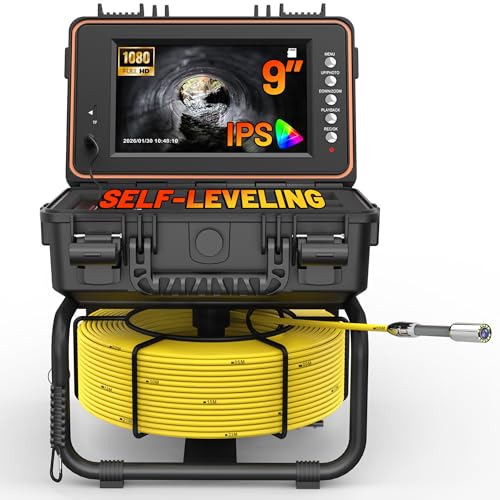
A 100-foot inspection path changes the job completely. This sewer camera is built around a 5mm cable and a trolley-style system rather than a pocket-sized probe, making it the more appropriate tool for drains, sewer lines, and longer pipe routes. The listing describes a 9-inch 1080P IPS display, a self-leveling camera, meter markings, and a 32GB card with DVR capability, all of which help turn a dark pipe inspection into a recordable diagnostic task.
The self-leveling feature matters because the image stays upright while the camera travels through bends. Twelve adjustable LEDs help illuminate the pipe, while five-times digital zoom can enlarge a detail on the screen. The 5100mAh battery is listed with six to eight hours of operation. That combination favors property maintenance, drain diagnostics, and documented repair work, though the 100-foot cable and trolley are excessive for checking a short cavity or vehicle component.
Pros
- 5mm cable reaches up to 100 feet for extended pipe inspections.
- Self-leveling camera helps keep the live image upright.
- 9-inch display provides a larger viewing area than handheld units.
- Meter markings help identify camera position inside a line.
- Listing information includes DVR recording, 32GB storage, and IP68 camera protection.
Cons
- The trolley and long cable are cumbersome for short general-purpose inspections.
- Its pipe-focused design is less convenient for engine bays, walls, and small household cavities.
Choose this system when reach and pipe navigation matter more than compactness. The large display and upright image are practical during a drain inspection where several people may need to watch the screen, while the marked cable gives the operator a better sense of distance. It is a poor fit for anyone seeking a lightweight borescope for occasional automotive or household use, but long pipe runs are exactly where its design has a clear advantage.
To buy this product, click here.
3. Ralcam Dual Lens Articulating Borescope — Best for Tight Access

With a listed 6.5mm camera and a five-foot semi-rigid probe, this Ralcam is a close match for buyers who value a compact camera head and firm cable control. The cable can hold a bent shape while being guided through a short route, which is useful around machinery, HVAC openings, and vehicle compartments. The available information describes dual front and side lenses, giving the operator two viewing directions without removing the probe.
The 5-inch IPS screen keeps the system self-contained, and adjustable lighting is useful when a reflective metal surface creates glare or a dark cavity swallows detail. The camera is listed as IP67 waterproof, but that rating should be treated as applying to the inspection lens or camera assembly rather than automatically covering the display and controls. A four-times zoom and 180-degree photo rotation are also listed, although those functions do not turn the semi-rigid probe into an actively steerable articulating scope.
Pros
- 6.5mm camera head reaches spaces that larger inspection cameras may miss.
- Dual front and side lenses provide two viewing directions.
- Five-foot semi-rigid probe is easier to position in short inspection paths.
- 5-inch screen, adjustable LEDs, and rechargeable operation support phone-free use.
- Listing information includes four-times zoom and 180-degree photo rotation.
Cons
- The five-foot probe offers less reach than the Teslong and pipe cameras.
- The supplied information does not give a specific articulation angle or clearly establish active tip steering.
This version suits short, close-up inspections where probe stiffness is helpful and side viewing can reveal the hidden face of a component. It is easier to manage than a 100-foot sewer cable, but it cannot cover the same distance. Pick it for compact access and dual-angle viewing, not for deep pipe work or true joystick-controlled navigation.
To buy this product, click here.
4. Borescopes TF600 — Best for Controlled Tip Direction

The TF600 is the specialist option in this group because its listing identifies genuine four-way 360-degree articulation on a 6.5mm, 1.55-meter probe. That is a meaningful distinction from a bendable cable. Rather than relying on the probe to curve before insertion, the operator can direct the distal camera in four directions after it is inside the inspection area, which can matter around valves, machinery, and recessed components.
Its modular design makes storage easier, while the supplied 32GB MicroSD card supports photo and video storage. The product information lists 1920×1080 photos and videos and an LED ring light for dark spaces. A 6.5mm probe is slightly larger than a strict 5mm target, and the 1.55-meter reach is much shorter than a sewer camera’s cable, so this is a control-first choice rather than a maximum-access model.
Pros
- Genuine four-way 360-degree articulation is documented.
- 6.5mm probe provides a relatively slim format for an articulating scope.
- 1.55-meter probe suits controlled close and medium-distance inspections.
- 1920×1080 photo and video capture is listed.
- 32GB MicroSD card and modular construction support storage and transport.
Cons
- The 6.5mm probe is wider than the exact 5mm class.
- The 1.55-meter probe is unsuitable for long drain or sewer runs.
Buyers who need to steer around an obstruction should give this model serious attention. Four-way control can be more valuable than extra LEDs or a larger display when the camera must face a particular surface after insertion. Skip it if the inspection openings are extremely narrow or if the job requires dozens of feet of push cable. Its strength is deliberate direction, not broad utility.
To buy this product, click here.
5. 5.5mm HD Borescope Inspection Camera — Best for Phone and Computer Use

This compact camera takes a different route from the screen-based models. The listing describes a 5.5mm lens, adjustable brightness across six lights, and adapters for Type-C phones, standard USB ports, and computers. That makes it attractive for someone who already works from a laptop or compatible mobile device and wants a small inspection camera without carrying a separate monitor.
The product information also lists IP67 protection and 30fps video capture, with photos and video saved to the connected device. Those details are useful for a quick look inside a drain, engine area, or cavity, but the phone or computer becomes part of the operating system. A connector alone does not guarantee compatibility with every Type-C phone, so the device’s operating-system support and any required app should be confirmed before purchase.
Pros
- 5.5mm lens suits narrow access points.
- Adapters support Type-C phones, standard USB ports, and computers according to the listing.
- Six adjustable LEDs provide control over illumination.
- 30fps video capture and image saving are listed.
- IP67 protection is identified for use around wet inspection areas.
Cons
- No integrated display is included, so a compatible connected device is required.
- The supplied information does not state the cable length or exact software compatibility.
This is the sensible format for quick inspections at a desk, in a garage, or beside a household drain when a phone or computer is already available. It is less self-contained than the Teslong and less suited to long pipe work than the sewer systems. Check the connector, operating system, and app requirements first, because physical Type-C fit does not prove complete device compatibility.
To buy this product, click here.
6. Sumkea 65Ft Borescope Camera — Best for Drain and Pipeline Work

The Sumkea is built around a 5mm fiberglass cable and a 65-foot reach, placing it between a handheld borescope and a full 100-foot sewer camera. The listing describes a 140-degree wide-angle IP68 camera head, self-leveling operation, a 512Hz transmitter sonde, a real-time meter counter, and a 9-inch IPS display. Together, those features target drain and pipeline work where finding the trouble spot matters as much as seeing the blockage.
Twelve adjustable LEDs and five-times digital zoom help with dark, dirty lines, while the listed 5100mAh battery supports extended work sessions. Recording to a 32GB card can help document cracks, corrosion, debris, or repair conditions. This is still a pipe-focused system, and its size is excessive for a small engine cavity or wall opening, but the combination of reach, distance information, and self-leveling viewing makes it more useful than a basic snake camera for drainage work.
Pros
- 5mm fiberglass cable reaches up to 65 feet.
- Self-leveling IP68 camera head is intended for pipe and drain inspection.
- 512Hz transmitter sonde and meter counter support location tracking.
- 9-inch IPS display, five-times zoom, and 12 adjustable LEDs aid pipe viewing.
- 32GB recording storage and a 5100mAh battery are listed.
Cons
- The push-camera format is cumbersome for short general-purpose inspections.
- Its pipe-focused features add little benefit for ordinary automotive or wall-cavity work.
Choose the Sumkea when a 65-foot route is long enough for the property but a 100-foot trolley system feels excessive. The sonde and meter counter are particularly relevant when a blockage or defect must be located before access work begins. It is a focused tool rather than a universal handheld borescope, and that specialization is exactly its advantage in drains.
To buy this product, click here.
7. Milwaukee M12TRADE AUTO Shop Borescope — Best for Automotive Documentation

The Milwaukee is aimed squarely at automotive inspection, with a listed 5mm camera head, dual cameras, adjustable LED brightness, and a 5.5-inch HD touchscreen. A slim head can help access places such as glow plug holes and injector ports, while the front and side views reduce the need to withdraw the probe simply to change perspective.
Its strongest distinction is documentation. The product information lists Wi-Fi file sharing and on-board editing tools for drawings, audio, text, and video trimming. That could be useful when an inspection image needs to accompany a repair approval or explain a finding to someone away from the vehicle. The supplied information does not state the probe length, battery details, or exact recording storage, so buyers should confirm those points before ordering.
Pros
- 5mm camera head is specified for tight automotive access points.
- Dual front and side cameras support multiple viewing directions.
- 5.5-inch touchscreen provides a larger self-contained viewing interface.
- Wi-Fi file sharing supports quick transfer of inspection material.
- On-board editing can add drawings, audio, text, and trimmed video.
Cons
- The supplied information does not identify the probe length.
- Battery capacity, runtime, and storage details are not clearly stated.
This model makes the most sense for automotive work where inspection evidence must move quickly from the vehicle to a repair discussion. It is more specialized than the general Teslong and does not offer the stated long reach of the sewer cameras. If the job is mainly about examining components through narrow engine openings and sharing the result, its screen and editing tools carry more weight than a long cable.
To buy this product, click here.
8. NTS500BD5DL5 Dual-Lens Inspection Camera — Best Screen-Based 5mm Option

The NTS500BD5DL5 stays close to the requested format with a 5mm camera head and a five-meter semi-rigid cable. Its dual-lens design provides front and side views on an integrated display, which is useful for deep wall cavities, automotive access points, pipe interiors, and machinery where a phone may be inconvenient. The semi-rigid cable should help the operator guide the camera through a moderate route while retaining some shape.
Adjustable LED lighting allows the operator to respond to dark or reflective surfaces, and the display switches between the two camera views. This is a straightforward screen-based arrangement, without the long push-cable equipment of a sewer camera or the documented four-way tip control of the TF600. The listing does not clearly identify recording resolution, battery capacity, or the exact display size, so those details should be checked before purchase if documentation is central to the job.
Pros
- 5mm camera head directly matches the target diameter.
- Dual front and side lenses provide two inspection directions.
- Five-meter semi-rigid cable offers useful reach for cavities and equipment.
- Integrated display avoids phone and app dependency.
- Adjustable LED lighting supports dark inspection areas.
Cons
- The supplied information does not clearly specify recording functions or storage.
- It lacks documented active articulation for steering the camera tip.
This is a good fit for buyers who want an exact 5mm class camera with a built-in screen and dual viewing, without moving into a large drain trolley. It gives up the Teslong’s stated longer reach and the TF600’s active articulation, but its dimensions and operating method are easy to understand. For wall cavities, moderate pipe paths, and general equipment inspection, that middle ground is useful.
To buy this product, click here.
9. Teslong Rifle Borescope — Best for Rifle Barrel Inspection

This Teslong is a specialized choice rather than a general inspection camera. Its listing identifies a 0.2-inch probe, which is intended for rifle barrels as small as .20 caliber, along with a 45-inch flexible probe and a close-focusing camera. For inspecting fouling, rifling wear, throat erosion, tool marks, or chamber damage, that application-specific sizing matters more than a long cable or broad pipe compatibility.
The integrated 5-inch HD IPS screen operates without a phone or Wi-Fi connection, and the product information lists adjustable LED lighting, a detachable 90-degree side-view mirror, four mirror sizes, and a 32GB MicroSD card for pictures and videos. The mirror is an accessory that changes the viewing direction. It is not a second camera and does not provide active articulation, so this scope is best understood as a focused barrel-inspection kit.
Pros
- 0.2-inch probe is listed for rifle barrels as small as .20 caliber.
- Close-focusing camera is intended for barrel-wall and chamber inspection.
- 5-inch integrated screen supports phone-free operation.
- Four mirror sizes and a detachable 90-degree side-view mirror are included according to the listing.
- 32GB MicroSD storage supports picture and video recording.
Cons
- The specialized probe and mirror system are poorly suited to general plumbing or wall inspections.
- The side-view mirror is not equivalent to dual-camera viewing or active articulation.
Pick this model only when rifle inspection is the actual task. Its close focus, barrel-sized probe, and mirror accessories are more relevant there than the broader dual-lens features found on general-purpose models. For engines, drains, or household cavities, a 5mm-class general borescope will be easier to use and more adaptable.
To buy this product, click here.
Buying Guide
Probe Diameter Determines Where the Camera Can Fit
A 5mm or 5.5mm camera head can pass through smaller openings than a larger head, but the diameter should be matched to the actual access point. The Teslong, Milwaukee, and NTS500 models stay close to the target size. The TF600 and Ralcam models use 6.5mm heads, which may still fit many inspection points while allowing room for more specialized viewing or articulation features.
Do not assume the smallest head is automatically the best. A narrow probe can be easier to insert, while a larger model may provide a more suitable cable design, viewing system, or steering mechanism. Measure the opening and account for the camera head, protective housing, and any attached accessory.
Dual-Lens Viewing Is Different From Active Articulation
A dual-lens camera switches between forward and side views. That can reveal a pipe wall or engine surface without pulling the probe out, but the tip itself does not necessarily steer. The Teslong, Ralcam, Milwaukee, and NTS500 listings describe front and side viewing systems.
The TF600 is different because its product information identifies four-way articulation. Active articulation changes the camera’s direction after insertion. That feature is useful when the operator must aim around an obstruction, while dual-lens viewing is useful when another fixed perspective will answer the inspection question.
Match Cable Length to the Inspection
Short probes are easier to manage in an engine bay, appliance, or wall cavity. The Ralcam’s five-foot cable and NTS500’s five-meter cable occupy that middle ground. The Teslong reaches 16.5 feet, while the Sumkea and sewer camera extend to 65 and 100 feet respectively.
More reach adds access, but it can also create loops and make camera control less predictable. A long cable is valuable inside a drain, yet excessive for a component located a few inches beyond an opening. Choose the shortest reach that comfortably covers the intended route.
Integrated Screens Remove Phone Dependency
A built-in display lets the camera operate as a self-contained tool. That is useful in dirty work areas, around vehicles, or anywhere a phone connection would be inconvenient. The Teslong, sewer camera, Ralcam, TF600, Milwaukee, NTS500, and rifle model all list integrated displays.
The 5.5mm USB camera takes the opposite approach. It uses a connected Type-C phone, standard USB port, or computer, which can reduce equipment carried to the job. Physical connector fit does not establish complete compatibility, so confirm the operating system, app, and adapter requirements before ordering.
Resolution Numbers Do Not Tell the Whole Image Story
Several listings use HD or 1080P terminology, but a resolution label alone does not establish practical sharpness. Focus distance, lighting, lens design, camera position, display quality, and surface glare all affect whether a defect is easy to see.
Adjustable lights can be more useful than a larger resolution number in a dark pipe or reflective engine cavity. A side camera may reveal a surface that a forward camera cannot frame properly. Judge the complete viewing system rather than treating the largest advertised number as the deciding factor.
Check What the IP Rating Covers
IP67 and IP68 claims should be read as component-specific information unless the listing clearly states that the entire system shares the rating. A protected camera head does not automatically make the handle, display, charging port, or connected phone waterproof.
Use the camera according to the product instructions and avoid treating an IP rating as permission for unlimited immersion or exposure to every liquid. The sewer camera and Sumkea are the most clearly focused on wet pipe work, while the other models are better viewed as general inspection tools with varying camera protection.
Recording Matters When the Inspection Must Be Shared
A live image is enough for a quick check, but documentation helps when a repair decision depends on what the camera found. The sewer camera lists DVR recording and a 32GB card. Sumkea lists image and video recording to a 32GB card, while the Milwaukee adds Wi-Fi file sharing and on-device editing.
For the NTS500 and some other models, the available product information does not clearly specify storage or recording details. Confirm those functions before choosing a camera for reports, repair approvals, or before-and-after comparisons.
Best 5mm Borescope FAQ
Is a 5.5mm borescope close enough to a 5mm model?
Usually, the difference is small in practical terms, but the opening still determines whether the camera fits. A 5.5mm probe may work in the same general inspection spaces as a 5mm probe, but buyers should measure the access point and account for the camera housing rather than relying on nominal diameter alone.
Which model is suitable for long drains?
The 100-foot sewer camera is the strongest choice for the longest routes in this comparison. Its 5mm cable, self-leveling camera, meter markings, large display, and recording functions are suited to pipe inspection. The 65-foot Sumkea is a more moderate-reach alternative with a 5mm cable and tracking features.
Does a dual-lens borescope steer around corners?
No. Dual lenses provide different fixed viewing directions, commonly forward and side views. They can reduce the need to withdraw and rotate the probe, but they do not prove that the camera tip actively articulates. The TF600 is the model here with documented four-way articulation.
Can these borescopes inspect a hot engine?
The supplied product information does not establish operating-temperature limits for these models. Allow machinery to cool as appropriate, avoid moving components, and follow the product instructions before inserting a probe into an engine or other mechanical system.
Is the USB-C camera compatible with every USB-C phone?
No. A Type-C connector confirms the physical connection style, not complete phone or app compatibility. Confirm the phone’s operating system, camera permissions, software requirements, and any OTG or adapter needs before ordering.
What is the advantage of a semi-rigid cable?
A semi-rigid cable can hold some of the shape given to it, which may make it easier to guide through a short cavity or around a gentle bend. It is still different from active articulation. A semi-rigid probe does not provide documented directional control of the camera tip unless the product specifically says it does.
Do I need a side-view camera for engine inspection?
It depends on access. A side view can help inspect a nearby wall or component without twisting the probe, which is useful in crowded engine spaces. If the camera must be aimed around an obstruction, active articulation may be more useful than a fixed side lens.
Final Verdict
The Teslong 5mm Dual Lens Borescope Camera is the strongest overall choice for mixed inspection work. Its 5.5mm probe, 16.5-foot reach, forward and side cameras, integrated screen, built-in light, and hands-free kickstand create a balanced tool for automotive, home, wall, duct, and moderate pipe inspections. It does not provide the documented four-way tip control of the TF600 or the long push-cable reach of the sewer systems, but it avoids being locked into one narrow application.
For drains and pipelines, choose the 100-foot sewer camera or the 65-foot Sumkea based on the reach and tracking features required. For automotive documentation, the Milwaukee’s 5mm head, dual cameras, touchscreen, file sharing, and editing tools are more targeted. The NTS500 is a straightforward exact-5mm screen-based option, while the compact USB camera suits buyers who already have a compatible phone or computer. Match the probe to the opening, the cable to the route, and the viewing system to the way the inspection will actually be performed.
