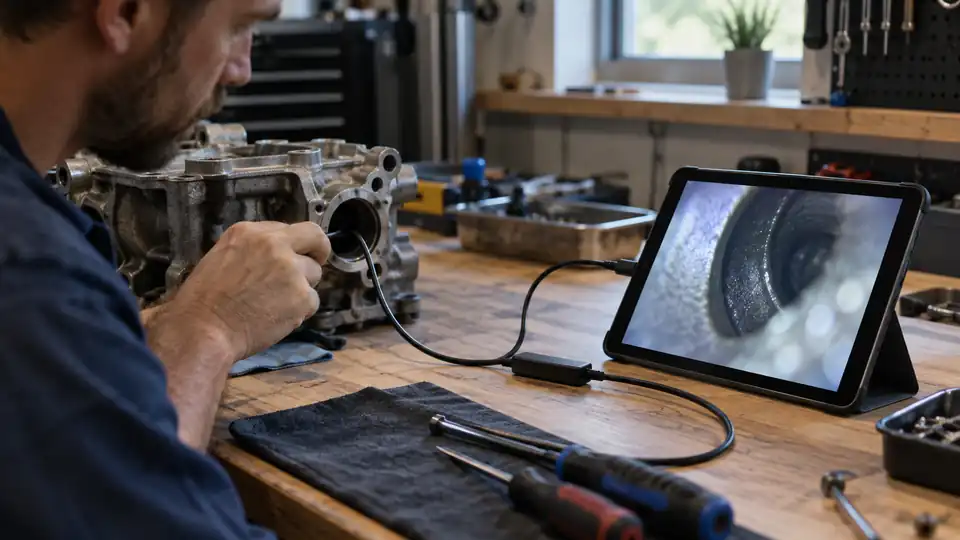
An iPad can turn a narrow inspection into a much clearer job, giving you a larger screen for examining engine cavities, drain lines, HVAC runs, appliance interiors, and wall openings. The right camera, however, needs more than a phone-compatible connector. Probe diameter, cable behavior, lighting, viewing direction, app support, and the difference between a wired camera and a Wi-Fi system all affect how useful the setup will be once the probe disappears into a dark space.
A semi-rigid cable is useful for guiding a camera through a short, fairly direct path, but it does not provide active tip control. Dual-lens models can show forward and side views without constantly repositioning the cable, while articulating borescopes let you steer the camera tip after insertion. Buyers should also check whether the listing specifically supports iPad or iOS use, because a Lightning or USB-C connection alone does not guarantee software compatibility.
The products below cover several inspection styles, from compact dual-lens cameras for general maintenance to specialized articulating instruments with smaller probes. The comparison gives extra weight to iPad connectivity, usable probe control, access, lighting, and documented viewing features rather than treating a high resolution claim as the whole story.
Quick Answer
Best overall for most iPad users: The CTEOUNPT Dual-Lens Endoscope Camera combines direct phone or tablet connection, a 7.9 mm probe, a 16.4-foot semi-rigid cable, forward and side cameras, and adjustable lighting.
Best for controlled tip direction: The Vividia VA-400i has a rigid articulating probe with a locking mechanism and up to 180 degrees of one-way bending.
Best for very small access points: The Vividia CT-2812 uses a 2.8 mm probe and two-way articulation, making it the most specialized choice for tight inspection paths.
Best for broad directional control: The Vividia CX-4010i pairs a 4 mm probe with joystick control and 360-degree all-direction articulation.
Best Borescope for iPad Comparison Table
| Product | Best For | Connection | Probe and Reach |
|---|---|---|---|
| CTEOUNPT Dual-Lens 16.4-Foot | General iPad inspections | USB, adapters included | 7.9 mm, 16.4 ft |
| KEEMIKA W400 Dual-Lens | Forward and side viewing | USB-C and Lightning adapters | 7.9 mm, 16.4 ft |
| Vividia VA-400i | Controlled tip direction | Direct USB connection | Rigid articulating probe |
| Vividia VA-400W3B | Wireless iPad operation | Wi-Fi box | 8.5 mm, 17.5 in |
| CTEOUNPT Dual-Lens 32.8-Foot | Longer pipe and cavity reach | USB, adapters included | 7.9 mm, 32.8 ft |
| CTEOUNPT Single-Lens 32.8-Foot | Long-reach forward viewing | USB, adapters included | 7.9 mm, 32.8 ft |
| Vividia CT-2812 | Very tight access | Built-in Wi-Fi | 2.8 mm, 3.94 ft |
| Dual Lens Endoscope Camera | Plumbing and close inspection | iOS connection | 8 mm, 16.5 ft |
| Vividia CX-4010i | Joystick articulation | Direct wired connection | 4 mm, 3.3 ft |
The detailed reviews explain how each camera handles iPad connectivity, access, viewing direction, cable control, and the trade-offs that matter in actual inspection work.
1. CTEOUNPT Endoscope Camera with Light — Best Overall

A forward camera and a side camera give this CTEOUNPT model a practical advantage inside spaces where turning the probe is awkward. If the camera is looking down a pipe and the area of interest sits along the wall, switching views can reveal more without repeatedly pulling the semi-rigid cable back and starting again. The listing identifies a 7.9 mm probe, 16.4-foot cable, and 1920 by 1440 image capture claim, which suits general automotive, appliance, HVAC, and plumbing inspections.
Connection is straightforward in principle. The camera plugs into a phone or tablet, and the package includes Type-C, Lightning, and Micro-USB adapters. The product information lists iOS 9.0 and newer compatibility, but iPad users should still confirm the connector and app requirements for their particular model. Eight plus one adjustable lights help in dark cavities, while the IP67 probe rating and stated underwater limit make it useful around damp areas without turning it into an unlimited underwater camera.
Pros
- Forward and side cameras support different viewing directions.
- 7.9 mm probe and 16.4-foot semi-rigid cable suit many household and vehicle inspections.
- Type-C, Lightning, and Micro-USB adapters are included.
- Adjustable LED lighting helps illuminate dark spaces.
- Supports photo and video capture through the connected device.
Cons
- The semi-rigid cable does not provide active tip articulation.
- The listing advises avoiding high heat, impacts, and forceful cable pulling.
This is the strongest all-purpose choice for an iPad owner who wants broad inspection coverage without moving to a specialized articulating instrument. It works best for relatively accessible cavities, drains, ducts, and engine areas where a 16.4-foot reach is enough. A different model makes more sense if the opening is exceptionally small or if steering the camera tip matters more than dual viewing.
To buy this product, click here.
2. KEEMIKA W400 Dual-Lens Endoscope — Best for Forward and Side Viewing

The KEEMIKA W400 takes a similar general-purpose approach but emphasizes the cable’s handling and its nine adjustable LEDs. Its 7.9 mm probe and 16.4-foot semi-rigid cable are short enough for many garage or home jobs without creating an unwieldy coil on the floor. That balance can help when an iPad is propped nearby and the operator needs one hand on the tablet while guiding the probe with the other.
The dual-camera arrangement is useful in a cylinder head, drain, duct, or appliance cavity where the forward path is easy to enter but the target sits off to the side. The package includes Type-C and Lightning adapters plus a hook, magnet, and mirror. The listing identifies iOS 9.0 and Android 7.0 compatibility through a dedicated app. The IP67 claim applies to the inspection probe, so the iPad, adapter, and connection point still need protection from moisture.
Pros
- Dual cameras provide forward and alternate side views.
- 9 adjustable LEDs offer control over illumination.
- 7.9 mm probe fits many narrow inspection openings.
- Type-C and Lightning adapters are included.
- Hook, magnet, and mirror expand the practical inspection kit.
Cons
- The 16.4-foot cable offers less reach than the longer CTEOUNPT options.
- It relies on an app and connected iPad rather than a self-contained display.
This camera suits users who want a manageable general-purpose setup and frequently inspect areas where side viewing saves time. It is less appropriate for a long drain run or a task requiring active directional control. Its value is in reducing probe repositioning, not in steering the camera tip through complex bends.
To buy this product, click here.
3. Vividia VA-400i USB Articulating Borescope — Best for Controlled Tip Direction

Some inspection paths are easy to enter but difficult to see around. The VA-400i addresses that problem with a rigid stainless-steel probe and one-way articulation that adjusts from straight to a full 180-degree bend. A locking and unlocking mechanism helps hold the selected angle, which is a meaningful distinction from a semi-rigid snake camera that can bend but cannot actively steer its distal tip.
The published information lists direct connection to iOS phones and tablets, Android devices, and Windows PCs through the Usee Plus software or app. A button on the handle captures pictures, and the focus range is listed from approximately 5 mm to infinity. Its 1280 by 720 HD specification is lower than the advertised capture numbers on several consumer dual-lens cameras, but controlled positioning and close focusing may matter more than headline resolution in a confined mechanical inspection.
Pros
- Documented one-way articulation reaches up to 180 degrees.
- Locking mechanism helps maintain a selected bend.
- Rigid stainless-steel probe supports controlled positioning.
- Focus range is listed from approximately 5 mm to infinity.
- Direct support for iOS tablets, Android devices, and Windows PCs is listed.
Cons
- It provides one-way articulation rather than two-way or four-way control.
- 1280 by 720 resolution is lower than the 1920 by 1440 claims on several alternatives.
The VA-400i is a better fit for deliberate, close mechanical inspection than for long pipe runs. Buyers who need to look behind a component or direct the view around an obstruction will benefit from the articulation. Those who mainly need a flexible cable, broad reach, or dual-lens side viewing may find a simpler camera easier to use.
To buy this product, click here.
4. Vividia VA-400W3B Wi-Fi Bundle — Best for Wireless iPad Operation

This bundle combines the VA-400 rigid articulating borescope with a W03B wireless box, allowing an iPad to view the camera without a direct USB cable running into the tablet. The box has a built-in rechargeable battery, while the probe is listed at 8.5 mm in diameter and 17.5 inches long. That short rigid reach is better suited to machinery, equipment housings, and close inspection points than to deep drains.
One-way articulation bends beyond 180 degrees, and the stated focus range of 10 to 100 mm gives the camera a defined working zone. Wi-Fi adds flexibility around the inspection area, but it also introduces another powered component and a wireless connection step. This is a specialized workflow for users who value separation between the probe and iPad more than plug-and-play simplicity.
Pros
- Wireless box supports iPad viewing without a direct camera cable to the tablet.
- Built-in rechargeable battery is included in the W03B box.
- VA-400 probe provides one-way articulation beyond 180 degrees.
- Rigid 8.5 mm probe offers controlled positioning.
- Published focus range is 10 to 100 mm.
Cons
- The 17.5-inch probe is too short for many deep-cavity or pipe inspections.
- It requires management of a separate wireless box and its battery.
Choose this bundle for close inspections where the iPad needs to stay away from the equipment or where a direct wired connection is inconvenient. It is less compelling for simple household checks, where a compact USB camera requires fewer pieces. The articulation and wireless layout are the reasons to select it.
To buy this product, click here.
5. CTEOUNPT Dual-Lens Endoscope, 32.8-Foot — Best for Long Reach
Doubling the cable length changes the kind of inspection this camera can approach. The 32.8-foot semi-rigid cable can reach farther into a drain, duct, wall cavity, or machinery path than the 16.4-foot versions, while the 7.9 mm probe retains access to relatively narrow openings. The dual-lens layout remains useful at distance because a side view can reveal a nearby wall or obstruction without requiring the entire cable to be rotated.
The product information lists Type-C, Lightning, and Micro-USB adapters, iOS 9.0 and newer support, adjustable eight plus one lighting, photo and video capture, and an IP67 probe with a stated underwater limit of 3.28 feet for one hour. Extra reach can help, but it also creates more cable to manage. The long cable is a feature for deep paths, not an automatic advantage for short, cluttered workspaces.
Pros
- 32.8-foot semi-rigid cable supports deeper inspection paths.
- Dual cameras provide forward and side viewing.
- 7.9 mm probe remains relatively narrow for general inspection use.
- Type-C, Lightning, and Micro-USB adapters are included.
- Adjustable LEDs and device-based photo and video capture are listed.
Cons
- The longer cable can be harder to control in compact work areas.
- It does not offer active articulation at the camera tip.
This is the better long-reach choice for users inspecting pipes, ducts, cavities, and other extended paths. For a quick engine check on a workbench, the extra cable may feel like loose rope underfoot. Buyers should choose it for access distance, then protect the iPad and connector from wet conditions because the stated IP67 rating concerns the probe.
To buy this product, click here.
6. CTEOUNPT Single-Lens Endoscope, 32.8-Foot — Best for Long-Range Forward Viewing

This version keeps the long 32.8-foot semi-rigid cable but uses a single forward-facing camera. That simpler viewing arrangement can be appropriate for following a direct path where the main question is what lies ahead. The listing gives a 2 MP camera with 1920 by 1440 resolution, a 7.9 mm probe, and eight adjustable lights, providing the basic ingredients for viewing dark spaces on an iPad.
Type-C, Lightning, and Micro-USB adapters are listed, along with iOS 9.0 and newer compatibility. The camera can capture photos and videos through the connected device, and the probe is described as IP67 rated with a stated immersion limit. Compared with the dual-lens alternative, this model gives up side viewing. That makes it less adaptable around pipe walls or engine components, but the forward-only setup may be all that is needed for a straight inspection path.
Pros
- 32.8-foot cable provides substantial reach.
- 7.9 mm probe suits many narrow openings.
- 2 MP, 1920 by 1440 camera specification is listed.
- Type-C, Lightning, and Micro-USB adapters support different devices.
- Eight adjustable LEDs help illuminate dark areas.
Cons
- Single-lens viewing lacks the alternate side camera found on dual-lens models.
- The semi-rigid cable does not actively steer the camera tip.
Select this model for long forward-looking runs where side inspection is secondary. It can make sense for a deep cavity or direct pipe route, while the dual-lens 32.8-foot model is more useful when the target may sit off-axis. As with the other phone-connected options, confirm that the app and adapter match the specific iPad before ordering.
To buy this product, click here.
7. Vividia CT-2812 LCD/Wi-Fi Borescope — Best for Very Tight Access

A 2.8 mm probe makes the CT-2812 the standout option for access points that reject the larger 7.9 or 8 mm cameras. Its 1.2-meter probe is much shorter than the long snake-camera cables, but that is a reasonable trade for specialized inspection work inside narrow machinery spaces. Two-way articulation with a stated maximum bend of around 150 degrees offers directional control after insertion.
The probe uses metal braided protection and is listed as IP67 rated. Bright LEDs with fiber-optic transmission are intended to carry illumination through the small inspection system, while built-in Wi-Fi connects the camera to an iPad, iPhone, or Android device. The product also includes an LCD system, though the supplied information does not clearly specify recording functions or display details. This is a focused instrument for access and control rather than a general-purpose drain camera.
Pros
- 2.8 mm probe reaches openings larger cameras cannot.
- Two-way articulation provides documented directional control.
- Metal braided probe protection is listed.
- Built-in Wi-Fi supports connection to iPad and other mobile devices.
- Bright LED lighting uses a fiber-optic transmission bundle.
Cons
- 1.2-meter probe length limits deep pipe and cavity work.
- The supplied information does not clearly specify recording capabilities.
This is the specialist choice for narrow access, compact machinery, and inspections where a 7.9 mm camera simply cannot enter. It is excessive for routine sink drains or broad home maintenance tasks. Confirm the viewing, storage, and recording details before purchase if documentation is central to the job.
To buy this product, click here.
8. Dual Lens Endoscope Camera with Light — Best for Plumbing and Close Inspection

This camera pairs dual-lens viewing with a 16.5-foot semi-rigid cable and an 8 mm camera specification. The listing describes a 1.2 to 4 inch preferred field of view and a 360-degree rotation feature, which can help orient the image during inspection. Image rotation should not be confused with active articulation, though. The cable still needs to be guided and repositioned manually.
For iPad users, the product information identifies iOS 9.0 and newer support through the USEEPLUS app. The IP67 probe is listed for underwater use up to 3.28 feet for one hour, and the camera is intended for plumbing, vehicle, wiring, home inspection, and other hard-to-reach areas. An 18-month warranty is also listed. Its 8 mm probe is slightly larger than the 7.9 mm options, so opening size deserves attention before ordering.
Pros
- Dual-lens system provides more than one viewing direction.
- 16.5-foot semi-rigid cable suits close and medium-reach inspections.
- Image rotation can help orient the on-screen view.
- IP67 probe rating and a stated immersion limit are provided.
- Product information lists an 18-month warranty and after-sales support.
Cons
- The 8 mm camera may not fit openings intended for smaller probes.
- Rotation does not provide active tip articulation.
This is a sensible plumbing and general-maintenance option for an iPad user who wants alternate views and a moderate cable length. It is less suitable for exceptionally narrow access or long pipe runs. Check the app and interface requirements for the exact iPad model, then treat the waterproofing claim as applying to the probe rather than the complete phone-connected setup.
To buy this product, click here.
9. Vividia CX-4010i Flexible Joystick Borescope — Best for Broad Directional Control

The CX-4010i is built around joystick control rather than a passive snake cable. Its 4 mm camera head and flexible 1-meter probe provide access to smaller openings, while the supplied information lists 360-degree all-direction control and 180-degree bending back. That combination can make a substantial difference when the inspection target is nearby but hidden behind an obstruction.
The camera connects directly to iPhone, iPad, and Android devices, and a phone or tablet holder is included. The 1280 by 720 CMOS camera specification is modest beside the advertised numbers of several general-purpose cameras, but tip control is the primary reason to select this model. Bright LEDs and an IP67 rating for the probe head and tube are listed. The short probe is a limitation for drains, ducts, and deep cavities.
Pros
- Joystick provides all-direction control according to the listing.
- 4 mm camera head reaches tighter openings than larger probes.
- 180-degree backward bending is listed.
- Direct iPad connection and a tablet holder are included.
- Bright LEDs and IP67 probe protection are specified.
Cons
- The 1-meter probe limits reach in long inspection paths.
- 1280 by 720 resolution is lower than several general-purpose alternatives.
The CX-4010i fits users who need to place the camera precisely inside compact machinery or behind a nearby obstruction. It is a poor match for long plumbing routes, where cable length matters more than joystick control. Pick it for maneuverability and smaller access, not for maximum reach or the highest advertised image number.
To buy this product, click here.
Buying Guide for the Best Borescope for iPad
Probe Diameter Determines Where the Camera Can Fit
A 2.8 mm probe can enter openings that an 8 mm camera cannot, which is why the Vividia CT-2812 and CX-4010i serve a different purpose from the general-purpose snake cameras. Smaller diameter does not automatically mean a better image or easier handling. Match the camera head to the access point first, then examine control, lighting, and reach.
Dual-Lens Viewing Is Different From Articulation
A dual-lens camera provides multiple viewing directions, often forward and side-facing. That can reduce the need to twist the cable. Articulation physically changes the camera tip direction through a control mechanism. Choose dual lenses for alternate views along a path, and choose articulation when you need to steer around an obstruction.
Match Cable Length to the Inspection
A 32.8-foot cable helps with deep cavities, ducts, and longer pipe routes, but extra cable takes more space and can be harder to guide. A 16.4-foot cable is easier to manage for many vehicle and household tasks. Short rigid probes are best for close machinery work, especially when controlled positioning matters more than distance.
Phone Compatibility Requires More Than a Connector
Lightning, USB-C, or Micro-USB adapters address physical connection, but the app and operating-system requirements still matter. The reviewed products list different iOS versions and apps, so verify the exact iPad model before ordering. A wired camera also uses the iPad as its viewing and recording device, while a Wi-Fi unit adds a separate wireless connection process.
Check What the IP Rating Covers
An IP67 claim attached to the probe does not make the iPad, connector, handle, or wireless box waterproof. Some listings also specify an immersion depth and duration. Stay within those stated limits, keep the connection dry, and avoid high-temperature or moving equipment unless the product information expressly supports that use.
Resolution Numbers Do Not Tell the Whole Image Story
Advertised 1920 by 1440 capture numbers can look attractive, but focus distance, lighting, camera position, app processing, and display quality affect what you can actually see. An articulating 1280 by 720 camera may reveal more of a hidden component because its tip can be aimed correctly. Resolution should be weighed alongside access and control.
Best Borescope for iPad FAQ
Can an iPad work with a USB borescope?
It can, provided the camera, adapter, app, and iPad operating system are compatible. The reviewed models list different combinations of Lightning, USB-C, and app support. Confirm the exact connector and software requirements for your iPad rather than relying on the connector shape alone.
Is a dual-lens borescope better than a single-lens model?
A dual-lens model is more useful when you need forward and side views inside a pipe, cavity, or engine area. A single-lens camera can be sufficient for a direct path and may be simpler to operate. Neither design provides active tip steering unless the listing specifically describes articulation.
What is the advantage of a Wi-Fi borescope?
Wi-Fi can separate the iPad from the camera connection and reduce the need for a cable running directly into the tablet. The system may require a separate powered wireless box or a connection step through an app. It does not mean the camera uses Bluetooth or internet access.
Can these cameras be used in hot engine parts?
The supplied product information does not establish broad high-temperature capability. Several listings advise avoiding high-temperature environments. Allow machinery to cool, keep clear of moving components, and follow the product instructions before inserting a probe.
Does a semi-rigid cable articulate?
No. A semi-rigid cable can bend and hold a general shape, which helps guide the camera. Active articulation requires a documented mechanism that changes the distal camera tip direction, such as the control systems on the Vividia VA-400i, CT-2812, and CX-4010i.
Which type is better for a drain inspection?
A longer cable, suitable probe diameter, adjustable lighting, and documented environmental protection are useful starting points. The 32.8-foot CTEOUNPT models provide more reach, while dual-lens versions can show a side wall without constant cable repositioning. These consumer cameras should not be treated as substitutes for specialized sewer inspection systems.
Final Verdict
The CTEOUNPT dual-lens 16.4-foot model is the strongest overall choice for most iPad owners because it combines forward and side viewing, a manageable semi-rigid cable, multiple adapters, adjustable lighting, and documented photo and video support. It is broad enough for household maintenance, vehicle inspection, HVAC work, and many plumbing tasks without the extra equipment required by a specialized articulating or Wi-Fi system.
Choose the Vividia VA-400i when controlled tip direction matters more than dual-lens viewing. For very small openings, the 2.8 mm CT-2812 is the more specialized answer, while the 32.8-foot CTEOUNPT dual-lens model makes sense for longer paths. Before ordering, verify the iPad connector and app requirements, measure the access opening, and match cable length to the inspection rather than automatically choosing the longest or highest-resolution option.
