
A borescope with a built-in screen can turn a blind inspection into a live, hands-on view of an engine cavity, wall gap, duct, drain, or appliance. The practical choice is rarely about the biggest resolution number alone. Probe diameter, cable control, viewing direction, screen usability, lighting, recording, and the ability to work without a phone all shape how useful the camera feels once it is inside a cramped space.
A semi-rigid cable can hold a useful position, but it does not steer the camera tip like an articulating probe. A side-view camera can reveal a wall or pipe surface without twisting the cable, but it is different from active articulation. Buyers should also check whether the screen system records images and video, since several integrated-display models provide live viewing only. The right choice depends on the task, the available access opening, the amount of reach required, and whether documentation matters.
The products below range from compact general-purpose cameras to dual-lens and articulating systems. The comparison gives more weight to integrated-screen operation, practical control, viewing flexibility, and clearly stated specifications than to advertising claims alone.
Quick Answer
Best overall: The DXZtoz Dual Lens Articulating Borescope combines a slim probe, two-way articulation, dual viewing directions, a 5-inch display, recording, and included storage. It suits demanding engine, machinery, wall, and pipe inspections where tip control and documentation matter.
Best for general-purpose inspection: The Teslong 5” Dual Lens Borescope Camera offers a large integrated screen, forward and side cameras, a long 16.5-foot cable, and phone-free operation.
Best for controlled tip direction: The Teslong Articulating Borescope uses a two-way articulating probe and a centered joystick, making it easier to redirect the camera in tight inspection paths.
Best for a slim probe: The NIDAGE 3.9mm Endoscope Camera reaches smaller openings than the 7.9mm and 8mm cameras in this group, although its short five-foot cable and lack of recording limit its range of use.
Best Borescope With Screen Comparison Table
| Product | Best For | Viewing System | Probe And Reach | Recording |
|---|---|---|---|---|
| DXZtoz Dual Lens Articulating Borescope | Detailed inspections and documentation | Front, side, two-way articulation | 0.25-inch probe, 5 feet | Photo and video, 32GB card |
| Teslong 5” Dual Lens Borescope Camera | Long-reach general inspection | Forward and side cameras | 8mm, 16.5 feet | Not clearly stated |
| Teslong Articulating Borescope | Controlled camera direction | Two-way articulation | 5-foot semi-rigid gooseneck | Photo and video |
| DXZtoz Two-Way Articulating Borescope | Engine and HVAC work | Two-way articulation | 8.5mm, 5.5 feet | Not clearly stated |
| Acoath Two-Way Articulating Borescope | Compact dual-view inspections | Front, side, two-way articulation | 0.33-inch, 5 feet | Photo and video, 32GB card |
| 1920P Dual Lens Borescope Tools | Forward and side viewing | Dual lens, three viewing modes | 7.9mm, 16.5 feet | No |
| Dual Lens Borescope Inspection Camera | Longer jobs with recording | Front and side cameras | 16-foot semi-rigid cable | Photo and video |
| Daxiongmao Endoscope Camera | Basic phone-free inspection | Single forward camera | 8mm, 16.5 feet | No |
| NIDAGE 3.9mm Endoscope Camera | Small access openings | Single forward camera | 3.9mm, 5 feet | No |
The detailed reviews explain how screen size, probe control, viewing direction, reach, and recording separate these nine choices.
1. DXZtoz Dual Lens Articulating Borescope — Best Overall

The DXZtoz stands out because it combines several features that are usually valuable in the same awkward inspection: a slim 0.25-inch probe, two-way articulation, a side camera, a 5-inch 1080P display, and a supplied 32GB memory card. A mechanic looking through a spark-plug opening, or someone tracing a hidden pipe bend, can change the camera direction without relying entirely on cable twisting. The thumb-stick control is intended to hold the tip at a selected angle, which is more useful than simply bending a cable before insertion.
Its dual-lens arrangement adds another way to look at nearby surfaces. The forward camera handles the path ahead, while the side camera helps inspect a wall, cylinder surface, pipe side, or cavity edge. The listing also identifies 10X zoom, seven LEDs, IP67 protection for the probe, a 3,000mAh battery, and five to six hours of stated working time. Those claims should be read as listing specifications rather than independent test results, but the overall arrangement is unusually well matched to inspections where a live view needs to become a recordable report.
Pros
- Very slim 0.25-inch probe for tighter access points.
- Two-way articulation provides active control of the camera tip.
- Front and side cameras reduce the need to reposition the probe.
- 5-inch 1080P display with 10X zoom gives a larger viewing surface.
- Photo and video recording with an included 32GB memory card.
Cons
- The probe length is five feet, so it is less suited to very long routes.
- Its larger feature set may be more than a homeowner needs for occasional checks.
This is the strongest match for buyers who need more than a basic live screen. It makes sense for engine cavities, machinery, wall interiors, and pipe sections where the camera must be directed, viewed from the side, and documented afterward. A simpler fixed camera will be easier to justify for quick drain or appliance checks, while the DXZtoz earns its top position through control and record-keeping rather than resolution language alone.
To buy this product, click here.
2. Teslong 5” Dual Lens Borescope Camera — Best for Long-Reach Dual Viewing

A 16.5-foot semi-rigid cable changes the character of an inspection. Instead of stopping at the edge of a wall cavity or shallow duct, the probe can reach farther into an engine bay, HVAC path, drain, or hidden void. The Teslong pairs that reach with forward and side cameras, each with its own LED lighting. That arrangement is useful when a straight-ahead view shows the route but the actual defect is sitting on the nearby wall.
The 5-inch IPS display is larger than the 4.3-inch screens used by many compact models, and the unit works without a phone, Wi-Fi connection, or app. Its built-in 5,000mAh battery is listed for approximately 4.5 hours of continuous use, with about five hours of charging time. The 8mm probe is more substantial than the 3.9mm NIDAGE camera, so the trade-off is straightforward: this Teslong brings reach and viewing flexibility, but it needs a wider access point.
Pros
- 16.5-foot semi-rigid cable reaches deep wall, HVAC, drain, and engine spaces.
- Forward and side cameras provide two genuine viewing directions.
- Large 5-inch IPS screen is easy to use without a phone.
- Independent LED lighting supports forward and side inspection.
- Includes a hard carrying case, hook, magnet, and mirror.
Cons
- The 8mm probe will not fit openings intended for slimmer cameras.
- The supplied product information does not clearly identify photo or video recording.
Choose this model for reach and broad coverage rather than active tip steering. It is a strong fit for a homeowner checking behind drywall or an HVAC path where the probe needs to travel a long distance. A shorter articulating scope will be easier to aim in a compact engine cavity, but the Teslong is the more natural choice when the inspection route itself is long.
To buy this product, click here.
3. Teslong Articulating Borescope — Best for Controlled Tip Direction

The Teslong Articulating Borescope focuses on the problem that appears after a straight probe has already entered the cavity: the camera is present, but it is looking the wrong way. Its two-way articulating probe can redirect the view, while the centered joystick is intended for one-handed control. That combination is useful around valves, wall cavities, HVAC spaces, and engine components where repeatedly withdrawing and reshaping a cable wastes time.
The five-foot semi-rigid gooseneck sits between a floppy inspection cable and a fully articulated industrial system. It can retain a shape as it is guided, giving the operator some control before the tip is inserted. A 4.5-inch IPS color screen keeps the workflow self-contained, and adjustable probe lighting helps in dark spaces. The product information also identifies photo and video capture, although it does not provide the same storage detail as the top-ranked DXZtoz.
Pros
- Two-way articulation helps redirect the camera after insertion.
- Centered joystick supports one-handed operation.
- 4.5-inch IPS screen works without an app or phone.
- Five-foot semi-rigid gooseneck balances shape retention and flexibility.
- Photo and video buttons are built into the handheld system.
Cons
- Five-foot reach is shorter than the long-cable options in this roundup.
- The product information does not clearly specify storage capacity.
This model suits users who value controlled viewing more than maximum reach. It is easier to manage in a vehicle, appliance, or wall inspection where the target is close but hidden behind turns. A dual-lens model may reveal a side surface without steering, while this Teslong offers more direct control of the camera direction. That distinction is the reason to choose it.
To buy this product, click here.
4. DXZtoz Two-Way Articulating Borescope — Best for Engine and HVAC Access

Engine inspection often involves a frustrating mix of short access points, reflective metal, and components that sit just outside the forward view. This DXZtoz uses a two-way control system with a stated 220-degree articulation range, allowing the camera to look around obstacles rather than depending solely on cable bending. Its 8.5mm camera is larger than the slim probes in this group, but the listing identifies a one to 15cm focal distance, eight LEDs, and 8X zoom for close work.
The 4.3-inch IPS screen keeps the inspection independent of a phone, and the 5.5-foot rigid gooseneck should hold a pre-formed path more securely than a loose flexible cable. The probe is listed as IP67 and oil resistant, which may be useful around wet plumbing or oily automotive environments. Those ratings apply to the stated probe system, not automatically to the handle, screen, or charging connection. A 3,000mAh rechargeable battery and carrying case round out a package aimed at repeated field use.
Pros
- Documented two-way articulation with a stated 220-degree range.
- 1 to 15cm focal distance is suited to close inspection tasks.
- 8X zoom and eight adjustable LEDs support detailed live viewing.
- 5.5-foot rigid gooseneck retains its shape during insertion.
- Includes a protective case, hook, magnet, and side mirror.
Cons
- The 8.5mm camera may be too large for smaller openings.
- The supplied information does not clearly state photo or video recording capability.
This is a practical choice for engine cylinders, valves, HVAC paths, and machinery where the camera must turn after entering the inspection area. Its probe is less access-friendly than a 3.9mm model, so the opening comes first. Choose it when tip direction and close focus matter more than fitting through the smallest possible gap.
To buy this product, click here.
5. Acoath Two-Way Articulating Borescope — Best Compact Articulating Dual-Lens System

The Acoath combines two distinct ways to change the view. Its probe uses two-way articulation with a stated 210-degree range, while a button switches between forward and side cameras. That matters in a pipe bend or wall cavity where the operator may need to steer around an obstacle, then inspect the nearby surface without rotating the entire cable. The 0.33-inch probe is slimmer than the 8mm cameras, though it is not as narrow as the 3.9mm NIDAGE.
A 4.3-inch IPS screen shows the live image, and the listing states that the system can capture photos and videos to its built-in 32GB TF card. Eight LEDs with four brightness levels provide lighting control in dark spaces. The five-foot semi-rigid cable is compact and manageable, but it cannot match the reach of the 16-foot models. For close automotive work, home renovation, HVAC checks, and pipe bends, that shorter length can keep the tool from becoming unwieldy.
Pros
- Two-way articulation and dual-lens viewing work together.
- 0.33-inch probe offers a useful balance of access and structure.
- Photo and video capture are supported with a built-in 32GB card.
- 4.3-inch IPS display operates without an app or internet connection.
- Includes a case, protective cap, hook, magnet, and mirror.
Cons
- Five-foot probe length limits deep or widely separated inspection routes.
- The 0.33-inch probe will not enter openings suited to the narrowest cameras.
The Acoath is a good fit for close inspection work where a second viewing direction and active steering are both useful. It gives up long-cable reach, but gains a more controlled approach around tight bends and nearby surfaces. It is especially compelling for someone who needs documentation but does not want to rely on a phone or separate storage setup.
To buy this product, click here.
6. 1920P Dual Lens Borescope Tools — Best for Long-Reach Side Viewing
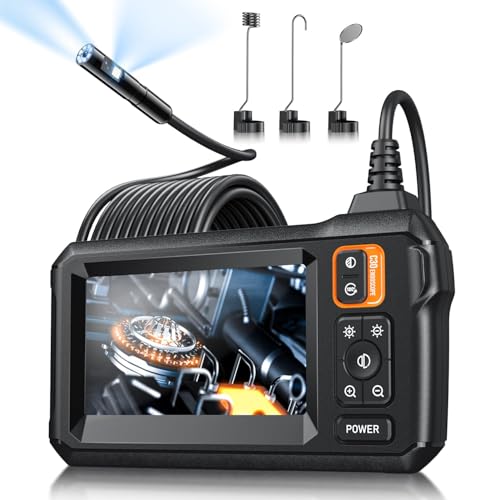
Some inspection paths are long and mostly straight, but the useful detail sits on the side. This dual-lens camera addresses that problem with front and side views that can be switched from the handheld unit. It does not actively steer the tip, so the semi-rigid cable still needs to be shaped before insertion. Once inside, however, the side camera can reduce the need to rotate or withdraw the probe simply to inspect a nearby wall.
The product uses a 4.3-inch IPS screen, an approximately 170-degree horizontal viewing angle, eight adjustable LEDs, and a 7.9mm probe on a 16.5-foot cable. Its stated 2cm to 10cm focus range is useful context because fixed-focus cameras need to be positioned at a suitable distance from the target. The camera does not capture or store photos, so it is intended for live inspection rather than creating a report.
Pros
- Front and side cameras provide three stated observation modes.
- 16.5-foot semi-rigid cable supports deep inspection routes.
- 7.9mm probe is suitable for many general inspection openings.
- Adjustable eight-LED lighting helps manage dark areas.
- IP67 probe rating is listed for wet inspection conditions.
Cons
- No photo or video storage is provided according to the listing.
- The semi-rigid cable is not an active articulating probe.
This model suits live checks behind walls, inside ducts, around engines, and along accessible pipe sections where reach matters more than documentation. It is a better match than a single-lens camera when the target may be beside the probe rather than directly ahead. Buyers needing controlled tip movement or saved evidence should move up to an articulating recording model.
To buy this product, click here.
7. Dual Lens Borescope Inspection Camera — Best for Dual-View Recording
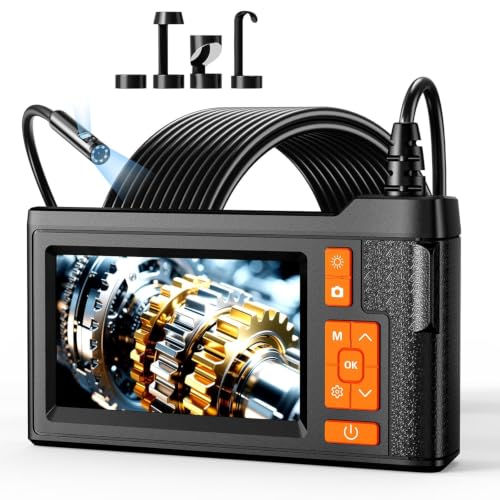
This dual-lens inspection camera adds a useful feature that several live-view models omit: photo and video capture. A button switches between the forward and side cameras, while the 4.3-inch display keeps the inspection phone-free. That can be handy when a hidden condition needs to be shown to someone else later, such as a blockage, damaged component, or cavity that is difficult to access a second time.
The listing identifies a 16-foot semi-rigid cable, eight adjustable LEDs, a 2,000mAh battery, and four to six hours of stated use. It also gives practical fixed-focus guidance of roughly three to eight centimeters from the target. The cable can be pre-bent for straight or mildly curved routes, but the product information specifically cautions against sharp 90-degree pipe bends, fully blocked drains, and long underground sewer lines. Those limits make the camera more suitable for accessible inspection paths than for dedicated sewer work.
Pros
- Front and side cameras can be switched without a phone or app.
- Photo and video recording support inspection documentation.
- 16-foot semi-rigid cable provides useful reach for walls, ducts, and engines.
- Eight adjustable LEDs help control brightness around reflective surfaces.
- Supplied hook, magnet, and side mirror extend its general-purpose use.
Cons
- Fixed focus requires suitable distance from the subject for a clear view.
- The cable is not recommended for sharp 90-degree bends or long underground sewer lines.
This is a sensible option for anyone who wants side viewing and saved evidence without moving to an articulating system. It works best where the cable can be guided through a relatively open route and the inspection target falls within its fixed-focus range. For tight engine angles, active articulation offers more control, while this model gives longer reach and straightforward recording.
To buy this product, click here.
8. Daxiongmao Endoscope Camera — Best for Simple Phone-Free Operation

The Daxiongmao keeps the workflow uncomplicated. Turn on the unit, view the live image on its 4.3-inch color LCD, and guide the 16.5-foot semi-rigid cable into the inspection area. There is no stated phone connection, Wi-Fi setup, or driver download, which is useful when the work is wet, dusty, or likely to leave fingerprints on a personal device. The 8mm probe is suited to general openings, including the spark-plug access described in the product information.
Eight adjustable LEDs provide illumination, and the listing identifies an IP67 rating for the probe along with a 1.5-inch to five-inch observation distance. The camera does not take photos or videos, so its role is diagnosis while standing beside the inspection rather than creating a visual record. A hook, magnet, and side mirror are included, giving it extra usefulness for retrieving small objects or checking a side surface.
Pros
- 16.5-foot semi-rigid cable offers substantial reach.
- 4.3-inch integrated screen works without a phone or app.
- Eight adjustable LEDs support dark-space viewing.
- IP67 probe rating is listed for wet environments.
- Includes hook, magnet, and side mirror accessories.
Cons
- The camera cannot capture or store photos and videos.
- The 8mm probe is less suitable for very small openings.
This model fits straightforward checks in plumbing, walls, HVAC, appliances, and vehicles where a live view answers the question. It is easier to use than a phone-dependent camera, but its single forward camera cannot match the coverage of the dual-lens products. Pick it when reach and basic operation matter more than side viewing, active steering, or documentation.
To buy this product, click here.
9. NIDAGE 3.9mm Endoscope Camera — Best for Small Access Openings

A 3.9mm probe opens up inspection points that an 8mm camera cannot enter. That is the defining reason to choose the NIDAGE. It can be useful around smaller automotive openings, machinery, printers, instruments, lockers, and other confined spaces where access is the first problem. The five-foot semi-rigid cable is short enough to manage around a workbench or engine bay, and it can hold a gentle shape while being guided.
The integrated IPS screen provides live viewing without a phone, Wi-Fi, or app. Six adjustable LEDs illuminate the probe tip, and the listing identifies IP67 protection for damp areas. The narrow probe does come with compromises: the cable is much shorter than the 16-foot choices, and the camera cannot take or store photos or videos. It is therefore a focused access tool rather than a long-range documentation system.
Pros
- 3.9mm probe reaches smaller openings than the larger cameras here.
- 5-foot semi-rigid cable is manageable in close inspection work.
- Integrated screen avoids phone and app compatibility concerns.
- Six adjustable LEDs provide tip lighting in dark spaces.
- IP67 protection is listed for damp inspection areas.
Cons
- Five-foot cable offers less reach than most alternatives in this group.
- No photo or video recording is provided according to the listing.
The NIDAGE earns its place through access rather than broad capability. It is the model to examine first when a narrow opening rules out the 7.9mm and 8mm cameras. For long wall cavities, deep drains, or jobs requiring saved evidence, a larger dual-lens or recording system will be more useful. Here, the smaller probe is the deciding advantage.
To buy this product, click here.
Buying Guide
Start With the Opening, Not the Resolution Number
Probe diameter determines whether the camera can enter the access point at all. The NIDAGE lists a 3.9mm probe, while several general-purpose models use approximately 7.9mm or 8mm probes. A larger camera may offer a more substantial cable and broader general utility, but it cannot compensate for an opening that is too small. Measure the access point when possible, then leave room for the cable to bend or move.
Choose Active Articulation Only When Tip Direction Matters
A semi-rigid cable can be bent before insertion and may hold its shape, but genuine articulation uses a control to redirect the distal camera tip after it is inside. That difference matters around engine components, pipe bends, and wall cavities where the camera must look behind an obstacle. The DXZtoz and Teslong articulating models provide this type of documented control. A dual-lens camera solves a different problem by offering a second viewing direction without mechanically steering the tip.
Match Cable Length to the Route
Long cables are useful for deep wall cavities, HVAC paths, drains, and engine bays, but extra length can become a loose coil around the operator. The 16-foot models offer much more reach than the five-foot articulating systems. A short cable can be easier to guide in a compact workspace, especially when the target is close to the access opening. More reach is helpful only when the inspection route genuinely requires it.
Decide Whether a Side Camera Is Worth More Than a Mirror
A genuine dual-lens borescope has separate forward and side cameras. The side view can reveal a nearby pipe wall, cylinder surface, or cavity edge without twisting the probe. A supplied mirror can also provide a side-looking view, but it is an accessory attached to a single-camera system and may be less convenient in a cramped space. Choose dual-lens hardware when viewing direction is a regular part of the inspection rather than an occasional need.
Check Whether the Screen System Records
An integrated screen removes the need to keep a phone clean, install an app, or solve device compatibility questions. It does not automatically mean that the camera can save evidence. The NIDAGE, Daxiongmao, and several 1920P models are listed as live-view devices without photo or video storage. The DXZtoz dual-lens articulating model and Acoath identify photo and video capture with 32GB storage, while the recording dual-lens model also supports documentation. If another person needs to review the inspection later, verify this feature before ordering.
Use Focus Information to Plan the Inspection
Fixed-focus cameras need to be held at a workable distance from the target. The dual-lens recording model lists a preferred distance of roughly three to eight centimeters, while other products identify wider focus ranges. A camera can show a live image while still looking soft if the lens is pressed too close to a surface. Move the probe slowly, adjust the LEDs to reduce glare, and clean the lens before judging image detail.
Read IP67 as a Probe Rating, Not a Whole-System Guarantee
Several products list IP67 protection for the probe. That can be useful for damp plumbing, wet cavities, and outdoor maintenance, but it does not automatically make the display, handle, connector, or charging port waterproof. It also does not mean unlimited underwater use. Keep the control unit and connections away from water, and follow the product instructions for the actual inspection conditions.
Best Borescope With Screen FAQ
Is an integrated screen better than using a phone?
An integrated screen is often simpler for messy or field inspections because it avoids phone compatibility, app setup, Wi-Fi pairing, and the risk of exposing a personal device to water or grime. A phone-based system may offer easier sharing or storage, but the products in this roundup focus on self-contained displays. The main trade-off is that screen-based models vary widely in recording capability.
Can a dual-lens borescope look around corners?
A side camera can show a direction that the forward camera cannot, but it does not actively bend the camera tip. The cable still has to reach the area and may need to be pre-bent. For true tip steering around an obstacle, choose a model with documented two-way articulation, such as the DXZtoz or Teslong articulating options.
Are these borescopes suitable for engine inspection?
Several listings describe automotive and engine uses, including spark-plug openings, cylinders, valves, pistons, and engine compartments. Fit depends on the actual access opening, probe diameter, and route inside the engine. Do not insert a probe into moving or hot machinery, and allow equipment to cool when required by safe working practice.
Can these cameras inspect drains and pipes?
They can be useful for accessible pipe sections, drains, and plumbing checks, especially when the probe has adjustable lighting and documented protection. They are not automatically professional sewer-camera systems. Cable length, stiffness, probe diameter, bend radius, focus distance, and the condition of the pipe all affect whether the camera can reach the suspected problem.
Does a 1920P or 1080P label guarantee a sharper image?
No. Those labels describe listing resolution terminology, but practical visibility also depends on focus distance, lighting, lens design, camera stability, display quality, and the surface being inspected. A camera positioned at the correct distance with controlled lighting may produce a more useful view than one with a larger advertised number used too close to a reflective surface.
What accessories are useful on a borescope?
A hook can help retrieve a small item, a magnet can collect suitable metal objects, and a mirror can provide a side view on a single-lens camera. These accessories do not change the camera’s probe diameter or make a fixed cable articulating. They are useful additions, but the probe, display, lighting, and viewing system should drive the main purchase decision.
How should a borescope lens be cleaned?
Follow the product instructions and use a method suitable for the camera lens. In practical use, debris, moisture, and fingerprints can soften the image or create glare. A clean lens, controlled LED brightness, and a suitable viewing distance are often more useful than immediately assuming the display or camera resolution is the problem.
Final Verdict
The DXZtoz Dual Lens Articulating Borescope is the strongest overall choice for buyers who want a serious integrated-screen inspection tool. Its slim probe, two-way articulation, front and side cameras, larger 5-inch display, recording capability, and included memory card cover more inspection situations than a fixed single-camera design. The shorter five-foot probe is the main trade-off, so it is best for controlled access rather than extremely long routes.
The Teslong 5” Dual Lens model is the better fit for long-reach work, while the Teslong Articulating Borescope and Acoath provide useful alternatives when controlled viewing matters. For a narrow access opening, the NIDAGE’s 3.9mm probe changes the decision entirely. Before ordering, match the camera to the actual opening, route, viewing direction, and documentation needs. A larger screen cannot rescue a probe that will not fit, and a long cable cannot replace active steering when the camera must turn inside the cavity.
