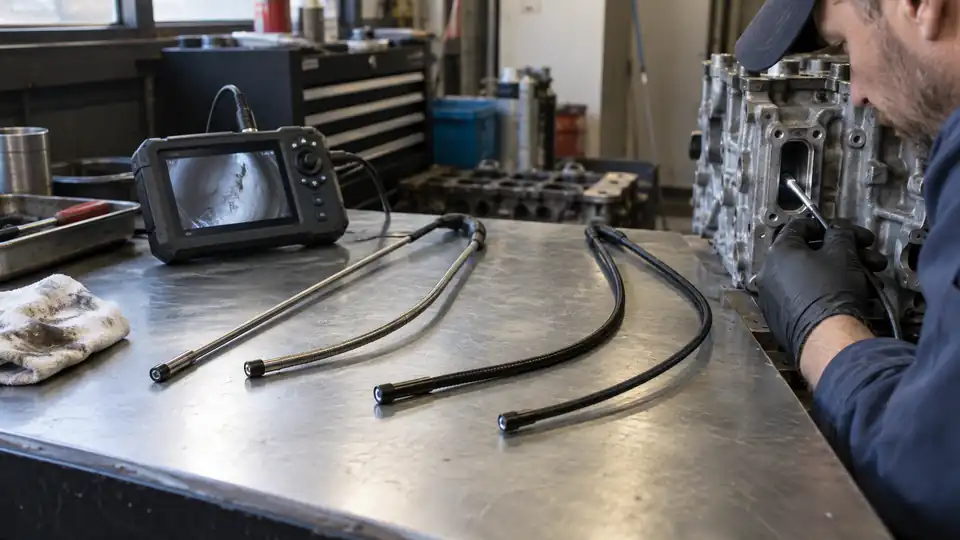
A flexible borescope earns its place when the inspection path is awkward, narrow, or hidden behind a panel. The right model can look around an engine component, follow a pipe bend, check a wall cavity, or inspect machinery without taking everything apart. The meaningful differences are probe diameter, cable behavior, active articulation, viewing direction, screen design, lighting, and whether images can be saved for later review.
It is easy to overvalue a long cable or a large resolution number. A long semi-rigid probe can reach farther, yet become harder to steer in a short access path. A dual-lens camera can show forward and side views, but it does not provide the directional control of an articulating tip. Phone compatibility also deserves care because a connector alone does not guarantee that every device or app will work. The best choice depends on whether your priority is controlled tip movement, narrow access, pipe reach, phone-free operation, or inspection records.
The models below cover genuine two-way and four-way articulation, dual-lens viewing, integrated displays, phone connectivity, and long flexible probes. The comparison weighs practical access and control alongside listing-supported features, so you can see which camera fits a confined automotive inspection, a drain, an HVAC cavity, or general maintenance work.
Quick Answer
- Best Overall: The Dual Lens Two-Way Articulating Borescope combines a 0.25-inch probe, dual cameras, 210-degree articulation, an integrated display, and phone-free operation.
- Best for Four-Way Control: The THINKCAR 4-Way Articulating Borescope offers joystick-controlled directional movement, a 6.2 mm probe, a 5-inch screen, and photo and video capture.
- Best for Long Reach: The DEPSTECH Dual-Lens Endoscope Camera provides a 16.5-foot semi-rigid cable, dual viewing, and a 5-inch screen for pipe, duct, and cavity work.
- Best for Phone-Based Inspection: The Klein Tools ET21 uses Wi-Fi to send live video and images to supported iPhone and Android devices, with a slim 5.5 mm camera.
Best Flexible Borescope Comparison Table
| Product | Best For | Probe or Cable | Viewing System |
|---|---|---|---|
| Dual Lens Two-Way Articulating Borescope | Overall control and access | 0.25 in, 5.3 ft | Dual lens, 210° articulation, 4.3 in screen |
| THINKCAR 4-Way Articulating Borescope | Multi-directional engine inspection | 6.2 mm, 1.5 m | Four-way articulation, 5 in screen |
| Articulating Borescope Inspection Camera | Slim controlled access | 6 mm, length not stated | Two-way 210°, 5 in screen |
| FFXET Two-Way Articulating Borescope | Zoom and phone-free viewing | 5 ft semi-rigid probe | Two-way 210°, 4.3 in screen |
| DEPSTECH Dual-Lens Endoscope Camera | Long pipe and cavity reach | 16.5 ft semi-rigid cable | Dual lens, 5 in screen |
| FFXET Dual Lens Borescope Camera | Long-reach dual viewing | 16.4 ft semi-rigid probe | Dual lens, 4.3 in screen |
| Klein Tools ET21 | Wi-Fi phone inspection | 5.5 mm, 5 ft | Phone display, adjustable LEDs |
| GEARWRENCH GWSCOPE | USB-C documentation | 8.5 mm probe | Phone, tablet, or computer |
| 1920P HD Dual-Lens Endoscope Camera | Phone-connected general use | 7.9 mm, 16.4 ft | Dual lens, phone app |
The detailed reviews explain how each probe handles access, viewing direction, documentation, and the practical compromises behind its ranking.
1. Dual Lens Two-Way Articulating Borescope — Best Overall

The strongest all-around combination here is a slim 0.25-inch probe paired with genuine two-way articulation and two camera views. The control wheel can bend the distal probe through a stated 210-degree range, which gives the operator more influence after the camera is inside a cavity. That matters in an engine bay or HVAC channel where pulling the cable back and trying again is slow and awkward.
Forward and side cameras add a second way to inspect a surface without treating a detachable mirror as a second lens. The 4.3-inch IPS display shows the selected view, including a split-screen mode, and the system works without Wi-Fi, an app, or a phone. Six adjustable front LEDs, side-camera illumination, and a rear auxiliary flashlight support dark work areas, while the listing identifies the probe as IP67 rated. The semi-rigid 5.3-foot cable gives it more shape control than a limp wire, though it is less suited to very long pipe runs.
Pros
- 0.25-inch probe suits narrow access points.
- Genuine two-way articulation reaches a stated 210-degree range.
- Dual front and side cameras provide different viewing directions.
- Integrated 4.3-inch display avoids phone and app dependency.
- Includes a case, hook, magnet, side mirror, and lens protector.
Cons
- The 5.3-foot probe is shorter than the long-reach snake cameras below.
- The listing does not identify the recording or storage method in the supplied information.
This is the most balanced choice for buyers who need to see around obstacles, steer the tip, and work without setting up a phone. It is especially well matched to vehicle components, HVAC spaces, machinery, and wall cavities where controlled viewing matters more than extreme cable length. A plumbing buyer needing to travel deep into a drain may prefer a 16-foot model, while a buyer who needs four-direction movement should look at the THINKCAR.
To buy this product, click here.
2. THINKCAR 4-Way Articulating Borescope — Best for Four-Way Control

Four-way articulation changes the handling equation. Rather than steering the cable and accepting a limited bend, the joystick-controlled probe can move in multiple directions around an obstruction. The supplied information lists a 6.2 mm slim probe, a 1.5-meter wear-resistant metal hose, and a 5-inch IPS display. That combination is aimed at controlled inspection inside engines, equipment, pipelines, and other spaces where the camera needs to look around nearby surfaces.
The built-in controls keep the workflow compact. Six adjustable LEDs illuminate the inspection area, and the system can capture photos and videos directly on the device. A one-hand design can be useful when one hand is holding a part, stabilizing the cable, or managing access around a vehicle. The listing describes the lens as IP67 water-resistant, but the supplied information does not define immersion limits for the complete unit, so the rating should be treated as a probe or lens feature rather than blanket protection for the screen and handle.
Pros
- Four-way articulation provides broader directional control than a bendable cable.
- 6.2 mm probe fits many confined inspection paths.
- 5-inch IPS display provides a self-contained viewing system.
- Photo and video capture support inspection records.
- Joystick and one-hand controls suit active probing.
Cons
- The 1.5-meter probe offers less reach than the 16-foot snake cameras.
- The listing does not specify the recording storage method or battery runtime.
This model makes the most sense when tip control is the deciding factor, especially for engine cavities and machinery with several nearby obstructions. It gives up some reach compared with a plumbing-oriented snake camera, but four-way movement can save repeated repositioning in a compact space. Buyers who mainly need to inspect a long drain may gain more from the DEPSTECH’s extended cable.
To buy this product, click here.
3. Articulating Borescope Inspection Camera — Best for Slim Controlled Access

A 6 mm probe gives this articulating camera a useful balance between access and physical control. The product information identifies a joystick-controlled 210-degree two-way articulating tip, which is the feature that separates it from ordinary semi-rigid snake cameras. Once the probe is inside an engine, wall, machine, or pipe, the operator can change the viewing direction without simply twisting the cable and hoping the camera turns the right way.
The 5-inch IPS screen provides phone-free monitoring, and the listing describes adjustable LED lighting, IP67 protection for the camera lens, and support for photo and video storage through a TF card. A stated 3 to 4 hours of battery runtime gives it a practical inspection window, although actual runtime can vary with lighting and use. The probe is slim enough for tight work, but the supplied information does not identify its cable length, so buyers planning a deep cavity inspection should verify the current listing.
Pros
- 6 mm probe suits restricted openings.
- Two-way articulation reaches a stated 210 degrees.
- 5-inch integrated IPS screen eliminates phone setup.
- TF card support allows photos and videos to be saved.
- Adjustable lighting and an IP67 camera lens support damp, dark areas.
Cons
- The probe length is not clearly identified in the supplied information.
- The stated 3 to 4 hour runtime is shorter than the five-hour claim of the top model.
This is a strong fit for someone who wants active direction control and a reasonably slim probe without moving to a four-way system. It is easier to recommend for engine, wall, and equipment access than for long drain runs because the cable length is unclear. Confirm the current listing details if reach is central to the job, then weigh its recording support against the more specialized controls of the THINKCAR.
To buy this product, click here.
4. FFXET Two-Way Articulating Borescope — Best for Zoom and Phone-Free Viewing

The FFXET focuses on controlled movement without making the operator depend on a smartphone. Its semi-rigid five-foot gooseneck probe uses a control wheel for two-way articulation through a stated 210-degree range. That can be useful when the camera needs to look along the side of a component or around a bend, while the semi-rigid construction helps the probe hold a chosen shape during insertion.
A 4.3-inch IPS screen shows the live image, and the listing describes 4X digital zoom plus a 180-degree image flip. These features can make an awkward screen orientation easier to read, though digital zoom should not be confused with improved optical detail. Six LEDs with five brightness levels support dark areas, and the camera is described as IP67 waterproof and oil-proof. The supplied information also lists up to four hours of battery use, but does not specify the included storage media for photos and video.
Pros
- Two-way active articulation reaches a stated 210 degrees.
- 4X digital zoom helps enlarge details on the display.
- 180-degree image flip corrects an awkward viewing orientation.
- Five brightness levels offer lighting adjustment.
- Works with an integrated screen rather than requiring Wi-Fi or an app.
Cons
- The five-foot probe has less reach than the long snake cameras.
- Digital zoom does not provide the same benefit as additional optical detail.
This camera suits short-to-medium inspection paths where tip direction and screen readability matter. It is a more controlled tool than a standard bendable cable, while its five-foot reach keeps the package focused on nearby work rather than deep pipe exploration. Choose it for engine bays, HVAC access, and machinery cavities, but look elsewhere if the inspection requires a long cable or four-way steering.
To buy this product, click here.
5. DEPSTECH Dual-Lens Endoscope Camera — Best for Long Reach

For a cable that must travel well beyond an engine bay or wall opening, the DEPSTECH brings a stated 16.5-foot semi-rigid probe. That extra reach makes it a natural fit for pipes, ducts, cavities, and other inspection routes where a five-foot cable would stop short. The cable can be shaped before insertion, although its length does not provide active tip articulation.
Two camera views let the operator switch between forward and side perspectives, which is useful when a pipe wall or obstruction sits beside the probe. A 5-inch IPS display provides a self-contained live view, and the listing describes 1080P imaging, built-in LEDs, and a waterproof camera. Photos and videos require a microSD card, which is not included according to the product information. The included hook and magnet add retrieval usefulness, but they do not change the camera’s viewing capability.
Pros
- 16.5-foot semi-rigid cable provides substantial inspection reach.
- Dual-lens switching offers forward and side views.
- 5-inch IPS screen supports phone-free operation.
- MicroSD recording support allows photo and video capture when a card is installed.
- Includes a hook, magnet, and storage bag.
Cons
- The semi-rigid cable does not provide active articulation.
- MicroSD storage is not included.
This is the sensible direction for long paths, especially plumbing, ducts, and cavities where cable reach matters more than joystick control. The dual-lens arrangement can reduce the need to withdraw and reposition the probe, yet it cannot steer the tip around a bend like the articulating models. Buyers focused on engine inspection may prefer a shorter, more controllable probe, while pipe-focused users will appreciate the extra cable.
To buy this product, click here.
6. FFXET Dual Lens Borescope Camera — Best for Long Reach Without an App

The appeal here is straightforward: a 16.4-foot semi-rigid cable, two actual lens views, and an integrated 4.3-inch display. That arrangement suits a homeowner or maintenance worker who wants to power up and inspect without pairing a phone or downloading an app. Front and side cameras can reveal different surfaces inside a drain, duct, engine area, or wall cavity, while the semi-rigid cable can be shaped to hold a route.
The listing states 1080P real-time viewing, IP67 protection for the probe, image flipping, and three to four hours of battery operation. Its controls are intended for one-handed use, and the included hook, magnet, and side-view mirror expand retrieval and inspection tasks. The mirror is an accessory and should not be confused with the built-in second lens. A significant limitation is explicit: this camera cannot take pictures or videos.
Pros
- 16.4-foot cable reaches deep inspection paths.
- Front and side cameras switch without changing attachments.
- 4.3-inch display works without Wi-Fi or an app.
- Image flip helps correct awkward probe orientation.
- Includes hook, magnet, and side-view mirror accessories.
Cons
- The camera cannot capture photos or videos.
- The semi-rigid probe does not actively articulate.
This model is a good match for live viewing where documentation is unnecessary. A blocked drain, a long duct, or a dropped object behind an appliance can be easier to explore with its extended cable and dual perspectives. Skip it if inspection records are part of the job, since the inability to save images or video is a real workflow limitation.
To buy this product, click here.
7. Klein Tools ET21 — Best for Wi-Fi Phone Inspection

The ET21 takes a different route from the screen-based cameras. Its 5.5 mm camera connects wirelessly to a smartphone through the listed app, sending video and images at a stated distance of up to 30 feet. A compact camera can enter openings that reject a larger probe, and the five-foot high-flex snake gives enough reach for walls, pipes, machinery, and vehicle spaces without carrying a separate monitor.
Phone-based operation can be convenient when saved images need to be shared immediately, since the product information specifically identifies viewing, saving, and sharing through the iOS and Android app. Adjustable LEDs help in dark cavities, and the camera is listed as IP67 rated. Wi-Fi is the connection method here, not internet access, but buyers still need to confirm that their particular phone and app environment is supported before ordering.
Pros
- 5.5 mm camera suits narrow access points.
- Wi-Fi sends live video and images to a smartphone.
- Published operating range is up to 30 feet.
- App supports viewing, saving, and sharing inspection media.
- Adjustable LEDs and an IP67-rated camera support dark, damp areas.
Cons
- Requires a compatible phone and the ET21 app.
- The five-foot camera length is limited for deep pipe inspections.
This is a strong choice for someone who already wants the phone to serve as the display and record-keeping tool. It avoids the bulk of an integrated monitor and gives images a familiar sharing path, while the slim camera helps with tight openings. Buyers seeking instant operation without app setup should choose a screen-based model instead.
To buy this product, click here.
8. GEARWRENCH GWSCOPE — Best for USB-C Documentation
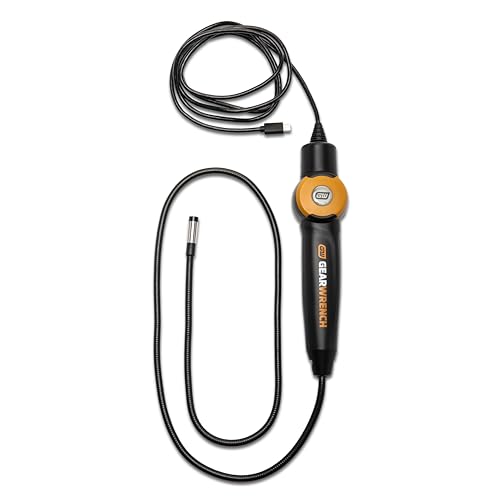
The GWSCOPE is aimed at a connected inspection workflow built around USB Type-C. The listing identifies compatibility with GEARWRENCH diagnostic tools, Android smartphones, Android tablets, and computers, along with live video, saved images, and recorded footage. That makes it useful when an inspection needs to become part of a repair estimate, service note, or shared record rather than remaining a glance on a handheld screen.
An 8.5 mm semi-rigid probe is larger than the 5.5 mm Klein camera and the 6 mm articulating options, so access openings need to be measured before purchase. The trade-off is a sturdy inspection format with adjustable brightness and an IP67-rated, dustproof probe. The product information also lists heat resistance up to 194 degrees Fahrenheit, but this should not be treated as permission to insert the camera into hot or moving machinery without following safe procedures.
Pros
- USB Type-C connection supports listed Android and computer devices.
- Integrated media capture supports saved images and recorded footage.
- 1080P camera and adjustable brightness suit dark inspection spaces.
- 8.5 mm semi-rigid probe balances reach with shape retention.
- Probe is listed as IP67 rated and heat resistant up to 194°F.
Cons
- 8.5 mm probe may not fit openings suited to slimmer cameras.
- USB-C hardware and software compatibility should be confirmed for the specific device.
Choose the GWSCOPE when documentation and USB-C connectivity matter more than the narrowest possible probe. It fits a workflow where another device already handles display and storage, especially around engine bays, wiring channels, and service work. It is less attractive for very small access points or buyers who want a completely self-contained camera.
To buy this product, click here.
9. 1920P HD Dual-Lens Endoscope Camera — Best for Phone-Connected Long Reach

A 16.4-foot semi-rigid cable gives this dual-lens camera the reach for drains, ducts, wall cavities, and equipment paths that extend beyond a short handheld probe. The 7.9 mm camera is larger than the slim articulating options, but it can still reach many ordinary inspection openings. The dual-lens setup provides front and side views, while the cable can be bent and shaped to follow a practical route.
This model connects to an iPhone or iPad through the recommended app according to the listing, and it supports photo and video recording. Eight adjustable LEDs provide lighting control, while the camera is identified as IP67 waterproof with a warning not to remain too long at water depths beyond three meters. That specific warning is useful because a waterproof camera rating should never be treated as unlimited underwater capability.
Pros
- 16.4-foot cable supports long inspection paths.
- Dual-lens design provides forward and side views.
- Photo and video recording are supported through the phone setup.
- Eight adjustable LEDs provide lighting control.
- Includes hook, magnet, side mirror, and protective cap.
Cons
- Requires a recommended app and compatible phone or tablet.
- 7.9 mm probe is less suited to very narrow openings than the slimmer models.
This camera is best for buyers who want extended reach and phone-based recording in a single package. It can cover a lot of ground in plumbing and home maintenance, but the 7.9 mm probe and app dependency make it less flexible for tiny access points or phone-free work. Confirm device compatibility before ordering, particularly if the intended iPhone or iPad uses a different connector or software environment.
To buy this product, click here.
Buying Guide
Probe Diameter Determines Where the Camera Can Fit
A smaller probe can pass through tighter openings, but diameter is only one part of the access equation. The 5.5 mm Klein camera and the 6 mm articulating model offer narrower entry than the 8.5 mm GEARWRENCH probe. Before ordering, measure the access point and account for the camera head, not merely the cable description. A slim probe is useful through a restricted opening, while a larger assembly may provide a more stable physical presence once inside.
Active Articulation Is Different From a Flexible Cable
A semi-rigid cable can bend and hold a shape, but that does not mean the camera tip steers mechanically. The THINKCAR uses four-way articulation, while several FFXET and generic articulating models list two-way movement. A dual-lens camera changes the viewing direction electronically or through camera selection, yet it does not replace active tip control. Pick articulation when the camera must look around an obstruction after insertion.
Match Cable Length to the Inspection Path
Five feet can be easier to control around an engine bay, appliance, or nearby wall cavity. A 16.4-foot or 16.5-foot cable reaches farther into pipes and ducts, but extra cable creates more material to manage and does not automatically make the camera easier to steer. Long-reach models are better for distance. Shorter articulating models are generally better when the important movement occurs near the camera head.
Choose the Viewing System Before Chasing Resolution
A forward camera looks where the probe points. A side-view camera can reveal a nearby pipe wall or engine surface without withdrawing the probe. An integrated screen removes app and phone compatibility concerns, while a phone-connected camera can make sharing and storage convenient. Advertised HD figures do not establish focus, low-light behavior, or practical defect visibility by themselves, so viewing direction, lighting, and camera control deserve equal attention.
Recording Changes the Best Choice
If the inspection is a quick live check, the FFXET dual-lens model can work without recording. If you need evidence for a repair discussion or service record, choose a product that explicitly supports photos or video. The articulating 5-inch camera lists TF card support, the DEPSTECH requires a microSD card that is not included, and the GEARWRENCH supports media capture through its connected devices. Do not assume that a built-in screen automatically means the camera can save files.
Check Which Component the IP Rating Covers
An IP67 or waterproof claim in the product information generally refers to the camera or probe when that component is specifically identified. It should not automatically be extended to the handle, screen, connector, phone, or charging port. The 1920P dual-lens listing also gives a specific warning about extended water depth, which reinforces the need to follow the product’s stated limits. Keep electronics and connections away from moisture unless their protection is clearly documented.
Best Flexible Borescope FAQ
What makes a borescope flexible?
Flexibility can come from a bendable or semi-rigid cable, but active articulation is a separate feature. A semi-rigid cable can be shaped before insertion and may hold its route. An articulating probe uses a control wheel or joystick to move the camera tip after it is inside the inspection area. Decide whether you need flexible reach, directional control, or both.
Is a dual-lens borescope the same as an articulating borescope?
No. A dual-lens model uses two camera views, commonly forward and side-facing, so the user can switch perspectives. An articulating model mechanically changes the camera tip direction. Some products combine both features, such as the top-ranked dual-lens articulating model, but one feature does not imply the other.
Is a five-foot probe long enough for engine inspection?
For many engine-bay and equipment tasks, five feet can provide useful reach without leaving a large amount of cable to manage. The right length depends on the access point and the route to the component. A longer cable may help around a vehicle or pipe, but it will not compensate for a probe that is too large or difficult to steer through bends.
Can these borescopes inspect a drain?
Several models list plumbing, sewer, pipe, or drain applications, especially the long-cable dual-lens cameras. A probe’s IP rating and cable length do not turn a consumer borescope into a professional sewer inspection system. Follow the stated water limits, protect the handle and connectors, and avoid treating the camera as suitable for every liquid or depth.
Do USB-C borescopes work with every USB-C phone?
No. A USB-C plug establishes a physical connection, but device support, operating-system behavior, app support, and required permissions can still vary. The GEARWRENCH listing identifies Android phones, tablets, computers, and GEARWRENCH diagnostic tools, but buyers should confirm their exact device and software requirements before purchase.
Is a built-in screen better than a phone app?
Neither setup is universally better. An integrated screen starts without pairing and avoids phone compatibility issues, which is useful for quick work or shared tools. A phone or tablet can make saving, viewing, and sharing more familiar, particularly with the Klein ET21 or GEARWRENCH. The trade-off is dependence on a compatible device, app, or connector.
Can a higher advertised resolution guarantee a clearer inspection?
No. Image usefulness also depends on focus, lighting, camera position, viewing distance, display quality, and the surface being inspected. A higher number may describe a listing’s image or video claim, but it does not independently establish better low-light visibility or defect detection. Compare the complete viewing system rather than relying on resolution alone.
Final Verdict
The Dual Lens Two-Way Articulating Borescope is the strongest overall choice because it combines a slim 0.25-inch probe, genuine 210-degree tip movement, forward and side cameras, an integrated display, and phone-free operation. That mix covers the broadest range of awkward inspection tasks without making one feature carry the entire recommendation. It is a particularly well-rounded option for engine areas, HVAC spaces, machinery, and wall cavities.
The THINKCAR is the better specialist choice when four-way joystick control matters more than long reach. For pipes and extended cavities, the DEPSTECH’s 16.5-foot cable is the more practical direction. The Klein ET21 and GEARWRENCH GWSCOPE suit buyers who prefer phone-based viewing, sharing, or documentation, while the FFXET long-reach camera makes sense for live inspection without recording. Match the probe to the opening, the cable to the route, and the viewing system to the way you plan to work.
