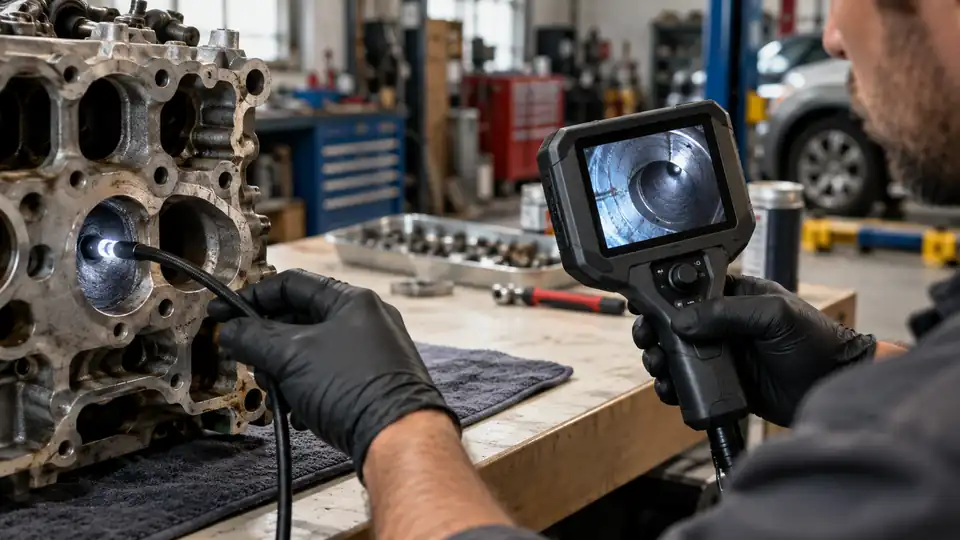
A side-view borescope earns its place when a forward-facing camera keeps staring into the same wall of a cavity. Engine galleries, pipe bends, cylinder walls, HVAC passages, and machinery housings often need a camera that can look across the inspection path rather than straight ahead. The strongest choices here combine a genuine side-view camera with useful probe control, practical lighting, manageable cable length, and a viewing system that suits the job.
Dual-lens viewing and active articulation solve different problems. A dual-lens model can switch from forward to side viewing, while an articulating probe physically steers the camera head after insertion. Probe diameter matters too. A 3 mm or 4 mm camera can reach openings that an 8 mm probe cannot, but a larger probe may offer a more substantial cable and a more self-supporting feel. The right choice depends on whether you need access, directional control, recording, phone compatibility, or an integrated screen most.
This comparison weighs those practical differences rather than treating resolution or LED count as the whole story. Some models are built for general maintenance, others for long pipe runs, tight engine spaces, or controlled industrial inspection. The rankings emphasize genuine side-view capability and the information available for each exact product.
Quick Answer
- Best Overall: Teslong TD500 for its dual cameras, articulating probe, and integrated 5-inch display.
- Best for Tight Access: Vividia DA-3012S for its 3 mm side-view camera and joystick articulation.
- Best for Pipe Inspection: Triple Lens Sewer Camera for its 50-foot semi-rigid cable and multiple viewing modes.
- Best for Phone and Computer Use: Vividia BD-5030i for its 4.8 mm dual-camera probe and iOS and Android support.
Best Side View Borescope Comparison Table
| Product | Best For | Probe or Cable | Viewing System |
|---|---|---|---|
| Teslong TD500 | General inspection | 6.5 mm articulating probe | Front and side cameras, 5-inch screen |
| Triple Lens Sewer Camera | Pipes and drains | 50-foot semi-rigid cable | Front and two side cameras |
| Vividia BD-5030i | iOS and Android devices | 4.8 mm, 11 feet | Front and side cameras |
| 5-Inch Dual-View Handle Endoscope | Short industrial inspections | 5 m semi-rigid cable | Front and side cameras, screen |
| Vividia UV-100 | UV-assisted inspection | 80 cm gooseneck probe | Side-view camera, UV and white LEDs |
| Vividia BD-8050U | Long computer-connected reach | 8 mm, 16 feet | Front and side cameras |
| Vividia VA-D4065 | Controlled tip direction | 6.5 mm, 2-foot probe | Front and side cameras, articulation |
| Vividia CF-S4010 | Small articulating access | 4 mm, 1 m | Side-view camera, 360-degree joystick |
| Vividia DA-3012S | Very narrow openings | 3 mm, 1.2 m | Side-view camera, joystick articulation |
The detailed reviews below show where each viewing system, probe size, and control method makes the biggest difference.
1. Teslong TD500: Best Overall

The Teslong TD500 brings together the features that make side-view inspection genuinely useful. Its 6.5 mm probe carries both a forward-facing camera and a side-view camera, so the operator can inspect the path ahead and then examine a nearby wall without immediately withdrawing the probe. That arrangement is useful inside engine spaces, equipment housings, and awkward cavities where rotating a fixed camera produces little change.
Its articulating probe adds a second layer of control. Dual cameras provide another viewing direction, while articulation helps aim the camera head after insertion. The 5-inch IPS screen keeps the system self-contained, which is handy beside a vehicle or machine where handling a phone, cable, and app would create extra clutter. The available information does not state the articulation range or recording specifications, so buyers should confirm those details before ordering.
Pros
- Forward-facing and side-view cameras in one probe.
- Articulating probe for directional control.
- Integrated 5-inch IPS display.
- 6.5 mm probe suits many general access points.
- Portable design intended for inspection work.
Cons
- The 6.5 mm diameter may be too large for very narrow openings.
- Articulation range and recording details are not clearly specified.
The TD500 is the strongest balanced choice for readers who need a real side-view camera but still want a flexible general-purpose inspection system. It offers more control than a basic semi-rigid dual-camera probe and avoids phone dependency. A smaller probe may be preferable for miniature access points, while a long sewer camera is a better fit for deep drains.
To buy this product, click here.
2. Triple Lens Sewer Camera: Best for Pipe Inspection

Long reach changes the buying decision for pipe work, and this camera is built around that fact. Its 50-foot semi-rigid cable can reach much farther than the shorter probes in this group. The system lists a front camera plus two side cameras, with five viewing modes and a 180-degree flip function. In a drain, that can make it easier to inspect both the route ahead and the surrounding pipe surface.
The 5-inch IPS display keeps navigation visible at the access point, while the listing describes a 2-megapixel image system and adjustable lighting. IP67 protection is listed for the pipe camera probe, but that rating should not automatically be applied to the display or handle. The long cable is useful in a drain or wall cavity, though it can be more cumbersome in a short inspection path.
Pros
- 50-foot semi-rigid cable for deep access.
- Front camera and two side cameras.
- Five listed viewing modes.
- 5-inch IPS display with adjustable probe lighting.
- Includes a case, hook, magnet, and Type-C charging cable.
Cons
- The long cable is less convenient in compact inspections.
- The listing does not specify the probe diameter.
This is the clearest choice for drains, long pipe paths, and cavities where reach matters more than compact handling. It offers more viewing directions than a standard dual-lens model, but it is a specialized system rather than the easiest tool for checking a small engine compartment. Confirm the exact probe dimensions before purchase if the camera must pass through a restricted opening.
To buy this product, click here.
3. Vividia BD-5030i: Best for iOS and Android Devices

A 4.8 mm probe offers a useful middle ground for access. The Vividia BD-5030i lists both front and side cameras, each with 1280 by 720 resolution, and the side camera has its own LED light. Its 11-foot semi-rigid probe is long enough for many vehicle, appliance, wall, and machinery inspections without becoming as unwieldy as a pipe camera.
The USB output supports iOS and Android devices according to the product information, with software for saving images and videos. Buyers should verify the required connector, adapter, and operating-system compatibility for their exact phone or tablet. The phone-based setup also means the display experience depends partly on the connected device, unlike the Teslong and other screen-equipped models.
Pros
- 4.8 mm probe for relatively narrow access.
- Front and side cameras with listed 1280 by 720 resolution.
- 11-foot semi-rigid probe.
- Supports iOS and Android devices according to the listing.
- Software supports saving photos and videos.
Cons
- Requires a compatible connected device instead of providing an integrated screen.
- Exact connector and app requirements need confirmation.
The BD-5030i suits anyone who already works comfortably from a phone, tablet, or compatible Android device and wants a slimmer dual-camera probe. It gives up the independent screen and active articulation found on higher-end options, but its 4.8 mm diameter and side-view camera make it a practical choice for confined inspection paths.
To buy this product, click here.
4. 5-Inch Dual-View Handle Endoscope: Best for Recording on a Built-In Screen

This handle-style inspection camera focuses on quick viewing and documentation. Its front and side lenses can display separately or together on the 5-inch IPS screen, which may reduce the need to reposition the probe during a short inspection. The listing also describes three-level digital zoom, photo and video recording, and storage support involving a 32GB card.
The 1 m semi-rigid cable is much shorter than the long plumbing models, but that can be an advantage around an engine bay, appliance, wall opening, or HVAC access panel. Nine listed LEDs with four brightness levels provide control in reflective or dark spaces. The probe is described as IP67, though the rating should be treated as applying to the documented probe rather than the entire system.
Pros
- Front and side cameras with separate or simultaneous display options.
- 5-inch IPS screen.
- Photo and video recording capability is listed.
- Three-level digital zoom.
- 1 m semi-rigid IP67 probe with adjustable lighting.
Cons
- The 1 m cable limits reach compared with longer inspection cameras.
- The listing says storage requires SD card insertion, so confirm the exact card arrangement.
This model works well for short, repeatable inspections where a self-contained screen and saved evidence matter. It is easier to manage than a 50-foot cable, but it lacks the documented active articulation of the Teslong or Vividia joystick models. Choose it for accessible cavities and quick reports, rather than deep pipe runs.
To buy this product, click here.
5. Vividia UV-100: Best for UV-Assisted Side Viewing

The UV-100 takes a more specialized approach. Its side-view camera is paired with four 375 nm UV LEDs and one white LED, allowing the operator to choose between UV-assisted illumination and standard visible light. The listing gives a focus range of approximately 10 mm to 200 mm, which is useful for inspecting surfaces at varying distances rather than holding the lens against a target.
Its 80 cm semi-rigid gooseneck probe can be bent and positioned, but the supplied information does not describe active tip articulation. That distinction matters. The probe can retain a chosen shape, while the camera head itself should not be treated as joystick-controlled. USB output supports Windows, MacBook, Android, and Chromebook devices, with software for photos and videos.
Pros
- Four listed 375 nm UV LEDs.
- Separate white LED for conventional illumination.
- Side-view camera with a stated 10 mm to 200 mm focus range.
- Semi-rigid 80 cm gooseneck probe.
- USB output and photo and video software support.
Cons
- The 80 cm probe is short for deep cavities or pipe runs.
- The gooseneck is not described as an actively articulating probe.
The UV-100 belongs on the shortlist when UV illumination is more useful than a second forward-facing camera. It is a focused tool for surface inspection, markings, residue, or other tasks where the extra light wavelength has a purpose. Buyers seeking general engine or drain coverage may prefer a dual-camera system with a longer probe.
To buy this product, click here.
6. Vividia BD-8050U: Best for Long Computer-Connected Reach

The BD-8050U extends the dual-camera concept to a 16-foot semi-rigid probe. Its 8 mm diameter is larger than the BD-5030i, so it needs a wider access point, but the added reach can help with walls, ducts, machinery, and other spaces where a short probe falls away too soon. The front and side cameras are both listed at 1280 by 720.
This model connects through USB 2.0 and lists support for Windows, MacBook, Chromebook, and Android devices. The software can save images and videos, and the viewing system can show both directions simultaneously according to the product information. As with other phone or computer-connected cameras, compatibility should be checked for the exact device and software setup before purchase.
Pros
- 16-foot semi-rigid probe.
- Front and side cameras.
- Listed 1280 by 720 camera resolution.
- Supports Windows, MacBook, Chromebook, and Android devices.
- Software supports saved photos and videos.
Cons
- 8 mm diameter limits access compared with slimmer probes.
- Requires a compatible computer or Android device for viewing.
The BD-8050U makes sense for longer inspection paths where a computer-connected workflow is acceptable. Its semi-rigid cable can help guide the camera, but extra length also takes more room to manage. Compared with the BD-5030i, it gives up some narrow-access ability in exchange for reach.
To buy this product, click here.
7. Vividia VA-D4065: Best for One-Way Tip Articulation

The VA-D4065 combines a 6.5 mm probe with front and side cameras and a one-way articulating head. The supplied information lists more than 180 degrees of articulation and a friction-based locking feature, giving the operator a way to set the camera direction after insertion. That is a meaningful difference from a cable that simply bends before entering a cavity.
The 2-foot rigid probe is short, but the rigid section may be useful when controlled positioning matters more than deep reach. Adjustable LED lighting is listed for both lenses, and IP67 water and dust resistance is identified for the probe. The system works with Windows, Mac, Android, and iOS, although an additional U2i adapter is required for iOS.
Pros
- More than 180 degrees of listed one-way articulation.
- Friction-based locking feature.
- Front and side cameras.
- Adjustable lighting for both lenses.
- Windows, Mac, Android, and iOS support is listed.
Cons
- The 2-foot probe provides limited reach.
- iOS use requires a U2i adapter.
This is a focused choice for inspections where the camera head must be aimed deliberately inside a nearby cavity. It offers more directional control than fixed dual-camera probes, but it cannot replace a long cable for drains or deep wall paths. Confirm whether the required display or adapter is included with the exact configuration before ordering.
To buy this product, click here.
8. Vividia CF-S4010: Best for 360-Degree Joystick Control

For tight spaces where the camera must be steered after insertion, the CF-S4010 offers a 4 mm side-view camera and 360-degree joystick articulation. The smaller camera head can reach narrower openings than the 6.5 mm models, while the joystick provides directional control rather than relying on the cable to form the desired path. Its 1 m flexible IP67 probe is intended for close-range inspection.
A 5-inch LCD monitor keeps the system independent of a phone or computer. The listing also identifies six bright LEDs and a rechargeable battery. The camera is side-view only, so it does not provide the forward and side perspective of a dual-camera model. That can be an advantage in a task focused on nearby walls, but it is less convenient if the operator needs to navigate forward through a long passage.
Pros
- 4 mm camera head for narrow access.
- 360-degree joystick articulation.
- Side-view camera suited to nearby surfaces.
- 5-inch LCD monitor.
- Six listed LEDs and rechargeable battery.
Cons
- Side-view-only operation lacks a forward camera.
- The 1 m probe is short for deep inspection paths.
The CF-S4010 is a specialist choice for controlled side-looking work in tight openings. It has stronger directional control than the semi-rigid models, but its short probe and single viewing direction limit its general-purpose reach. It is most useful when the access point is narrow and the target surface is close enough for a 1 m probe.
To buy this product, click here.
9. Vividia DA-3012S: Best for Very Narrow Openings
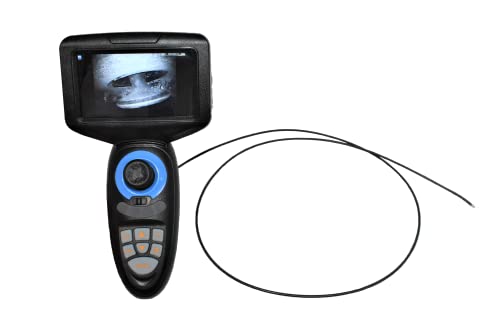
The DA-3012S has the smallest listed probe diameter in this group at 3 mm, making it the most access-focused option here. Its side-view camera is paired with joystick control and more than 180 degrees of listed bending. The 1.2 m metal-braided waterproof probe gives it more reach than the CF-S4010 while keeping the camera head suitable for narrow openings.
The 4.5-inch LCD monitor can record photos and videos to an SD card, and built-in Wi-Fi supports connection to iPhone, iPad, and Android devices according to the listing. The listed camera resolution is 400 by 400, which is lower than several alternatives in this comparison. That specification should temper expectations for fine detail, particularly when the inspection depends on small surface defects.
Pros
- 3 mm probe diameter for very narrow access.
- Joystick all-direction articulation.
- More than 180 degrees of listed bending.
- 4.5-inch LCD monitor with photo and video capture.
- Built-in Wi-Fi support for listed mobile devices.
Cons
- The listed 400 by 400 camera resolution is relatively limited.
- Side-view-only operation does not provide a forward camera.
Choose the DA-3012S when the opening itself is the hard part. Its 3 mm probe and active control can reach spaces that larger cameras cannot, while the integrated monitor avoids a phone-only workflow. Buyers who need a sharper documented image or a forward camera may prefer the Teslong, BD-5030i, or another dual-camera model.
To buy this product, click here.
Buying Guide
Probe Diameter Determines Access
Probe diameter is one of the first specifications to check because it determines whether the camera can pass through the opening at all. The DA-3012S lists a 3 mm probe, while the BD-8050U lists 8 mm. That difference is substantial in small engine passages, appliance gaps, and machinery cavities. A smaller probe improves access, but it does not automatically provide a sharper image, longer reach, or stronger cable control.
A Side Camera Is Different From Active Articulation
A side-view camera changes the direction in which the lens sees. Active articulation changes the physical direction of the camera head. The Teslong and VA-D4065 combine dual-camera viewing with articulation, while the CF-S4010 and DA-3012S use side-view cameras with joystick control. A fixed dual-lens probe can show more than one direction, but it cannot steer its tip like an articulating model.
Match Reach to the Inspection Path
The 50-foot sewer camera is suited to long drains and pipe paths, while the 1 m and 1.2 m probes are easier to manage in nearby cavities. Extra length can be helpful, but it also creates more cable to guide, clean, and store. For an engine bay or appliance, a compact probe may feel more controlled than a long sewer-style cable.
Choose Between an Integrated Screen and a Connected Device
An integrated display simplifies setup because the camera and screen are supplied as one inspection system. The Teslong, CF-S4010, and many other listed models use their own screens. USB and Wi-Fi models can be convenient for saving files to a phone or computer, but the exact connector, operating-system, adapter, and app requirements deserve a check before purchase.
Lighting and Focus Affect What the Screen Shows
LED count alone does not determine image quality. Brightness control can be more useful around shiny metal or wet pipe surfaces because excessive light may create glare. The UV-100 lists a 10 mm to 200 mm focus range, while the DA-3012S lists a close-focus range of approximately 3 mm to 200 mm. Those details help explain how near the camera can be to the target while maintaining a usable view.
Read IP Ratings Carefully
An IP67 listing can be useful for a probe that encounters moisture, but it does not mean the display, handle, phone, or connector can be submerged. The supplied information identifies waterproof or IP-rated probes on several products, yet it does not establish unlimited underwater use. Keep the control unit and connections away from liquid unless the exact instructions support the intended conditions.
Best Side View Borescope FAQ
What makes a borescope suitable for side-view inspection?
A genuine side-view camera points across the probe path, allowing the operator to inspect nearby walls, cylinder surfaces, pipe interiors, or machinery components without relying solely on a forward-facing lens. Some products add a front camera, while others are side-view only. Check the listed camera arrangement rather than assuming that a mirror attachment is a second camera.
Is an articulating probe better than a dual-lens borescope?
They solve different access problems. An articulating probe changes the physical direction of the camera head, which helps aim at a target after insertion. A dual-lens borescope provides separate viewing directions but may have little or no tip steering. A product such as the Teslong combines both approaches, while the BD-5030i focuses on dual-camera viewing without documented active articulation.
Can a side-view borescope inspect an engine?
It can be useful for engine and machinery inspection when the probe diameter, temperature conditions, access path, and camera rating suit the task. A side-view lens can help inspect nearby walls or surfaces after the probe enters an opening. Cool machinery before inspection, avoid moving components, and verify the exact probe size before assuming it fits a particular engine opening.
Does a longer cable always make a borescope better?
No. A longer cable increases reach, which matters in drains and long cavities, but it can be harder to guide in a small workspace. The 50-foot sewer camera is aimed at deep pipe access, while a 1 m probe may be easier to control around an engine or appliance. Choose enough reach for the inspection path rather than the longest option by default.
Do all USB borescopes work with every phone?
No. Compatibility depends on the connector, operating system, software, adapter, and device support. The BD-5030i lists iOS and Android support, while the BD-8050U lists Windows, MacBook, Chromebook, and Android support. Those statements do not guarantee compatibility with every device in those categories, so confirm the exact setup before ordering.
Is a 3 mm probe always the best choice?
A 3 mm probe is valuable when a narrow opening is the main obstacle, but a smaller camera may involve trade-offs in resolution, durability, cable feel, or available features. The DA-3012S provides very narrow access and joystick articulation, while larger models may offer higher listed image specifications, dual cameras, longer reach, or a larger display.
What should I check before using an IP67 probe around water?
Check which component carries the rating and whether the listing provides immersion limits. A probe rating should not be extended automatically to the monitor, handle, charging connection, or phone. Dry the system properly after use and keep electrical connections protected unless the exact product instructions support the environment.
Final Verdict
The Teslong TD500 is the strongest overall choice for broad side-view inspection because it combines front and side cameras, an articulating probe, and a 5-inch integrated display. That combination gives the operator multiple ways to inspect a cavity without depending on a phone or accepting a fixed camera head. Its 6.5 mm probe is larger than the narrowest options, so it is best suited to openings that can accommodate it.
Different jobs call for different compromises. The Triple Lens Sewer Camera is the better fit for long pipe paths, while the Vividia DA-3012S and CF-S4010 focus on narrow openings and joystick control. The Vividia BD-5030i is a sensible connected-device option, and the dual-view handle model is useful for short inspections that need saved photos or video. Before ordering, match the probe diameter, reach, viewing direction, articulation, and device requirements to the actual inspection path rather than choosing from resolution or accessory counts alone.
