
A barrel-inspection camera should make it easier to locate fouling, surface marks, and visible wear without guessing at the view. Probe shape, close focus, mirror fit, display choice, and recording matter more than a general-purpose camera’s headline resolution.
The five selections here all provide a rigid rod during inspection. A straight rod helps with controlled insertion and locating the camera along the bore. The choices differ in monitor size, manual focus, storage design, and the option to use a computer or phone as the display.
Choose the camera and mirror together for the available bore clearance. A mirror pack by itself is an accessory, so it is not counted as a separate borescope in this comparison. Work only with an unloaded firearm and follow the equipment and firearm instructions.
Quick Answer
- Best overall: Teslong NTG500H Rigid Rifle Borescope . Choose this configuration when its probe, viewing arrangement, and access fit the task.
- Best for manual Focus and Foldable Storage: Teslong NTG200H Focus-and-Fold Rigid Borescope.
- Best for a Rigid Probe With Wireless iOS Viewing: Teslong NTG150HW Wi-Fi Rigid Rifle Borescope.
Best Rigid Borescope Comparison Table
| Product | Best For | Probe or Cable | Viewing System |
|---|---|---|---|
| Teslong NTG500H Rigid Rifle Borescope | Rigid rifle-bore inspection | 0.2-inch, 26-inch rigid probe | Screen, side-view mirror |
| Teslong Rigid Rifle Borescope, USB | Computer and Android viewing | 0.2-inch, 26-inch rigid probe | USB, side-view mirror |
| Teslong Rigid Rifle Borescope, 4.5-Inch Screen | Self-contained rifle inspection | 0.2-inch, 26-inch rigid probe | 4.5-inch screen, side-view mirror |
| Teslong NTG200H Focus-and-Fold Rigid Borescope | Manual Focus and Foldable Storage | Approximately 5 mm folding rigid rod; 26-inch deployed rigid probe | 4.5-inch IPS screen; manual focus; side mirror |
| Teslong NTG150HW Wi-Fi Rigid Rifle Borescope | A Rigid Probe With Wireless iOS Viewing | Approximately 5 mm rigid camera rod; 26-inch marked rigid probe | Phone/tablet through Wi-Fi box; side mirror |
The comparison table shows the main differences in access, viewing, and handling. The individual reviews below explain which configuration fits each inspection task.
1. Teslong NTG500H Rigid Rifle Borescope — Best Overall

The NTG500H is the strongest standalone rigid option in this comparison. Its 0.2-inch probe is listed for rifle barrels measuring .20 caliber and larger, while the 26-inch rod provides enough length to inspect through a long barrel without repeatedly changing the insertion direction. That rigid construction matters in a straight bore, where a soft cable can be awkward to guide and keep centered.
A 5-inch HD color IPS screen keeps the inspection independent of a phone, computer, or app. The product information lists still-image and video recording to an included 32GB Micro SD card, plus a microphone and speaker for recorded audio. Six adjustable LEDs illuminate dark areas, and the included detachable 90-degree side-view mirrors help shift the view from the bore axis toward the barrel wall. It is a focused rifle tool rather than a general-purpose drain camera, which is exactly why it ranks first for rigid-bore work.
Pros
- 0.2-inch rigid probe is listed for .20 caliber and larger rifle barrels.
- 26-inch length supports inspection through long barrels.
- 5-inch IPS monitor works without an external app.
- Includes adjustable LEDs, side-view mirrors, and a 32GB Micro SD card.
- Supports still-image, video, and audio recording according to the listing.
Cons
- Rigid rifle probe is specialized and unsuitable for curved inspection paths.
- The available information does not specify a waterproof rating for the complete system.
This is the strongest choice for someone examining barrel cleanliness, throat erosion, rifling wear, tool marks, chamber damage, or fouling with a dedicated rigid instrument. Buyers needing to inspect engines, drains, or wall cavities should choose a semi-rigid camera instead. The NTG500H wins by matching its probe, display, and viewing accessories to one demanding straight-line task rather than trying to cover every inspection scenario.
To buy this product, click here.
2. Teslong Rigid Rifle Borescope, USB — Best for Computer Viewing

This Teslong follows the same practical rifle-inspection formula with a 0.2-inch diameter and 26-inch rigid rod. The close-focusing camera is intended to show barrel cleanliness, fouling, rifling wear, tool marks, throat erosion, and chamber damage. A rigid rod of this length gives the user a stable reference point inside a straight bore, rather than the loose, springy feel that can make a flexible cable frustrating in a barrel.
Its main distinction is the viewing connection. The listing identifies Android, Windows, and MacBook compatibility through USB, Micro-USB, and a Type-C adapter, while specifically excluding iPhone and iPad support. Six adjustable LEDs and a detachable 90-degree mirror support forward or side-wall views. This setup makes sense for someone who already works from a laptop or Android device and wants to save or review inspection images there.
Pros
- Rigid 26-inch rod is suited to long rifle barrels.
- 0.2-inch probe is listed for .20 caliber and larger firearms.
- Supports Android, Windows, and MacBook connections according to the listing.
- Includes adjustable LED lighting and three side-view mirrors.
- Close-focusing camera is intended for detailed bore inspection.
Cons
- Does not work with iPhone or iPad according to the product information.
- Requires a compatible connected device rather than providing its own display.
Choose this model if computer-based viewing fits your inspection routine and iOS compatibility is irrelevant. It is less convenient than the NTG500H for a standalone bench setup, but it may fit better beside a Windows laptop or Android device. Confirm the connector and operating-system requirements before ordering, since a physical Type-C connection alone does not guarantee support on every device.
To buy this product, click here.
3. Teslong Rigid Rifle Borescope, 4.5-Inch Screen — Best for Marked Probe Control

A scale printed on the 26-inch insertion tube gives this Teslong a useful feature for repeatable inspection. If a particular mark on the rod corresponds to a chamber area, throat, or section of rifling, the user can refer to that position during a later pass. The 0.2-inch probe is listed for .20 caliber and larger rifles, and the rigid format keeps the camera path predictable through a straight barrel.
The integrated 4.5-inch screen displays the camera feed and supports still and video recording at the listed 1920 by 1080 resolution. A 32GB card is installed, while six adjustable LEDs help illuminate the dark bore. The detachable 90-degree side-view mirror changes the perspective toward the barrel wall, and three mirrors are included. Its screen is smaller than the NTG500H display, but the package remains self-contained and straightforward.
Pros
- 26-inch rigid rod includes a scale for locating inspection positions.
- 0.2-inch probe is listed for .20 caliber and larger rifles.
- 4.5-inch display avoids phone and app dependence.
- Supports still and video recording with an included 32GB card.
- Includes adjustable LEDs, three side-view mirrors, and a screen bracket.
Cons
- Smaller display than the NTG500H.
- Rigid probe design is limited to relatively straight access paths.
This model suits a bench where consistent probe positioning matters. It is a sensible alternative to the NTG500H for buyers who value the marked insertion tube and supplied bracket, while the smaller display may matter less in a close-up inspection. It should be skipped for drains, engine cavities, and other winding paths where a semi-rigid cable is easier to guide.
To buy this product, click here.
4. Teslong NTG200H Focus-and-Fold Rigid Borescope — Best for Manual Focus and Foldable Storage

The Teslong NTG200H adds manual focus and a folding design to the rigid rifle-borescope format. Its deployed rod is 26 inches long, and the kit includes a 4.5-inch IPS monitor, adjustable LED lighting, a side-view mirror, and a 32GB memory card.
The NTG200H retains a straight rod during inspection but folds for packing. It is useful when the buyer wants rigid handling, a dedicated display, and manual focus for adjusting the close view to the barrel and mirror configuration.
Manual focus is useful when the distance between the camera and the barrel wall changes with the caliber or mirror position. Instead of relying entirely on a fixed viewing distance, the user can refine focus for the surface being examined. The two-section rod folds for storage and is assembled straight for inspection; the hinge is a packing feature rather than an articulating tip for following bends. This model is specified for .22-caliber and larger firearms, subject to the installed mirror and available clearance. Its dedicated screen and recording card make it a self-contained option for buyers who value both controllable focus and a smaller stored package.
Pros
- Manual focus helps refine the close-up barrel-wall view.
- Folding rod reduces stored length.
- Standalone screen and included recording card.
Cons
- Folding joint is for storage, not navigating curved passages.
- Requires .22-caliber-or-larger clearance with the appropriate mirror.
Choose this configuration for manual Focus and Foldable Storage.
To buy this product, click here.
5. Teslong NTG150HW Wi-Fi Rigid Rifle Borescope — Best for A Rigid Probe With Wireless iOS Viewing
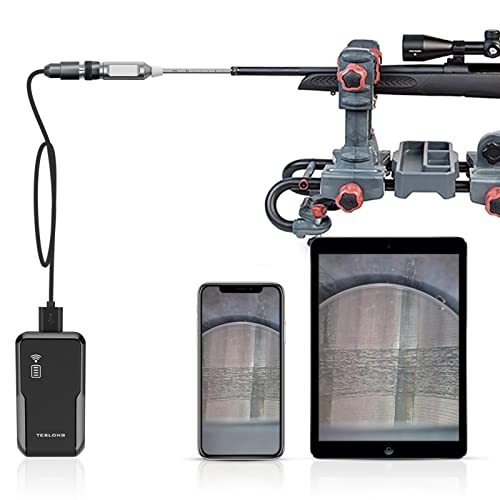
The Teslong NTG150HW combines a marked 26-inch rigid rod with a wireless adapter for viewing on a compatible iPhone, iPad, or Android device. Removing the adapter also provides a direct computer connection for supported systems.
The NTG150HW adds a phone-viewing option without substituting a bendable cable for the rigid rod. It suits a buyer who wants a marked straight probe and an iPhone or iPad display, with the wireless box kept charged and outside the bore.
The wireless adapter changes the viewing arrangement without changing the probe into a flexible or articulating camera. The rod still follows a straight access path, and the removable side-view mirror redirects the close-focus image toward the barrel wall. This is useful for buyers who want the position control of a rigid instrument but prefer their existing phone or tablet as the display. The adapter must remain charged and the viewing device must support the required connection. The listing specifies .22-caliber and larger access; verify clearance with the chosen mirror installed. A phone display and its charging or data connections should remain separate from the working area.
Pros
- Rigid probe with an iOS/Android wireless viewing option.
- Marked rod helps locate the camera along a straight barrel.
- Detachable mirror and optional direct computer connection.
Cons
- Requires a charged Wi-Fi box and compatible viewing device.
- Rigid probe cannot negotiate a curved access path.
Choose this configuration for a Rigid Probe With Wireless iOS Viewing.
To buy this product, click here.
Buying Guide
Choose the Probe Shape for the Access Route
A rigid rod follows a straight line and provides a predictable position reference. A flexible cable is easier to arrange around the workbench but does not provide the same direct control. A folding rigid rod folds for storage and is deployed straight during inspection.
Match the Mirror to the Bore
The bare camera diameter does not describe the clearance with a side-view mirror installed. Choose the mirror for the caliber and follow the fit guidance for the exact camera. A suitable mirror changes the viewing direction without turning a fixed head into an articulating camera.
Pick the Viewing Device First
A standalone monitor avoids app and connector questions. USB versions need a supported host, and a USB-C adapter does not automatically make an older USB camera compatible with an iPhone. Wi-Fi versions add a charged adapter and a supported app.
Keep Useful Images for Comparison
Saved images are useful for comparing the same location across inspections. A marked rod helps identify that location. Check the recording-card package on standalone systems and the capture software on computer or phone configurations.
Frequently Asked Questions
Are mirror sets included in the product count?
No. Each counted selection is a complete camera configuration. Mirrors included within a camera kit remain accessories to that kit; a replacement mirror pack alone is not counted as another borescope.
Can a rigid probe follow a curved pipe?
A rigid rod needs a straight access path and room for insertion and removal. A bendable or semi-rigid cable may suit a curved route, but it is a different structure and should not be described as a true rigid rod.
Will every USB rifle scope work with an iPhone?
No. The USB-only Teslong NTG100 and NTG100H configurations selected here are intended for compatible Android and computer hosts. Choose a supported Wi-Fi configuration or an independent monitor when that better matches the viewing device.
What does manual focus add?
Manual focus on the NTG200H allows adjustment when the distance to the barrel wall changes. Fixed-focus cameras instead depend more on camera and mirror position. In either case, stable positioning and appropriate lighting help produce a useful image.
Final Verdict
For a larger standalone display, the NTG500H is the strongest starting point. The USB NTG100H suits a compatible bench computer, while the NTG450H provides a compact independent monitor. Choose the NTG200H for manual focus and foldable storage, or the rigid NTG150HW for supported wireless iPhone and iPad viewing.
Match the complete camera head to the opening, choose the viewing and recording arrangement you will use, and select the exact cable and accessory package for the job.
