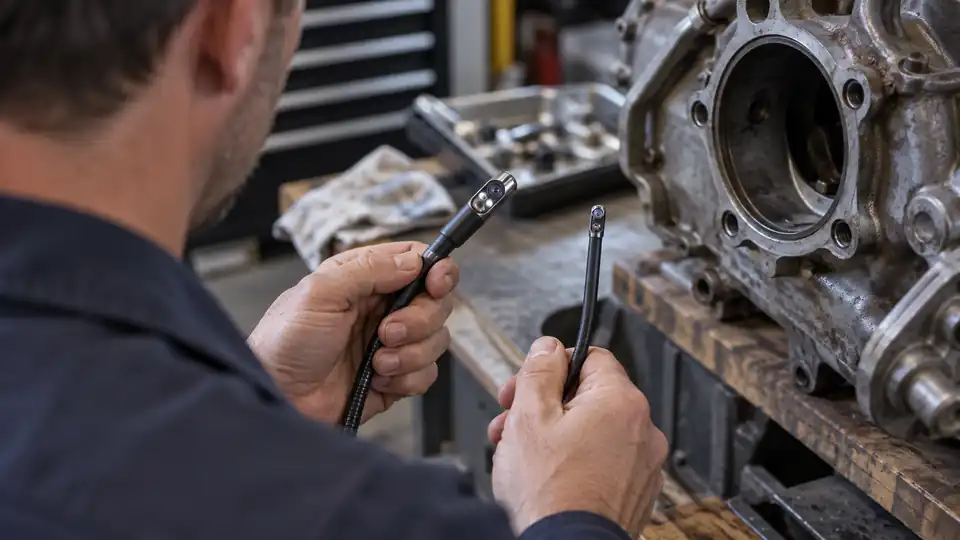
A triple-lens borescope can save repeated probe repositioning when a cavity, pipe, engine passage, or wall opening hides the area you need to see. Instead of relying on a single forward-facing camera, these inspection cameras add side-facing views, split-screen viewing, or quick lens switching. That extra perspective matters most in tight spaces where turning the cable is awkward or impossible.
The headline resolution is only part of the decision. Cable length, probe stiffness, screen size, lighting controls, storage, battery runtime, and the exact viewing arrangement can change how useful a camera feels during an inspection. A 50-foot cable may reach farther, while a shorter semi-rigid probe can be easier to guide through a small engine cavity. IP67 protection can help with damp work, but it does not make the entire control unit suitable for immersion.
The products below focus on genuine triple-lens inspection cameras with integrated screens. Some emphasize long reach, others favor compact handling, extended battery life, or straightforward operation without a phone app. The comparison weighs those differences rather than treating every 1080p or 1920P claim as proof of identical image quality.
Quick Answer
- Best Overall: VEVOR Triple Lens Endoscope with 32.8FT Cable for its long ultra-rigid cable, 8 mm lens, 8X image zoom, 5 to 6 hour listed runtime, and included 32GB card.
- Best for Long Reach: Triple Lens Borescope with 5-inch IPS Screen for inspections that benefit from a 50-foot semi-rigid cable and phone-free operation.
- Best for Compact General Use: DEPSTECH Triple Lens Inspection Endoscope for its 5-inch display, selectable views, 16.5-foot cable, image and video capture, and included retrieval accessories.
- Best for Split-Screen Viewing: VEVOR Triple Lens Endoscope Camera for showing front and side views together while inspecting automotive, wall, drain, or HVAC spaces.
Best Triple Lens Borescope Comparison Table
| Product | Best For | Probe And Cable | Viewing And Storage |
|---|---|---|---|
| VEVOR Triple Lens Endoscope with 32.8FT Cable | Overall inspection use | 8 mm lens, 32.8 ft ultra-rigid cable | Front and two side cameras, 8X zoom, 32GB card |
| Triple Lens Borescope with 5-inch IPS Screen | Long-distance inspection | 50 ft semi-rigid cable | Three 1920*1080P lenses, 32GB card |
| DEPSTECH Triple Lens Inspection Endoscope | Documented work and home repairs | 16.5 ft semi-rigid cable | Three HD cameras, 5-inch IPS screen, microSD support |
| Epicmate 50FT Triple Lens Inspection Camera | Long pipe and cavity runs | 50 ft semi-rigid cable | Five viewing modes, 32GB card |
| VEVOR Triple Lens Endoscope Camera | Split-screen front and side viewing | 8 mm lens, 16.4 ft semi-rigid cable | 4.5-inch IPS screen, 32GB TF card |
| Triple Lens Borescope for Mechanic Inspections | Automotive, HVAC, and walls | 16.5 ft semi-rigid cable | 5-inch IPS screen, front and side views |
| NIDAGE Triple Lens Endoscope Camera | Shorter engine and cavity inspections | 11.5 ft semi-rigid cable | 4.3-inch monitor, triple-lens viewing |
| DEPSTECH 700SE Triple-Lens Borescope | A 7-Inch Multi-View Workstation | Front camera plus two side cameras; 16.5 ft semi-rigid cable | 7-inch IPS screen; split-screen modes; Photo/video recording with audio commentary |
| Teslong 10-Foot Triple-Lens Borescope | A Compact Ten-Foot Triple-View Kit | Approximately 7.9 mm triple-camera probe; 10 ft semi-rigid cable | 5-inch IPS display; front and two side views; Photos/video; 32GB microSD included |
The detailed reviews explain how each viewing system, cable, screen, and storage arrangement affects practical inspection work.
1. VEVOR Triple Lens Endoscope with 32.8FT Cable — Best Overall
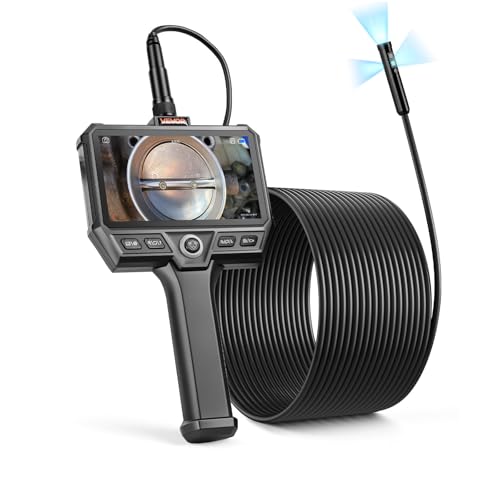
The strongest balance here comes from the combination of a front camera, two side cameras, and a 32.8-foot ultra-rigid cable. That setup suits inspections where the target may be several feet inside a pipe, duct, engine area, or machinery enclosure. The cable’s added stiffness should help with push force and positioning, although a rigid shaft can require more care around sharp bends.
The listed 8 mm lens is slim enough for many general inspection openings, while the 5-inch IPS screen gives the operator a practical live view. Image zoom is available at 1X, 2X, 4X, 6X, and 8X. Zoom cannot replace good focus or lighting, but it can help enlarge a mark or buildup already visible on the display. A 5000mAh battery, 8+2 lights, photo capture, video recording, 180-degree image rotation, and a 32GB card create a well-rounded package for longer jobs.
Pros
- Front and two side cameras provide three viewing directions.
- 32.8-foot ultra-rigid cable supports long-reach inspections.
- 8 mm lens suits many confined inspection openings.
- Offers up to 8X image zoom and 180-degree image rotation.
- Lists a 5000mAh battery and included 32GB memory card.
Cons
- The ultra-rigid cable may be harder to guide through tight bends than a more flexible cable.
- The listing identifies 1280*720 video recording, which is lower than the stated still-image capture resolution.
This is the most complete choice for buyers who need reach, multiple viewpoints, and longer operation in one unit. It makes particular sense for pipe runs, HVAC paths, vehicle cavities, and machinery where a 16-foot cable may fall short. Buyers working in very short or sharply curved access paths may prefer a more flexible semi-rigid design, while those who want a simple compact tool may find the longer cable more than they need.
To buy this product, click here.
2. Triple Lens Borescope with 5-inch IPS Screen — Best for Long Reach

A 50-foot semi-rigid cable gives this camera a clear role in extended inspection paths. It can reach farther into drains, walls, HVAC routes, and larger equipment than the shorter options in this group. The cable is described as semi-rigid enough to retain its shape, which may reduce camera shake during a long push, though extra length can become harder to manage in a small workspace.
The product information lists three 1920*1080P HD lenses, 8+1 LEDs, three brightness levels, and a 5-inch IPS screen. It starts without a phone, Bluetooth connection, or app, which simplifies the workflow when the operator needs to begin quickly. A 32GB SD card is included for storing inspection material. The IP67 claim applies to the inspection camera listing, but buyers should still confirm how the rating applies to the probe, cable connections, and control unit before using it around water.
Pros
- 50-foot semi-rigid cable provides the longest listed reach in this group.
- Three listed 1920*1080P lenses support multi-angle inspection.
- 5-inch IPS screen provides a phone-free viewing setup.
- Includes a 32GB SD card for storing inspection material.
- Offers 8+1 LEDs with three brightness levels.
Cons
- The 50-foot cable can be cumbersome in confined work areas.
- The product description does not identify a specific photo or video recording resolution.
Choose this model when reach is the deciding factor and the inspection path is long enough to justify a 50-foot cable. It is less attractive for a quick engine check or a short cavity where excess cable can form loops around the operator. Its phone-free design is useful for users who want a self-contained screen and straightforward controls rather than another app-based device.
To buy this product, click here.
3. DEPSTECH Triple Lens Inspection Endoscope — Best for Documented Work

The DS620 takes a more compact approach with a 16.5-foot semi-rigid cable and a 5-inch IPS display. Its three cameras can be switched with a button, so the operator can select another view without repeatedly repositioning the probe. That is useful around the outside of a pipe obstruction, inside a wall cavity, or near an engine component where rotating the cable changes the camera position too much.
The listing describes three 2MP HD cameras, 1080P video, a 76-degree field of view, and 10 adjustable LEDs arranged across the viewing system. Photos and videos can be saved to a microSD card, but the card is listed as not included. Runtime is given as 2 to 3 hours, and a hook and magnet are included for retrieving small objects. A stated 24-month warranty and support service add useful purchase context, though neither changes the camera’s cable reach or viewing limitations.
Pros
- Button-based switching between three camera views simplifies inspection.
- 5-inch IPS screen is suitable for real-time viewing.
- Lists 2MP cameras and 1080P video capture.
- Includes magnet and hook accessories for retrieval tasks.
- Lists IP67 probe protection and a 24-month warranty.
Cons
- MicroSD card is required for storage and is not included.
- Its 16.5-foot cable offers less reach than the 32.8-foot and 50-foot models.
This is a strong fit for routine automotive, home repair, HVAC, and machinery inspections where 16.5 feet is sufficient and documentation matters. The missing memory card adds a small setup step, while the shorter cable keeps the system easier to handle than a long-reach sewer-style camera. It should be skipped for deep pipe runs that demand much more cable.
To buy this product, click here.
4. Epicmate 50FT Triple Lens Inspection Camera — Best for Long Pipe Runs

Epicmate pairs a 50-foot semi-rigid cable with three independent lenses and five listed viewing modes. The 5-inch IPS display can show real-time inspection footage, while 180-degree image flipping helps correct the orientation when the probe enters a space from an awkward angle. That combination suits sewer, wall, duct, and machinery inspections where the operator may need to understand several sides of a target.
The product information also gives a useful limitation that many listings leave out. The semi-rigid cable is described as effective in straighter sections but less flexible around 90-degree bends and P-shaped bends. Turbid water can reduce visibility, and flushing with clean water before inspection is suggested. A 32GB card is included, and adjustable LED lighting is listed, making this a practical documentation tool for longer paths, provided the route is compatible with the cable’s behavior.
Pros
- 50-foot cable supports extended pipe, wall, and duct inspections.
- Three independent lenses provide multiple viewing directions.
- Five listed viewing modes add flexibility during inspection.
- Includes a 32GB card and adjustable LED lighting.
- Lists 180-degree image flipping for easier screen orientation.
Cons
- Semi-rigid cable flexibility is limited around sharp and P-shaped bends.
- Turbid water can reduce the visibility of the inspection image.
This model belongs in a long-reach setup where the route is reasonably straight and the operator wants multiple views without constant cable repositioning. It is less suitable for tightly bent residential drain layouts, where cable navigation can become the main obstacle. Buyers should also prepare the inspection path for clearer water rather than expecting the lighting to overcome heavy turbidity.
To buy this product, click here.
5. VEVOR Triple Lens Endoscope Camera — Best for Split-Screen Viewing

This VEVOR model is distinctive because its front and side views can appear on a split screen, allowing the operator to watch more than one direction at once. That arrangement can be helpful around a suspected crack, blockage, or hidden component where switching views back and forth would slow the inspection. The 4.5-inch IPS screen is smaller than the 5-inch displays used by several alternatives, but the screen still lists an 854 by 450 resolution.
The 8 mm lens, 16.4-foot semi-rigid cable, 8+2 lights, and three brightness levels form a practical general-purpose combination. The 2860mAh battery is listed for 4 to 5 hours of operation, and a 32GB TF card is included for photos and videos. The camera also lists 180-degree image rotation, a hook, a magnet, and a protective cap. These features support automotive, drain, wall, and HVAC work, though the shorter cable is less suited to distant pipe runs.
Pros
- Front and side cameras can be displayed in split-screen mode.
- 8 mm lens and 16.4-foot cable suit general confined-space work.
- Lists 4 to 5 hours of operation from a 2860mAh battery.
- Includes a 32GB TF card, hook, magnet, and protective cap.
- Offers 8+2 lights with three brightness levels.
Cons
- Its 4.5-inch screen is smaller than the 5-inch displays on several competing models.
- 16.4-foot cable reach is limited for deep pipe or duct routes.
Pick this VEVOR when simultaneous front-and-side awareness matters more than maximum reach. Split-screen viewing can make a short inspection more efficient, particularly around walls, engines, and machinery. For a long drain or sewer path, the 32.8-foot VEVOR or a 50-foot model is a better match.
To buy this product, click here.
6. Triple Lens Borescope for Mechanic Inspections — Best for Automotive and HVAC Work

With a 16.5-foot semi-rigid cable and a 5-inch IPS screen, this inspection camera sits in the middle of the group for reach and display size. The listing describes a front-and-side triple-lens arrangement, adjustable LED lighting, and a rechargeable battery rated for up to 3 hours. That combination is suited to engine areas, HVAC ducts, walls, drains, and other jobs where a phone-free screen makes setup straightforward.
The product information identifies 1080P HD output and IP67 protection for the inspection camera. Those claims are useful indicators of the intended environment, but they do not establish focus performance in every cavity or unlimited underwater use. The semi-rigid cable should retain enough shape to help guide the lens, while the 5-inch screen gives more room for viewing than a phone-dependent camera. Its balance favors regular short-to-medium inspections rather than long sewer routes.
Pros
- 5-inch IPS screen supports phone-free inspection.
- Triple-lens design provides front and side views.
- 16.5-foot semi-rigid cable suits automotive and HVAC access.
- Lists adjustable LED lighting for dark or damp areas.
- Rechargeable battery is listed for up to 3 hours.
Cons
- Its stated runtime is shorter than the 4 to 6 hour claims of several alternatives.
- The listing does not identify a supplied memory card or exact recording resolution.
This model makes sense for recurring vehicle, appliance, wall, and HVAC checks where the cable length is adequate and simple controls matter. The lack of clearly listed storage makes it less appealing for buyers who need a ready-to-document kit on arrival. It is a more manageable choice than a 50-foot camera for work close to the operator.
To buy this product, click here.
7. NIDAGE Triple Lens Endoscope Camera — Best for Short Engine Inspections

NIDAGE uses an 11.5-foot semi-rigid cable and a 4.3-inch monitor, making it one of the more compact choices here. The listing specifically describes engine-related work such as checking valve guides, carbon buildup, and cylinder-wall surfaces, along with plumbing, HVAC, tubing, conduit, and deep woodworking joints. Three lenses are intended to show more of the target without repeated cable movement.
The product information also lists IP67 protection, adjustable LEDs, and a cable that holds its shape during positioning. The wording around “1920P” should be treated as a listing claim rather than a directly comparable measurement against every other camera. Its shorter reach can be an advantage in an engine bay or small cavity, where excess cable would add clutter, but it limits use in deeper drains and longer ducts.
Pros
- 11.5-foot semi-rigid cable is manageable for short inspection paths.
- Triple-lens design supports broader viewing around a target.
- 4.3-inch monitor provides a self-contained display.
- Lists IP67 protection and adjustable LED lighting.
- Product information specifically identifies engine, HVAC, conduit, and plumbing uses.
Cons
- 11.5-foot cable provides less reach than every other model in this comparison.
- The listing does not clearly specify storage, runtime, or recording details.
NIDAGE is best suited to focused inspections close to the access point, especially engine cavities, appliance spaces, and short HVAC sections. Buyers who need photos, videos, or long operating sessions should confirm those details before ordering because the product description does not clearly identify them. Its compact cable may be easier to control than a long snake camera during a quick diagnostic check.
To buy this product, click here.
8. DEPSTECH 700SE Triple-Lens Borescope — Best for A 7-Inch Multi-View Workstation

The DEPSTECH 700SE combines a 7-inch IPS screen with three camera directions and a 16.5-foot semi-rigid cable. Camera switching and split-screen modes let the operator compare perspectives without changing a mirror attachment at the probe tip.
A large display is useful when comparing the three camera directions or showing a finding to another person. The 700SE adds a 16.5-foot cable and recording with spoken commentary, making it a strong choice when reviewing footage is part of the job.
The large screen is the main reason to choose this configuration over a compact handheld unit. It gives more working space for reviewing a surface and is easier to position for a second person to see. An aluminum support bracket helps steady the monitor, while adjustable LEDs illuminate the close inspection area. The microphone and speaker support spoken notes during video recording, which can make a later review easier to follow. Its approximately 3–8 cm focusing range still calls for careful positioning. Three lenses expand viewing coverage, but they do not provide mechanical articulation or make a sharp bend passable.
Pros
- 7-inch IPS display provides a large working image.
- Three cameras and split-screen modes expand viewing options.
- Recording with audio notes helps explain findings later.
Cons
- Larger display is bulkier than compact inspection units.
- Camera switching does not mechanically steer the tip.
Choose this configuration for a 7-Inch Multi-View Workstation.
To buy this product, click here.
9. Teslong 10-Foot Triple-Lens Borescope — Best for A Compact Ten-Foot Triple-View Kit
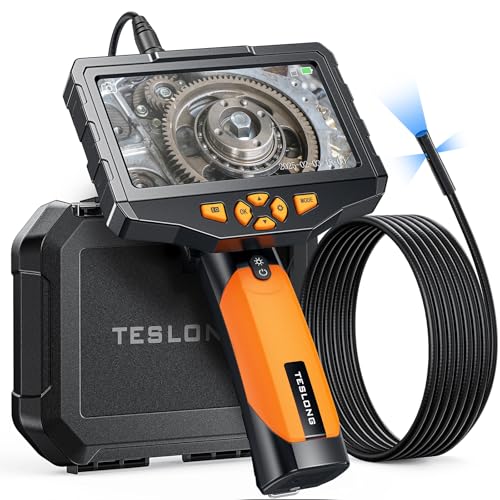
This Teslong puts one forward camera and two side cameras into an approximately 7.9 mm probe. A button changes the selected view on the 5-inch IPS display, and a 10-foot semi-rigid cable gives more reach than a short articulating instrument.
The Teslong provides three camera directions with a manageable ten-foot cable and included recording card. It suits nearby equipment, accessible pipework, and wall cavities where a longer cable would add handling without improving access.
The three-camera arrangement is useful when the inspection target extends around the probe rather than only ahead of it. Switching views can reduce the number of times the cable needs to be withdrawn and repositioned. The included 32GB microSD card supports JPEG photographs and MPEG-4 video, so the kit can retain inspection findings without requiring a phone. The cable holds its shape after bending, but it does not have a joystick-controlled head. Its 10-foot length is a manageable middle ground for local maintenance work; choose a longer system when the access route extends farther away. Keep the display dry even when using the IP67-rated probe in a damp location.
Pros
- Front and two side cameras offer three viewing directions.
- 5-inch display and included 32GB card form a recording kit.
- 10-foot cable is manageable for local maintenance work.
Cons
- Less reach than 16-foot or reel-based inspection systems.
- No mechanical tip steering.
Choose this configuration for a Compact Ten-Foot Triple-View Kit.
To buy this product, click here.
Buying Guide
Triple-Lens Viewing Does Not Mean Active Articulation
A triple-lens camera gives multiple optical directions, usually through one forward-facing camera and two side-facing cameras. That can reduce the need to rotate or withdraw the probe, but it does not mean the camera tip mechanically bends under joystick control. These products use semi-rigid cables, so they can be shaped before insertion, yet the product description does not establish active articulation for any model here.
Match Cable Length to the Inspection Path
The 11.5-foot NIDAGE cable is easier to manage for short engine or cavity work, while 16.4 to 16.5 feet covers many household and automotive jobs. The 32.8-foot VEVOR reaches farther into pipes and ducts, and the 50-foot models suit extended routes. Extra length is useful only when the path needs it. Loose cable can become awkward around the operator and may reduce control near the camera head.
Probe Diameter Affects Access
The VEVOR models identify an 8 mm lens. That dimension may fit openings that a larger camera cannot, but it does not guarantee access through every spark-plug hole, pipe, or equipment passage. Check the actual opening and the camera-head dimensions before ordering. A smaller probe can improve access, while a larger display or longer cable may matter more once the camera is inside.
Storage And Recording Are Different From Live Viewing
A screen lets you see the live camera feed, but recording depends on the product’s stated photo, video, and storage features. The 32.8-foot VEVOR lists photo capture, video recording, and a 32GB card. DEPSTECH supports photo and video capture but lists the microSD card separately. Other models provide less clear information, so confirm the current listing if inspection records are central to your work.
IP67 Protection Has A Defined Scope
IP67 appears in several listings, but buyers should identify which component the rating describes. A protected probe does not automatically make the screen, handle, charging port, or cable connection safe for immersion. Water, oil, dirt, and contaminated drain liquid can also affect visibility even when the probe has environmental protection. Follow the product instructions and keep the control unit away from moisture.
Lighting And Resolution Work Together
More LEDs can brighten a dark cavity, but glare, distance, focus, and the surface being inspected still affect the image. Similarly, terms such as 1080P or 1920P do not establish identical real-world sharpness across different cameras. Adjustable brightness is useful because a reflective metal surface may need less light than a dark pipe interior.
Best Triple Lens Borescope FAQ
What Does A Triple-Lens Borescope Show?
It uses three camera views, commonly one forward-facing lens and two side-facing lenses. Depending on the model, the views may be switched, displayed separately, or shown together. The extra cameras help inspect adjacent surfaces without repeatedly rotating the probe, but they do not provide documented mechanical tip articulation.
Which Model Has The Longest Cable?
The Triple Lens Borescope with 5-inch IPS Screen and the Epicmate camera both list 50-foot cables. The first lists a semi-rigid cable, while Epicmate’s information specifically cautions that sharp 90-degree and P-shaped bends can be difficult. The 50-foot length is best reserved for inspection paths that genuinely require extended reach.
Can These Cameras Record Photos And Videos?
Recording capability varies. The 32.8-foot VEVOR lists 1920*1080P photo capture, 1280*720 video recording, and a 32GB card. DEPSTECH lists photo and video capture but says the microSD card is not included. The 4.5-inch VEVOR lists photo and video storage with a 32GB TF card. Confirm details for the remaining models before relying on them for documentation.
Is A Semi-Rigid Cable The Same As An Articulating Probe?
No. A semi-rigid cable can bend and may hold a preset shape, which helps guide the camera through an opening. Active articulation requires a documented mechanism that changes the distal camera direction after insertion. The product information here describes semi-rigid or ultra-rigid cables, not joystick-controlled articulation.
Which Camera Is Most Suitable For A Short Engine Check?
The NIDAGE model lists an 11.5-foot cable and specifically describes engine inspection uses, making it a compact option for work near the access point. The 16.5-foot DEPSTECH and VEVOR models offer more reach and additional storage or viewing features if the inspection extends farther into the vehicle.
Do These Borescopes Require A Phone?
The listed models use integrated displays and operate without a phone, app, Bluetooth connection, or Wi-Fi setup for live viewing. That can simplify use in a garage, workshop, drain area, or utility space. Storage and recording controls still vary by product.
Final Verdict
Additional options: DEPSTECH 700SE Triple-Lens Borescope suits a 7-Inch Multi-View Workstation; Teslong 10-Foot Triple-Lens Borescope suits a Compact Ten-Foot Triple-View Kit. Choose the configuration that fits the access route and your recording needs.
The VEVOR Triple Lens Endoscope with 32.8-foot ultra-rigid cable is the strongest overall choice for buyers who want a balanced triple-camera system. Its 8 mm lens, front-and-side viewing, 8X zoom, 5-inch screen, listed 5 to 6 hour runtime, and included 32GB card give it broad coverage across automotive, HVAC, plumbing, and machinery inspection. The rigid cable is a trade-off around tight bends, so it is best where reach and push control matter.
Choose the 50-foot Triple Lens Borescope when the inspection path demands maximum listed reach, or select DEPSTECH for a more compact system with clear photo and video support plus retrieval accessories. The split-screen VEVOR is appealing when simultaneous front-and-side awareness matters, while NIDAGE is easier to justify for short engine and cavity checks. Match the camera to the opening, route, storage needs, and cable behavior rather than choosing by resolution language alone.
