
A semi-rigid borescope has to do two jobs at once. Its cable needs enough flexibility to pass around bends, yet enough stiffness to push through an opening and hold a useful position. That balance matters during engine checks, drain inspections, HVAC work, wall-cavity searches, and appliance repairs, where a limp cable can feel like wet spaghetti and an overly stiff one can fight every turn.
Probe diameter, cable length, viewing direction, lighting, and connection method shape the experience more than a resolution number printed in a product title. A dual-lens camera can show forward and side views, but it does not actively steer the tip. A long cable reaches farther, but it can be harder to guide in a short inspection. Phone-connected models keep the kit compact, while screen-based units avoid app and device compatibility questions.
This comparison weighs those practical differences across nine semi-rigid inspection cameras. Some favor narrow access and phone portability, others bring longer reach or an integrated display. The right choice depends on whether you are tracing a drain, checking an engine cavity, looking behind a wall, or documenting what the camera sees.
Quick Answer
Best overall: DEPSTECH 2K Endoscope Camera combines a 7.9 mm probe, front and side cameras, a 16.5-foot semi-rigid cable, adjustable lighting, and phone support for iOS and Android. Its app requirement and OTG limitation on some Android devices are the main points to check first.
Best for long reach: Acoath Dual-Lens Endoscope Camera pairs dual viewing with a listed 33-foot semi-rigid cable, giving it more reach for long cavities, pipes, and drains.
Best phone-free option: Endoscope Camera with Light for Automotive Wall Sewer Drain Inspection uses a 5-inch screen, triple lenses, a 50-foot cable, a rechargeable battery, and a 32GB MicroSD card, so inspection does not depend on a phone or app.
Best compact screen model: Vorth Endoscope Camera has a 4.3-inch screen, dual lenses, a short lens design, 2x zoom, and a 16.5-foot cable for users who prefer a self-contained kit.
Best Semi Rigid Borescope Comparison Table
| Product | Best For | Probe and Cable | Viewing System |
|---|---|---|---|
| DEPSTECH 2K Endoscope Camera | Best overall balance | 7.9 mm, 16.5 ft | Front and side cameras, phone app |
| Endoscope Camera 32.8ft Single Lens | Long phone-connected reach | Length listed as 32.8 ft | Single lens, phone app |
| Acoath Dual-Lens Endoscope Camera | Long-reach dual viewing | 7.9 mm, 33 ft | Front and side lenses, phone app |
| 49.2 Feet Inspection Endoscope Camera | Integrated-screen inspections | Length listing is inconsistent | 4.3-inch IPS screen, single camera details listed |
| Vorth Endoscope Camera | Compact dual-lens screen kit | 7.9 mm, 16.5 ft | Dual lens, 4.3-inch IPS screen |
| Dual-Lens Endoscope Camera | Tight spaces and broad connector support | 7.9 mm, 16.4 ft | Front and side lenses, phone app |
| Endoscope Camera for Automotive, Wall, and Sewer Inspection | Long reach and phone-free use | 50 ft | Triple lens, 5-inch IPS screen |
| TOPDC Endoscope Camera | Phone-based general inspection | 7.9 mm, 16.4 ft | Single camera, phone app |
| Dual Lens Endoscope Camera for Automotive and Home | Simple dual-lens phone use | 16.5 ft | Front and side lenses, phone connection |
The detailed reviews below focus on cable control, viewing options, connectivity, lighting, and the kind of inspection each camera can reasonably support.
1. DEPSTECH 2K Endoscope Camera — Best Overall

The DEPSTECH model offers the most balanced setup in this group for general semi-rigid inspection work. Its 7.9 mm probe is slim enough for many narrow access points, while the 16.5-foot cable gives useful reach without creating the sprawling coil that can make a short inspection awkward. The semi-rigid construction is meant to bend around passages while retaining directional stability, which is the central appeal of this category.
Its front and side cameras are more useful than a single forward-facing lens when the camera reaches a junction, pipe wall, engine cavity, or wall void. Switching views through the app can reduce the need to pull the probe back and twist it repeatedly. The listing also identifies a 2560×1440 image specification, adjustable 8+1 lighting, 2x zoom, photo and video capture, and 90-degree image rotation. This is a phone-dependent tool, however, and Android devices require OTG support with the DEPSTECHCAM app.
Pros
- Front and side cameras provide two viewing directions.
- 7.9 mm probe suits many confined inspection points.
- 16.5-foot semi-rigid cable balances reach and control.
- Phone app supports photo, video, zoom, and image rotation functions.
- Includes hook, magnet, and protective cap accessories.
Cons
- Requires the DEPSTECHCAM app for operation.
- Android use depends on OTG support and the listed operating-system requirements.
This is the strongest first choice for buyers who want one compact camera for automotive, drain, HVAC, appliance, and wall inspections. The dual-camera arrangement adds practical viewing flexibility without suggesting that the probe actively articulates. Buyers who want a built-in display or who prefer to avoid app compatibility checks should look at the screen-based options below instead.
To buy this product, click here.
2. Endoscope Camera 32.8ft Single Lens — Best for Long Phone-Connected Reach
Reach is the defining reason to look at this model. The product title lists a 32.8-foot semi-rigid snake camera, giving it substantially more cable than the compact 16.4- to 16.5-foot options. That extra length can matter when an inspection path runs through a long drain, duct, cavity, or machinery space where a shorter probe stops before the area of interest.
The available product information identifies a single-lens camera, 1920P HD labeling, eight adjustable LED lights, IP67 waterproofing, and support for iOS and Android. A single lens keeps the viewing system straightforward, but it also means the user must reposition the probe to change the perspective. The product is therefore better suited to inspections where forward viewing is enough and reach matters more than side visibility.
Pros
- Listing identifies a 32.8-foot semi-rigid cable.
- Single-lens layout keeps the viewing system simple.
- Eight adjustable LED lights support dark inspection spaces.
- IP67 protection is listed for damp inspection environments.
- Supports phone-connected use with iOS and Android.
Cons
- Single-lens design does not provide a separate side camera.
- The available information does not clearly specify the probe diameter or app requirements.
Choose this camera when the inspection route is long and a forward-facing view will usually answer the question. A long semi-rigid cable can be helpful in a drain or deep cavity, though it may take more room to manage around a workbench or vehicle. Buyers who regularly need to inspect side walls should favor one of the dual-lens models.
To buy this product, click here.
3. Acoath Dual-Lens Endoscope Camera — Best for Long-Reach Dual Viewing

The Acoath combines two useful traits that rarely appear together in the smaller phone-based kits: a dual-lens viewing system and a listed 33-foot semi-rigid cable. Its 7.9 mm probe is intended for tight spaces, while the extra cable gives the camera more room to travel through pipes, drains, wall cavities, and other extended paths. The product information identifies a front and side lens, so the second view comes from another camera perspective rather than a detachable mirror.
Connection requires the SUP-ANESOK app, with listed support for iOS 9.0 and Android 7 or later. The kit includes Android, Lightning, and Type-C connectors, plus a hook, magnet, mirror, and protective cap. The mirror is an accessory for looking around corners and should not be confused with the built-in side lens. IP67 protection is listed with a specific immersion claim of up to 3.28 feet for one hour, so that stated limit should guide wet-use expectations.
Pros
- Dual-lens system provides forward and side viewing.
- Listed 33-foot semi-rigid cable reaches farther than compact models.
- 7.9 mm probe is suited to narrow access points.
- Includes Type-C, Lightning, and Android connectors.
- Specific immersion guidance is provided in the product information.
Cons
- Requires the SUP-ANESOK app and a compatible phone.
- Longer cable can be more difficult to organize in short inspection paths.
This model makes sense for long runs where a single forward view would force repeated repositioning. It is especially interesting for pipe and drain work, provided the cable length and stated immersion limit match the job. For engine compartments or quick household checks, the shorter DEPSTECH or TOPDC-style formats may feel easier to handle.
To buy this product, click here.
4. 49.2 Feet Inspection Endoscope Camera — Best for an Integrated Screen

A built-in display changes the workflow immediately. This inspection camera includes a 4.3-inch IPS screen, so the user can view the probe without installing an app, connecting a phone, or wondering whether a particular USB port supports camera input. The listing identifies a 1920×1080 live image, an approximately 170-degree horizontal screen viewing angle, eight adjustable LEDs, and a stated 2 to 10 cm focus range.
The product title lists a 49.2-foot semi-rigid cord, while one feature description refers to a 16.5-foot cable. That inconsistency matters for anyone buying specifically for a long pipe or drain run, so the current listing should be checked before ordering. The camera also includes hook, magnet, and side-mirror accessories. Those attachments expand the tool’s usefulness, but the supplied information does not identify a dual-camera system or active articulation.
Pros
- Integrated 4.3-inch IPS screen avoids phone and app dependency.
- Eight adjustable LEDs are listed for dark spaces.
- Listed focus range is suited to close inspection of pipe walls and surfaces.
- Includes hook, magnet, and side-mirror accessories.
- Semi-rigid cable design is intended to retain a guided shape.
Cons
- The listing gives conflicting cable-length information.
- The supplied information does not clearly specify recording or storage capability.
This is a sensible route for someone who wants a self-contained inspection screen and does not want a phone near a wet or dirty work area. Its cable-length discrepancy prevents a stronger long-reach recommendation, so confirm that detail before purchase. For short household, appliance, or automotive inspections, the screen may be more important than the maximum advertised cable length.
To buy this product, click here.
5. Vorth Endoscope Camera — Best Compact Screen and Dual-Lens Combination

The Vorth takes a different route from phone-connected cameras by putting the viewing hardware in the kit. Its 4.3-inch IPS screen displays the feed, while the dual-lens probe offers forward and side views. A 1.06-inch short lens is listed as half the length of traditional lenses, a detail that may help when the camera needs to turn through a tight angle rather than approaching an opening in a straight line.
The 7.9 mm probe and 16.5-foot semi-rigid cable suit general vehicle, appliance, wall, drain, and HVAC checks. The listing also identifies 2x zoom, 180-degree image rotation, contrast adjustment, eight adjustable LEDs, and a 1.6- to 3.9-inch focusing range. There is no app, Wi-Fi, or Bluetooth setup, and a Type-C charging cable is included. That simplicity is appealing in a basement, garage, or workshop where a phone screen would be inconvenient.
Pros
- Built-in 4.3-inch IPS screen removes phone dependency.
- Dual lenses provide forward and side viewing.
- Short lens design is intended to help with difficult angles.
- 2x zoom, image rotation, and contrast adjustment are listed.
- Includes hook, magnet, side mirror, and fixing devices.
Cons
- 16.5-foot cable offers less reach than the long-cable models.
- The product uses Type-C charging, but the supplied information does not state battery capacity or runtime.
Pick the Vorth when a self-contained screen and dual viewing matter more than maximum reach. It is particularly practical for quick checks behind appliances, inside vehicle compartments, or around drain openings. A phone-based model may be easier to store in a small tool bag, while the Vorth makes more sense for buyers who want a ready-to-use inspection kit with physical controls.
To buy this product, click here.
6. Dual-Lens Endoscope Camera — Best for Tight Spaces and Broad Connector Support
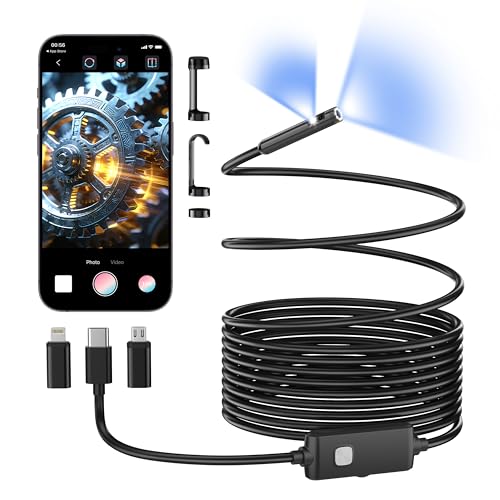
At 7.9 mm, this camera uses the same slim probe class found in several leading choices here, but its appeal comes from a straightforward dual-lens arrangement and broad connector support. The product information lists front and side views, 1920×1440 image detail, eight adjustable LEDs, and a 16.4-foot semi-rigid cable. That combination suits engine cavities, pipes, drywall gaps, and other locations where a second viewing direction can save a frustrating withdrawal and reinsertion.
The camera connects through USB-C, Micro-USB, or Lightning using the supplied adapters, then operates through an app. Physical connector coverage is helpful, but compatibility still depends on the phone and its software support. The kit includes a magnet, hook, and protective cap. IP67 protection is listed for the probe, not automatically for the phone, adapters, or the entire inspection setup.
Pros
- Front and side cameras support two viewing directions.
- 7.9 mm probe reaches relatively tight openings.
- USB-C, Micro-USB, and Lightning connections are listed.
- 16.4-foot semi-rigid cable offers useful general-purpose reach.
- Includes retrieval accessories for hooks and magnetic objects.
Cons
- Requires an app and a compatible phone or tablet.
- The listing does not identify a built-in screen or independent display.
This is a good fit for users who work across different phone connector types and want dual viewing without carrying a separate monitor. It is less suitable for anyone who wants a completely phone-free workflow or a cable long enough for extended drains. Before ordering, check the target device’s operating-system and camera-input support rather than relying on the connector alone.
To buy this product, click here.
7. Endoscope Camera for Automotive, Wall, and Sewer Inspection — Best for Long Reach and Phone-Free Use

This is the most self-contained long-reach system in the group. The listing identifies a 50-foot semi-rigid cable, a 5-inch IPS color screen, a 2600mAh rechargeable battery, and a 32GB MicroSD card. Those details point toward longer drain, sewer, wall, and machinery inspections where a phone-connected probe would be awkward and where recording evidence can be useful for later review.
Its triple-lens arrangement includes a forward lens and left and right side views, with combinations such as forward plus side viewing described in the product information. That can reduce probe repositioning at a pipe junction or inside a broad cavity. IP67 protection is listed for the cable and lenses, and the probe lighting is adjustable. The longer cable adds reach, but it also creates more material to guide, coil, and keep clear of the work area.
Pros
- 50-foot semi-rigid cable provides the longest listed reach here.
- Triple-lens system covers forward and side viewing directions.
- 5-inch IPS screen supports phone-free inspection.
- 32GB MicroSD card and built-in battery are listed.
- Adjustable probe lighting and IP67 protection are identified.
Cons
- The longer cable may be cumbersome for short inspections.
- The supplied information does not specify probe diameter.
This model deserves attention for long paths where the 16-foot class simply cannot reach. The screen, battery, and included storage create a more complete inspection workflow than a basic phone camera. Skip it if most tasks involve a small engine bay, appliance, or short wall opening, where the extra cable may feel like a garden hose in a closet.
To buy this product, click here.
8. TOPDC Endoscope Camera — Best for Phone-Based General Inspection

The TOPDC follows a familiar, portable format: a 7.9 mm probe, a 16.4-foot semi-rigid cable, adjustable lighting, and direct phone connection. Its listed 2.0MP camera specification, 1920×1440 image detail, 70-degree viewing angle, and 2 to 10 cm focus range give buyers more context than a generic HD label. Close-focus information is particularly useful for pipe walls, engine components, and objects just beyond the camera head.
This is a single-camera model with a 360-degree rotation claim in the product information. That should be read as an image or camera-view function rather than evidence of active tip articulation. The kit includes Type-C, Micro-USB, and Lightning connections, plus hook, magnet, mirror, and fixing device accessories. The listing supports iOS 10.0 and Android 6.0 or later, though device compatibility still depends on the phone and app.
Pros
- 7.9 mm probe is suitable for many confined access points.
- 2 to 10 cm focusing range is clearly listed.
- Supports Type-C, Micro-USB, and Lightning connections.
- Includes hook, magnet, mirror, and fixing device accessories.
- 16.4-foot semi-rigid cable fits common household and automotive tasks.
Cons
- Single-camera design lacks a dedicated side view.
- Requires the UseePlus app and a compatible phone.
TOPDC is a useful choice for straightforward inspections where forward viewing and phone capture are enough. The defined focus range helps set expectations for close work, while the connector set gives it broad practical reach across older and newer devices. Buyers who frequently inspect around corners without moving the probe should choose a genuine dual-lens model instead.
To buy this product, click here.
9. Dual Lens Endoscope Camera for Automotive and Home — Best for Simple Dual-View Phone Use

This camera keeps the basic inspection workflow uncomplicated: plug it into a phone, use the semi-rigid cable to guide the probe, and switch between front and side views as needed. The listing identifies a 1920×1440 camera, a 16.5-foot cable, IP67 protection, and offline operation without Wi-Fi. That last point is useful in a garage, basement, or utility space where a direct wired connection is easier than setting up a wireless network.
The supplied accessories include a magnet, hook, and mirror. The front and side cameras are the important viewing features here, while the mirror offers a separate way to look around an obstruction. A long press switches lenses, and one-click controls are listed for image capture. The product information says it supports iPhone and Android use, but buyers should still confirm the connector and app requirements for the specific device.
Pros
- Front and side lenses provide two inspection perspectives.
- 16.5-foot semi-rigid cable suits general home and vehicle work.
- Offline wired operation does not depend on Wi-Fi.
- Includes hook, magnet, and mirror accessories.
- IP67 protection is listed for damp inspection work.
Cons
- Phone compatibility details are less specific than some competing listings.
- No integrated screen is identified.
This model fits buyers who want dual viewing and a conventional wired phone workflow without a separate monitor. It can handle common pipe, wall, appliance, and engine checks, but the 16.5-foot cable is better for moderate reach than long sewer runs. Confirm the current connector and app information before purchase, especially if the camera will be used with an older phone.
To buy this product, click here.
Buying Guide
Probe Diameter Determines Where the Camera Can Fit
A 7.9 mm probe appears throughout this group, and that size is a useful middle ground for many automotive, appliance, wall, and plumbing inspections. A smaller probe may enter a tighter opening, but diameter alone does not determine image quality, cable control, or how easy the camera is to guide. Check the actual access point first, especially around engine openings, small service holes, and narrow pipe fittings.
Semi-Rigid Cable Means Control, Not Active Articulation
A semi-rigid cable can bend and hold some of the shape given to it. That helps push a camera through a cavity or guide it around a broad curve. It does not mean the camera tip can be steered with a joystick or directional control. The products here use fixed camera heads with semi-rigid cables, while dual-lens designs provide another viewing direction without mechanically bending the tip.
Dual-Lens Viewing Can Reduce Repositioning
Front and side cameras are valuable at junctions, pipe walls, and cavities where the target may sit beside the probe rather than directly ahead. Switching to a side view can reveal more without pulling the cable back. A dual-lens camera still cannot aim freely in every direction, so it is different from an articulating borescope. A supplied mirror is also a separate accessory, not a second camera.
Match Cable Length to the Inspection Path
Cables around 16.4 to 16.5 feet are manageable for vehicles, walls, appliances, HVAC openings, and short drains. The Acoath lists 33 feet, while the long-reach screen model lists 50 feet. More reach helps only when the inspection actually needs it. Excess cable must be coiled and guided, and that can make a short path harder to control. One model also presents conflicting length information, so verify the current listing before relying on it for deep access.
Phone Compatibility Requires More Than a Connector
USB-C, Lightning, and Micro-USB adapters make physical connection easier, but they do not guarantee that every phone can display the camera feed. App support, operating-system version, OTG support on Android, and camera permissions can affect setup. DEPSTECH specifically identifies OTG as a requirement for some Android devices. Check the listed app and device requirements before placing the camera in a tool bag for a job.
Integrated Screens Remove App Dependency
Screen-based cameras such as the Vorth and the long-reach triple-lens model create a self-contained workflow. That can be convenient around water, dirt, or a vehicle bay, where using a phone is awkward. A screen does not automatically mean the camera records photos or video, however. Look for explicit storage, memory-card, photo, or video details if documentation matters for the inspection.
IP67 Applies to the Documented Component
Most products here list IP67 protection for the probe, cable, or lenses. That does not automatically make the phone, display, connector, charging port, or control unit waterproof. The Acoath listing gives a specific immersion limit, while other descriptions provide broader waterproofing language. Follow the stated conditions and keep the phone or screen away from water unless its own protection is documented.
Best Semi Rigid Borescope FAQ
What Is a Semi-Rigid Borescope?
A semi-rigid borescope combines a camera probe with a cable that can bend but retains enough stiffness to be pushed and guided. It is useful for reaching behind panels, through openings, into pipes, and around engine components. It is different from a fully flexible cable that may require a separate guide, and it is different from an actively articulating probe that mechanically steers the camera tip.
Are Dual-Lens Borescopes Better Than Single-Lens Models?
They can be more useful when the inspection target may sit beside the probe. A front camera points ahead, while a side camera can show a pipe wall, cavity edge, or nearby component without requiring as much repositioning. A single-lens model can be the better choice for simple forward paths, and it may have a more straightforward operating process.
Can These Cameras Be Used to Inspect a Car Engine?
Several listed models identify automotive or engine inspection among their intended uses. A 7.9 mm probe, adjustable lighting, and a semi-rigid cable can help reach confined areas. Allow the engine and surrounding components to cool, avoid moving machinery, and follow the product instructions. Do not assume that every probe fits every spark-plug opening or that a waterproof rating covers heat, fuel, oil, or the entire camera system.
Does a Longer Cable Always Make a Borescope Better?
No. A longer cable provides more reach for deep cavities, drains, and extended pipe paths, but it also adds material to manage. A 16.5-foot cable may be easier around a vehicle or appliance, while a 33- or 50-foot cable makes more sense for a distant inspection point. Match the length to the path rather than selecting the longest option automatically.
Do These Borescopes Record Photos and Video?
Several phone-connected listings identify photo and video capture through an app. The long-reach triple-lens model lists a 32GB MicroSD card, which supports a more independent recording workflow. The integrated-screen model with the 4.3-inch display does not clearly identify recording or storage in the supplied information, so confirm that feature if documentation is necessary.
Can an IP67 Probe Be Put Underwater?
Only within the conditions stated for that specific product. IP67 language generally applies to a specified component, often the probe or camera head, rather than every part of the kit. The Acoath listing provides a depth and time claim, while other listings use broader IP67 wording. Keep the phone, adapters, display, and charging connections dry unless their protection is explicitly identified.
What Should I Check Before Using a Phone-Connected Borescope?
Confirm the phone’s operating-system version, connector type, app requirement, and Android OTG support where applicable. A physical USB-C or Lightning connection does not guarantee software compatibility. It is also useful to test the app before beginning an inspection, since discovering a permissions or connection problem beside a blocked drain is a frustrating time to troubleshoot.
Final Verdict
The DEPSTECH 2K Endoscope Camera is the strongest overall choice for most semi-rigid inspection tasks in this comparison. Its 7.9 mm probe, dual front-and-side cameras, 16.5-foot cable, adjustable lighting, and phone capture functions create a balanced setup for vehicles, walls, appliances, HVAC spaces, and moderate pipe work. The main trade-off is its dependence on the DEPSTECHCAM app and compatible phone hardware.
Choose the Acoath if long reach and dual viewing matter more, or step up to the 50-foot triple-lens system if you want a phone-free workflow with an integrated screen and listed storage. The Vorth is a more compact screen-based alternative, while the TOPDC and other phone-connected models suit simpler forward-view inspections. Before ordering, verify probe access, cable length, phone compatibility, and the exact waterproofing limits for the task ahead.
